
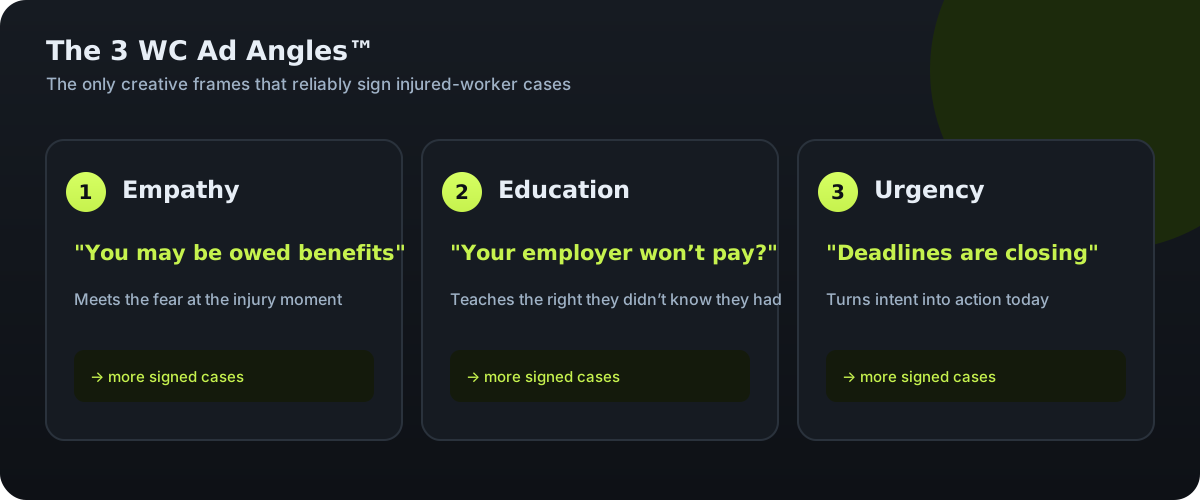
An injured worker rarely opens Google the day they get hurt. They open Facebook. They scroll, they vent, they ask their cousin’s friend what to do — and somewhere in that feed is either your ad or your competitor’s.
That’s the opening most workers’ comp firms miss. Search catches demand that already exists; Meta creates it, interrupting a scrolling worker before they ever type “workers comp lawyer near me.” The catch is that interruption is unforgiving — bad creative on Meta doesn’t just underperform, it fills your pipeline with people who will never sign.
This piece is the Meta playbook we run inside high-volume WC firms. It’s the creative framework, the qualification, and the benchmarks — built on real spend, not theory. For the wider channel strategy this sits inside, see our full WC marketing playbook.
Why Meta works for workers’ comp
You reach injured workers before they search — which is both the advantage and the risk.
There are roughly 2.6 million nonfatal workplace injuries and illnesses reported every year, according to the U.S. Bureau of Labor Statistics. Most of those workers don’t know they have a case. They assume the insurer will “handle it” — until a check gets denied or a deadline slips.
That gap between getting hurt and knowing you need a lawyer is where Meta earns its place. Search is intent — the worker is already looking. Meta is interruption — you reach them during the confusion, weeks before they’d ever open a search bar.
Interruption is powerful and cheap, but it cuts both ways. On search, the click is qualified by the query itself; on Meta, your creative has to do that filtering, or you’ll pay for every bored scroller who taps “learn more.”
Sources: U.S. Bureau of Labor Statistics (2023 injury data); WordStream 2026 benchmarks; consumer legal-search survey, 2025.
The 3 creative angles that sign cases
Our core framework — because the angle decides the lead, and the lead decides the case.
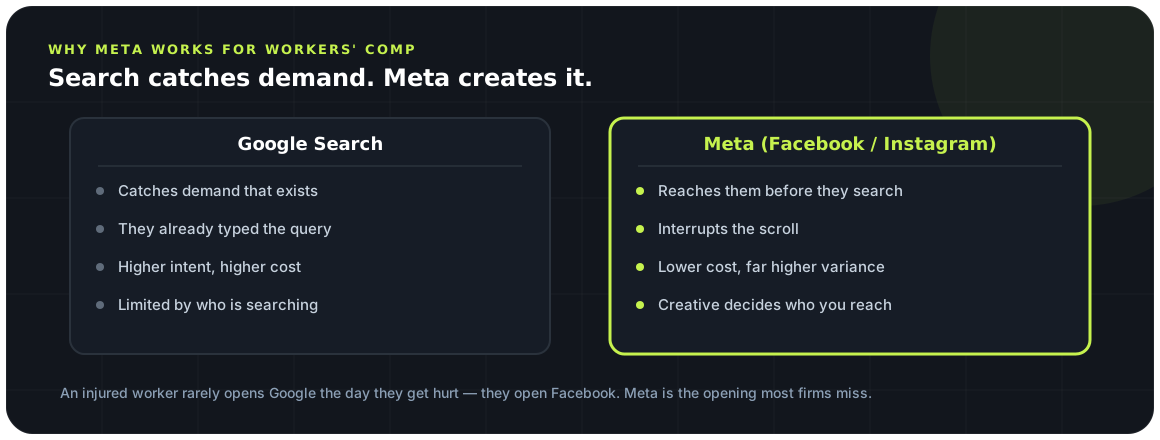
After managing millions in WC spend, one pattern holds: nearly every ad that signs cases pulls from one of three emotional angles. We call it The 3 WC Ad Angles — empathy, education, and urgency.
Each angle speaks to a different injured worker at a different moment. The empathy angle reaches the scared and the overwhelmed. The education angle reaches the frustrated. The urgency angle reaches the ones running out of time.
You’re not writing an ad. You’re finishing a sentence the injured worker already started in their head.
Spencer Moeller, WorkersComp MarketingAngle 1 — Empathy: “You may be owed more than you think”
This is the highest-volume angle for a reason. The injured worker feels dismissed — by their employer, the insurer, sometimes their own doctor — and an ad that simply says “this isn’t your fault, and you may be owed benefits” lands like relief.
Empathy creative uses plain, human language and a real face, not stock lawyers in suits. It works best for cold audiences who don’t yet know they have a case.
Angle 2 — Education: “Your employer won’t pay for your surgery? Here’s why.”
The education angle targets the frustrated worker mid-fight. They’ve been denied, delayed, or lowballed, and they’re actively confused about their rights.
These ads teach one specific thing — why claims get denied, what “maximum medical improvement” really means, what a settlement should include. Teaching earns trust, and trust signs cases.
Angle 3 — Urgency: “Most states give you only days to report a work injury”
Urgency works because workers’ comp genuinely runs on deadlines. Reporting windows and statutes of limitation are real, and an honest deadline reminder converts the procrastinators.
Use urgency carefully and truthfully — Meta polices scare tactics, and injured workers can smell manipulation. Frame it as protection, not pressure.
| Angle | Emotional trigger | Example hook | Best for |
|---|---|---|---|
| Empathy | Feeling dismissed / scared | “Hurt at work? It’s not your fault — and you may be owed more than you think.” | Cold audiences who don’t know they have a case |
| Education | Frustration / confusion | “Employer won’t pay for your surgery? Here’s why — and what to do next.” | Workers mid-claim who’ve been denied or delayed |
| Urgency | Fear of missing out / deadlines | “Most states give you only days to report a work injury. Don’t lose your claim.” | Procrastinators near a reporting or filing deadline |
Qualifying in the creative and the form
Kill junk leads at the source — before your intake team ever wastes a dial.
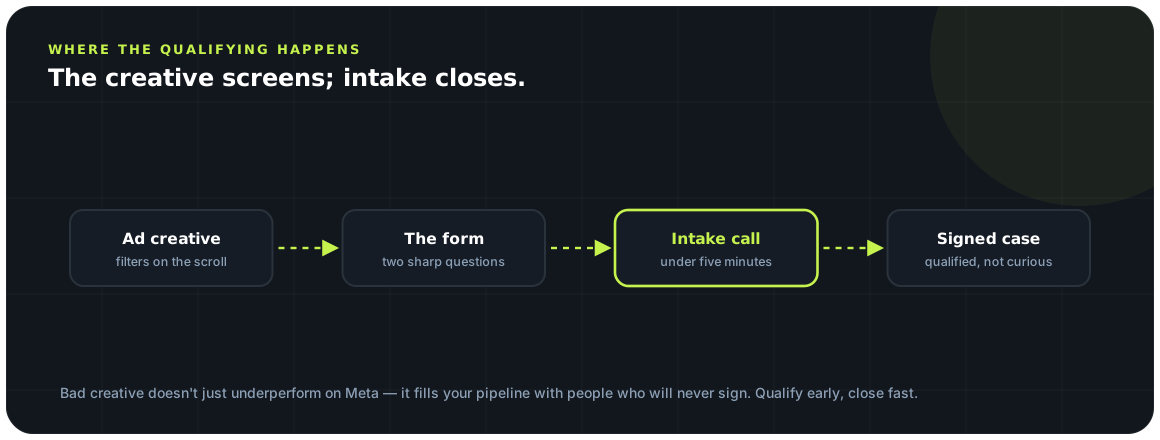
The complaint every firm has about Meta is the same: “the leads are junk.” Usually the leads aren’t the problem — the qualification is missing. On Meta you filter before the lead, not after.
Qualification starts in the creative. If your ad names the situation precisely — “injured on the job in the last two years” — the wrong people scroll past and the right people raise their hand.
Then the form does the second pass. A one-tap instant form maximizes volume but invites tire-kickers; adding two or three qualifying questions trims junk dramatically for a small hit to volume.
Whatever you qualify in, the lead still goes cold fast. MIT and InsideSales research found that responding in five minutes versus thirty makes you up to 100× more likely to make contact and 21× more likely to qualify the lead — with roughly 10% of qualification odds decaying every minute in that first window.
Source: MIT / InsideSales Lead Response Management study.
Targeting and the privacy shift
The old playbook of narrow interest targeting is dead. Broad plus good creative won.
Firms still ask us to target “people interested in workers’ compensation.” That targeting barely exists anymore, and it wouldn’t work if it did — injured workers don’t list “workplace injury” as an interest.
The privacy shift changed the math. With less signal to slice audiences finely, Meta’s algorithm now performs best when you give it room: broad targeting, a wide age range, and let the creative do the filtering. Your ad becomes the targeting.
What still works precisely is first-party data. Upload your past-client and lead lists to build lookalike audiences, and the algorithm finds more people who resemble workers who actually signed.
Own your data and you’re insulated from the next privacy change. See how we structure this inside our WC lead system.
What good looks like: CPL and benchmarks
Meta usually costs less per lead than search — with far more variance. Here are the numbers.
For context on how expensive legal traffic is, WordStream’s 2026 benchmarks put the average cost per click for legal at $9.87 and average cost per lead at $131.63 — the priciest category in paid search.
Meta typically comes in lower, in the $40–$120 CPL range for WC. But the average hides the truth: Meta’s variance is enormous, and a low CPL with a low qualification rate is more expensive than it looks.
That’s why we never judge Meta on CPL alone. The numbers that matter are cost per qualified lead and lead-to-signed rate — the metrics that trace all the way to a signed case.
| Metric | Poor | Good | Elite |
|---|---|---|---|
| Cost per lead (CPL) | > $120 | $60–$90 | < $50 |
| Click-through rate (CTR) | < 0.8% | 1.5–2.5% | > 3% |
| Cost per qualified lead | > $200 | $100–$160 | < $90 |
| Lead-to-signed rate | < 4% | 6–10% | > 12% |
Ranges reflect our own WC campaign data across $16.5M in managed spend; your numbers depend on market, angle, and intake speed. Directional, not a quote.
Across the accounts we’ve run, Meta produced 219,000 injured-worker leads at ~$75 CPL and 21,000 signed cases at ~$775 per case. Those aren’t the cheapest leads on paper — they’re the ones that signed. See real firm results.
Meta mistakes that waste WC budgets
None of these look dramatic on the dashboard. They just quietly bleed spend.
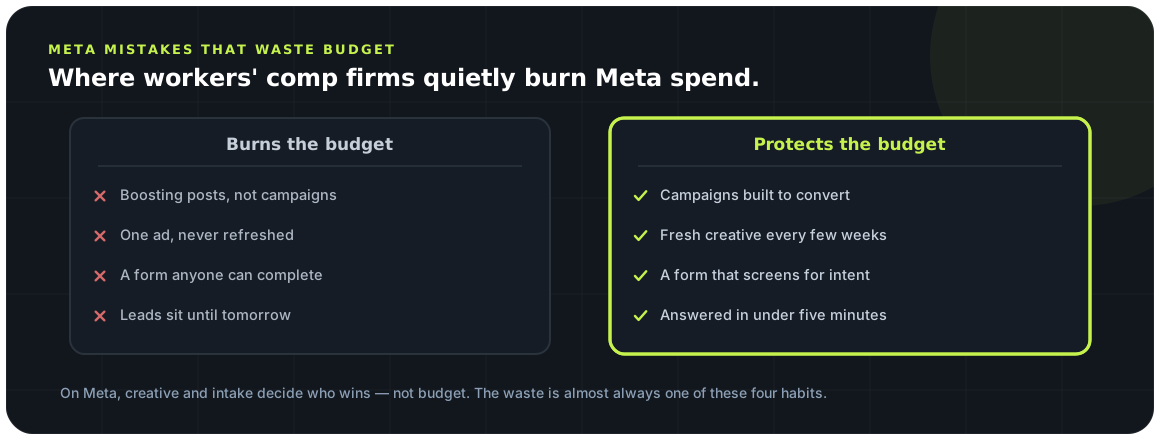
- Optimizing for cheap leads, not signed cases. The lowest CPL usually buys the lowest-quality lead.
- One angle, one ad. Without testing empathy, education, and urgency, you never find your winner.
- No qualification in the form. A bare instant form floods intake with people who’ll never sign.
- Narrow interest targeting. Fighting the algorithm instead of feeding it broad audiences and strong creative.
- Ignoring retargeting. Leaving warm, half-convinced prospects to forget you.
- Slow intake. Great Meta creative feeding an hour-long response time is money set on fire.
- Boring, corporate creative. Stock-photo lawyers scroll right past; real faces and plain talk stop the thumb.
Key takeaways
-
Injured workers are on Facebook before Google. They scroll, vent, and ask for help on social long before they search — which is why Meta reaches demand Google cannot see.
-
Creative does the qualifying, not just the targeting. The angles that sign cases speak to the worry, not the injury, and the ad and form screen the lead before intake ever picks up.
-
The privacy shift changed targeting, not viability. You cannot target injured workers directly, so broad targeting, self-selecting creative, and custom and lookalike audiences carry the weight.
-
Measure CPL against a real benchmark. Cost per lead only means something next to category benchmarks and, ultimately, cost per signed case.
-
Most wasted Meta budget is self-inflicted. Optimizing for the wrong event, weak creative, and no qualifying drain budget faster than any audience problem.
Frequently asked questions
How much do Meta ads cost for a workers’ comp firm?
Cost per lead typically runs $40–$120 for workers’ comp on Meta — usually below Google, where legal averages $131.63 per lead. Monthly budgets vary widely, but most firms serious about volume start in the low-to-mid four figures and scale once intake can convert the flow. The real cost that matters is cost per signed case, not per lead.
Are Facebook leads lower quality than Google?
On average, yes — Meta interrupts people rather than catching active intent, so raw lead quality is lower and more variable. But that gap closes fast when you qualify in the creative and the form and respond in under five minutes. Well-run Meta campaigns sign plenty of cases; lazy ones just fill a pipeline with tire-kickers.
What’s a good cost per lead on Meta for WC?
A CPL of $60–$90 is solid, and under $50 is elite — but only if those leads qualify. A $40 lead that never signs is more expensive than a $90 lead that does, so judge Meta on cost per qualified lead and lead-to-signed rate, not CPL alone.
How fast do Meta ads work?
Faster than SEO, comparable to search — you can see leads within days of launch. But the first two to three weeks are a learning phase where costs are higher and unstable as the algorithm calibrates. Give a campaign at least a month and a few creative tests before judging it.
Do I need a landing page, or are lead forms enough?
Meta instant lead forms are enough to start and often outperform landing pages on cost because they never leave the app. Landing pages win when you need more qualification, stronger trust-building, or better tracking. Many firms run both — instant forms for volume and a landing page for higher-intent traffic.
Sources & further reading
-
01
Injury & industry data
BLS injury and illness data defines the audience and the highest-risk industries to build creative around.
-
02
Platform & ad policy
Meta for Business documents the ad formats, optimization events, and the policy limits that shape WC campaigns.
-
03
Cost benchmarks
Industry CPL and conversion benchmarks to judge whether your Meta numbers are healthy.
- 04
External sources were accurate at publication and change over time; confirm current figures at the source. General marketing information, not legal advice.