
Firm owners still ask how to “target people who got hurt at work” on Facebook. The honest answer is that you can’t, and haven’t been able to for years — Meta stripped out health, legal, and other sensitive interest categories. That sounds like a problem. In practice it pushed everyone toward an approach that works better anyway. Here’s who you can actually reach, and how to reach the right people without the targeting that no longer exists.
Why you can’t just target injured workers
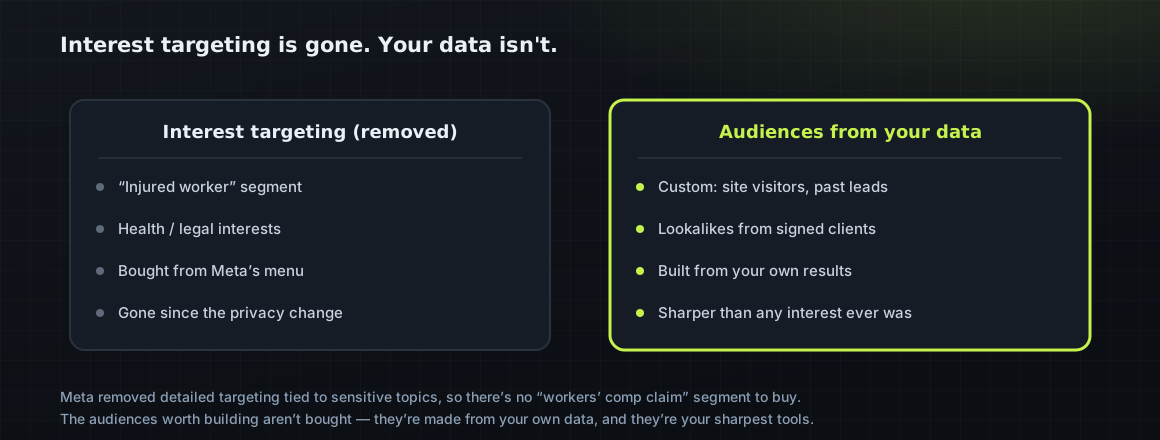
Meta removed detailed-targeting options tied to sensitive topics — health conditions, legal matters, and more — because letting advertisers select people by those traits was a privacy problem. There is no “recently injured at work” interest, no “filing a workers’ comp claim” segment, and there won’t be. On top of that, a workers’ comp firm is treated as a health-adjacent advertiser, which brings extra scrutiny to what you can say and how you can target. Fighting this is a waste of energy; the firms that win stopped trying to buy a segment and started earning the algorithm’s attention instead.
Why Meta and Google put your firm in that stricter bucket in the first place — and what it changes about your account — is covered in why they treat your firm as a health advertiser.
The health-advertiser classification adds a second layer worth understanding, because it shapes more than targeting. Being treated as a sensitive-category advertiser can affect what optimization data Meta shares back with you, how your ads are reviewed, and how much latitude you have in copy and imagery. It’s not a reason to avoid the platform — plenty of workers’ comp firms run profitable Meta accounts — but it is a reason to expect more scrutiny and to build your strategy around what the platform actually permits rather than around what you wish it did.
Understand why this happened and the rule stops feeling arbitrary. Letting advertisers pick people out by a health condition or a legal problem was a privacy hazard — imagine an ad that could only be shown to people flagged as “recently injured” — so the platforms removed those detailed-targeting options across the board. It wasn’t aimed at law firms specifically; it swept up every advertiser touching sensitive categories. Fighting it, looking for a workaround, or paying a vendor who claims a secret way back in is wasted energy and, often, a policy violation waiting to happen. The interest list is gone and it is not coming back, so the winning move is to get good at the approach that replaced it.
There’s a mindset shift buried in that sentence that separates firms who thrive on modern Meta from those who churn through agencies blaming the platform. The old model treated the advertiser as a hunter picking targets off a list. The new model treats the advertiser as someone who sets a good lure in a wide pond and lets the system find the fish. Firms that keep trying to hunt — demanding narrower audiences, chasing phantom targeting options — fight the platform’s design and lose. Firms that embrace the lure model, pouring their energy into creative that speaks unmistakably to an injured worker, work with the platform and win. Same account, same budget, opposite results, decided entirely by which model the firm operates under.
That approach also happens to be more durable. An interest segment was always a crude proxy — “interested in personal injury law” swept in paralegals, insurance adjusters, and curious neighbors alongside actual injured workers. Broad targeting plus self-selecting creative and conversion data lets Meta’s system find the real buyers by watching who actually engages and converts, which is a truer signal than any interest checkbox ever was. Firms that mourn the old targeting are mourning a tool that was never as precise as it felt.
Broad targeting and creative self-selection
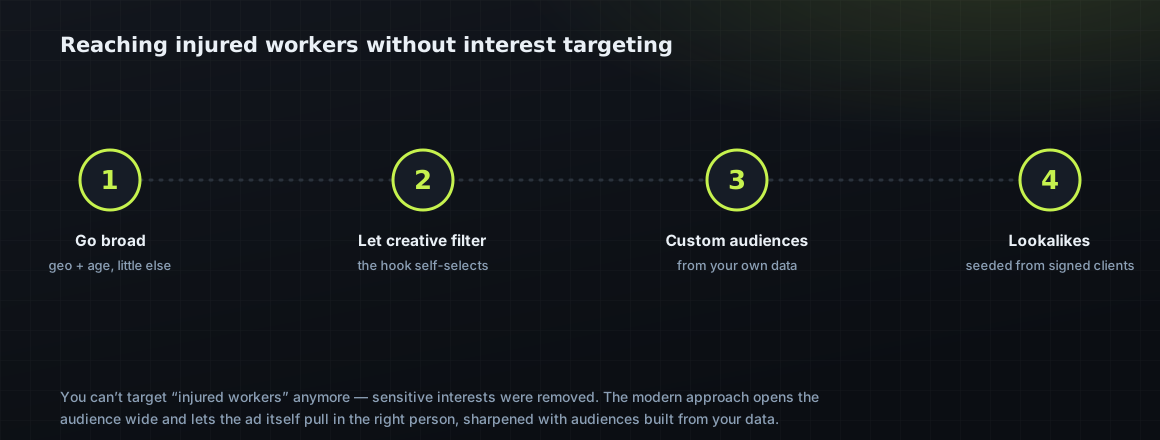
Here’s the shift that confuses firm owners: on modern Meta, the creative does the targeting. You open the audience wide — a geography, an age range, and little else — and let the ad itself pull in the right person. An ad that opens with “Hurt on the job in [state]?” is a filter. The injured worker stops scrolling; everyone else keeps going. Meta’s delivery system then watches who engages and converts, and steers the budget toward more people like them. Give it a clear signal and a wide pool, and it finds your buyers faster than any interest list ever did.
The self-selection idea deserves a concrete example, because it’s the whole game now. Two ads run to the identical broad audience. One opens with a generic “Injured? We can help.” The other opens with “Hurt on the job in [state] and your claim was denied?” The second ad is doing the targeting the interest list used to do — it stops the exact person you want and lets everyone else scroll past, and Meta’s delivery system, watching who responds, learns to show it to more people like them. The more specific and self-selecting your hook, the more the broad audience behaves like a targeted one. Your creative is now your primary targeting lever, which is a gift, because it’s the one lever no privacy change can take away.
It also changes who you should trust with the work. An agency still selling you on their “targeting secrets” or a proprietary list of injured-worker audiences is either behind the times or bluffing, because those levers no longer exist. The agencies worth hiring now compete on creative and on data discipline — how many angles they can test, how cleanly they feed conversions back to the algorithm, how well they build audiences from your results. When you evaluate help for Meta, ask about their creative process and their tracking setup, not their targeting tricks. The answer tells you whether they’re operating in the current reality or the one from five years ago.
The same test applies to your own team. If the person running your Meta ads spends their week rebuilding audience sets and barely touches the creative, they’re optimizing the lever that no longer matters. Redirect that effort: fewer hours in the audience tab, more hours writing hooks, briefing video, and reviewing which angles actually produced qualified leads. The account will improve not because you found better targeting, but because you finally started working the lever that drives modern Meta performance. It’s a small reallocation of attention with an outsized effect on cost per signed case.
This is why creative volume matters more than audience tinkering in a modern Meta account. Firms used to spend their optimization energy slicing audiences ever finer; now that energy belongs in testing hooks and angles, because the hook is what selects the audience. A firm that ships one new self-selecting creative a week will out-target a firm endlessly rebuilding audience sets, every time. Put your effort where the leverage moved.
Practically, that means building a creative pipeline, not a one-time batch of ads. The firms that win keep a running list of angles injured workers respond to — denied claims, the fear of being fired for filing, not knowing what a case is worth, distrust of the insurance company’s doctor — and turn each into fresh creative on a regular cadence. Some will flop and some will carry the account for a month before fatiguing. The point isn’t to find one perfect ad; it’s to always have the next three in testing, because on modern Meta the creative is the targeting, and a targeting strategy you refresh weekly beats one you set once and forget.
The audiences you should build
Broad doesn’t mean blind. The audiences worth building aren’t bought from Meta’s interest menu — they’re made from your own data, and they’re the sharpest tools you have.
Lookalikes reward patience and good hygiene. A lookalike built the day you install the pixel, from a thin list of mixed-quality leads, will underperform and sour a firm on the whole idea. The same lookalike built a few months later, seeded from a clean list of a few hundred people who actually signed, can become the most efficient prospecting audience in the account. Give the seed time to accumulate real signed cases, keep it updated as new clients sign, and let Meta rebuild the lookalike periodically so it learns from your latest and best data. The tool is powerful; it just needs a good teacher, and the teacher is your own signed-case list.
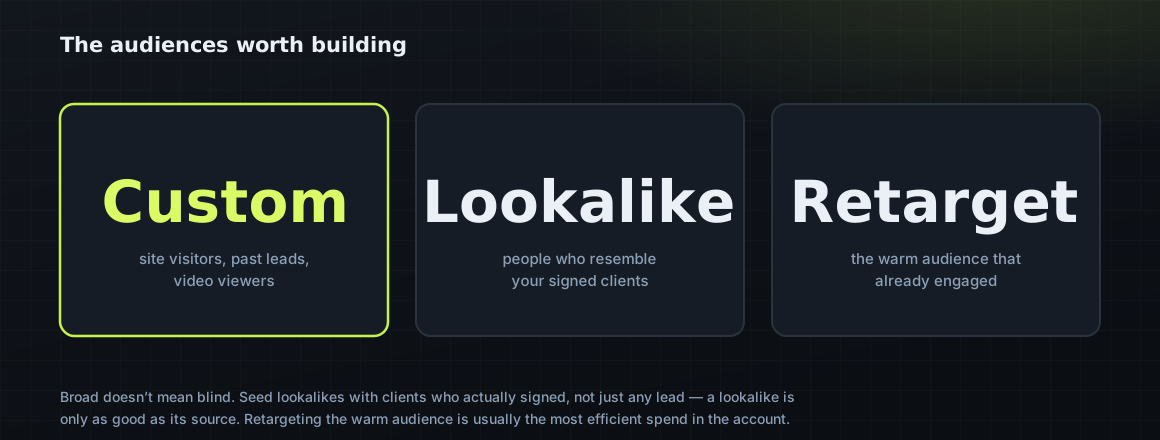
The quality of a lookalike is only as good as its seed. A lookalike built from everyone who ever filled a form copies your junk leads too; one built from clients who actually signed teaches Meta what a real case looks like. Feed it your best data, and getting that data flowing cleanly from your site and CRM is a job for the intake tech stack.
A word on why you should feed the algorithm rather than fight it. Meta’s delivery system is very good at finding people likely to take the action you optimize for — if you tell it what a good outcome looks like and give it a wide enough pool to search. That means optimizing for a real conversion (a qualified lead or better, not just a click), sending clean conversion data back through the pixel or the conversions API, and resisting the urge to over-segment a broad audience into starvation. Every artificial constraint you add — a tiny audience, a narrow age band, a dozen exclusions — is a hand tied behind the algorithm’s back. Give it a clear goal and room to work, and it will out-target anything you could build by hand.
Geography, age, and the basics
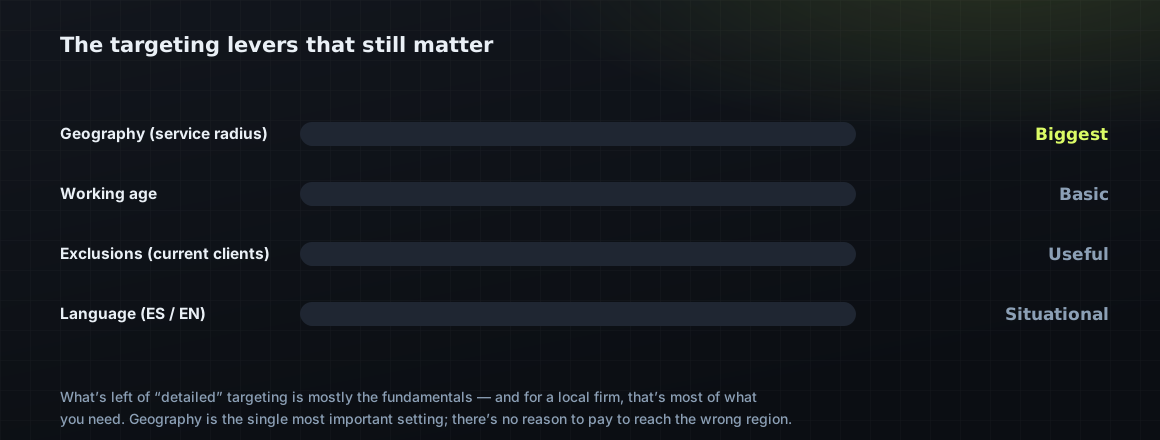
What’s left of “detailed” targeting is mostly the fundamentals — and for a local firm, that’s most of what you need.
Where the Spanish-speaking injured-worker market is large, a separate audience and separate creative usually beats a single translated campaign — the case for that is in winning the Spanish-speaking market.
Getting the audience-building data right depends on infrastructure most firms underinvest in. Your custom and lookalike audiences are only as good as the data feeding them, which means the pixel has to be firing correctly on your site, your conversions need to be defined and sent back to Meta, and your CRM has to be able to hand back a clean list of people who actually signed. When that plumbing is broken — a pixel that never fired, a “lead” event that counts every form-open — your lookalikes learn from garbage and your whole account drifts. The unglamorous work of getting the tracking right is what makes the clever audience strategy possible, and it lives in the intake tech stack.
Retargeting: the warm audience
The highest-converting audience you can build on Meta is the one that already knows you: people who visited your site, watched most of a video, or opened a form and didn’t finish. They cost less to convert because they’re partway there. Retargeting them with a proof-and-CTA ad is often the most efficient spend in the whole account — the full approach is in workers’ comp retargeting.
Exclusions are the quiet efficiency lever inside all of this. Every dollar spent showing ads to your current clients, your own staff, or people who signed last week is a dollar wasted, and at scale that waste is real money. Build exclusion audiences from your client list and recent signers and apply them across the account, so your budget is always chasing new injured workers rather than re-touching people already in your pipeline. It’s a five-minute setup that quietly lowers your cost per new case by trimming spend you were never getting anything for.
What good looks like
A healthy Meta account for a workers’ comp firm looks almost too simple: broad geo-and-age audiences at the top, fed by creative that self-selects injured workers; custom and lookalike audiences built from real client data; a warm retargeting audience catching the people who engaged; and current clients excluded throughout. You resist the urge to over-segment, you feed the algorithm clean conversion data, and you let the creative do the work the interest list used to. Then you measure it honestly — which is its own challenge, covered in marketing attribution.
Scaling without breaking the account
Once the broad-plus-creative approach is working, the instinct is to scale by adding audiences and complexity — and that instinct is usually wrong. The way to scale a modern Meta account is to raise budget on what’s working gradually enough that the delivery system doesn’t get thrown back into a learning phase, and to keep feeding it fresh creative so the audience doesn’t fatigue. Audience saturation and creative fatigue, not targeting limits, are what actually cap a scaling account: the same ad shown to the same broad pool too long stops converting, and the fix is new creative, not a new audience.
Watch for the signs of fatigue — a rising cost per result, a falling click-through rate, a frequency number climbing past a few impressions per person — and respond with new hooks and formats rather than by rebuilding your targeting. A healthy scaling account looks almost boringly simple at the audience level and very busy at the creative level: broad audiences holding steady, a steady stream of new ads entering and tired ones retiring. That’s the opposite of how firms scaled a decade ago, and it’s why so many owners feel like Meta “stopped working” — the platform didn’t change its mind about them; the lever that controls scale moved from the audience tab to the creative one.
Measured honestly, all of this points back at the same scoreboard as every other channel: cost per signed case, tracked cleanly enough to trust. The audience strategy is a means, not an end. Get the tracking right, let broad audiences and self-selecting creative do the targeting, sharpen with data-built custom and lookalike audiences, retarget the warm, exclude the people you’re already paying for elsewhere, and measure the whole thing in signed cases. Do that and the loss of interest targeting stops feeling like a handicap and starts looking like what it actually was: a nudge toward an approach that works better anyway. Honest measurement of it all is covered in marketing attribution.
One last reframe to carry out of this. The removal of interest targeting felt, to a lot of firm owners, like Meta taking something away — and in a narrow sense it did. But the firms getting the best results on the platform today aren’t the ones who found a clever way around the restriction; they’re the ones who stopped looking for one and got genuinely good at broad targeting, self-selecting creative, and audiences built from their own data. That skill set is more durable than any targeting hack, because it’s built on your results rather than on a platform feature that can vanish in the next privacy update. Reaching injured workers on Meta is absolutely still possible and still profitable. It just rewards a different, better discipline than it used to — and the firms that learn it have a real edge over the ones still waiting for the old targeting to come back.
To make it concrete, a healthy modern setup for a workers’ comp firm looks like this end to end: broad audiences defined only by service geography and working age; a steady stream of self-selecting creative that names the injured worker’s situation in the first line; a pixel and conversions feed sending real qualified-lead and signed-case data back to Meta; custom audiences of site visitors and past leads for retargeting; lookalikes seeded from actual signed clients and refreshed as the list grows; and exclusions that keep budget off current clients and recent signers. No interest targeting anywhere, because there is none to use — and none needed, because the creative and the data are doing the work it used to do, better. That’s not a workaround for a limitation. It’s the current best practice, and most of your competitors haven’t adopted it yet.
The quiet opportunity in all of this is that most workers’ comp firms haven’t adapted. Plenty of owners are still asking their agency to “target injured workers,” still judging Meta by cost per lead, still spending their optimization time slicing audiences that no longer matter — and getting the mediocre results that approach now produces. A firm that adopts the current playbook — broad audiences, self-selecting creative, clean conversion data, lookalikes seeded from real signed clients, disciplined exclusions — has a genuine edge, not because it found a secret, but because it’s operating in the present while competitors operate in 2019. The targeting change that felt like a loss is, for the firms willing to learn the new discipline, one of the clearest competitive openings on the platform.
Key takeaways
-
You cannot target injured workers directly. And you have not been able to for years, which is the honest starting point for every Meta plan.
-
Broad targeting plus self-selecting creative is the method. You let the creative find the audience instead of the other way around.
-
Build the audiences that actually help. Custom and lookalike audiences from your own data do the targeting the platform will not.
-
Retargeting is your warm audience. The people who already engaged are the cheapest cases you will sign on Meta.
-
Scale without breaking the account. Widen deliberately; sudden changes reset learning and spike cost.
Frequently asked questions
Can you target injured workers on Facebook or Meta?
No. Meta removed detailed-targeting options tied to sensitive topics like health conditions and legal matters, so there’s no ‘injured worker’ or ‘workers’ comp claim’ segment to buy. The modern approach is broad targeting plus creative that self-selects the right person, sharpened with audiences built from your own data.
How do workers’ comp firms target ads on Meta now?
With a wide audience — a service geography and a working-age range — and creative that filters. A hook like ‘Hurt on the job in [state]?’ stops the right viewer and Meta’s delivery system steers budget toward people who engage and convert. You layer in custom and lookalike audiences from your own client data.
What is a lookalike audience and should a workers’ comp firm use one?
A lookalike audience is a group Meta builds by finding people who resemble a source you provide. Yes, use it — but seed it with your signed clients, not just any lead. A lookalike is only as good as its source, so feeding it your best data teaches Meta what a real case looks like.
Should workers’ comp firms use broad or detailed targeting on Meta?
Broad. Since sensitive interests were removed, over-segmenting mostly starves the algorithm of the data it needs. Open the audience wide on geography and age, let self-selecting creative pull in the right person, and feed the account clean conversion data so delivery can optimize.
What audiences should a workers’ comp firm build on Meta?
Custom audiences from your pixel’s site visitors, past leads, and video viewers; lookalike audiences seeded from signed clients; and exclusions for current clients and recent leads. Retargeting your warm audience — people who already engaged — is usually the most efficient spend in the account.
Sources & further reading
-
01
Meta audiences documentation
Meta for Business covers broad targeting, custom and lookalike audiences, and the privacy changes that reshaped them.
-
02
Further reading
The constraints and the warm audience.
Platform rules and benchmarks change over time; confirm current details in the platform’s own documentation. General marketing information, not legal advice.