
Every Meta campaign for a workers’ comp firm faces one fork before a single dollar is spent: when someone taps your ad, do they fill out a form that opens right inside Facebook, or do they land on your website? It sounds like a small setup choice. It quietly decides your lead volume, your cost per lead, your lead quality, and how hard your intake team has to work. Here’s how the two actually differ, and how to choose the one that fits your firm.
It’s worth saying up front that this is not a question with a universal answer, and anyone who tells you “always use instant forms” or “landing pages always win” is selling a preference, not a strategy. The right choice is contingent on your firm — how fast your intake moves, how much your best case types need explaining, how much you value owning your data. Two good firms in the same market can correctly make opposite choices. The goal of this guide isn’t to crown a winner; it’s to give you the framework to make the call that fits your machine, and to measure it honestly once you have.
Keep one principle in view throughout: cost per lead is the number that will lie to you here, louder than anywhere else. Instant forms will almost always show a lower cost per lead than landing pages, which makes them look like the obvious winner on any surface-level report. But the whole point of this comparison is that the cheaper lead is often the more expensive case. If you take one thing from the sections that follow, take the habit of carrying every comparison all the way to cost per signed case before you decide anything — because on that number, the “obvious” answer flips often enough that trusting the obvious one is how firms lose money confidently.
The two paths a Meta click can take
A lead ad opens an instant form inside Facebook or Instagram, pre-filled with the name, email, and phone Meta already has. The person never leaves the app. A landing page ad sends them to a page on your website where they read, then fill out your form. The difference in friction is the whole story: one is two taps without typing, the other is a click, a page load, and a decision to fill out a form on an unfamiliar site.
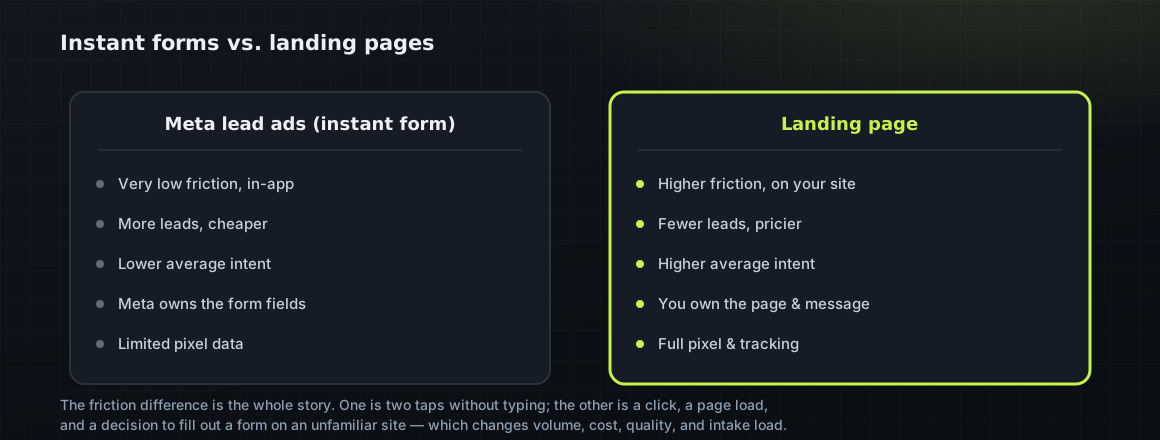
Read that table and the trap is obvious: the option that looks best on a cost-per-lead report is the one that sends you the least-committed people. Cheaper leads are not the same as cheaper cases.
It helps to picture the two people these paths catch. The instant-form person was scrolling, saw your ad, and tapped twice without breaking stride — curious, maybe motivated, maybe not, and definitely not committed. The landing-page person clicked, waited for a page to load, read a little, and chose to fill out a form on a site they’d never seen. That second person did more work to reach you, and the work is a filter: it screens out the idly curious and leaves you talking to someone who decided you were worth the effort. Neither person is “better” in the abstract — but they convert at very different rates, and your plan has to account for which one each path delivers.
The volume difference is not subtle, either. Because an instant form asks so little, the same ad budget typically produces meaningfully more leads through instant forms than through a landing page — sometimes dramatically more. That flood can look like a triumph on a leads report and feel like a crisis at the intake desk, where a team built to handle thirty inquiries a week suddenly faces a hundred, most of them lukewarm. Volume you can’t answer isn’t an asset; it’s a liability that also trains your team to stop trusting the channel. Any decision about instant forms has to start with an honest look at whether your intake can actually catch what they’ll deliver.
Why instant forms feel worse
Firms that switch to lead ads often see their cost per lead drop and their close rate drop with it. That’s not a broken campaign — it’s the physics of friction. A pre-filled, two-tap form catches people who were mildly curious, half-scrolling, not yet committed to hiring anyone. Some are exactly the injured worker you want. Many tapped the way you’d tap a quiz. The volume is real; so is the noise.
The qualifying questions that fix it
The instant form’s biggest weakness is also its most underused fix: you can add your own questions. A form that asks nothing but confirms a name and number screens no one. A form that asks two sharp questions turns a curiosity-tap into a small commitment — and filters out most of the noise before it ever reaches your intake team.
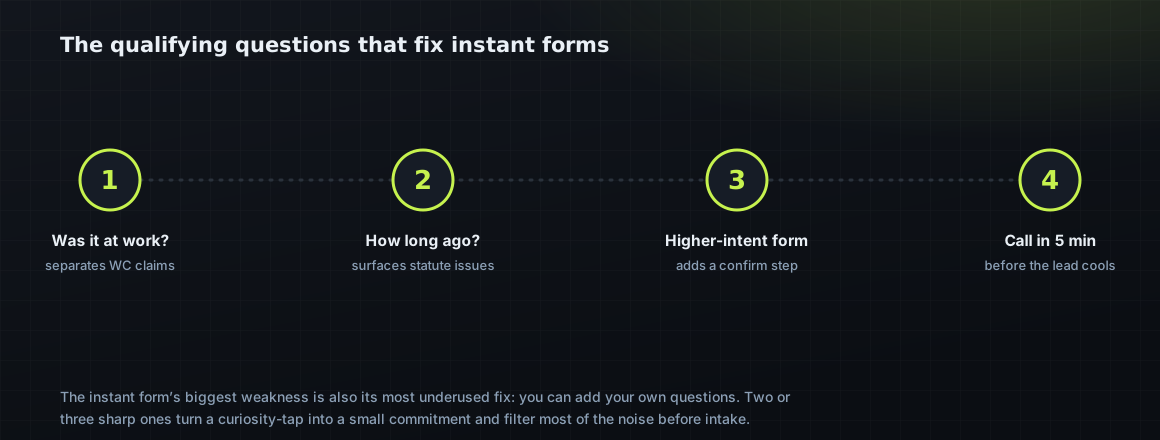
There’s a balance: every question you add lowers volume and raises intent. Add too many and you’ve rebuilt the friction of a landing page inside the form. Two or three well-chosen questions is usually the sweet spot — enough to qualify, not so many that the injured worker who genuinely needs you gives up.
Think of each question as a small toll that only the serious will pay. “Were you injured at work?” costs a genuine claimant nothing and stops most of the accidental taps. “How long ago?” takes another second and surfaces a statute problem before it wastes an intake call. Meta’s higher-intent form option — which adds a review step before submission — is a toll of its own, trading a little volume for leads who confirmed they meant it. The art is calibration: too few questions and intake drowns; too many and you’ve rebuilt a landing page’s friction inside the form and thrown away the volume advantage you switched for. Start with two, watch your qualified-lead rate and your cost per signed case, and adjust from there rather than guessing.
Resist the temptation to over-qualify, though, because the same questions that filter noise also deter genuine claimants who are in pain and low on patience. An injured worker filling out a form on their phone, one-handed, in a doctor’s waiting room, will abandon a form that asks for their claim number, their employer’s insurance carrier, and the date of their last medical appointment — and that worker was exactly the case you wanted. Two questions that a serious person answers in five seconds is the target. Every question beyond that is a small tax on your best leads as well as your worst, so add them only when the data says the noise justifies it.
When a landing page wins
Instant forms aren’t always the answer. A landing page earns its higher cost per lead in three situations: when you need your pixel firing on your own site to build audiences and measure conversions; when the case type needs explanation before someone will trust you with it; and when your intake simply can’t absorb the volume a low-friction form produces.
A landing page asks more of the visitor, so the ones who finish have already decided you’re worth their effort. Sometimes the friction is the filter you wanted.
Landing pages also give you something instant forms can’t: control and data. On your own page, you decide the headline, the proof, the images, the order of the argument, and exactly what you ask — and your pixel fires on your domain, building the retargeting audiences and conversion signals that make the rest of your Meta account smarter over time. An instant form keeps the person inside Facebook, which is convenient for them and opaque for you. For a firm that’s serious about compounding its Meta performance — feeding the algorithm clean conversion data and building warm audiences — the landing page’s extra friction buys real infrastructure, not just higher intent.
The case type should steer the choice as much as the intake. A straightforward “I got hurt at work and need a lawyer” situation converts fine off a low-friction instant form — there’s not much to explain. A denied claim, a serious injury with a disputed permanent rating, or a third-party case tangled up with the comp claim is different: the worker needs to understand why your firm is the right call before they’ll commit, and a landing page gives you the room to make that case that a three-field instant form never will. Match the path to the complexity of the sale, not just to the cost per lead, and you’ll route each case type to the format that actually converts it.
Spencer Moeller, WorkersComp MarketingThe page itself has to be built to convert, not to win design awards — the anatomy of one that turns a Meta click into a signed case is in landing pages that convert clicks into signed cases.
Speed-to-lead is non-negotiable here
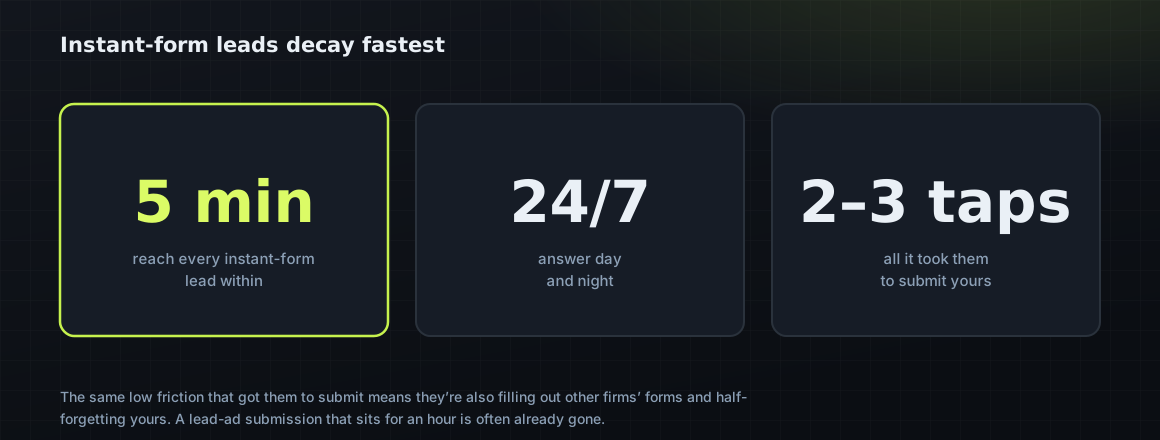
Whatever path you choose, instant-form leads punish a slow intake harder than any other source. The same low friction that got them to submit means they’re also filling out three other firms’ forms and half-forgetting they filled out yours. A lead-ad submission that sits for an hour is often already gone. If you run instant forms, you are signing up to call within minutes, every time, day and night.
That makes speed-to-lead and after-hours AI intake part of the campaign, not a separate department. And it makes the plumbing between Meta and your phone — the instant Zapier or CRM connection that pulls the lead in the moment it’s submitted — worth getting right, which is covered in the intake tech stack. A form that lands in an email inbox nobody watches is a lead you paid for and threw away.
The plumbing matters more here than anywhere else in Meta advertising. An instant-form lead needs to travel from Meta to whoever will call it in seconds, not hours — which means a live connection (a native integration, a CRM sync, or a well-built automation) pulling each submission the instant it happens and putting it in front of a person or an AI agent who will dial immediately. Firms that rely on downloading a CSV of leads once a day, or on an email that pings an unwatched inbox, are effectively not running instant forms at all; they’re collecting the names of people who already hired someone else. If you’re going to trade for volume and speed-sensitivity, build the pipe that makes speed possible.
How to choose
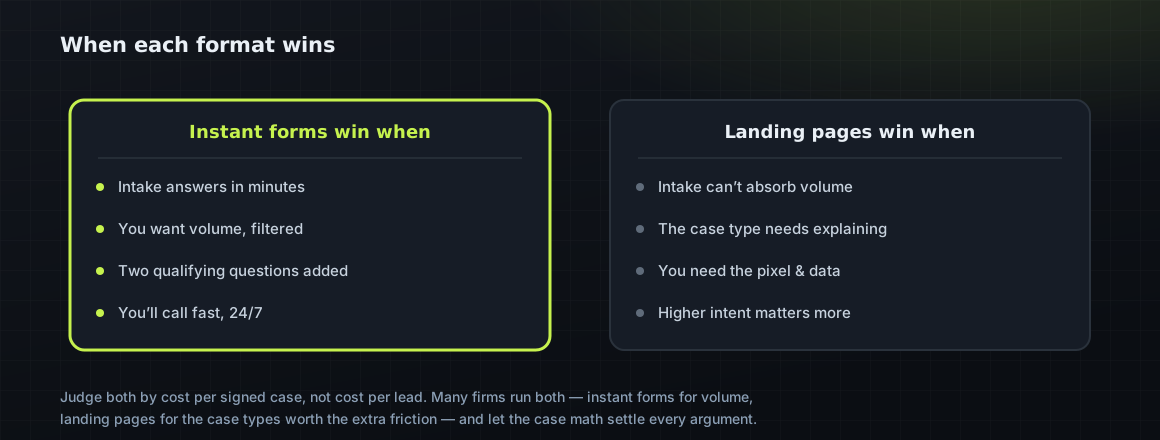
Start with the honest question: can your intake answer a low-friction lead within five minutes, every time? If yes, instant forms with two qualifying questions usually win on cost per signed case — more volume, filtered at the form, called fast. If your intake is stretched, or your strongest case types need explaining, a landing page’s higher intent will serve you better even at a higher cost per lead. Many firms end up running both — instant forms for volume, landing pages for the case types worth the extra friction — and let cost per signed case, not cost per lead, settle every argument between them.
The mistakes that waste instant-form budgets
A few errors show up again and again once firms turn instant forms on. The first is running them with no qualifying questions, so intake drowns in claims that were never compensable and the team learns to distrust every Meta lead. The second is treating the leads like search leads — calling once, during business hours, and giving up — when instant-form leads specifically need speed and persistence because their intent was lower to begin with. The third is judging the channel on cost per lead, congratulating yourself on cheap leads while cost per signed case quietly climbs.
The fourth is the quiet killer: no follow-up sequence. A landing-page lead who was ready might sign off the first call; an instant-form lead often needs several touches over days before the “maybe” becomes a “yes.” Firms that call once and move on leave most of the value on the table. A simple, persistent nurture sequence — a mix of calls and texts over the first week — turns a meaningful share of those lukewarm taps into signed cases, and it costs nothing but the discipline to run it. The approach is in lead nurture for workers’ comp.
None of this makes instant forms a mistake — it makes them a tool with a specific manual. Used with qualification, speed, honest cost-per-case measurement, and a real follow-up sequence, they can be the cheapest source of signed cases in a Meta account. Used carelessly, they’re the fastest way to conclude that “Facebook doesn’t work” while the real problem was the process, not the platform.
Put simply: the format is a setting, not a strategy. Whichever path you choose, the outcomes are decided by the same fundamentals that decide every channel — how fast you answer, how well you qualify, how persistently you follow up, and whether you measure the result in signed cases instead of leads. Firms that get those fundamentals right make instant forms work, make landing pages work, and often run both, sending each case type down the path that converts it best. Firms that get them wrong blame the format, switch, and get the same disappointing result in a new costume. Fix the machine first; then the choice between instant forms and landing pages becomes a small optimization rather than a hunt for a savior.
A practical way to settle it for your firm is to run both for a defined window and let the data referee. Point the same budget and the same creative at an instant-form campaign and a landing-page campaign, tag every lead by source, and track them through your own intake to signed cases. A few weeks of honest numbers will tell you which path produces cases at a lower cost for your intake, your case types, and your market — which is the only comparison that matters. The answer you get may not match the case study you read or the vendor’s confident recommendation, and that’s exactly why running your own test beats taking anyone’s word for it.
The reassuring thing about this whole decision is that it’s reversible and testable, unlike most marketing commitments. You aren’t locked into instant forms or landing pages; you can run both, shift budget between them as the numbers come in, and change your mind next quarter without penalty. That makes the format choice a low-risk experiment rather than a bet-the-firm decision — provided you actually measure it in signed cases rather than arguing about it in the abstract. Treat it as an ongoing optimization, let each case type find the path that converts it best, and revisit the split as your intake speed and creative improve. The firms that win here aren’t the ones who guessed right once; they’re the ones who kept measuring and kept adjusting.
Key takeaways
-
Every Meta click forks: instant form or landing page. The choice is made before a dollar is spent, and it shapes lead quality.
-
Instant forms feel worse for a reason. Frictionless forms produce more leads at lower intent unless you add qualifying.
-
Qualifying questions fix instant forms. A few screening questions trade a little volume for a lot of lead quality.
-
Speed-to-lead is non-negotiable here. Instant-form leads cool fastest; minutes decide whether they convert.
-
Choose by capacity, not preference. If intake answers in minutes, instant forms scale; if not, a landing page protects quality.
Frequently asked questions
Are Meta lead ads or landing pages better for workers’ comp firms?
Neither is universally better. Lead ads (instant forms) get you more leads at a lower cost per lead but lower average intent; landing pages cost more per lead and convert better. The right choice depends on how fast your intake answers and how well you qualify inside the form — and you judge both by cost per signed case, not cost per lead.
Why are my Meta lead ad leads low quality?
Instant forms are pre-filled and take two taps, so they catch people who were only mildly curious. The fix is to add two or three qualifying questions — like whether the injury happened at work and how long ago — and to use Meta’s higher-intent form option, which adds a confirmation step before submitting.
How many questions should a Meta lead form have?
Usually two or three. Every question you add lowers volume and raises intent; too many rebuilds the friction of a landing page inside the form. Two sharp qualifying questions is typically the sweet spot — enough to filter noise without losing the injured worker who genuinely needs you.
Do I need a landing page if I use Meta lead ads?
Not always, but a landing page wins when you need your pixel firing on your own site to build audiences and measure conversions, when the case type needs explanation to build trust, or when your intake can’t absorb the volume instant forms produce. Many firms run both.
How fast do I need to follow up with Meta lead ads?
Within minutes. Instant-form leads decay faster than any other source because the same low friction that got them to submit means they’re also filling out other firms’ forms. If you run lead ads, you’re committing to call within five minutes, day and night.
Sources & further reading
-
01
Meta lead ads documentation
Meta for Business covers instant forms, qualifying questions, and the CRM delivery behind lead ads.
- 02
Platform rules and benchmarks change over time; confirm current details in the platform’s own documentation. General marketing information, not legal advice.