Every workers’ comp firm owner has had the same two thoughts, usually in the same week: “We should be on TV,” and “Isn’t TV a waste of money now?” The honest answer is that both can be true — it depends entirely on how you buy it and what you expect it to do.
Legal is one of the most saturated categories on American television, and workers’ comp and injury firms are a big part of why. There is a reason: for a frightened person choosing a lawyer, familiarity is a powerful tiebreaker, and nothing manufactures familiarity like being on the screen in the living room for months. But that same dynamic is what makes broadcast so easy to waste — it rewards scale and repetition, punishes dabbling, and hides its results behind a measurement problem that lets vendors sell firms spots that never moved a case.
This piece is the grown-up version of the TV conversation. Not “TV is dead” and not “real firms advertise on TV,” but: what broadcast actually buys, when it pays and when it doesn’t, how connected TV changed the math, how to buy it for frequency, what makes the creative work for injured workers, and how to measure something that feels unmeasurable. If you are going to spend broadcast money, spend it knowing exactly what job it is doing.
The two opposite mistakes
One firm buys TV for its ego. The next refuses it out of dogma. Both misread the tool.
The first mistake is buying broadcast as a status symbol. A partner wants to see the firm on TV, so the firm books a package of spots, feels important for a quarter, and quietly cannot tell whether a single case came from it. The buy was driven by how it felt, not by what it did, and the vendor was happy to sell it that way because “brand awareness” is unfalsifiable.
The second mistake is the mirror image: a digitally-native firm dismisses all broadcast as a dinosaur, and in doing so gives up the one thing digital is worst at — broad, repeated, low-cost familiarity across an entire market. Search and social are superb at capturing people who are already looking; they are expensive and narrow ways to become the name a person starts out trusting.
The way out of both is to treat broadcast as what it is: a top-of-funnel familiarity engine that makes everything downstream cheaper, judged by evidence rather than by feel. Get that framing right and the rest of the decisions — budget, channel, creative, measurement — get much easier.
What broadcast actually buys
Reach and familiarity — the recognized name, not the immediate click.
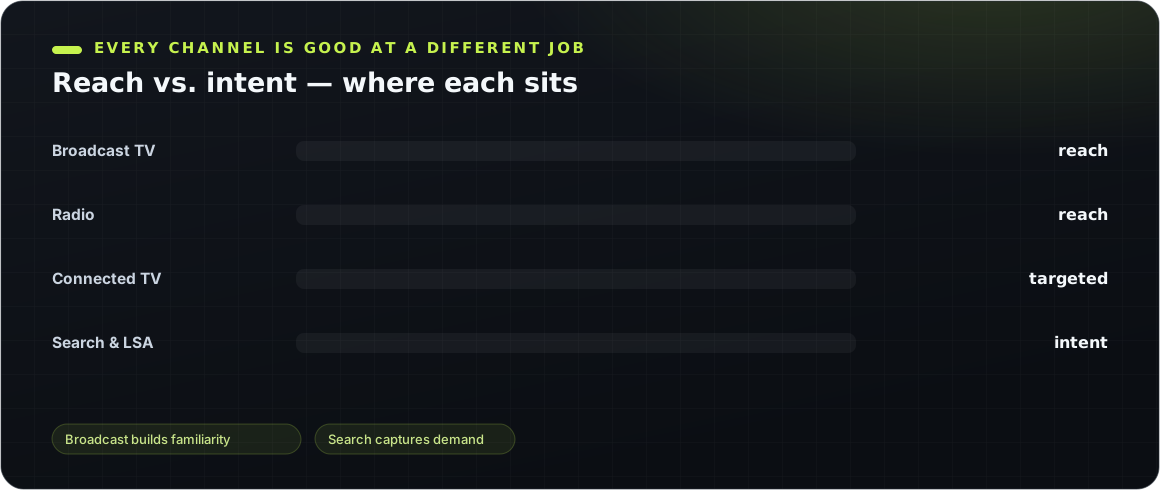
To use broadcast well you have to be honest about what it is bad at. It is bad at direct response. Nobody is meant to leap off the couch mid-injury and dial during your thirty-second spot; if that is the standard, broadcast will always look like a failure next to a search ad someone clicked while actively hunting for a lawyer.
What broadcast is uniquely good at is familiarity at scale. Injured workers, as we covered in the piece on video and the recognized firm, overwhelmingly call the name they already know — the firm that feels safe because they have seen it a hundred times. Months of presence in the living room, or a voice that rides along on the morning commute, build that recognition across an entire market in a way it would cost a fortune to build one search click at a time. When the injury finally happens and the person opens their phone, you are not a stranger in a row of strangers; you are the name they half-expected to find.
That is the mechanism. Broadcast does not win the case at the moment it airs; it pre-loads the choice so that the demand-capture channels — Google Screened and search — convert better and cheaper when the moment comes. Treat it as the top of one funnel, not a separate funnel of its own.
When broadcast pays — and when it burns cash
The dividing line is frequency. Below it, broadcast does nothing; above it, it compounds.
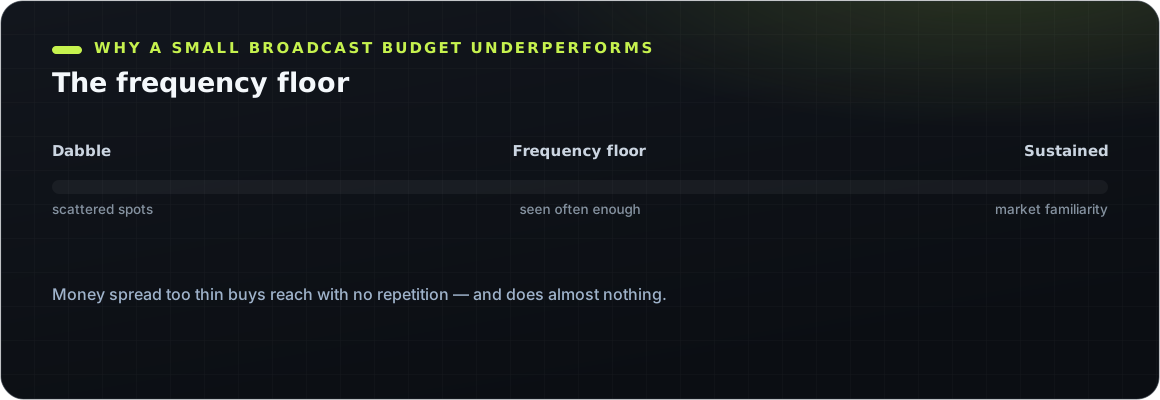
The single most important word in broadcast is frequency — how many times the same person sees or hears you. Reaching a million people once does almost nothing; reaching a hundred thousand people twelve times builds a brand. Familiarity is a repetition effect, and repetition is exactly what a thin budget cannot buy.
This is why the honest budget test is not a dollar figure — it scales with the size of your market — but a question: can we afford to be seen often, by the people we care about, for long enough to be remembered? If yes, broadcast can pay. If the budget only stretches to a scatter of spots across a whole metro, that money will almost always produce more signed cases inside search and Meta first, where even a small budget can capture real demand. Broadcast rewards concentration and punishes dabbling; a smaller area covered with real frequency beats a big area covered thinly every time.
Two other conditions decide whether broadcast pays. You need the intake capacity to answer the calls it drives — broadcast tends to spike calls in bursts, and an ad that generates a call nobody answers is worse than no ad. And you need patience: familiarity accrues over months, so broadcast bought for four weeks and judged on week four will always disappoint. It is a compounding buy, not a switch.
The streaming shift: connected TV
CTV keeps broadcast’s reach and fixes its two worst problems — targeting and measurement.
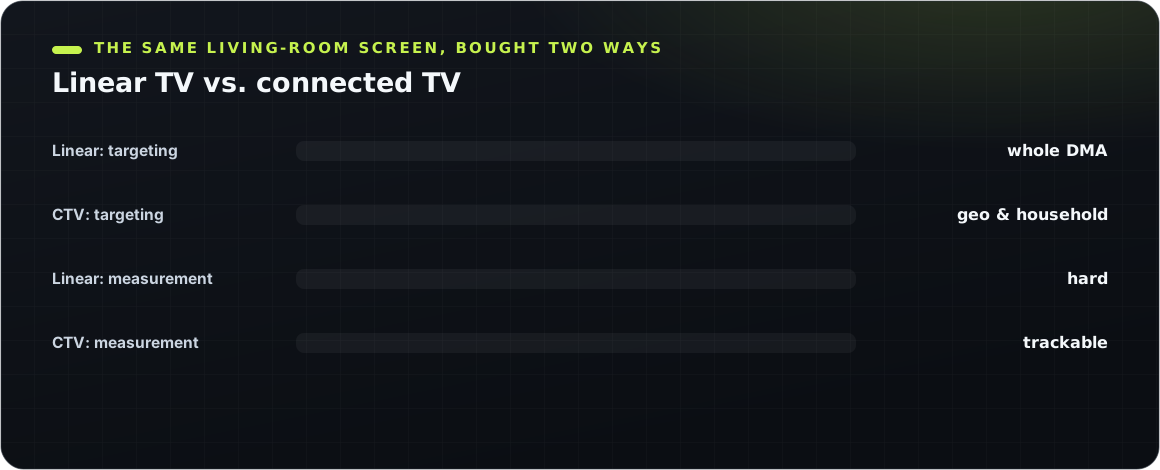
The most important development in broadcast for a local law firm is connected TV — ads served inside streaming apps and on smart TVs. It looks to the viewer exactly like a TV commercial: full screen, in the living room, often unskippable. But it is bought like digital, which fixes the two things that always made linear TV risky for a firm.
First, targeting. Instead of buying a whole media market and paying to reach everyone from teenagers to retirees, CTV lets you concentrate on the geographies and household profiles where injured workers actually are — the ZIP codes around industrial parks, warehouses, and blue-collar employers. Your frequency dollars land on the right living rooms instead of the whole metro.
Second, measurement. Because it is digital underneath, CTV can connect an ad exposure to a later visit to your site or a rise in searches for your name, giving you something linear almost never could: evidence. That is why, for most firms deciding to test the screen for the first time, CTV is the right place to start — you get broadcast’s familiarity effect with a fraction of the waste and a way to actually see whether it worked. Linear cable and broadcast still have a role for blanket reach once a firm is large enough, but they are the second step, not the first.
How to buy it: frequency over reach-once
Concentrate. Repeat. Pick the moments your prospect is actually watching or listening.
Whatever the channel, the buying principles are the same, and they all bend toward concentration:
Buy frequency, not a spot count. A media plan that brags about “500 spots” across a whole market is often just thin reach dressed up. Ask instead how many times a typical target viewer will see you per week, and for how many weeks. If the honest answer is “once or twice,” the plan will not work no matter how big the spot count sounds.
Concentrate the area. Own a county or a set of ZIPs with real frequency before you try to blanket a state faintly. Depth beats breadth in a familiarity medium.
Match the daypart to the audience. Injured workers skew toward people doing physical jobs on real schedules — early mornings, drive-time radio, daytime and news programming, Spanish-language stations in many markets. That points naturally toward reaching the Spanish-speaking injured worker, an audience broadcast reaches especially efficiently. Prime-time entertainment is glamorous and expensive and often the wrong room.
Do not forget radio. Radio is the underrated cousin — cheaper, intimate, and perfectly matched to a commuting, working audience. A consistent radio presence on the right stations can build familiarity at a fraction of TV’s cost, and the same discipline applies: frequency and consistency over a scatter of spots.
| Channel | Best at | Targeting | Measurement | Good first step for |
|---|---|---|---|---|
| Connected TV (CTV/OTT) | Targeted big-screen familiarity | Geo & household | Trackable | Most firms testing the screen |
| Broadcast / cable TV | Mass reach, low cost per thousand | Whole market | Hard (lift-based) | Larger firms, big budgets |
| Radio | Cheap, intimate, commute-matched | Station & daypart | Hard (lift-based) | Frequency on a budget |
Creative that works for injured workers
You have a few seconds and a distracted room. One fear, one human, one number.
Broadcast creative fails when it tries to be a brochure. The viewer is half-watching, will not remember a list of practice areas, and cannot write down three phone numbers. The spots that work for injured workers do three things and stop.
Name the fear in the first few seconds. “Hurt at work and worried they think you’re faking?” earns attention that “the law offices of” never will. Lead with the situation the viewer is in, exactly as we argued for message in the branding piece — fear first, service second.
Show a real human. A recognizable attorney speaking plainly does more for a frightened stranger than any production value. Broadcast is where a faceless firm can become a face people feel they already know.
Repeat one call to action. One memorable phone number or one simple next step, said and shown more than once. In a familiarity medium, the goal is not to be clever — it is to be remembered.
Measuring the “unmeasurable”
You cannot click a TV ad — but you can absolutely see whether it moved anything.

The reason broadcast gets wasted is that it is measured badly or not at all — and the classic method, asking callers “how did you hear about us,” is close to worthless, because people misremember and often say “I saw you on TV” about a firm they actually found on Google. You need signals that do not depend on the caller’s memory. Three work.
Branded-search lift. When broadcast is working, more people search your firm’s name. Watch searches for your brand, and direct visits to your site, before, during, and after a flight. A clear rise that tracks your airings is the fingerprint of familiarity being built.
Call and traffic lift. Overall call volume and site traffic should rise while broadcast runs, over and above your steady digital baseline. Dedicated phone numbers and simple vanity URLs on the creative help attribute some of it directly, though most of the effect shows up as a lift across all your channels at once — which is exactly what a familiarity medium should do.
The geographic holdout. The cleanest test there is: run broadcast in some areas and deliberately not in others, then compare signed-case volume between them. If the covered markets pull ahead, broadcast is working; if they don’t, you just saved yourself a fortune. This is the same evidence-first discipline we brought to attribution — measure the lift, not the anecdote.
Broadcast is neither a status symbol nor a relic. It is a familiarity engine that, bought with discipline and measured with honesty, can make every other channel you run convert better. Bought on ego and measured on feel, it is the most expensive way to feel important in your market. The difference is entirely in the buying.
Key takeaways
-
Firms make two opposite TV mistakes. They either dismiss it entirely or pour money into reach-once vanity buys.
-
Broadcast buys familiarity at scale. It builds the recognition that makes a worker call you first, but only with frequency.
-
Connected TV changed the math. Streaming lets a comp firm target and measure in ways broadcast never could.
-
Frequency beats reach-once. Being seen several times by the right audience beats one impression across everyone.
-
Creative has to meet the worker’s fear. The ad that works reassures the injured worker; it does not shout.
Frequently asked questions
Does TV advertising still work for workers’ comp firms?
It can, for the right firm in the right market. Broadcast’s job is reach and familiarity — making your name the one an injured worker already recognizes when they finally need a lawyer. It works when a firm has enough budget to hit real frequency in its market and a strong intake operation to catch the calls it drives. It fails when a firm buys a handful of scattered spots, expects direct-response results, and cannot answer the phone when the ad runs.
Is connected TV (CTV) better than traditional cable for a law firm?
For most firms starting out, yes. Connected TV — ads on streaming apps and smart TVs — lets you target by geography and household and gives you real measurement, so you are not spraying a whole DMA and guessing. Traditional cable and broadcast still deliver mass reach, often at a low cost per thousand, but with far less targeting and much harder attribution. Many firms now start on CTV and add linear only once the market and budget justify blanket reach.
How much does a workers’ comp firm need to spend on TV?
Enough to be seen repeatedly, or not at all. Broadcast works through frequency — the same viewer seeing you many times — so a budget spread too thin buys a little reach with almost no frequency and does nothing. There is no universal number because it scales with market size, but the honest test is whether you can afford meaningful, sustained frequency in your target area. If the budget only covers a few scattered spots, that money almost always does more in digital first.
How do you measure TV and radio for a law firm?
Not by asking callers how they heard about you, which is unreliable. Measure the lifts broadcast creates: the rise in branded searches for your firm name, the increase in direct calls and site traffic during and after flights, and cleanest of all, a geographic holdout — run broadcast in some areas and not others and compare signed-case volume. Dedicated phone numbers and vanity URLs help, but the pattern of lift across channels is the real evidence.
What makes a good workers’ comp TV or radio ad?
Name the injured worker’s fear in the first few seconds, make one clear promise, and repeat one memorable way to reach you. Broadcast is a familiarity medium, not a spec sheet — the viewer will not remember three phone numbers or a list of practice areas. Lead with the situation they are in, show a real human, and drill in a single call to action. Plain, warm, and repeated beats slick and cluttered every time.
Should we do TV instead of Google and Meta ads?
No — broadcast complements demand-capture channels, it does not replace them. Google and Local Services Ads catch people actively searching for a lawyer right now; TV, radio, and CTV build the familiarity that makes those searches more likely to be for your name and more likely to convert. A firm should generally have its search and intake fundamentals working first, then add broadcast to widen the top of the funnel — not skip the fundamentals to be on TV.
Sources & further reading
-
01
The awareness mix
Where broadcast sits among brand plays.
-
02
Pair it with demand capture
The channels that catch the triggered search.
- 03
Benchmarks here draw on WorkersComp Marketing’s own managed-spend data across live firms; your numbers will differ. General marketing information, not legal advice.