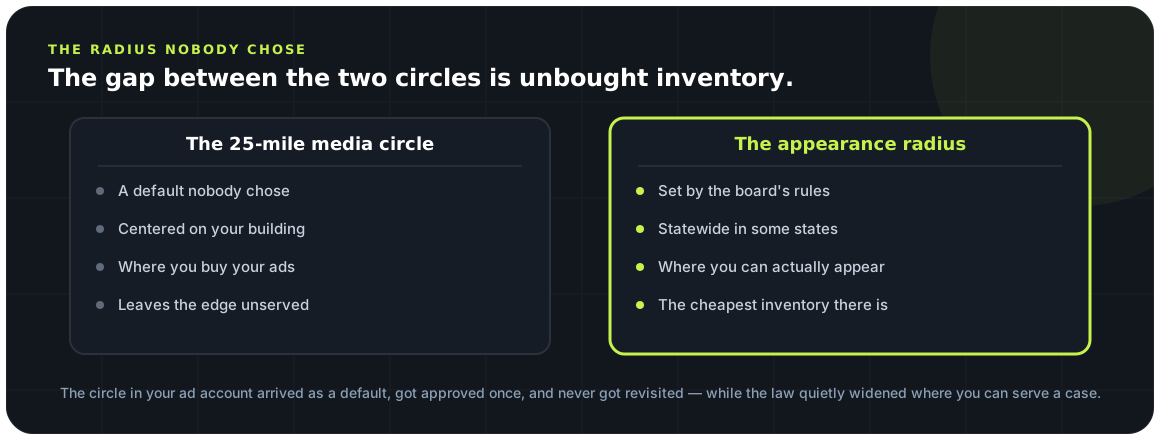
Open any comp firm’s ad account and you will find a circle. It is usually 25 miles, sometimes 50, occasionally a hand-drawn blob around three counties, and it is almost always centred on the firm’s own building. Nobody at the firm chose that number. It arrived as a default, got approved once, and has been the silent boundary of the business ever since.
Ask where it came from and you get two honest answers, both about driving. The first is the client: how far an injured worker with a back injury will drive to sign paperwork. The second is the lawyer: how far it is worth sending an attorney for a hearing that may take eleven minutes. For most of the history of this practice area those two distances were roughly the same, so one circle served for both, and nobody had to notice that it was doing two jobs.
The second job has quietly been reassigned. Not everywhere, not for every proceeding, and not by anything a marketing department would ever be told about — but by rule, in writing, with dates attached.
So the claim, stated plainly: the geography of a comp practice is a property of the forum, not of the firm; the forum published its rules and changed them; and because almost nobody re-read them, a large number of firms are advertising inside a boundary that stopped being the boundary somewhere between 2021 and 2025. Fixing it costs a map, a targeting setting and one page on the website.
The radius nobody chose
One circle has been doing two different jobs, and only one of them was ever about the client.
There is a particular kind of decision that is dangerous precisely because it never felt like a decision. The service radius is the clearest example in this market. It is entered once, during setup, usually by whoever is building the campaign that week. It is never revisited, because nothing in any report ever points at it. A radius does not produce a bad metric. It produces an absence, and absences do not appear in dashboards.
What makes it worth re-opening now is that the radius was always a proxy. It stood in for two underlying constraints: client travel and attorney travel. Those constraints were real, they were different from each other, and collapsing them into one number was fine for as long as they moved together.
They have stopped moving together. Client travel is largely a matter of preference and marketing, and it has loosened everywhere — e-signature, remote consultations and document upload did that years ago, and most firms already know it, which is why a firm will happily sign a client it has never met. Attorney travel is different. It was never a preference. It was a rule, and the rule has a publisher.
The illustration below is the structure of the whole article: two rings around one firm, drawn from two different sources, and the band between them that nobody is bidding in.
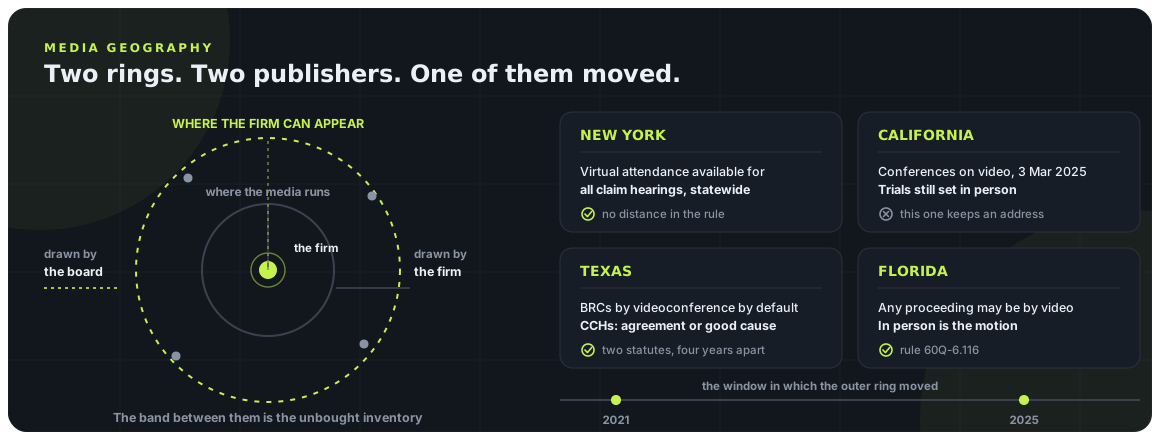
Notice what the diagram does not claim. It does not say the outer ring is the whole state, and it does not say the inner ring was wrong. It says there are two rings, that they are now different sizes, and that only one of them is in anybody’s ad account.
Four states, four different answers
This is the section to read with your own board’s website open in the next tab.
The reason this is a marketing article and not a procedural one is that all four of these rules are published on public pages written for injured workers, in plain language, and you can read all four in about fifteen minutes. We are not interpreting them. We are pointing out that they exist, that they are different, and that they bound the thing your media plan is drawn around.
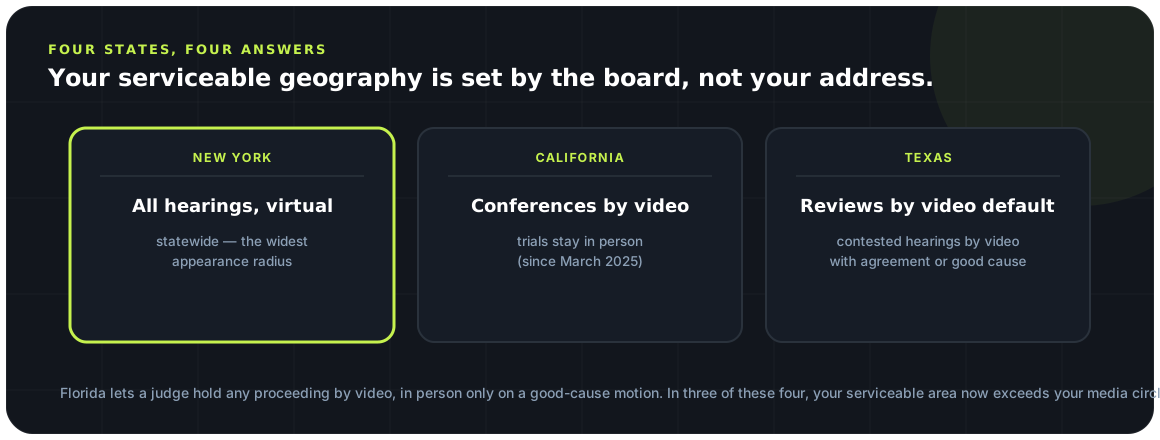
New York is the furthest along. The Workers’ Compensation Board’s own page states that virtual hearings let injured workers, attorneys and witnesses attend by video from a computer or mobile device, and that “attending your hearing virtually is available for all workers’ compensation claim hearings statewide” (NYS WCB). Not conferences. Not a category of hearing. All claim hearings, statewide. There is no distance in that sentence at all.
California drew the line in a different place and published both halves of it. The Division of Workers’ Compensation moved status conferences, mandatory settlement conferences, priority conferences and lien conferences off telephone lines and onto the CourtCall video platform beginning 3 March 2025, giving each judge a virtual courtroom. The same page then says, in one sentence: “All trials, lien trials, and expedited hearings will continue to be set in person” (CA DWC). That is the most useful sentence in this article, because it is the one that keeps the inner ring honest.
Texas got there in two statutory steps, four years apart. House Bill 1752, effective June 2021, allowed the Division of Workers’ Compensation to hold benefit review conferences by video conference or phone with a good-cause exception for in person — and DWC states that it will continue to schedule all BRCs by videoconference unless it determines a good-cause exception exists. Then House Bill 2488, effective 20 June 2025, created Texas Labor Code §410.0055, allowing a contested case hearing to be held by videoconference if all parties agree, and allowing DWC to make a good-cause determination if they do not (TDI legislative updates). The practical artefact is the set notice: TDI tells injured workers to check the notice to see whether the proceeding is by videoconference or at a local field office.
Florida wrote the general permission into its rules of procedure. Under Fla. Admin. Code R. 60Q-6.116, the judge may conduct any proceedings using video teleconference equipment, platforms or applications approved by the Deputy Chief Judge, and a motion for an in-person hearing or mediation instead of a video teleconference proceeding may be granted on a showing of good cause. Note the direction of travel in that drafting: video is the thing you get, and in person is the thing you move for.
| State | What is virtual | What still has an address | When it changed |
|---|---|---|---|
| New York | Virtual attendance available for all claim hearings, statewide | Nothing stated as in-person-only on the Board’s virtual hearings page | Platform live and expanded; witness video rules tightened February 2026 |
| California | Status conferences, MSCs, priority conferences, lien conferences — on the CourtCall video platform, one virtual courtroom per judge | Trials, lien trials and expedited hearings continue to be set in person | 3 March 2025 |
| Texas | Benefit review conferences scheduled by videoconference by default; contested case hearings by videoconference on agreement or good cause | A BRC or CCH set at a local field office, per the set notice | HB 1752 (June 2021); HB 2488 / Lab. Code §410.0055 (20 June 2025) |
| Florida | A judge may conduct any proceeding by video teleconference on an approved platform | In person is available on a motion showing good cause | Rule 60Q-6.116, in the current rules of procedure |
Four drafting traditions, one shared direction, and one genuinely important exception. In three of the four, the default for the most common proceedings is now a video link. In the fourth — California — the default is a video link for conferences and a courtroom for trials, which is not a halfway position so much as a precise one.
Your service radius is not a marketing setting. It is a procedural fact, and your board publishes it.
The appearance that still has an address
California’s one sentence about trials is what turns a ring into two rings.
It would be easy, and wrong, to read the previous section as “comp has gone remote, advertise everywhere.” The California rule is the corrective, and it is worth sitting with because it generalises.
Conferences and trials are not the same object. A conference is frequent, short, procedural, and in a great many matters it is where the thing actually resolves. A trial is rare, long, evidentiary, and it is the appearance with the highest cost of being far away — a day of an attorney’s time plus travel, not forty minutes on a video link. California has drawn its rule along exactly that seam, and so, in its own way, has Texas: the routine proceeding is presumptively video, the contested evidentiary one needs agreement or a finding.
For a media plan, that produces a structure rather than a number. There is an outer ring — the area in which the firm can handle the ordinary course of a matter without anybody travelling. And there is an inner ring — the area within which the firm is willing to send a lawyer to the small minority of matters that reach an in-person appearance. The outer ring is set by the board. The inner ring is set by the firm’s own economics and is a genuine business decision, which is the first time the radius has been one.
The volume side is where we have to be careful, because this is exactly the point at which an article like this reaches for a statistic that does not exist. We looked for a clean published breakdown of comp proceedings by format, or of matters that ever require an in-person appearance, and we could not find one we would put in print. What the boards do publish is volume. Florida’s Office of the Judges of Compensation Claims recorded 76,633 petitions filed and 19,917 mediations held in its 2022–23 annual report (OJCC Annual Report 2022–23). That tells you the system’s routine business is conducted at enormous scale in proceedings of exactly the kind the rules now let a judge hold by video. It does not tell you what share of matters never require travel, and we are not going to derive one from it.
What New York’s rule did to the law office
A detail in the claimant instructions quietly re-describes what a law office is for.
Buried in New York’s claimant requirements is a sentence that repays reading twice. All claimants and lay witnesses testifying in virtual hearings are required to appear and testify by video with their faces fully visible on screen. Then: “Represented claimants can appear by video to testify from the office of their attorney or legal representative, or from another location” (NYS WCB).
Read it as an estate agent would. The office is no longer a place the client must come to in order for the matter to proceed; it is now one of at least two acceptable backdrops, and the rule names the alternative in the same breath. For a firm, that is a change in what the building is for. It remains useful — some clients will want it, some testimony is better given from a controlled room with a good connection — but it has stopped being load-bearing.
And notice what replaced it. The Board did not remove the requirement; it changed its medium. The constraint is no longer can this person travel but can this person appear on camera, with their face visible, on a stable connection. New York even handles the failure case explicitly: in rare instances an unrepresented claimant who cannot appear by video for want of the necessary technology may be permitted to appear by telephone. Represented claimants are not offered that route in the same terms.
There is a straight line from here to something we have argued before about the only practice area whose entire qualified audience is impaired on arrival. A hearing that happens on a phone is a hearing that happens on the same device, held in the same hand, as the one that could not comfortably fill out your contact form. The firm that is good at this is good at it for the same reasons in both places.
What a bigger ring does to the arithmetic
Nothing in the cost per signed case changes. The number of cases does.
Across the ad accounts we manage — roughly $16.5 million in managed workers’ comp spend, about 219,000 injured-worker leads at around $75 each, and about 21,000 signed cases at around $775 — the governing arithmetic is the one we have published openly: cost per lead divided by close rate. Geography does not appear anywhere in that formula, which is precisely why extending a ring is so easy to overlook. It does not promise a better number. It promises more of the same number.
That is an underrated kind of win, and it is worth being exact about why. Most of what a firm can do to its media either raises efficiency or raises volume at worse efficiency. Extending a ring into genuinely serviceable territory does neither: it adds inventory at roughly comparable economics, with no new fixed cost, because the office, the staff and the systems are already paid for.
Two caveats keep this honest, and both cut against the enthusiastic version.
The first is that the extended band is not a copy of the core. Population thins with distance; so does competitive density, usually faster, which is the whole point. But brand familiarity thins fastest of all, and in a category where recognition does a great deal of the conversion work, a firm that is a household name in its own county is a stranger forty miles out. Expect the outer band to convert worse at first, and plan for it rather than being surprised by it.
The second is that a wider ring is a capacity decision wearing a media costume. More signed cases from further away is still more signed cases, and we have written about the ceiling that spend scales past and intake does not. If your answer rate is already slipping, the extended band will make it worse before it makes anything better.
| Metric | Inner ring only | Inner + extended band | How it reads in the monthly report |
|---|---|---|---|
| Cost per lead | ~$75 | ~$75 — possibly lower in a thinner auction | Flat, or quietly improved |
| Close rate | Your rate | Lower at first, recovering with familiarity | Looks like a lead-quality problem for a quarter |
| Cost per signed case | ~$775 | Higher at first, then converging | The number that will be used to kill it in month two |
| Addressable injured workers | Your county | Your county plus the band | Not in the report at all |
| Fixed cost | Office, staff, systems | Identical | Unchanged — which is the entire argument |
Where this stops being true
Four limits, stated before somebody doubles a radius on a Monday morning.
It does not cross a state line. Nothing in any of these rules touches admission. A video platform changes how a proceeding is conducted inside one system; it does not change where a lawyer may practise. Everything in this article happens inside a single jurisdiction.
It does not make all of the practice remote. Doctors, independent medical examinations, designated-doctor appointments and the practical business of a treating relationship remain physical and local. We have written separately about the date employer or carrier control of the treating physician lapses; a firm operating at distance needs a referral network out there, and building one is work.
It does not override what the client wants. Some injured workers want to sit across a desk from a lawyer, and that preference deserves to be served rather than argued with. The honest version of this strategy says plainly on the website what the process looks like, including whether the client will ever need to travel, and then lets them choose.
And it is not a licence to invent a figure. There is no published national count of comp matters that never require an in-person appearance, no published measure of how much serviceable area any of these rule changes added, and no study we could find of what remote proceedings did to law-firm geography. Every number in this article is either a rule, a date or our own book. The rest is structure, and structure is worth more than a decorated guess.
Drawing your own two-tier map
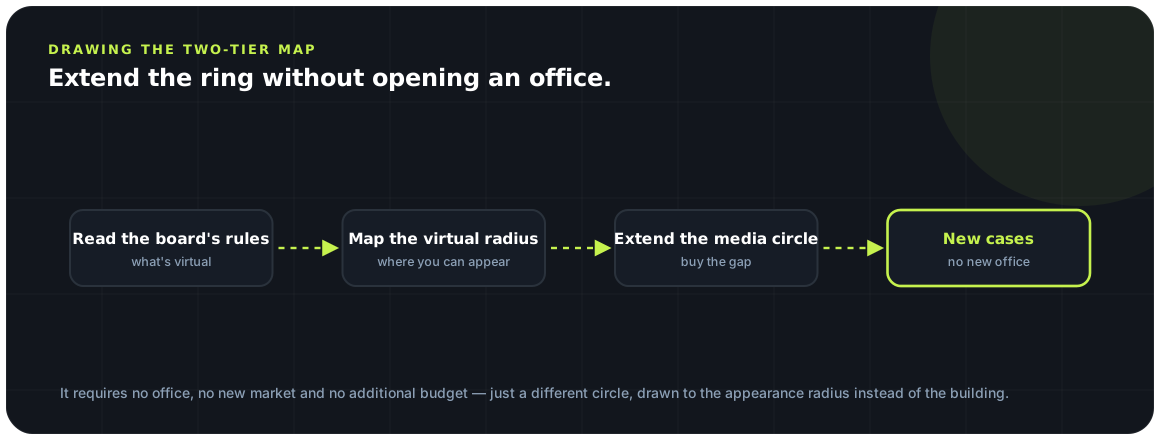
An afternoon of reading, one targeting change, one page, one intake question.
None of what follows requires budget. It requires somebody to do it.
One. Read your own forum’s two pages. Every board publishes a page for injured workers about attending a proceeding, and most publish the rule or statute behind it. Write down two lists: proceedings that may be held remotely, and proceedings that still have an address. If your state has changed its rules in the last five years, find the effective date — it tells you how long the gap has been open.
Two. Pull the fifty files. The appearance audit from earlier: fifty closed matters, every appearance, screen or address. This is the number that sets the inner ring, and it is the only one that is actually about your firm.
Three. Draw both rings on the same map. Inner ring: where you will send an attorney for an in-person appearance. Outer ring: where you can take a matter at all. Then overlay the one thing neither ring knows about — where the injuries are. Industry mix, not population; a warehousing-and-construction county of 60,000 can outproduce a professional-services county of 200,000.
Four. Split the band out as its own campaign. Not an expanded radius on the existing one. A separate campaign, separate budget, separate reporting line, so cost per signed case in the band can be read on its own and judged on its own. Expect it to look worse for a quarter. Decide in advance how long you are giving it, and write the number down before you see any data, which is the only reliable defence against killing something in week six.
Five. Add one question to intake, and one field. The question is where the person is — county, not just ZIP, because the forum is organised by county. The field is which ring they fell in. Within two quarters you will have cost per signed case split by ring, which is the whole experiment, and it will have cost one dropdown.
Finally, the synthesis with the thing we published a week ago. We argued that the comp category is losing units and gaining value, and that holding share in a shrinking market requires taking share rather than waiting for volume. This is the least glamorous way to take share that exists: not better creative, not a new channel, not a bigger budget, but a circle that was drawn for a reason that stopped applying, redrawn against a rule the state published and nobody read.
Key takeaways
-
The service radius is a procedural fact, not a marketing setting. It was a proxy for two travel constraints, and only one of them was ever about the client.
-
Four states, four answers, all published. New York makes virtual attendance available for all claim hearings statewide; California excepts trials; Texas moved in two statutory steps; Florida’s rule makes video the default and in-person the motion.
-
One ring becomes two. An outer ring set by the board, for matters nobody needs to travel for; an inner ring set by the firm, for the rare in-person appearance.
-
The band is a thin auction attached to a thick market. Competitive density clusters around city centres; injury-generating industry does not.
-
Fix it with a map, a split campaign and one page. Fifty closed files set the inner ring; the board’s own page sets the outer one; a separate campaign makes the band readable.
WorkersComp Marketing is a marketing agency, not a law firm. Nothing here is legal advice, and nothing here is advice about your professional-conduct obligations. Procedure is state law, it varies by state and by forum, and it changes; the rules quoted here are quoted to show that they exist and that they differ, not to tell anyone how a particular proceeding will be conducted. A hearing or set notice governs an individual matter. Read your own board’s current rules, and ask your own counsel, before you change where you practise or what you advertise.
Frequently asked questions
Is this just an argument for advertising statewide?
No, and a statewide buy is usually the wrong answer. Statewide means bidding against every firm in the state in the places they are strongest, which is how a firm turns a geography advantage into a price war. The argument here is narrower and cheaper: extend the ring into the band immediately outside it, where the competitive density falls off faster than the population does, and where you can now appear without anyone driving. That is a few counties, not a state. It is also testable in one quarter at a fraction of a statewide budget.
What about the cases that still require an in-person appearance?
That is exactly why the answer is two rings rather than one. In California, trials, lien trials and expedited hearings are still set in person, so the distance a firm is willing to send an attorney to a trial is a real constraint and it should be drawn as the inner ring. What changed is that this constraint no longer governs every matter, and the share of matters it governs is much smaller than the share it used to govern. Draw both rings, know which is which, and decide deliberately which cases you will accept in the outer band.
Does this mean we can take cases in another state?
No. Nothing here touches admission, and a video platform does not change where a lawyer is licensed to practise. The appearance rules we are reading are rules about how a proceeding is conducted inside one state’s system; they are not a licence to practise in another. Everything in this article happens inside a single jurisdiction, and whether your firm may appear in a particular forum at all is a question for your own counsel and your state’s bar, not for a marketing article.
How is this different from the article about opening a second office?
That article is about committing capital to a market you do not yet have: the four assets that make a home market profitable, only one of which transfers on day one, and the phased sequence that stops a firm cancelling in month four. This is the opposite problem. It is about the area a firm can already serve from the office it already has, with no new address, no new staff and no new fixed cost, and which it is simply not advertising in. If anything, this article is what you should exhaust before the other one becomes relevant.
Won’t clients still want to meet us in person?
Some will, and that preference should be honoured rather than argued with. But notice that the question has moved: the issue is now what the client wants, not what the forum requires, and those are two different constraints with two different fixes. A client who wants to meet can be met; a statute that required an appearance could not be negotiated with. The practical answer is to say plainly on the website what the process looks like from the client’s side, including whether they will ever need to travel, and let them decide. Most firms do not say it at all, which is the thing to fix first.
Is there a number for how many comp matters never require an in-person appearance?
Not one we will print. We looked, and no state publishes a clean national or even statewide breakdown of proceedings by format in a form we would be willing to quote. The boards publish volumes of petitions, conferences and mediations, and in Florida’s case those are substantial, but a published count of mediations is not a published count of matters that never required travel. What you can produce is better: your own closed files for the last year, with a column for every appearance and where it happened. That is one afternoon and it is specific to your forum.
Where does this rank against everything else we could do with the budget?
High, because the cost of being wrong is small and the work is mostly reading. There is no build, no new creative and no new fixed cost; the change is to a targeting setting and to one page on the website. The risk is that the extended band converts worse than the core, which you will know within a quarter from cost per signed case by geography. Set against a channel test that needs months of spend before it says anything, a geography test that needs a map, a setting and a tracking split is unusually cheap evidence.
Sources & further reading
-
01
New York — virtual hearings statewide
The Board’s own page: virtual attendance available for all claim hearings, the video-on requirement for claimants and lay witnesses, and the attorney’s office named as one acceptable location among others.
-
02
California — conferences on video, trials in person
The DWC page announcing the March 2025 move to the CourtCall video platform, and the sentence excepting trials, lien trials and expedited hearings.
-
03
Texas — two statutes, four years apart
HB 1752 (2021) on remote benefit review conferences and HB 2488 (2025) creating Labor Code §410.0055 for videoconference contested case hearings, plus the page telling injured workers to read the set notice.
-
04
Florida — the rule and the volume
Rule 60Q-6.116 on video teleconference proceedings and the good-cause motion for in person, and the OJCC annual report for petition and mediation volumes.
-
05
Further reading
What a second market really costs, the arithmetic a wider ring has to survive, and where the injuries actually are.
Procedure, rules and statutes vary by state and change over time — confirm the current rule in your forum with counsel, and read the notice for any individual matter. General marketing information, not legal advice.