There is a strange asymmetry in how law firms treat competitive information. A managing partner will pay a consultant four figures for a market report built on estimates, and will not spend ninety minutes with two archives that contain the actual ads, the actual copy and the actual start dates — published deliberately, by the platforms, for free, to anyone with a browser and no account.
Part of this is that the tools are known mostly as a creative-inspiration exercise: open the library, scroll a competitor’s ads, screenshot the ones that look good. That use is real and it is also the least valuable thing in the building. The archives are not a mood board. They are the only public record of who is spending, on what argument, for how long — in a market where every other performance number is private.
This article makes one claim: elapsed time is the only performance signal visible from outside an ad account, Meta is the only one of the two archives that publishes it, and in workers’ comp that signal is scarce enough to be worth reading precisely because almost nothing survives long enough to produce it.
Two archives, two different measurements
They look like the same product. They publish different fields, and the difference decides what you can conclude.
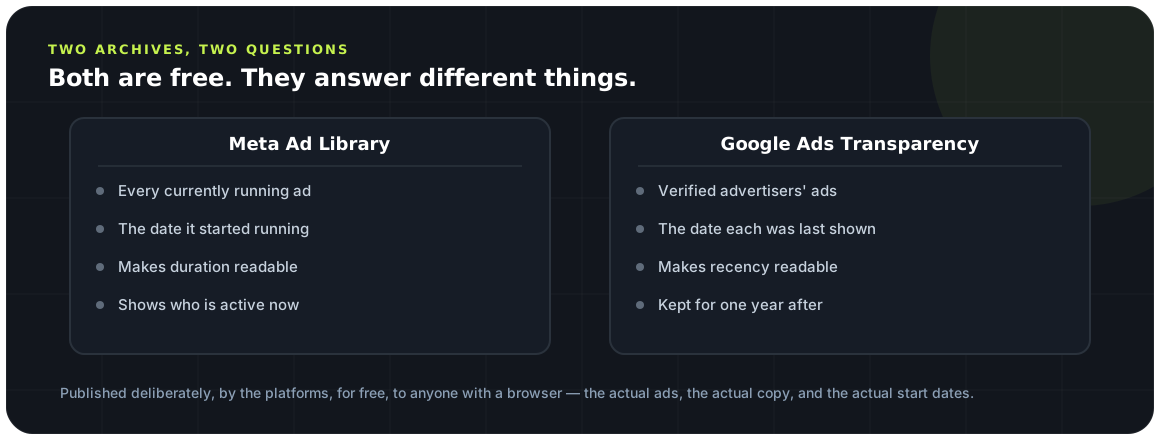
Meta’s Ad Library began in 2018 as a political-ad archive and was widened in March 2019 to bring in all active ads any Page is running — not just ads about politics or issues. It is open without a Facebook account. Every card carries a Library ID, the advertiser Page name, the full creative, the platforms it runs on, an active or inactive status, and one field that does more work than all the others: Started running on, with a date.
Google’s Ads Transparency Center arrived later and is built on a different principle. Google publishes a searchable repository of advertisers and the ads they have served across Search, Display, Gmail, Maps, Play, Shopping and YouTube, filterable by date and location. On the ad detail page for a US ad you get the advertiser’s legal name, a verified or unverified badge, the region, the format, how many variations exist — and Last shown, with a date. There is no start date.
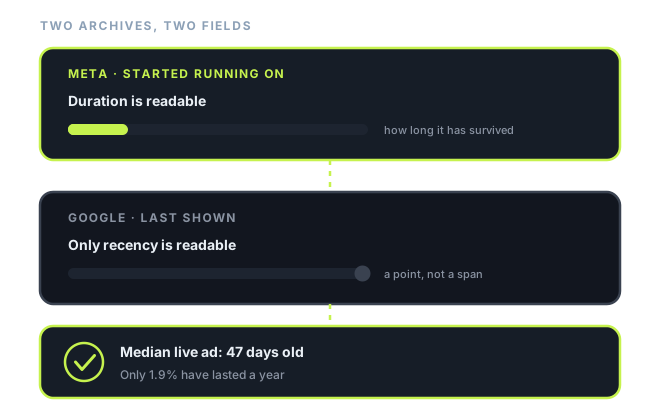
That single difference is the whole methodological story. A start date plus a live status gives you a duration: this ad has been running continuously for n days and somebody is paying for it this morning. A last-shown date gives you recency: this ad existed as recently as n days ago. Recency tells you a competitor is active. Duration tells you something about whether what they are doing is working.
| Field | Meta Ad Library | Google Ads Transparency Center |
|---|---|---|
| Date published | Started running on | Last shown |
| What that makes readable | Duration — how long it has survived | Recency — how recently it ran |
| Who is included | Any Page running ads | Verified advertisers only (unverified are included in Europe and Türkiye) |
| Retention | Live ads are listed while active; a start date is shown, but no record of what a Page ran before | One year from the date the ad was last shown |
| Completeness | Individual ads, each with its own Library ID | Up to five common variations of an ad |
| Lag before an ad appears | Effectively immediate in practice | 48–72 hours |
| Spend or impressions | Political and issue ads only | Extra detail is a Europe, Türkiye and political-ads feature |
| Click through to the landing page | Yes | No — permanently removed; the archive now renders static screenshots |
| Search by | Keyword, exact phrase, or advertiser Page | Advertiser name or website domain |
Two rows in that table deserve their own sentence, because both are recent and both are widely mis-stated in the guides that circulate on this topic.
The first is Google’s verification gate. Google’s own FAQ states that an advertiser page may be missing because the advertiser has not completed Advertiser Verification, or has not served an ad in the last 365 days. In the US, the archive covers verified advertisers; unverified ones are included in Europe and Türkiye. A blank result is therefore ambiguous, and reading it as “they are not advertising” is the most common mistake made with this tool.
The second is the click-through. Google has removed the ability to click an ad in the Transparency Center through to its landing page, and the FAQ is unusually direct about it: the feature “was an unintended result of a rendering technology that is now being deprecated”, the archive is moving to static screenshot renderings, and the removal is permanent. If your method for reading a competitor’s funnel depended on following their ad to the page behind it, that method is gone. You can still read the ad. You now have to find the page yourself.
What 877 live ads actually look like
A single query, run once, on the morning of 21 September 2026. Here is exactly what it was and exactly what came back.
We searched the Meta Ad Library for active ads in the United States containing the exact phrase “injured at work”, across all media types. Meta reported approximately 930 results. We captured 877 of them with start dates attached — about 94% — along with the advertiser Page name on 871 cards.
Two things came out of it. The first was about time.
| Days running | Ads | Share | What it is evidence of |
|---|---|---|---|
| Under 7 | 92 | 10.5% | Nothing yet. Too young to have been judged by anyone, including its owner. |
| 7–29 | 276 | 31.5% | Survived a first look. At law-firm volumes, still inside the noise. |
| 30–89 | 185 | 21.1% | Survived at least one budget conversation. |
| 90–179 | 283 | 32.3% | Deliberate. Somebody chose to keep this alive through a quarter. |
| 180–364 | 24 | 2.7% | Rare enough to be worth reading closely. |
| 365 or more | 17 | 1.9% | Either a genuine winner or a forgotten line item. Both are findings. |
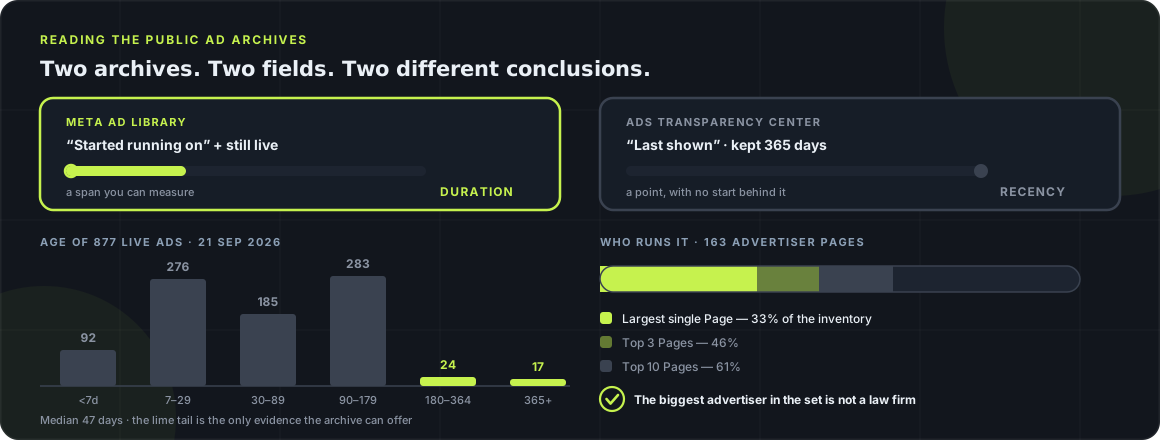
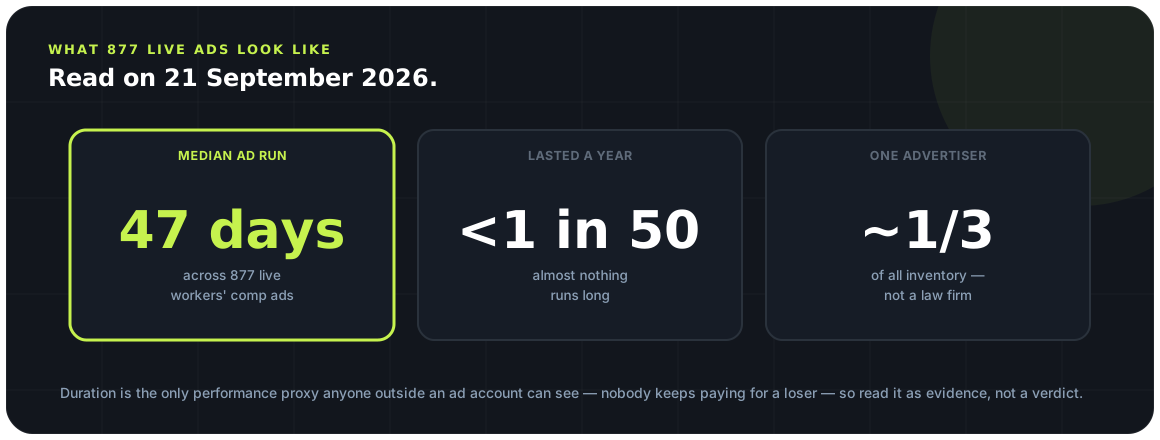
The median live ad had been running 47 days. A quarter of them were 13 days old or less. Forty-two per cent were under a month. At the other end, 41 ads — 4.7% of the sample — had been live for six months or more, 17 of those for a year or more, and the two oldest had been running continuously for more than seven years.
The second finding was the one we did not go looking for, and it is the more useful of the two. Those 871 named cards came from just 163 distinct advertiser Pages. The single largest Page accounted for 286 of them — roughly a third of the entire live inventory for that phrase. The top three Pages together ran 46% of it. The top ten ran 61%.
And the largest advertiser was not a law firm. Its Page name is a benefits slogan rather than a firm name, as are several others high in the list. We are not going to name them here; the query is in the paragraph above and it takes about thirty seconds to run, which is rather the point of an archive.
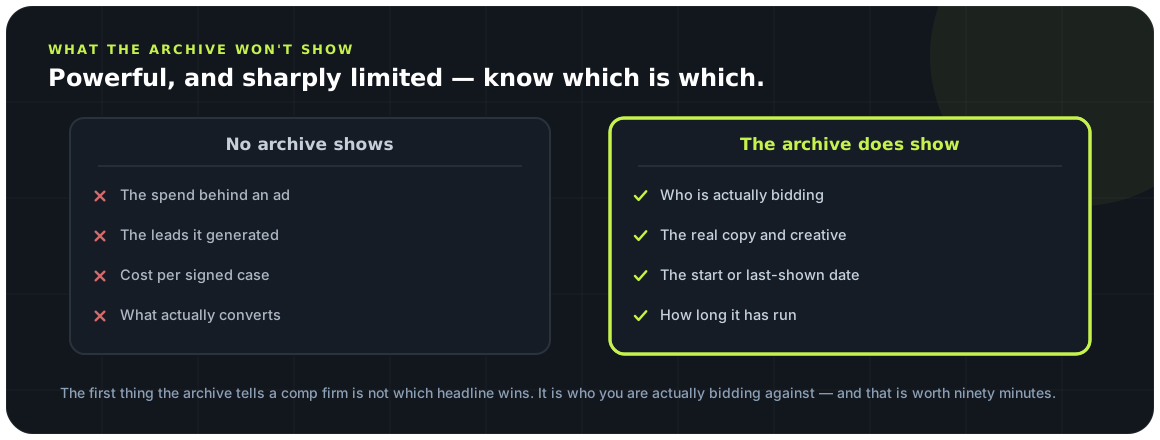
The diagram below sets out what each archive publishes and what can honestly be concluded from it.
Why elapsed time is the signal — and how far to trust it
You cannot see a competitor’s cost per lead. You can see what they are still willing to fund, which is a weaker version of the same information.
Every meaningful performance number in this business is private. Cost per lead, close rate, cost per signed case, the landing page’s conversion rate — none of it is published by anybody, and the figures that circulate at conferences are mostly unsourced. What is public is the fact that an ad is still running, and the date it started.
That is not nothing, because advertising budgets are not sentimental. An ad that has been live for 200 days has survived every monthly budget review in between. Somebody with access to the actual numbers looked at it repeatedly and chose not to switch it off. You cannot see their reason. You can see their revealed preference.
This matters more in workers’ comp than in most categories, for a reason we have written about at length. At a typical firm’s lead volume, most creative tests cannot produce a trustworthy answer — detecting a modest lift in close rate takes far more leads per arm than a single firm generates in a year. The firm that cannot test its way to an answer is exactly the firm that should be reading what the market’s largest spenders have already funded for six months. They had the volume. You have the archive.
An archive cannot tell you what works. It can tell you what somebody is still willing to pay for this morning — and in this market, almost nothing is.
Spencer Moeller, WorkersComp MarketingNow the discipline. There are at least five innocent reasons an ad runs a long time, and only one of them is “it works”.
A budget can be large enough that a mediocre unit never rises to anyone’s attention. An always-on brand campaign may never have been judged on cost per lead in the first place. An agency can simply stop looking — the most common of the five, and the least discussed. A campaign may be optimising to a cheap upstream event, in which case the ad is winning at producing form fills and losing at producing signed cases, and the archive shows you the winning half. And sometimes it is a genuine winner.
Which is why the stronger reading runs the other way. An ad that vanished after eleven days almost certainly was not working. Absence is the cleaner signal — and it is the one nobody reads, because it requires having written down what was there last month. The archives will not do that for you. Google keeps a commercial ad for one year from the date it was last shown; Meta will tell you when a live ad began, but nothing about what a Page ran and dropped before you arrived. Which brings us to the least glamorous recommendation in this article, and the one with the highest return: the log matters more than the analysis.
What Google’s archive answers, and what it refuses to
It is the weaker of the two for performance reading and the stronger for a question most firms never ask.
Because Google publishes last-shown rather than started-running, you cannot read duration directly. You can approximate it: the search interface carries a date filter, so you can bracket an ad’s first appearance by narrowing the window until it drops out. That is a slow method and it is bounded by the 365-day retention limit, but it works, and nobody does it.
What Google does better is answer a question about identity. Google’s ads transparency policy states that it displays the advertiser rather than the agency that creates the ads, and additionally displays the name of the payer where that differs from the advertiser name — along with a verified or unverified badge and the advertiser’s legal name and location as provided through verification.
For a comp firm that produces a genuinely useful check. Search a competitor’s website domain rather than their firm name and you will see every advertiser account pointing at that domain, which in our experience is frequently more than one. It is also the fastest way to find out whether somebody else is buying traffic to a page you thought you controlled — the defensive half of the argument we made in the piece on conquesting and brand defence. And it works on your own domain, which is where we would suggest anyone starts.
The four things no archive will ever show you
The gaps are structural, not temporary, and one of them is specific to workers’ comp.
Targeting. Neither archive publishes who a US commercial ad was aimed at. Google’s extra disclosures — targeting information, recipient counts, subject-matter labels — exist to satisfy regulation in Europe and Türkiye and for political advertising. In the US you see the creative and not the audience. An ad you judge weak may be doing well against an audience you cannot see, and vice versa.
Money. Spend and impression data is a political-and-issue-ads feature on Meta and a regional one on Google. You cannot infer a competitor’s budget from the number of ads they run; a Page with 200 live ads may be spending less than a Page with three.
What happens after the click. On Google the landing page is no longer reachable from the archive at all. On Meta you can still follow the link, but the page you land on is the page as it exists today, not the page as it existed when the ad launched — and the part that actually decides the outcome, the conversation on the phone, is invisible from anywhere.
And, in comp specifically, the half of the account that matters most. As we set out in the piece on why the platforms treat your firm as a health advertiser, a comp advertiser sits inside a sensitive category, which withdraws advertiser-curated audiences from the Google account and constrains what may be encoded in Meta event and audience names. The practical effect on archive reading is this: what you can see in the library skews heavily toward cold prospecting creative, because that is the work the classification leaves intact. A competitor’s list-based and retargeting work — where a great deal of the efficiency in this category lives — is structurally under-represented in what you are looking at.
The substitution test, run against live inventory
The archive is the only place you can check, rather than assume, whether your market is saying the same four things.
We have argued before that comp marketing converges on a small set of interchangeable claims — aggressive, experienced, free consultation, no fee unless we win — and that the last of those is not a marketing decision at all but a paraphrase of the fee statute, which is why every competitor arrives at it independently. The instrument we proposed there was the substitution test: if a rival could paste their logo onto your claim and run it unchanged, it is not an offer.
That argument has always had a weakness. It asks a firm to accept a generalisation about its market on our say-so. The archive removes the weakness, because you can now run the test against the actual live inventory in your actual market in about twenty minutes.
Pull every live ad from your five nearest competitors. Strip the Page names. Put the primary text in a single column. Then read down it and mark, for each ad, whether the claim it makes would still be true if it belonged to a different firm. In every market we have done this in, the majority of lines survive the swap untouched — and the exercise is far more persuasive to a partner group than any argument we could write, because they are reading their own market rather than our characterisation of it.
That last item is the one our 877-ad read kept returning to. If the largest advertisers against a phrase are aggregators rather than firms, the ad auction in front of you is not a contest between local practices with similar economics. It is a contest between a law firm buying cases and an operation buying leads to resell — which is a different business with a different tolerance for cost per lead, and a decent part of the reason paid inventory in this category prices the way it does. We have set out the economics of that market separately in the pieces on exclusive versus shared leads and on buying versus building a pipeline. The relevant point here is narrower: you can now verify, for your own market, in five minutes, whether that is who you are bidding against.
The ninety-minute read, and the log that makes it compound
Monthly, on a calendar entry, with an owner. The first read is worth little; the fourth is worth a great deal.
Here is the whole procedure. It is deliberately small, because the version that gets done every month beats the version that gets done once.
Minutes 0–15 — yourself. Search your own Page in the Meta Ad Library and your own domain in the Ads Transparency Center. Confirm that what is running is what you think is running, that nothing is live that should have been switched off, and that no third party is advertising against your domain.
Minutes 15–50 — your five real competitors. Not the biggest firms in the state; the five you actually lose cases to. Search each by Page name on Meta and by website domain on Google. For each, record the number of distinct arguments, the age of the oldest live ad, and anything that is new since last month.
Minutes 50–70 — the category read. Run two or three exact-phrase searches for the language your market actually uses, restricted to the United States, and look at the advertiser names rather than the creative. You are answering one question: who is here that is not a law firm?
Minutes 70–90 — the log. One row per ad: date read, advertiser, platform, start date if available, the argument in five words, and whether it was present last month. This is the part that creates the asset. A single read is a snapshot. Four reads is a time series, and a time series tells you which arguments are surviving in your market — which is the closest thing to a creative test that a firm your size will ever get to run.
Two closing cautions. First, none of this is a substitute for measuring your own account; the archive is context, and cost per signed case is still the only number that settles anything. Second, resist the pull toward imitation. A market in which every firm reads the same library and copies the same surviving headline converges on one undifferentiated ad, which is the problem this category already has. Read the archive for the arguments being made and then ask which of them is true about your firm in a way it is not true about the others. If you want the raw material for that step, the Meta Ad Creative Library in the Growth Library sets out the concepts and the compliance line; and the wider case for why a differentiated claim is worth building at all is in the piece on branding in a commoditised market.
Key takeaways
-
Every ad against you is public and free. Meta and Google publish live ad archives, with start dates attached.
-
877 live “injured at work” ads show a market that churns. Creative turns over fast, and much of it is not from law firms.
-
Elapsed time is the signal. An ad still running after weeks is one that is working; the start date is the tell.
-
The archives refuse to show four things. Spend, targeting, results, and what is being tested: know their limits before you draw conclusions.
-
Run the substitution test against live inventory. A ninety-minute read, logged over time, turns the archive into a decision instead of a browse.
Frequently asked questions
Does a long-running ad actually mean it is a good ad?
It means somebody is still paying for it, which is weaker than “it works” and much stronger than nothing. There are at least five innocent explanations for a long-lived ad: a budget large enough that a mediocre unit never gets noticed, an always-on brand campaign that was never meant to be judged on cost per lead, an agency that stopped looking, a campaign optimising to a cheap upstream event like a form fill rather than a signed case, and a genuine winner. Only the last one is useful to you, and the archive cannot tell you which you are looking at. What it can tell you is the opposite with much more confidence: an ad that disappeared after eleven days was almost certainly not working. Absence is the cleaner signal, and it is the one nobody reads, because nobody is keeping a list of what used to be there.
Can I just copy the ads that have been running longest?
You can, and it will usually underperform, for a reason that has nothing to do with the creative. An ad is one component of a system that includes the offer, the landing page, the audience the account has learned to find, the speed of the phone answer and the firm’s actual reputation in that market. You can see exactly one of those five in the archive. Copying the visible component and inheriting none of the invisible ones is how firms end up with a competitor’s headline attached to their own intake problem. The defensible use of a long-lived ad is diagnostic rather than generative: read it for the argument it makes — what it claims, who it addresses, what fear it names — and then decide whether that argument is available to your firm and true about it. Borrow the argument if it is. Never borrow the sentence.
Why can’t I find a competitor in Google’s Ads Transparency Center?
Google’s own FAQ gives two reasons: the advertiser has not completed Advertiser Verification, or they have not served an ad in the last 365 days. In the United States, the archive covers verified advertisers — unverified advertisers are only included in Europe and Türkiye. So a blank result is genuinely ambiguous and you should not read it as “they are not advertising”. Two further gaps are worth knowing. Google shows up to five common variations of an ad rather than every version, and it takes 48 to 72 hours for a newly served ad to appear. Search by website domain rather than by firm name, because the domain search catches every advertiser account pointing at that site — which sometimes surfaces accounts the firm does not know are running.
Is looking at competitors’ ads compliant?
Reading a public archive that the platforms built and published deliberately is not a compliance question at all. Both libraries are open to anyone, with or without an account. The compliance questions arrive one step later, when you act on what you read: copying a competitor’s creative raises intellectual-property issues that belong to your counsel, and bidding on their name raises trademark and state-bar questions we set out separately in the piece on conquesting. The rule we hold to is simple and it is about quality rather than law: use the archive to understand the arguments in your market, not to become an echo of them. A market where every firm reads the same library and copies the same headline converges on one undifferentiated ad, which is the problem, not the solution.
How often should we actually do this?
Monthly, on a calendar entry, for about ninety minutes — and the reason is that the archives do not keep history for you in any useful form. Google retains a commercial ad for one year from the date it was last shown, and Meta’s start-date field tells you when something began but nothing about what has already gone. The value is almost entirely in the differences between successive reads: which advertisers appeared, which vanished, which ad survived another month, which argument a competitor abandoned. The first read is a snapshot and is worth relatively little. The fourth read is a time series and is worth a great deal. That means the log matters more than the analysis, and the log is a spreadsheet, not a project.
We are a single-market firm. Is a national keyword read even relevant?
The national number is context, not an instruction. What you should run is the advertiser-level read for your own market: the five or six firms you actually lose cases to, each searched by Page in the Meta Ad Library and by website domain in Google’s Ads Transparency Center. That gives you the thing that matters locally — how many distinct arguments each competitor is running, how long the survivors have lasted, and whether anyone has appeared who is not a law firm at all. The national reads are useful for one thing: they tell you whether what you are seeing locally is a local fact or a market-wide one. A competitor cycling creative every three weeks looks alarming until you learn that the median live ad in the category is forty-seven days old.
Sources & further reading
-
01
The ad archives
Meta’s Ad Library and Google’s Ads Transparency Center publish every advertiser’s live ads.
-
02
How the archives work
What the libraries measure, and the advertiser-verification and transparency policies behind them.
-
03
Further reading
Turning the archive into a decision.
External sources were accurate at publication and change over time; confirm current figures at the source. General marketing information, not legal advice.