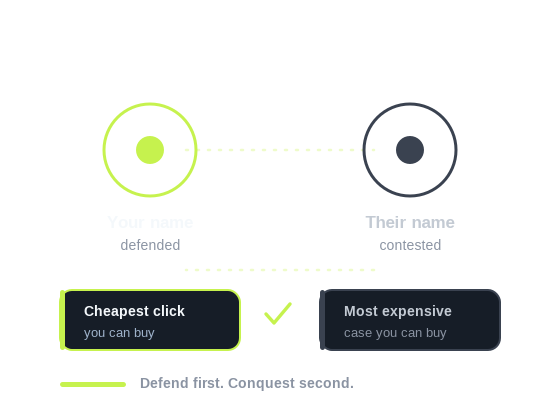
The most valuable search query in a workers’ comp firm’s entire market is its own name, and it is the one query most firms have never bought.
Think about who types it. Not a person idly researching whether they have a case. Someone who saw the billboard on the way to the clinic, or heard the radio spot, or got the firm’s name from a co-worker who signed last year, or took a card from the union rep. They have already been convinced. Everything expensive has already happened — the impressions, the frequency, the referral relationship, the reputation. All that remains is for them to arrive.
And at that exact moment, on that exact screen, a competitor can stand in the doorway for a few dollars.
This is not hypothetical and it is not rare. Branded search is one of the most commonly bid-on inventories in competitive legal categories, and workers’ comp is one of the most competitive there is. The firm that spends $40,000 a month generating name recognition and nothing at all defending it is running a very expensive lead-generation program on behalf of whoever is bidding.
The door most firms leave unlocked
Every other channel you run creates branded searches. Exactly one line item decides who catches them.
Here is the thing that makes branded search different from every other query a firm buys: you create the demand for it yourself, and you create it with the most expensive marketing you do. Television, radio, billboards, community sponsorships, the years of referral cultivation, the reviews, the recognition that took a decade — the measurable output of all of it is people looking you up by name. That is what brand spending buys. It does not buy visits. It buys searches.
Which means branded search is the collection point for the entire rest of the marketing budget. It is where broadcast, out-of-home, referrals and brand all cash out. Leaving it undefended is not a small paid-search oversight; it is a leak at the exact point where the most expensive dollars in the firm finally turn into phone calls.
The diagram below is what that page actually looks like when someone reaches for a firm by name.
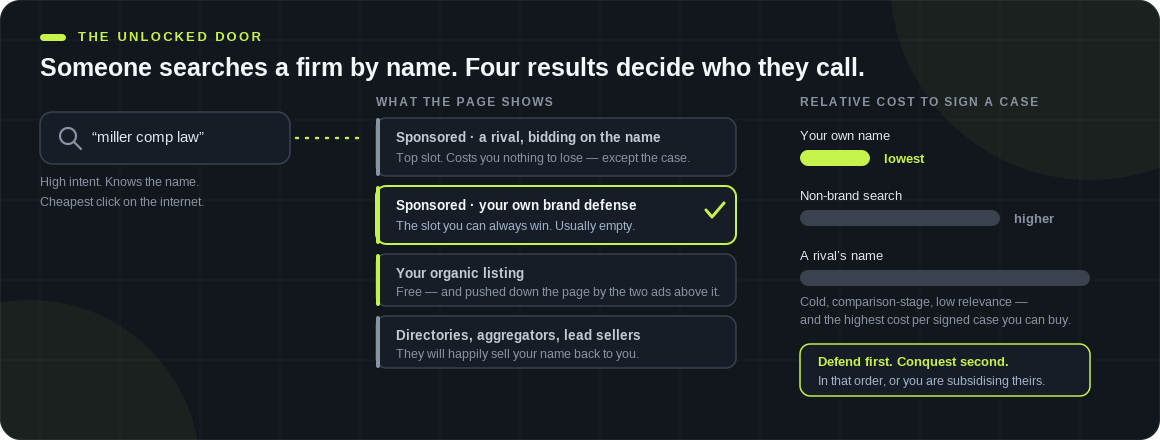
Notice what happens even when nobody is conquesting you. Directories, aggregators and lead sellers bid on firm names as a matter of routine business model — they rank for your name, capture the click, and then sell the resulting lead. Sometimes back to you. The undefended branded query is not a quiet space; it is simply a space you have chosen not to occupy.
There is a real cannibalisation argument to take seriously: some share of branded clicks would have arrived free. That is true, and it is measurable — we come back to how in the measurement section. But the honest framing is not “paid vs. free.” It is: what does it cost to insure the single highest-converting audience in your account against a competitor who can appear above you tomorrow morning at no notice? For most firms, the branded line is a small fraction of total search spend and the least volatile thing in the account.
Why your own name is the cheapest inventory you will ever buy
Relevance is a discount. Nowhere is your relevance higher than on your own name.
Search auctions do not simply sell to the highest bidder. Google is explicit that Ad Rank is calculated from bid, ad and landing-page quality, auction competitiveness, context and format — and that “higher quality ads typically lead to lower costs and more advertising success” (Google Ads Help, Ad Rank). That single mechanic explains the entire economics of both sides of this article.
On your own name, every quality input is at its ceiling. The keyword matches the ad headline, the headline matches the landing page, the landing page is literally the entity being searched for, and click-through rates on branded queries are typically far above non-brand. You are the most relevant possible answer to that query, and the auction prices you accordingly. Competitors bidding on your name face the mirror image: lower expected click-through, weaker landing-page relevance, higher cost to hold the same position. Defending your brand is structurally cheap. Attacking someone else’s is structurally expensive. That asymmetry is the single most useful fact in this whole subject, and it points in one direction.
Set against the firm figures we work from — roughly $16.5M in managed workers’ comp Meta ad spend, about 219,000 injured-worker leads at roughly $75 CPL, and about 21,000 signed cases at roughly $775 each — the ranking is straightforward. Cases that arrive through recognition and referral are the cheapest a firm signs. Branded search is where those cases present themselves. Losing them to a conquest ad does not just cost the case; it makes every upstream brand dollar look worse than it was.
Brand spending doesn’t buy visits. It buys searches. If you haven’t bought the search, you’ve paid for the demand and left someone else to collect it.
Spencer Moeller, WorkersComp Marketing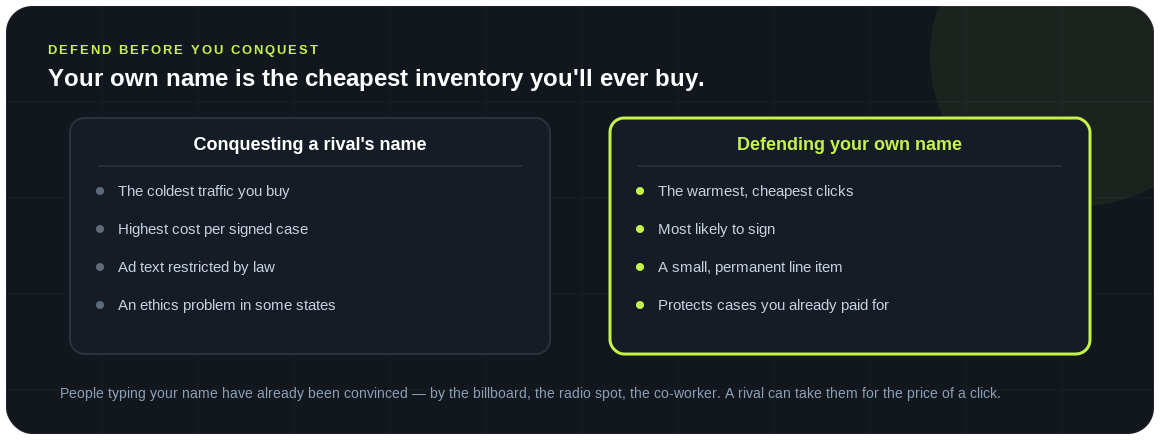
What the platform allows — keyword yes, ad text no
Google separates what you may target from what you may say. The distinction is the whole policy.
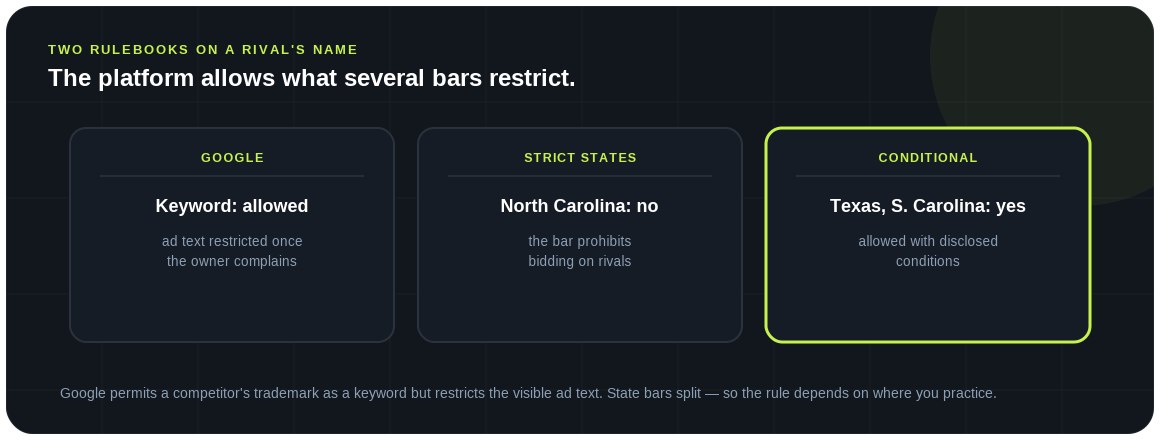
Google’s trademark policy for ads draws a line that surprises most firm owners. Google states that it abides by local trademark law and does not allow ads that infringe trademark rights, but that advertisers may use others’ trademarks in certain situations; and it handles this by complaint. Since 24 July 2023, Google accepts and processes trademark complaints only against specific advertisers and/or ads named by the complainant, rather than industry-wide (Google Advertising Policies Help, Trademarks).
In practice this produces two different rules for two different things:
| Where the name appears | Status | What it means for a firm |
|---|---|---|
| As a keyword you bid on | Generally permitted | The searcher never sees your keyword list. Google does not police trademarks at the targeting layer. |
| In your headline or description | Restricted on complaint | Once the owner files, the mark can be removed from your visible ad copy — and yours specifically. |
| In your display URL | Restricted on complaint | Same mechanism. Do not build a campaign that depends on it surviving. |
| Impersonating the competitor | Never | Beyond policy — this is where trademark law and bar conduct rules both bite hardest. |
Two operational consequences follow. First, any conquest ad whose persuasive power comes from naming the rival is built on sand: it works until a paralegal at that firm spends ten minutes filing a complaint. Second, and more usefully, the same mechanism is a defensive tool. If a competitor is running your firm’s name in their headlines, the complaint process exists for exactly that, and it now targets them individually rather than triggering a category-wide change.
What your bar says, and why it changes at the state line
The same facts produce opposite answers in different states. This is the part firms skip.
Platform policy is not the binding constraint for a law firm; professional conduct rules are. And here the ground genuinely shifts depending on where you practise. Three published opinions frame the range.
North Carolina prohibits it. The North Carolina State Bar’s 2010 Formal Ethics Opinion 14 rules that it is a violation of the Rules of Professional Conduct for a lawyer to select another lawyer’s name as a keyword in a search engine’s search-based advertising, reasoning that the intentional purchase of the recognition associated with one lawyer’s name in order to direct consumers to a competing lawyer’s website is “neither fair nor straightforward” (N.C. 2010 FEO 14).
Texas permits it. The Professional Ethics Committee for the State Bar of Texas, considering effectively the same question, concluded that a lawyer does not violate the Texas Disciplinary Rules of Professional Conduct by using a competing lawyer’s or law firm’s name as a keyword in search-engine advertising (Texas Opinion 661). The divergence between the two states was notable enough that the ABA covered it directly, with several ethics commentators taking the view that Texas reached the better conclusion (ABA Journal).
South Carolina permits it, with conditions worth reading closely. Ethics Advisory Opinion 20-01 concludes a lawyer may use competitive keyword advertising including the names of competing lawyers and firms — while cautioning that all other advertising rules still apply, that ads should not contain or imply derogatory or uncivil statements about the competitor, and that a surreptitious link posing as a competitor’s location while rerouting the user to the lawyer’s own site would be deceitful conduct (S.C. EAO 20-01).
There is a second, quieter risk that no opinion resolves: the relationship one. Workers’ comp is a referral-dense practice area. The firms whose names you would bid on are frequently the same firms that refer out conflicts, over-capacity cases, and matters outside their specialty. A conquest campaign that produces four cases a month and costs you a referral relationship that produced two a month at zero acquisition cost is a bad trade dressed up as a growth tactic. This is discussed less than the ethics question and probably decides more outcomes. It belongs in the same conversation as everything else in our marketing-compliance guide.
When conquesting actually pays: three conditions
It is defensible in some markets. It is almost never the next thing you should do.
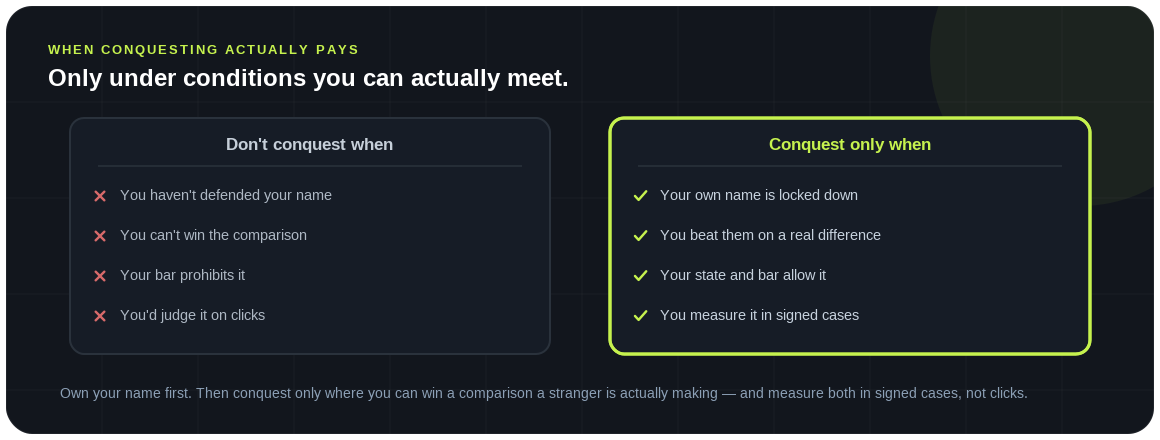
Assume your state permits it, your brand is defended, and the relationship risk is acceptable. Conquesting can still be right or wrong, and three conditions decide it.
Condition one: you can answer the comparison the searcher is making. Someone searching a rival by name is not asking “who is a good comp lawyer?” — they are asking “is this the firm I should call?” That is a comparison question, and you can only win it with a comparison answer: something true and specific that the searcher can evaluate in three seconds. Bilingual intake when the rival has none. Answering the phone at 9pm when they close at five. A distinct specialisation in the injury type or industry that person is dealing with. If your honest answer is “we’re also a good workers’ comp firm,” you have nothing to say and you will pay a premium to say it.
Condition two: their brand is bigger than yours. Conquesting is an asymmetry play. Bidding on the name of a firm with less recognition than you have is spending money to reach a smaller audience than your own name already reaches. It only makes arithmetic sense pointed upward — at the market’s heaviest advertiser, whose brand spending is generating far more branded searches than yours. And you should expect them to notice and retaliate on your name, which is a fight the smaller advertiser can more easily afford to start than to finish.
Condition three: your intake can take the harder call. Conquest traffic arrives comparing. It is colder, more sceptical, and asks more questions than any other source in the account. If your intake conversation is built for a warm caller who has already decided, this traffic will convert badly and you will conclude the channel does not work when what did not work was the handoff.
| Defending your own name | Bidding on a rival’s | |
|---|---|---|
| Searcher’s state of mind | Already decided; arriving | Comparing; not yours yet |
| Relative click cost | Lowest in the account | Among the highest |
| Relative cost per signed case | Lowest | Highest |
| Volume ceiling | Capped by your brand spend | Capped by theirs |
| Ethics exposure | Effectively none | State-dependent; prohibited in at least one |
| Retaliation risk | None | High — and it lands on your brand terms |
| What happens if you stop | You hand warm traffic to whoever is bidding | Nothing; the leak was never yours |
The ad and the page: answer the comparison, don’t shout over it
The creative constraint is the point, not an obstacle.
Because you cannot rely on naming the competitor in ad text, and because doing so invites both a complaint and, in some states, a conduct problem, the conquest ad has to work on its own merits. That constraint improves the ad. What is left when you cannot say “better than Firm X” is the one thing that would have persuaded anyway: a concrete, verifiable difference stated plainly.
Three rules keep it clean. Never disparage — South Carolina’s opinion flags derogatory or uncivil comparison specifically, and a searcher comparing two firms reads an attack as a reason to distrust the attacker. Never imply affiliation or endorsement; the searcher must be able to tell instantly whose firm this is, which is why the sponsored label and a clear firm name in the headline are protective as well as required. And never send conquest traffic to a homepage: a comparison-stage visitor who lands on a generic page has to restart the evaluation, and most will simply go back and click the firm they searched for.
The landing page for conquest traffic is a different page from the one that serves your branded traffic, because the job is different. Branded traffic needs the fastest possible route to a phone call. Conquest traffic needs a reason first — evidence, specificity, results, the thing that makes you a legitimate second option rather than an interruption. This is the same discipline covered in where paid search leaks: match the page to the state of mind, or pay for the click twice.
Measuring it without fooling yourself
Both campaigns are unusually easy to misread — in opposite directions.
Branded search flatters itself. It will show the best conversion rate and the lowest cost per lead in the account, because it is harvesting demand created elsewhere. Read naively, the dashboard says “move budget into branded” — which is impossible, since branded volume is capped by brand awareness, not by bid. The correct reading is the reverse: branded performance is a readout of everything else you are running. When branded search volume climbs, your broadcast, out-of-home and referral work is landing. When it flattens, they are not. That makes the branded line one of the better leading indicators a firm has, and one of the worst things to take credit for.
Conquesting flatters itself differently. Attribution will credit the conquest click for cases that would have found you anyway through a slower path, and volume looks impressive because rival-brand queries are numerous. The only honest test is a holdout: pause the conquest campaign for a defined period and watch total signed cases, not conquest-campaign signed cases. If total volume is unchanged, the campaign was reshuffling attribution, not creating cases. That is the same incrementality discipline we set out in why your dashboard is lying to you, and it is the only version of this measurement that survives contact with a partner meeting.
Both campaigns should ultimately be judged on one number: cost per signed case, by campaign, with phone calls tracked. In workers’ comp the decisive conversion is almost always a call, not a form, and a conquest campaign measured on form fills will look dead while quietly producing cases — or look alive while producing none.
One last piece of housekeeping that belongs in this conversation. Your own brand terms should appear as negative keywords in your non-brand campaigns, and rival brand terms should be negatived out of every campaign that is not deliberately conquesting. Without that, broad-match generic campaigns quietly absorb branded queries, inflate their own apparent performance, and make the branded line look unnecessary — which is how a firm talks itself out of the cheapest inventory it owns.
Key takeaways
-
Your own name is the cheapest inventory you will ever buy. Bidding on your brand defends the door most firms leave unlocked.
-
The platform allows the keyword, not the ad text. You can bid on a competitor’s name; you cannot use it in your ad copy.
-
The ethics change at the state line. Some bars permit competitor keyword bidding, others restrict it; it is a state-by-state question.
-
Conquesting pays under three conditions. A strong offer, a comparison page, and a market where it is permitted.
-
Answer the comparison, do not shout over it. The winning ad and page make the honest case for choosing you, calmly.
Frequently asked questions
Is it legal to bid on a competitor law firm’s name in Google Ads?
Two separate questions sit inside that one. On platform policy, Google generally permits a competitor’s trademark as a keyword and restricts its use in visible ad text or display URLs once the trademark owner files a complaint — and since July 2023 those complaints are processed against specific advertisers and ads rather than industry-wide. On professional conduct, it depends on your state: North Carolina’s 2010 FEO 14 treats it as a rules violation, while Texas Opinion 661 and South Carolina EAO 20-01 permit it with conditions. Check your own state’s rule with counsel before running it.
Should we bid on our own firm name if we already rank first organically?
Usually yes, and it is the cheapest line in the account when you do. Ranking first organically does not mean appearing first on the screen — on a phone, two sponsored results plus a map module can push a first-place organic listing below the fold. The ad slot is also the only position a competitor or a lead-selling directory can take from you at will. Some share of those clicks would have come free, so measure it honestly, but treat it as insurance on the warmest audience your marketing produces rather than as an incremental-traffic play.
Someone is bidding on our firm’s name. What do we do?
Three things, in order. Turn on your own branded campaign today, so you are not absent from a page you should own. If your firm name appears in their visible ad text or display URL, file a trademark complaint with Google — that is precisely what the complaint process covers, and it now targets that advertiser specifically. Then decide, deliberately and with your state’s rule in front of you, whether to respond in kind; retaliation escalates costs for both firms and is easier to start than to stop.
Does conquesting hurt referral relationships between comp firms?
It can, and this is underrated. Workers’ comp is a referral-dense practice area, and the firms with the most searchable names are often the same firms that refer out conflicts, overflow, and matters outside their specialty. Before conquesting a particular firm, price the relationship: a campaign producing a handful of cases a month is a bad trade if it ends a referral channel that produced cases at no acquisition cost at all.
How much should a workers’ comp firm budget for brand defense?
Less than firms expect, because the volume is capped by how many people search your name, not by your bid. A tight exact- and phrase-match campaign on the firm name, common misspellings, attorney names and “[firm name] reviews” will typically not spend a large daily cap. Set the cap, point it at a page built for someone who has already decided to call you, and review it monthly — if it is spending far more than expected, that is usually a match-type problem or a sign that brand awareness is growing.
How do we know if a conquest campaign is actually producing cases?
Pause it for a defined window and watch total signed cases across the whole firm, not the campaign’s attributed conversions. Attribution will credit conquest clicks for cases that would have arrived by another route, so a campaign can look productive while adding nothing. If total signed cases fall while it is off and recover when it is back on, it is incremental. If nothing moves, you were paying for a reshuffle. Track calls, not just forms — in comp, the decisive conversion is almost always a phone call.
Sources & further reading
-
01
What the platform allows
Google’s Ad Rank and trademark policies set what you can bid on and what you can say.
-
02
What the bar says, by state
State ethics opinions split on competitor keyword bidding; confirm your own jurisdiction.
- 03
Rules vary by state and change over time — confirm your state’s version with bar counsel. General marketing information, not legal advice.