Ask a managing partner how the firm gets medical referrals and you will hear about relationships. A chiropractor in the next suburb who sends two or three a year. An orthopaedist somebody went to school with. A clinic that stopped sending anybody after the office manager left. The strategy, to the extent there is one, is to know more doctors, and the plan for knowing more doctors is lunch.
That is a reasonable way to build a referral channel in a practice area where the patient chooses the doctor. Workers’ compensation is not that practice area. In the comp states that run directed care, the injured worker’s choice is bounded before he makes it: the employer or the carrier has already fixed the set he may choose from, as a network or a panel, and we have written separately about whose doctor it is and the date that control lapses. What that earlier piece did not say — because it is a different argument — is that the choosing is written down. The list of who was chosen is a document. In California it is a document with a URL.
The list you were going to build already exists
Not a leaked list, not a scraped list. A statute requires it to be published, requires it to carry phone numbers, and requires it to be current within a quarter.
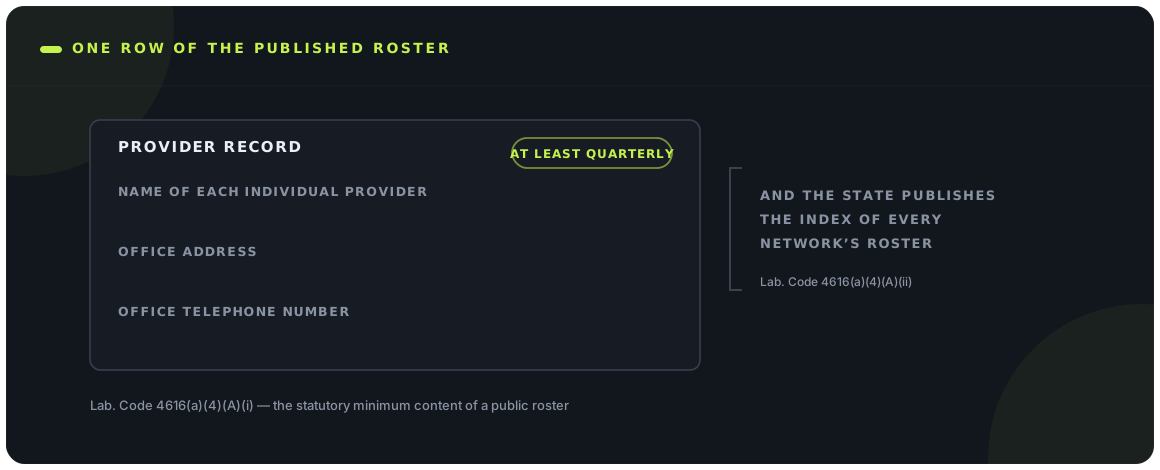
Here is the operative sentence, in full, from Labor Code § 4616(a)(4)(A)(i):
“Commencing July 1, 2021, every medical provider network shall post on its internet website a roster of all participating providers, which includes all physicians and ancillary service providers in the medical provider network, and shall update the roster at least quarterly… The roster of participating providers shall include, at a minimum, the name of each individual provider and their office address and office telephone number.”
Read that as a marketer rather than as a lawyer. It is a requirement to publish a maintained contact database. Name, office address, office telephone, for every physician and every ancillary provider, with a floor on how stale it is allowed to get. Nothing in the comp marketing stack is that clean. Lead lists are inferred, ad platform audiences are modelled, competitor intelligence is pieced together from public ad archives. This is a primary source, maintained under a legal obligation by the party that compiled it.
And you do not have to know which networks exist to find them. Clause (ii) of the same subparagraph puts the index on the state: the administrative director “shall post, on the division’s internet website, the internet website address of every approved medical provider network.” The Division of Workers’ Compensation also publishes a list of active networks — current as at 22 October 2026 — carrying, in its own column headings, each network’s ID number, applicant legal name, street address, city, state, ZIP, network name, expiration date and websites.
There is a deduplication problem, and it is worth knowing before you draw conclusions from the count. An industry association — the American Association of Payers, Administrators & Networks — put a white paper to California’s Commission on Health and Safety and Workers’ Compensation in June 2026 stating that “currently, there are approximately 300 active MPNs in the system, but many of those MPNs use common PPOs,” and that “a PPO’s network list of providers may be tapped into by multiple MPNs.” So three hundred networks is not three hundred distinct provider lists. The same physician can appear on many rosters through one contract. Deduplicate by provider, not by network, or you will mistake repetition for density.
| Instrument | What it must contain | Who has to produce it | How a firm gets it |
|---|---|---|---|
| The network roster Lab. Code § 4616(a)(4)(A)(i) | All participating providers, physicians and ancillary, each with name, office address and office telephone number; updated at least quarterly | Every approved network | Open the network’s website |
| The index of rosters Lab. Code § 4616(a)(4)(A)(ii) | The website address of every approved network | The administrative director | Open the division’s website |
| The active-network list DWC publication | Network ID, applicant legal name, address, network name, expiration date, websites | DWC Medical Unit | Download the list, or the searchable datasets on the state open-data portal |
| The complete provider directory 8 CCR § 9767.12(a)(2)(C) | The full directory, in writing and/or on the website, quarterly updates dated on the listing, plus a phone number and email for reporting inaccuracies | The employer, insurer or network | Request it in writing — DWC’s FAQ names the worker’s legal representative as an entitled requester |
| The economic profiling policy Lab. Code § 4616.1 | How the network evaluates physicians on cost and utilisation, and how that is used in retention and termination decisions | Filed by the network with the administrative director | Ask the administrative director — § 4616.1(b) makes each approved filing “available to the public upon request” |
What the roster is actually a map of
A network roster is a solution to a geographic constraint. Read the constraint and the roster stops being a list of doctors and becomes a statement about where the workers are.
A network does not choose its geography freely. 8 CCR § 9767.5(a) requires that a network “must have at least three available physicians of each specialty to treat common injuries experienced by injured employees based on the type of occupation or industry in which the employee is engaged,” and then pins that to distance. Subdivision (a)(1): “An MPN must have at least three available primary treating physicians and a hospital for emergency health care services, or if separate from such hospital, a provider of all emergency health care services, within 30 minutes or 15 miles of each covered employee’s residence or workplace.” Subdivision (a)(2) extends it: occupational health services and specialists “within 60 minutes or 30 miles of a covered employee’s residence or workplace.”
That is a media-geography fact disguised as a clinical one. The network has to prove it, too — Labor Code § 4616(b)(3) requires that “every medical provider network shall submit geocoding of its network for reapproval to establish that the number and geographic location of physicians in the network meets the required access standards.” So every approved network has filed, with the state, a geocoded demonstration that its listed providers sit within fifteen and thirty miles of its covered employees.
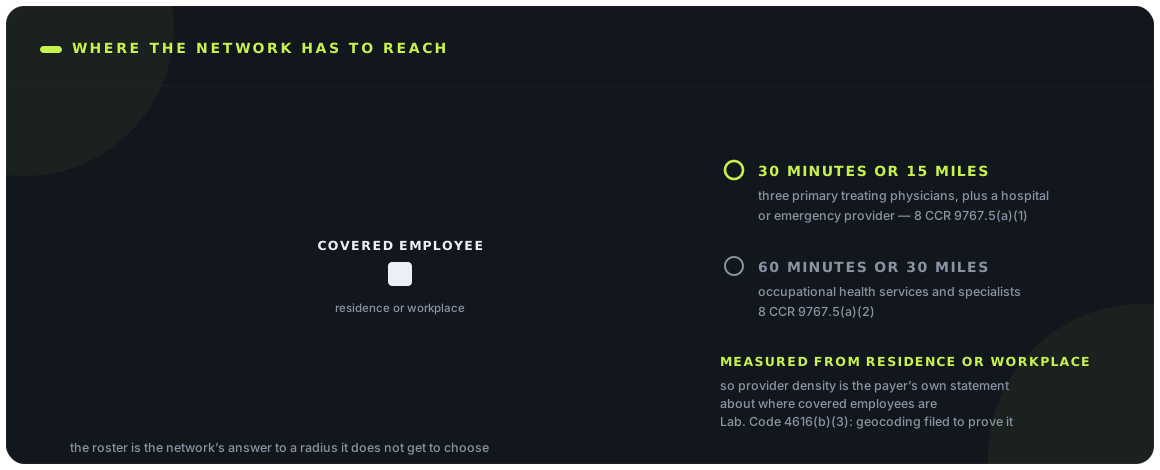
Turn that around and it answers a question firms normally pay for. Where, inside a metropolitan area, are the insured workers? Not the population — the covered employees, the people whose employers carry comp and whose injuries will be routed somewhere. The ad platforms will sell you reach by ZIP and interest. They will not tell you that. A network that has listed eleven orthopaedists in one county and two in the next has made a statement about where its covered employees are, and it made that statement under an access standard it has to defend at reapproval.
This is the same logic we applied to the forum’s published geography, arriving from the other direction. There, the tribunal’s own service area told a firm how far its market really extended. Here, the carriers’ networks tell a firm where inside that area the density sits. Neither number came out of an ad account.
Why the names on it are the wrong call sheet
The thing that puts a physician on the roster is the thing that makes him the least likely person on it to send you a case. The structure is in the statute; the behaviour is an inference, and we will label it as one.
The obvious move, once you have the roster, is to work it. Print the orthopaedists, assign them to somebody, start the lunches. We think that is close to backwards, and the reason is a statute almost nobody in legal marketing has read.
Labor Code § 4616.1 governs what networks are allowed to do with the economics of their own physicians. Subdivision (c) defines the practice: “economic profiling” means “any evaluation of a particular physician, provider, medical group, or individual practice association based in whole or in part on the economic costs or utilization of services associated with medical care provided or authorized by the physician, provider, medical group, or individual practice association.” Subdivision (a) says what the filed description has to cover: “how these policies and procedures are used in utilization review, peer review, incentive and penalty programs, and in provider retention and termination decisions.”
Retention and termination. Membership of the list is conditional, and one of the conditions a network may lawfully apply is the cost of the care the physician provides or authorises. Labor Code § 4616(b)(2) puts the same obligation in positive terms: “every medical provider network shall establish and follow procedures to continuously review the quality of care, performance of medical personnel, utilization of services and facilities, and costs.”
Now add what the network side says the membership is worth. The same industry white paper describes the upside plainly: “if a provider signs a contract with one PPO, they may be able to reap the benefits (and patient referrals) of being included in multiple employer MPNs (and directories).” That is not a critic’s characterisation. It is the association of payers, administrators and networks explaining to a state commission that network participation delivers patient volume.
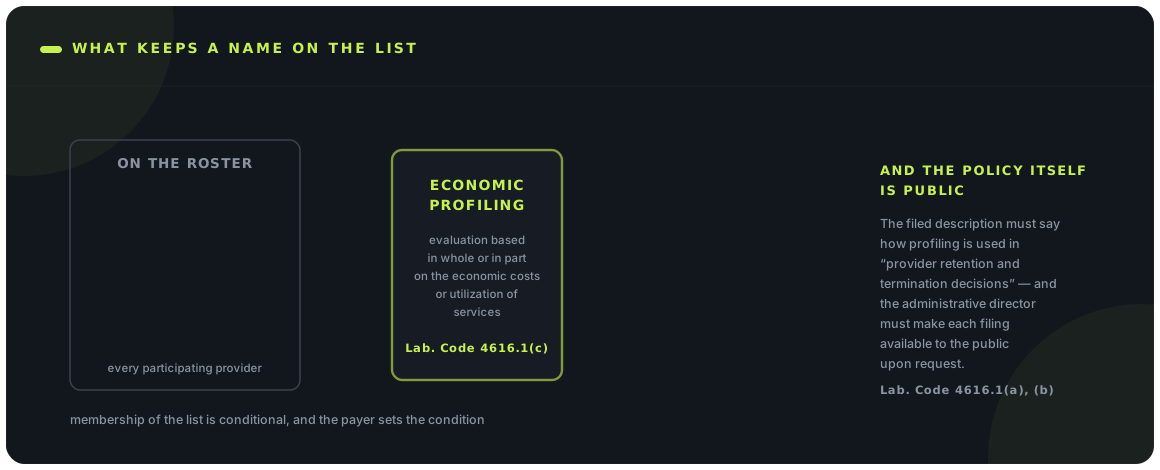
There is one more public document here, and it is the most under-used of the lot. § 4616.1(a) requires the filing; § 4616.1(b) says what happens to it: “The administrative director shall make each approved medical provider network economic profiling policy filing available to the public upon request,” subject only to a carve-out for information determined to be confidential under state or federal law. A firm can therefore read, for a named network operating in its own venue, that network’s written policy on how it evaluates and removes physicians. We are not aware of a comp firm that has asked for one. It is one letter.
The exits are in the regulation, and they have dates
Directed care is not a sealed room. The access standards set appointment deadlines, and one of those deadlines lets the worker treat outside the network entirely.
A firm reading the roster as a static list misses the most useful thing in the regulation, which is that the same section setting the geography also sets a clock. 8 CCR § 9767.5 does not merely require providers to exist within a radius; it requires appointments to be available within stated periods, and it says what happens when they are not.
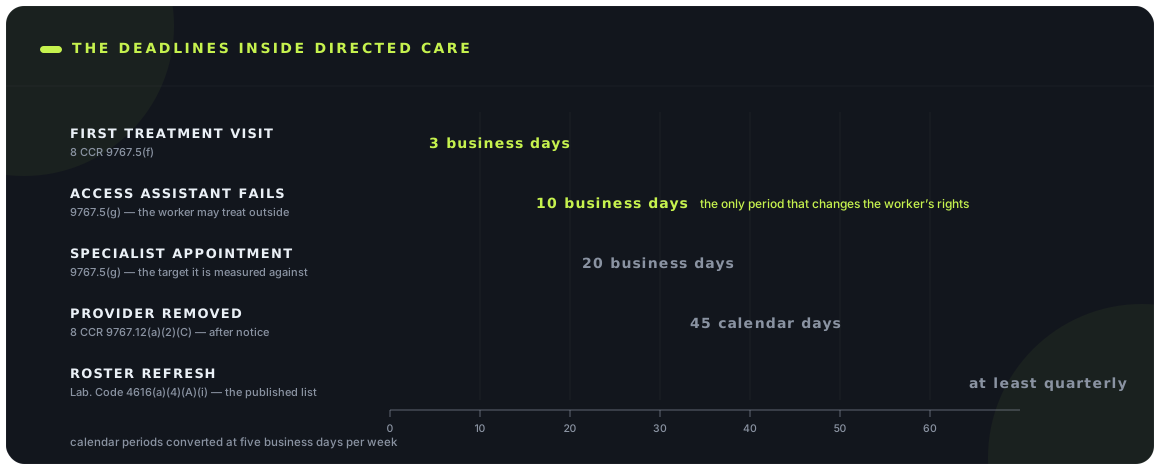
Subdivision (f): for non-emergency services, the network applicant “shall ensure that an appointment for the first treatment visit under the MPN is available within 3 business days of a covered employee’s notice to an MPN medical access assistant that treatment is needed.” Subdivision (g) is the one to read twice:
“If an MPN medical access assistant is unable to schedule a timely medical appointment with an appropriate specialist within ten business days of an employee’s request, the employer shall permit the employee to obtain necessary treatment with an appropriate specialist outside of the MPN.”
The same subdivision sets the target it is measured against: an initial appointment with a specialist in a referred specialty “available within 20 business days of a covered employee’s reasonable requests for an appointment through an MPN medical access assistant.” And § 4616(a)(5) staffs the mechanism: every network must provide medical access assistants with a toll-free number, “available at least from 7 a.m. to 8 p.m. Pacific standard time, Monday through Saturday, to respond to injured employees, contact physicians’ offices during regular business hours, and schedule appointments.”
Sit with that last one for a moment, because it is a competitive fact rather than a legal one. The carrier side funds a named, toll-free, thirteen-hour, six-day appointment-booking service for injured workers, by statute. Few of the firms we have worked inside match that, and we have no survey telling us how many do. We wrote a whole piece on after-hours intake without noticing that the opposing party has a statutory coverage floor and the firm has none.
| The standard | What the regulation requires | What it tells a firm |
|---|---|---|
| Specialty depth § 9767.5(a) | At least three available physicians of each specialty needed for the common injuries of the covered occupations | The roster’s specialty mix is a description of the industries in the network’s book |
| Primary care radius § 9767.5(a)(1) | Three primary treating physicians plus emergency care within 30 minutes or 15 miles of each covered employee’s residence or workplace | Provider density is a proxy for covered-employee density |
| Specialist radius § 9767.5(a)(2) | Occupational health services and specialists within 60 minutes or 30 miles | The real catchment of a comp case is wider than a primary-care ring |
| First appointment § 9767.5(f) | First treatment visit available within 3 business days of notice to a medical access assistant | The treatment clock starts faster than most firms’ follow-up sequences do |
| Specialist appointment § 9767.5(g) | Specialist appointment available within 20 business days; if the access assistant cannot schedule one within 10 business days, the employer must permit treatment outside the network | A dated, checkable event at which a worker lawfully leaves the carrier’s list |
| Assistant coverage Lab. Code § 4616(a)(5) | Toll-free medical access assistants available at least 7 a.m. to 8 p.m. Pacific, Monday through Saturday | The opposing party has a statutory coverage floor; the firm’s intake has whatever it chose |
One signed client, one letter, the whole directory
The web roster is the public minimum. The complete directory is a written entitlement, and the regulator names the legal representative as somebody who can demand it.
A network’s public web roster is the floor, not the ceiling. The notification regulation, 8 CCR § 9767.12, governs what the injured worker has to be told, and the provider-directory subdivision is more demanding than the website requirement. § 9767.12(a)(2)(C) requires the employer, insurer or network to “ensure covered employees have access to, at minimum, a regional area listing of MPN providers in addition to maintaining and making available its complete provider directory listing in writing and/or on the MPN’s website.” The same subdivision requires updates “at minimum, on a quarterly basis with the date of the last update provided on the listing given to the employee,” a phone number and email address on every listing “for reporting of provider listing inaccuracies,” and removal of a provider who has died or stopped treating comp patients at the listed address “within 45 days of notice.”
Then DWC’s own published answers go further, and this is the sentence a firm should know by heart. Asked whether a complete directory must be provided on request, the Division answers: “Yes. If a worker or a worker’s legal representative requests a complete provider directory listing of all providers in the MPN, it is to be made available in writing.” And on partial compliance: “It is not acceptable to only provide a select list of five or ten providers, as that does not constitute a complete regional area listing.”
Two cautions on this, because the mechanism is easy to abuse in description. First, the request belongs to the case, not to the marketing department: it is made because the client needs to choose a physician, which is exactly what the regulation is for. A request made for no reason other than list-building is a different thing and we are not recommending it. Second, what arrives is a directory of names, addresses and phone numbers. It is not consent to be contacted, and it is not a referral relationship. What a firm may then do with it runs into professional conduct rules, which is a subject we have treated separately and at length in what comp firms can and cannot say.
Georgia: the same list, nailed to a wall
The second regime, and the reason this article does not claim a national rule. Georgia requires the list to be posted where the workers are, not where a marketer can read it — which changes who can see it, and makes one intake question unusually valuable.
It would be convenient to write that comp states publish their provider lists. They do not, and the differences are not cosmetic. Georgia’s version of the same instrument is a panel, and the statute is specific about its contents. O.C.G.A. § 34-9-201(b)(1) requires that the employer “shall maintain a list of at least six physicians or professional associations or corporations of physicians who are reasonably accessible to the employees,” that “at least one of the physicians shall practice the specialty of orthopedic surgery,” and that “not more than two industrial clinics shall be included on the panel.” The employee “may accept the services of a physician selected by the employer from the panel or may select another physician from the panel,” and may make one change between panel physicians “without prior authorization of the board.”
So far, so similar. The divergence is in the publication. Subsection (c): the employer “shall post the Panel of Physicians or Managed Care Organization Procedures in prominent places upon the business premises” and otherwise take all reasonable measures to ensure that employees “understand the function of the panel” and “are given appropriate assistance in contacting panel or managed care organization members when necessary.” The State Board’s Rule 81.1 ties the rights summary to the same spot: the employer “shall post the summary of rights, benefits, and obligations… in the same location as the panel of physicians which is required by O.C.G.A. § 34-9-201.”
That asymmetry has a practical consequence, and it is the most actionable thing in this article. In a posted-panel state, the only people who can read the panel are the people who work there — which means your own callers. One line in the intake script asks what they were told about choosing a doctor and, in panel states, whether a list of doctors was posted where they work and which names were on it. Logged in a reportable field, that answer accumulates into the provider map California firms can simply download.
And it does something else, which is why the question earns its place in a script that is already too long. O.C.G.A. § 34-9-201(f) provides: “If the employer fails to provide any of the procedures for selection of physicians as set forth in subsection (c) of this Code section, an employee may select any physician to render service at the expense of the employer.” Whether that applies to a given claim is a question for the firm’s lawyers on the facts. But the intake question that builds the marketing map is the same question that surfaces the issue, and a firm that asks it is doing two jobs with one line.
| California (network in place) | Georgia (traditional panel) | |
|---|---|---|
| What the list is | A roster of all participating providers in an approved medical provider network | A panel of at least six physicians or physician associations, one an orthopaedic surgeon, no more than two industrial clinics |
| Where it has to appear | On the network’s internet website, with the state publishing the index of those websites | “In prominent places upon the business premises” |
| Who can read it | Anyone | People at that workplace — and, through them, their lawyers |
| Required currency | Updated at least quarterly; listed provider removed within 45 days of notice | None stated in the Code section; we were unable to obtain Board Rule 201 to check whether it adds one |
| If the duty is not met | DWC lists directory failures among common MPN application deficiencies | The employee “may select any physician to render service at the expense of the employer” |
| Citation | Lab. Code § 4616(a)(4)(A); 8 CCR § 9767.12(a)(2)(C) | O.C.G.A. § 34-9-201(b)(1), (c), (f) |
The build: one afternoon, then one intake question
There is no software to buy and no vendor to brief. The whole exercise is a download, a count, a subtraction and a field in your CRM.
What follows is deliberately unambitious. The point is to get a first version in front of the person who decides the marketing budget, not to build a data product.
One. Get the index. Open the division’s list of approved networks and the active-network list, and filter to the networks whose names you already recognise from your own clients’ benefit notices. That recognition step matters: three hundred networks is a research project, and the six that cover most of your market is an afternoon.
Two. Pull those rosters. Each one is required to carry name, office address and office telephone. Normalise to a spreadsheet, deduplicate by provider rather than by network — remembering the shared-PPO problem — and count by specialty and by ZIP or county.
Three. Subtract. Get the state licensing board’s list of orthopaedists, pain specialists, neurologists and the other specialties your cases actually need in the same counties, and take the roster out of it. What is left is the group this article has been pointing at: practising specialists in your venue with no network listing to protect. That is your outreach set, and it is a fraction of the size of the roster you started with, which is the point — a short list you can actually work beats a long list nobody calls.
Four. Add the intake line. One question about what the worker was told regarding choice of doctor, plus, in panel states, whether a list was posted at work. Put the answer in a reportable field, not in a note. Then report it monthly next to lead source, the way we argue for in marketing attribution.
Five. Measure in signed cases, not conversations. A provider-source code on the intake record, read quarterly, is the only thing that tells you whether any of this worked. If after two quarters the out-of-network set has produced nothing, you have spent an afternoon and some phone calls to learn that the channel is not there in your market, which is a real answer and cheaper than most ways of getting one.
Where this stops
Four limits, stated plainly, because an article that argues for a tactic owes the reader its failure conditions.
It is a list of names, not of willingness. Nothing in any statute cited here obliges a physician to speak to a law firm, return a call, or send anybody anywhere. The roster removes the discovery problem. It does not touch the persuasion problem, and the persuasion problem is the hard one.
The in-network inference is directional and unmeasured. Said once in the callout above and worth repeating here, because it is the load-bearing soft spot in the argument. The profiling power is statutory. The behaviour it might produce is an inference we have not been able to source, and a reader who thinks we have overstated it is entitled to that view. The structural reading survives either way: the out-of-network group is still the group nobody else has identified.
The rules cited here are two states’ rules, read on 5 November 2026. California amended § 4616 to add the public-roster requirement with effect from July 2021 and the access standards carry their own amendment history. Georgia’s panel section was last amended in 2015. Neither is frozen. Before any of this informs something more consequential than a spreadsheet, check the current text — and if your firm practises in neither state, start by finding out which instrument your own act uses, because the answer determines whether step one of the build is a download or an intake question.
Professional conduct rules bind what comes next. Everything in this article is about obtaining and reading public documents. What a firm may do by way of contact, and what it must never do by way of anything resembling payment for a referral, is governed by the rules of professional conduct in each state and sits outside the scope of a marketing article. If reading this makes somebody want to move quickly, that is the point at which to slow down and ask the firm’s own ethics counsel rather than its agency.
Key takeaways
-
In California the provider list is a published document with phone numbers. Lab. Code § 4616(a)(4)(A)(i) requires every medical provider network to post a roster of all participating providers on its website, updated at least quarterly, carrying “at a minimum, the name of each individual provider and their office address and office telephone number.”
-
The state publishes the index, so you do not need to know the networks first. Clause (ii) puts the website address of every approved network on the division’s own site, and DWC separately publishes a list of active networks with ID numbers, legal names, addresses and websites.
-
Deduplicate by provider, not by network. An industry white paper to the state commission reports “approximately 300 active MPNs” but notes that many share common PPOs and that one PPO’s provider list “may be tapped into by multiple MPNs.” Network count overstates the number of distinct lists.
-
The roster is a geography, not just a directory. 8 CCR § 9767.5 keys the network to three primary treating physicians within 30 minutes or 15 miles of each covered employee’s residence or workplace and specialists within 60 minutes or 30 miles, and § 4616(b)(3) makes the network file geocoding to prove it. Provider density is the payer’s own statement about where covered employees are.
-
Read it as an exclusion list. § 4616.1(c) lets a network evaluate a physician on “the economic costs or utilization of services” he generates, and § 4616.1(a) has the filed policy describe how that bears on “provider retention and termination decisions.” The outreach set is what remains after subtracting the roster from the licensed specialists in your counties.
-
A network’s own profiling policy is obtainable on request. § 4616.1(b): the administrative director “shall make each approved medical provider network economic profiling policy filing available to the public upon request.” A firm can read how a named network in its venue evaluates and removes physicians. We are not aware of one that has asked.
-
Ten business days is the exit the regulation itself provides. Under § 9767.5(g), if the medical access assistant cannot schedule a specialist appointment within ten business days of the request, “the employer shall permit the employee to obtain necessary treatment with an appropriate specialist outside of the MPN.” Of the five periods directed care runs on, that is the only one that changes the worker’s rights.
-
The complete directory is a written entitlement and the regulator names the lawyer. DWC’s FAQ: “If a worker or a worker’s legal representative requests a complete provider directory listing of all providers in the MPN, it is to be made available in writing” — and a “select list of five or ten providers” does not discharge the duty.
-
Do not generalise California to the panel states. O.C.G.A. § 34-9-201 requires at least six physicians, one an orthopaedic surgeon, posted “in prominent places upon the business premises” — readable by employees, not by the internet. In those states the client is the access route and the intake script is the instrument.
-
One intake line does two jobs in Georgia. Asking whether a panel was posted builds the provider map and surfaces § 34-9-201(f), under which an employer who has not provided the subsection (c) procedures leaves the employee free to “select any physician to render service at the expense of the employer.” Whether it applies is for the firm’s lawyers; asking is for intake.
WorkersComp Marketing is a marketing agency, not a law firm, and nothing here is legal advice about any claim, any client, or any firm’s referral or intake practices. Whether a particular medical provider network is validly approved, what a given employer’s panel obligations are, whether an employee may treat outside a network on any set of facts, and what consequences follow from a failure to post a panel are questions of state law that turn on circumstances we do not have. The provisions cited here — California Labor Code §§ 4616 and 4616.1, 8 CCR §§ 9767.5 and 9767.12, and O.C.G.A. § 34-9-201 — were read on 5 November 2026 and are amended from time to time; the two California Labor Code sections were read on two independent publishers of the code each, agreeing word for word, and the Georgia Code section on one, because no official Georgia route returned it; the current official versions govern. Rules of professional conduct on solicitation, contact and anything resembling payment for a referral vary by state and are not addressed here. Verify the current rule, and any ethical question, with counsel before acting on it.
Frequently asked questions
Is a workers’ comp medical provider network’s physician list really public?
In California, yes, and the statute says so in terms. Lab. Code § 4616(a)(4)(A)(i) provides that “commencing July 1, 2021, every medical provider network shall post on its internet website a roster of all participating providers, which includes all physicians and ancillary service providers in the medical provider network, and shall update the roster at least quarterly,” and that the roster “shall include, at a minimum, the name of each individual provider and their office address and office telephone number.” Clause (ii) then requires the administrative director to post “on the division’s internet website, the internet website address of every approved medical provider network.” So the rosters are public and the index of them is public. That is a statement about California. Other states publish provider information in other ways, or not at all.
Does this mean we should start calling the doctors on the roster for referrals?
That is the obvious read and we think it is the wrong one. The thing that puts a physician on the roster is a contract with the network, and Lab. Code § 4616.1(c) permits the network to evaluate that physician on “the economic costs or utilization of services associated with medical care provided or authorized” by them, with subdivision (a) requiring the filed policy to describe how such evaluation is used “in utilization review, peer review, incentive and penalty programs, and in provider retention and termination decisions.” An industry association’s own white paper describes network participation as bringing “the benefits (and patient referrals)” of inclusion in multiple employer networks. None of that proves an in-network physician will not refer a patient to counsel, and we have no data measuring referral behaviour by network status — the inference is directional. But the roster’s more defensible use is as a map of where injured workers are sent and as the list you subtract from, not as a call sheet.
What does the roster tell us that our ad platform does not?
Where the injured workers physically are, at a resolution no impression report gives you. Read the roster against the access standards: 8 CCR § 9767.5(a)(1) requires “at least three available primary treating physicians and a hospital for emergency health care services” within “30 minutes or 15 miles of each covered employee’s residence or workplace,” and (a)(2) requires occupational health services and specialists within “60 minutes or 30 miles.” A network’s roster is therefore a solution to a geographic constraint keyed to where covered employees live and work. Density of listed providers in a county is the network’s own statement that covered employees are there. Labor Code § 4616(b)(3) adds that every network submits “geocoding of its network for reapproval to establish that the number and geographic location of physicians in the network meets the required access standards.”
Can a law firm get the complete provider directory for a network?
In California, DWC’s own MPN FAQ says yes, and names the representative: “If a worker or a worker’s legal representative requests a complete provider directory listing of all providers in the MPN, it is to be made available in writing.” The same FAQ says a partial answer does not discharge the duty — “It is not acceptable to only provide a select list of five or ten providers, as that does not constitute a complete regional area listing.” The regulation behind it, 8 CCR § 9767.12(a)(2)(C), requires the complete directory to be maintained and made available “in writing and/or on the MPN’s website,” updated “at minimum, on a quarterly basis with the date of the last update provided on the listing,” and requires a departed or deceased provider to be removed “within 45 days of notice.” One signed client inside a network is therefore a route to that network’s whole directory — requested in the ordinary course of the case, which is what the regulation is for.
What happens in states that do not publish rosters online?
Georgia is the instructive contrast, because the list exists and is public in a different sense. O.C.G.A. § 34-9-201(b)(1) requires the employer to “maintain a list of at least six physicians or professional associations or corporations of physicians who are reasonably accessible to the employees,” of whom “at least one of the physicians shall practice the specialty of orthopedic surgery,” with “not more than two industrial clinics” included. Subsection (c) requires the employer to “post the Panel of Physicians or Managed Care Organization Procedures in prominent places upon the business premises.” That is a posting to employees, not to the internet — so a firm cannot read it from a desk. Its access route is the client. And subsection (f) gives the question teeth: “If the employer fails to provide any of the procedures for selection of physicians as set forth in subsection (c) of this Code section, an employee may select any physician to render service at the expense of the employer.”
Why would an intake agent ask whether a list of doctors was posted at work?
Because in a posted-panel state the answer does two jobs at once. It is market intelligence — the panel names the providers that employer’s injured workers are routed to, which is information no public database in that state gives you. And it is a fact about the case: under O.C.G.A. § 34-9-201(f), an employer who has not provided the subsection (c) procedures leaves the employee free to “select any physician to render service at the expense of the employer.” Whether that applies to any particular claim is a legal question for the firm’s lawyers, not for its marketing. The marketing point is narrower: the question costs one line in the intake script and we have not yet seen it in one.
How many of these networks are there?
In California, a few hundred, with heavy overlap. DWC publishes a list of active medical provider networks — current as at 22 October 2026 — carrying each network’s ID number, applicant legal name, address, network name, expiration date and website. An industry association’s June 2026 white paper to the state’s health and safety commission states that “currently, there are approximately 300 active MPNs in the system, but many of those MPNs use common PPOs,” and that “a PPO’s network list of providers may be tapped into by multiple MPNs.” The practical consequence is that the number of networks overstates the number of distinct provider lists: deduplicate before you conclude anything about a market.
Is there any statutory coverage standard for the other side’s intake?
There is, and it is more generous than most firms’ own. Lab. Code § 4616(a)(5) requires every network to provide medical access assistants with a toll-free number who are “available at least from 7 a.m. to 8 p.m. Pacific standard time, Monday through Saturday, to respond to injured employees, contact physicians’ offices during regular business hours, and schedule appointments.” 8 CCR § 9767.12(a)(2)(A) requires the employee notification to carry that number along with “a description of the access assistance they provide, including finding available MPN physicians of the injured workers’ choice and scheduling and confirming physician appointments.” Thirteen hours a day, six days a week, funded by the payer. Compare it against your own answered-call hours before deciding the comparison is unfair.
Is reading these documents a compliance problem for the firm?
Reading a published roster, downloading a state agency’s list, or requesting a filing the statute makes “available to the public upon request” is not the part anyone needs to worry about. What a firm does next can be. Contact with physicians, anything that looks like compensation for sending cases, and anything that looks like solicitation of the physicians’ patients are all governed by state rules of professional conduct and sit outside a marketing article’s scope. Our piece on what comp firms can and cannot say covers the general shape of those limits, and the firm’s own ethics counsel covers the specifics. The sequence we would recommend is: build the map, then ask the question, then make the calls.
What is the smallest version of this a firm can actually do?
Two things, both small. Pull the state’s index of approved network websites, open the rosters of the three or four networks that carry the most volume in your counties, and count listed providers by specialty and by ZIP — that is an afternoon and it gives you a provider map for your venue. Then add one line to the intake script asking what the worker was told about choosing a doctor, and in posted-panel states whether a list was posted where they work, and log the answer in a field you can report on. Ninety days of that is a provider map built from two sources that cost nothing, which is more than most firms in the category have.
Sources & further reading
-
01
California — the public roster requirement and the state-maintained index
Cal. Lab. Code § 4616(a)(4)(A)(i): “Commencing July 1, 2021, every medical provider network shall post on its internet website a roster of all participating providers, which includes all physicians and ancillary service providers in the medical provider network, and shall update the roster at least quarterly. Every network shall provide to the administrative director the internet website address of the network and of its roster of participating providers. The roster of participating providers shall include, at a minimum, the name of each individual provider and their office address and office telephone number.” Clause (ii): “The administrative director shall post, on the division’s internet website, the internet website address of every approved medical provider network.” Subparagraph (B) adds network-website posting of contact and access-assistant information. § 4616(a)(5) sets the medical access assistant requirement and the 7 a.m. to 8 p.m. Pacific, Monday–Saturday availability floor. § 4616(b)(2) requires continuous review of “the quality of care, performance of medical personnel, utilization of services and facilities, and costs”; § 4616(b)(3) requires geocoding at reapproval. Read 5 November 2026 and checked against two independent publishers of the code, whose texts agree word for word: FindLaw (stating it is current as of 1 January 2026) and California Public Law (marked verified 2 November 2026). The roster sentence in clause (i) is independently corroborated by DWC’s own MPN FAQ, which quotes it back. The official text at leginfo.legislature.ca.gov returned errors on every attempt on 5 November 2026 and was not read; the official version governs.
-
02
California — economic profiling, and the filing the public may request
Cal. Lab. Code § 4616.1(a): an insurer, employer or network provider that uses economic profiling “shall file with the administrative director a description of any policies and procedures related to economic profiling utilized,” and the filing “shall describe how these policies and procedures are used in utilization review, peer review, incentive and penalty programs, and in provider retention and termination decisions.” (b): “The administrative director shall make each approved medical provider network economic profiling policy filing available to the public upon request,” subject to a confidentiality carve-out. (c) defines “economic profiling” as “any evaluation of a particular physician, provider, medical group, or individual practice association based in whole or in part on the economic costs or utilization of services associated with medical care provided or authorized by the physician, provider, medical group, or individual practice association.”
Read 5 November 2026 on two independent publishers of the code, onecle and California Public Law, whose texts agree word for word. -
03
California — the access standards, and the ten-business-day exit
8 CCR § 9767.5(a): a network “must have at least three available physicians of each specialty to treat common injuries experienced by injured employees based on the type of occupation or industry in which the employee is engaged.” (a)(1): “at least three available primary treating physicians and a hospital for emergency health care services… within 30 minutes or 15 miles of each covered employee’s residence or workplace.” (a)(2): occupational health services and specialists “within 60 minutes or 30 miles.” (f): a first treatment visit “available within 3 business days” of notice to a medical access assistant. (g): a specialist appointment “available within 20 business days” of a reasonable request, and “if an MPN medical access assistant is unable to schedule a timely medical appointment with an appropriate specialist within ten business days of an employee’s request, the employer shall permit the employee to obtain necessary treatment with an appropriate specialist outside of the MPN.” (b) permits alternative standards for health-care-shortage areas, subject to approval. The DIR page carries a convenience disclaimer; the official Title 8 text governs.
-
04
California — what the employee notification must carry about the directory
8 CCR § 9767.12(a)(2)(B) requires the notification to give “the web address that includes a roster of all treating physicians in the MPN.” (a)(2)(C) requires the employer, insurer or network to “ensure covered employees have access to, at minimum, a regional area listing of MPN providers in addition to maintaining and making available its complete provider directory listing in writing and/or on the MPN’s website,” with updates “at minimum, on a quarterly basis with the date of the last update provided on the listing given to the employee,” a phone number and email address on each listing “for reporting of provider listing inaccuracies,” and removal of a deceased or departed provider “within 45 days of notice.” (a)(2)(A) requires a toll-free number for medical access assistants with “a description of the access assistance they provide, including finding available MPN physicians of the injured workers’ choice and scheduling and confirming physician appointments, and the times they are available.” The page’s source note ends at a 2014 amendment while the Labor Code requirement dates from 2021, so read the two together.
-
05
California — DWC’s own answers on the complete directory
Division of Workers’ Compensation, answers to frequently asked questions about medical provider networks. On a written request: “Yes. If a worker or a worker’s legal representative requests a complete provider directory listing of all providers in the MPN, it is to be made available in writing.” On what a directory must be: “If the MPN provider directory is available on a website, the URL shall be provided, as well as sufficient information to allow an employee to access the provider directory online. If the MPN provider directory is not available on a website, at a minimum, a written regional area listing of all MPN providers within the mileage or the county requested by the covered employees shall be provided. It is not acceptable to only provide a select list of five or ten providers, as that does not constitute a complete regional area listing.” The same page lists, among common application deficiencies, “failure to include all required information in the complete employee notification (i.e. instructions to access the MPN provider directory).” Read 5 November 2026.
-
06
California — the published list of active networks
DWC, “Active Medical Provider Networks (MPN).” The header states that “the status of the MPNs on this list were produced and processed from information known to DWC as of 10/22/2026” and directs readers to the DWC Medical Unit to verify a specific entry. Column headings: “MPN ID# | APPLICANT LEGAL NAME | STREET ADDRESS | CITY | STATE | ZIP | MPN NAME | EXPIRATION | WEBSITES.” The DWC MPN main page states that “searchable lists of approved medical provider networks are now available on the Department of Industrial Relations’ Open Data Portal at CA.gov” and links lists by approval date and by applicant name. This article states neither a page count nor a row count for that file, because we did not obtain a reliable count of either.
-
07
The network count, the shared-PPO problem, and the referral benefit — from the network side
American Association of Payers, Administrators & Networks, “The Success of Medical Provider Networks in the California Workers’ Compensation System,” June 2026, filed as Item 8 for a meeting of the California Commission on Health and Safety and Workers’ Compensation. At page 10: “currently, there are approximately 300 active MPNs in the system, but many of those MPNs use common PPOs. As a result, if a provider signs a contract with one PPO, they may be able to reap the benefits (and patient referrals) of being included in multiple employer MPNs (and directories)”; and “a PPO’s network list of providers may be tapped into by multiple MPNs.” This is an industry association’s advocacy document, not a state analysis, and its network count carries no cited source — we use it as the network side’s own characterisation, which is what makes the referral-benefit sentence worth quoting. The paper also reports, from a WCRI study of 152,472 matched claims across 34 states, a state range of network participation from 43% (Louisiana, Minnesota) to 90% (New Jersey), and reads California as above 70% from a chart rather than from a stated figure; we treat that California reading as directional.
-
08
Georgia — the posted panel of physicians
O.C.G.A. § 34-9-201(b)(1): the employer “shall maintain a list of at least six physicians or professional associations or corporations of physicians who are reasonably accessible to the employees… This list shall be known as the ‘Panel of Physicians.’ At least one of the physicians shall practice the specialty of orthopedic surgery. Not more than two industrial clinics shall be included on the panel. An employee may accept the services of a physician selected by the employer from the panel or may select another physician from the panel… The employee may make one change from one physician to another on the same panel without prior authorization of the board.” (c): the employer “shall post the Panel of Physicians or Managed Care Organization Procedures in prominent places upon the business premises” and ensure employees “understand the function of the panel” and “are given appropriate assistance in contacting panel or managed care organization members when necessary.” (f): “If the employer fails to provide any of the procedures for selection of physicians as set forth in subsection (c) of this Code section, an employee may select any physician to render service at the expense of the employer.” The Code text above was read on 5 November 2026 on Justia, whose 2018, 2022 and 2025 versions carry the same operative language. We could not obtain it from an official Georgia source: the General Assembly’s O.C.G.A. site returns only a JavaScript shell, the Attorney General’s site and the State Board’s statutes page carry no code text, and the Secretary of State’s rules site omits the Board’s chapter. The substance is corroborated from the Board’s own 2026 rules, which we did read: Rule 81.1 requires the employer to post the summary of rights “in the same location as the panel of physicians which is required by O.C.G.A. § 34-9-201,” and Rule 200(b)(1) refers to “subsection (b) of O.C.G.A. §34-9-201” for changes of physician. The panel is filed on Form WC-P1 under Board Rule 201, which we were not able to read; so where this article says the Code section states no update interval, that is a statement about the Code section and not about Rule 201. The official O.C.G.A. governs.
-
09
Our own work this piece builds on
Who controls the choice of treating physician and the date that control lapses; the four referral populations and why referred cases behave differently from paid leads; the forum’s published geography as the real boundary of a firm’s market; the attribution discipline that makes a provider source code mean anything; and the compliance limits on what a firm may say and to whom. The Workers’ Compensation Intelligence Center holds the county-level BLS and Census series you would read a provider map against, and the Growth Library holds the longer playbooks.