There is a conversation that happens in workers’ comp firms whenever somebody proposes spending real money against the Spanish-speaking injured-worker market, and it usually ends the same way. Everyone agrees the demand is there. Everyone agrees the competition is thinner. And then a partner says some version of those files cost more to run, the room nods, and the budget goes somewhere else for another quarter.
That sentence is doing a lot of work for something nobody has ever costed. It is worth costing, because California — which is where a large share of the country’s comp advertising dollars land — has already costed it, in a regulation, in dollars, in a table that has not moved since 2013. The answer is not what the room assumes.
We have written before about the demand side of this market: who is in it, how they search, and what message-match from ad to page to intake looks like. This article is the other half of that decision. It is about where the language cost of a comp case actually falls, statute by statute and event by event, and what a firm should conclude from the fact that the split does not run where it thinks.
The two conversations nobody prices
A comp case is a long series of conversations with one person. The statute pays for the ones a proceeding produces, and is silent on the ones a firm starts.
Strip a workers’ compensation claim down to its mechanics and it is a sequence of occasions on which somebody talks to an injured worker. A treating physician asks where it hurts. An evaluator runs an examination and writes a report that decides what the case is worth. A defence attorney takes a deposition. A judge hears a dispute. An Information and Assistance officer tries to resolve one without a judge. And, running alongside all of it, the worker’s own firm talks to them: the first call, the retainer, the status update, the explanation of why the carrier has gone quiet.
If the worker does not speak English proficiently, every one of those occasions needs an interpreter. The question a managing partner actually faces is not whether that is true. It is who sends the invoice, and to whom.
California answers that question with a list. 8 CCR § 9795.3(a) sets out the events for which interpreter fees are “paid by the claims administrator” where the service is requested by an employee who does not proficiently speak or understand English. There are six concrete classes and a seventh that is a catch-all:
a physician examination the injured employee attends at the request of the claims administrator, the administrative director or the appeals board; a medical treatment appointment; comprehensive, follow-up or supplemental medical-legal evaluations; a deposition of an injured employee or dependent claimant taken at the claims administrator’s request; an appeals board hearing or arbitration; a conference held by an Information and Assistance officer; and, last, other similar settings the Workers’ Compensation Appeals Board finds reasonable and necessary to determine the validity and extent of injury.
Read that list for what it does not contain. It does not contain the call in which a prospective client first describes the injury to an intake coordinator. It does not contain the meeting at which the retainer is explained and signed. It does not contain the call six weeks later when the client wants to know what is happening. Those are the conversations the firm convenes on its own initiative, and no schedule anywhere prices them.
Who pays for the interpreter, and under which section
Three sections, one direction. The obligation is unambiguous; what is easy to miss is the condition attached to it.
The regulation above is a fee schedule. The obligation it prices comes from the Labor Code, in three places, and they are worth reading as a set because each one covers a different stretch of the case.
Section 4600(f) deals with the examination the other side asks for. Where an employee is examined by a physician at the request of the employer, the insurer, the administrative director, the appeals board or a workers’ compensation judge, and does not proficiently speak or understand English, “the employee shall be entitled to the services of a qualified interpreter.” Then the operative sentence: “These services shall be provided by the employer.” Not reimbursed, not advanced — provided.
Section 4600(g) deals with treatment. Where an injured employee cannot effectively communicate with the treating physician because of limited English, “the injured employee is entitled to the services of a qualified interpreter during medical treatment appointments,” and “upon request of the injured employee, the employer or insurance carrier shall pay for interpreter services.” The Appeals Board put the same proposition in its own words, sitting en banc, in Guitron v. Santa Fe Extruders: “the employer is required to provide reasonably required interpreter services during medical treatment appointments.”
Section 5811(b)(2) is the general rule and the broadest of the three: “Interpreter fees that are reasonably, actually, and necessarily incurred shall be paid by the employer under this section,” provided they follow the administrative director’s fee schedule. The subdivision then lists the settings in which a qualified interpreter may render services: a deposition, an appeals board hearing, a medical treatment appointment or medical-legal examination, and settings the administrative director finds reasonably necessary to ascertain the validity or extent of injury. And § 5710(b)(5) handles the deposition specifically: where the employer or carrier is the party that requested it, “the employer shall pay for the services of a language interpreter certified or deemed certified,” at the administrative director’s rate. That is the same subdivision that makes the defence pay the claimant’s attorney by the hour for the deposition it asked for; the interpreter rides along with the fee.
Two rails — and one of them just moved
The schedule has two pricing mechanisms. One is a number the Division owns. The other is a pointer to a table somebody else controls, and that table was rewritten last month.
8 CCR § 9795.3(b) splits the priced world in two, and the split is more consequential than it looks.
For everything except hearings, arbitrations and depositions — which is to say every medical treatment appointment, every employer-requested examination, every medical-legal evaluation, every Information and Assistance conference — subdivision (b)(2) sets the fee at “$11.25 per quarter hour or portion thereof, with a minimum payment of two hours, or the market rate, whichever is greater.” That is $45 an hour, with a floor of $90 for turning up at all. Travel time is $5.00 a quarter hour where the distance is over 25 miles. Those figures were set when the section was last amended, operative 13 August 2013, and they have not moved since.
For hearings, arbitrations and depositions, subdivision (b)(1) does something different. It does not state a price. It bills at the greater of the one-half day or full day rate in the county Superior Court interpreter fee schedule, or the market rate. For a deposition, “half day” is defined elsewhere in the regulations as all or any part of 3.5 hours; for a hearing, it is all or any part of a morning or afternoon session.
So one rail is a number the Division of Workers’ Compensation owns and has left alone for thirteen years. The other is a pointer to a table maintained by an institution with no role in workers’ compensation at all — the courts. And the courts have just moved it.
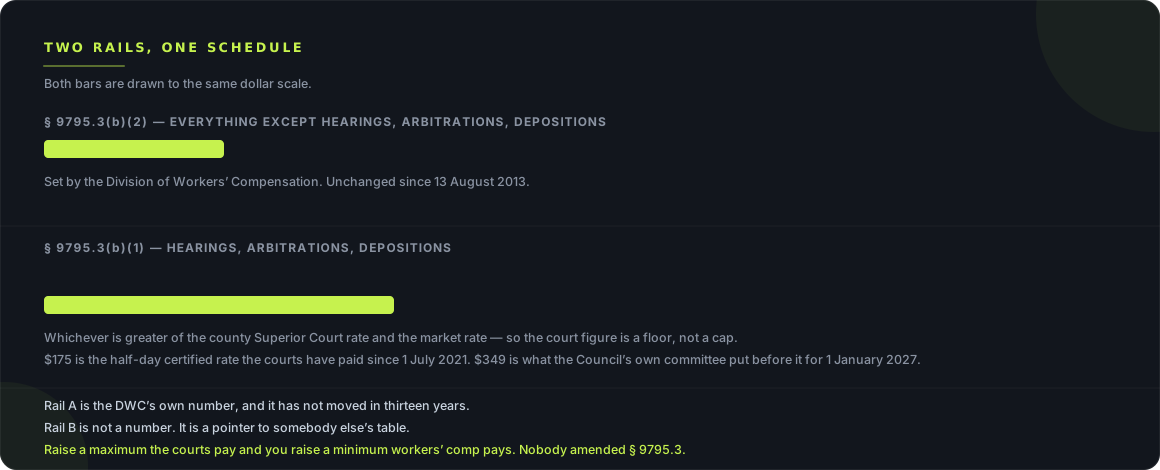
Until now, the county court figure for a state-certified or registered interpreter has been $175 for a half day and $350 for a full day, with an hourly rate of $44 — the Judicial Council’s standard rates, effective 1 July 2021, which the Council’s own expenditure report of 30 June 2026 still lists as current. That report is candid about the gap between policy and practice: “These rates are not mandated—in practice, many contractors have been negotiating higher rates with the courts.”
On 16 October 2026 the Judicial Council acted. Its own newsroom reported a week later that the Council “approved three changes” at that business meeting and, among them, “capped independent contractor pay at federal rates.” The committee report that went before the Council — dated 24 September 2026, with an effective date of 1 January 2027 — recommended maximums for certified and registered interpreters of $349 for a half day, $617 for a full day and $87 an hour, and stated that “the final proposed policy in this report reflects the new federal rates effective October 1, 2026.” It records 363 public comments.
The mechanism here deserves a moment. Nobody amended § 9795.3. The Division of Workers’ Compensation did not open a rulemaking, publish a notice or take comment. But because subdivision (b)(1) is a pointer rather than a number, raising a maximum the courts are willing to pay raises a floor that workers’ compensation is obliged to pay — and note the direction of that word. In the court system the figure is a ceiling on what a court may pay a contractor. In comp it is one half of a “whichever is greater” test, which makes it a minimum. The same number does opposite work in the two systems.
Three ways a firm moves the cost back into its own building
The shift is real but conditional. Each condition has an obvious, helpful-looking way to fail it.
A cost-shift that depends on conditions is only worth what the conditions are worth. There are three places where a firm trying to be helpful converts a bill that belonged to the carrier into a bill that belongs to somebody else, usually itself or its client.
The second trap is quieter and sits in the medical-legal line. Subdivision (a)(3) requires payment for interpreting at comprehensive, follow-up or supplemental medical-legal evaluations only if the related medical report is compensable under the medical-legal article — and the regulation goes on to provide that a party who retained the interpreter remains liable for the fee if the claims administrator is not. If a firm books the interpreter for an evaluation whose report turns out not to be payable, the firm is the party holding the invoice. The exposure is small per event and entirely avoidable, but it is the firm’s, not the carrier’s.
The third is the cancellation rule, § 9795.3(c): unless the interpreter is notified of a cancellation at least 24 hours before the service is to be provided, they are paid no less than the minimum fee. A client who misses a treatment appointment still generates a two-hour minimum. That one does land on the carrier rather than the firm, but it is the single cheapest thing a firm can fix, because it is the same appointment-reminder discipline a decent client-communication system already runs — and a carrier that is being billed for no-shows is a carrier that will fight the next interpreter bill.
There is a related rule on the hearing side. 8 CCR § 9795.1.5 provides that to be paid for services at a hearing, deposition or arbitration the interpreter must be certified — on the State Personnel Board or California courts list — or provisionally certified by agreement of the parties or on a judge’s or arbitrator’s finding on the record. Both of those sections were filed and became operative on 13 August 2013, the same day as the fee schedule, and neither has been amended since.
California is not the rule
Three states, three different answers to the same question — and one thing that is true of all three.
Everything above is Californian. A firm operating anywhere else should not carry the conclusion across the state line, because the three largest comp systems we checked put the duty in three different places and only one of them attaches a price to it.
In Texas, the only interpreter provision we could reach in the Division of Workers’ Compensation’s own rules compilation is 28 TAC § 102.4(e), and it is about the carrier talking to the claimant, not about proceedings: “If a claimant is unable to communicate with an insurance carrier due to a language barrier, and the claimant is unable to provide a person that he or she trusts to serve as a translator, the insurance carrier must provide a means to translate except as needed for a division proceeding. The claimant must not be required to contract with or otherwise employ a translator.” Note the carve-out. Texas puts a duty on the carrier for the carrier’s own communications and expressly takes Division proceedings out of that rule. We found no fee schedule, and we could not establish from the agency’s compilation who provides or pays for an interpreter at a benefit review conference or a contested case hearing.
In New York, the duty is on the state. Workers’ Compensation Law § 17-A(2) provides that “the board shall provide interpretation services to injured employees” with respect to “its provision of services, information and/or benefits.” The Board’s own language-access page explains that New York “requires State agencies that provide direct public services to offer interpretation services in the language requested,” with a coordinator and a complaint route. There is no carrier obligation in that section, no list of events and no rate.
The banner across that figure is the one claim in this article that spans more than one jurisdiction, so it was written last and checked against each state separately. California: the events in § 9795.3(a) and § 5811(b) are an examination, a treatment appointment, an evaluation, a deposition, a hearing, an arbitration and an I&A conference — no attorney–client meeting, and the catch-all turns on a Board finding about “the validity and extent of injury.” Texas: § 102.4(e) runs between the carrier and the claimant and says nothing about the claimant’s attorney. New York: § 17-A(2) runs between the Board and the injured employee and says nothing about the attorney either. None of the three reaches the firm’s own conversation with its client. That absence is an inference from the structure of three lists rather than an express exclusion in any of them, and it is worth saying so plainly.
What it comes to on one file
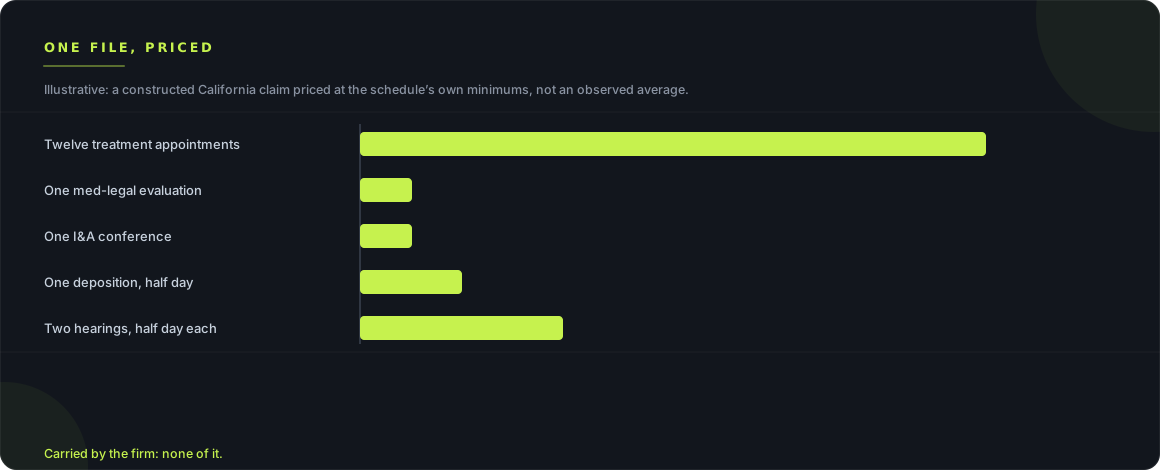
A constructed case, priced at the schedule’s own minimums. The point is not the total. It is which column the total sits in.
Take a Spanish-speaking client with a disputed claim that runs to a hearing. Twelve treatment appointments over the life of the file. One medical-legal evaluation. One Information and Assistance conference. One deposition the carrier asks for. Two appearances before a workers’ compensation judge. Nothing exotic, and nothing generous: every line below is priced at the schedule’s minimum, which means the real figure for any actual case is higher.
| Event | How many | Priced under | Unit | Line |
|---|---|---|---|---|
| Medical treatment appointment | 12 | § 9795.3(b)(2) | $90 two-hour minimum | $1,080 |
| Medical-legal evaluation | 1 | § 9795.3(b)(2) | $90 two-hour minimum | $90 |
| Information & Assistance conference | 1 | § 9795.3(b)(2) | $90 two-hour minimum | $90 |
| Deposition at the carrier’s request | 1 | § 9795.3(b)(1) | $175 half day | $175 |
| Appeals board hearing | 2 | § 9795.3(b)(1) | $175 half day | $350 |
| Carried by the claims administrator | 17 events | — | — | $1,785 |
| Carried by the firm | 0 | — | — | $0 |
If the court rate moves to $349 for a half day, the three hearing-and-deposition lines go from $525 to $1,047, and the same file costs $2,307 — $522 more, a rise of about 29 per cent on a bill the firm was never going to see. That is a problem for carriers and for the Division’s budget. For a claimant firm it is an argument that the economics of this segment are becoming more favourable, not less, which is the opposite of what a cost objection assumes.
Those first two figures are not a targeting instruction and should not be read as one. They are the reason this market is not a niche: the workers who are most exposed to the injuries comp exists to compensate are disproportionately the workers least likely to be served in English, and that is a published federal statistic rather than an impression. The 24.2 per cent share of all 2024 fatalities that 1,229 of 5,070 represents is our arithmetic on the BLS table, not a figure BLS publishes.
Where the bilingual money actually belongs
Run the whole funnel through the same question and the answer stops being ambiguous.
Lay every language touchpoint in a comp firm’s operation end to end, from the first impression of an ad to the last hearing, and mark who pays for each one. The pattern is not subtle.
| Touchpoint | Who carries the cost | Priced by |
|---|---|---|
| Spanish ad creative and media | The firm | Nothing |
| The Spanish landing page | The firm | Nothing |
| The intake call, in Spanish, answered live | The firm | Nothing |
| Retainer, case strategy, status calls | The firm | Nothing |
| Medical treatment appointments | Claims administrator | § 9795.3(b)(2) |
| Employer-requested medical examination | Claims administrator | § 9795.3(b)(2) |
| Medical-legal evaluation | Claims administrator, if the report is payable | § 9795.3(b)(2) |
| Deposition preparation, in your office | Claims administrator | § 9795.3(a)(4)(i), (b)(1) |
| The deposition itself | Claims administrator | § 9795.3(b)(1) |
| Hearings and arbitration | Claims administrator | § 9795.3(b)(1) |
Every row the firm carries sits above the signature. Every row somebody else carries sits below it. The whole marginal cost of serving this segment is an acquisition and intake cost, which means it is a marketing budget question wearing a case-handling costume — and it has been answered in the wrong department for years.
That reframing has an uncomfortable corollary, because the rows the firm does carry are the ones it has historically done worst. When we went through the accessibility data for the one practice area where accessibility and conversion are the same thing, the single least comfortable finding was that pages in Spanish averaged 64.3 detected errors against 46.0 for English pages. The page a firm builds to reach an underserved audience is, on the measured average, the worse page. Nobody is subsidising that one.
Our own numbers can set the order of magnitude on the other side of that split, with a caveat. Across roughly $16.5M of managed workers’ comp Meta spend we have produced around 219,000 injured-worker leads at about $75 each and around 21,000 signed cases at about $775 each. Those are our aggregate figures, not an industry benchmark, and they are not broken out by the language of the enquiry in anything we can publish. What they do establish is the scale of the comparison: the acquisition cost of a single signed case is roughly half the illustrative interpreter bill that the other side carries on that same case for its whole life. The expensive part of this segment was never the interpreting.
Monday
Four things, none of which requires a decision above office-manager level.
Ask the client, at intake, in the client’s language. The entitlement under § 4600(g) runs on request. Add one line to the intake script that asks whether the client wants an interpreter at medical appointments and records the answer, and a second that tells them it is paid for. That is the whole trigger mechanism, and right now it is sitting with the person least likely to know the rule exists.
Put “certified” in the case-handling checklist. Default to a certified interpreter. Where one genuinely cannot be obtained, get the claims administrator’s written consent before the appointment. The cost of skipping that step is the whole bill.
Bill the deposition preparation. § 9795.3(a)(4)(i) names “preparation of the deponent immediately prior to the deposition” as a covered event. If your office has been running those sessions with whoever on staff speaks Spanish, you have been donating a line item that the regulation assigns to the other side.
Then move the argument to where it belongs. Next time the cost objection comes up, the honest answer is that the case-handling language cost is shifted, published and about to rise for the party that carries it — and that the real cost of this market is a Spanish page, a Spanish ad and a bilingual phone line. Those are the things to argue about, because those are the things the firm is actually buying.
Key takeaways
California shifts the interpreter cost of a comp case onto the employer. Six named classes of event, from the treatment appointment to the hearing, priced in 8 CCR § 9795.3.
It does not reach the firm’s own conversations. The intake call and every client call after it are priced by nobody, so the marginal cost of this segment is an acquisition cost.
One exception, and it is money. § 9795.3(a)(4)(i) covers deposition preparation — your own client, in your own office, on the carrier’s tab.
The shift runs on a request and on certification. The worker has to ask, and a non-certified interpreter needs the carrier’s written consent in advance or nobody pays.
One rail of the schedule is a pointer, not a number. Hearings and depositions track the court rate, and the Judicial Council approved a change to it on 16 October 2026.
Do not carry this across a state line. Texas puts the duty on the carrier for its own communications; New York puts it on the Board. Neither publishes a rate.
WorkersComp Marketing is a marketing agency, not a law firm. This article describes statutes and regulations — California Labor Code §§ 4600, 5710 and 5811, title 8 of the California Code of Regulations §§ 9795.1, 9795.1.5, 9795.1.6 and 9795.3, together with 28 Texas Administrative Code § 102.4 and New York Workers’ Compensation Law § 17-A — and it describes them in order to explain where a firm’s language spending should sit. Nothing here is legal advice, nothing here is advice about whether any particular worker is entitled to an interpreter or any particular bill is payable, and nothing here is advice about your professional-conduct obligations. Whether a given interpreter fee is recoverable on a given file is a question for the lawyer handling it.
Frequently asked questions
Does this mean a Spanish-speaking caseload is cheaper to run than an English-speaking one?
No, and we are not claiming it. The claim is narrower and more useful than that: the language line specifically — the cost of someone interpreting between the worker and the system — is shifted onto the claims administrator in California at a published rate, across the events listed in 8 CCR § 9795.3(a). Whether a bilingual file is cheaper or dearer overall depends on things nobody has published case-level data on, and we are not going to invent it. What follows from the shift is a budget conclusion, not a profitability conclusion: the part of the language cost a firm genuinely carries sits in acquisition and intake rather than in case handling.
Who actually sends the interpreter’s invoice, and what happens if the carrier refuses it?
Usually the interpreter or the agency bills the claims administrator directly, and where that fails the route is a lien. The Appeals Board set out what a lien claimant has to prove, sitting en banc in Guitron v. Santa Fe Extruders: that the services were reasonably required, that they were actually provided, that the interpreter was qualified, and that the fees charged were reasonable. That is a real burden and it is one reason bills get fought. It is also why the certification and advance-consent paperwork in §§ 9795.1.5 and 9795.1.6 matters more than it looks — it is the difference between a bill with an obvious payer and a bill with an argument attached.
What is the “market rate” the schedule keeps mentioning?
Both pricing rails in § 9795.3(b) are written as “whichever is greater” — the scheduled figure or the market rate. So the schedule sets a floor rather than a ceiling, and an interpreter who can document a higher market rate may claim it. Subdivision (d) also allows the claims administrator and the interpreter or agency to agree a rate in advance that is above or below the section’s figures. In practice that is where most volume is priced, which is worth knowing before anyone treats $90 as the number.
Should we be running Spanish ads to find these cases?
That is a separate decision and we have written it up separately, in the piece on the Spanish-speaking injured-worker market. Nothing in this article is an argument for a targeting change — it is an argument about where a cost sits. The two connect at one point only: if a firm has been declining to fund Spanish acquisition because it believed the resulting files were expensive to run, that belief is checkable, it is substantially wrong in California, and the money it was holding back belongs in the ad, the page and the phone line.
How confident are you about the 1 January 2027 court rate?
Confident about the direction, not about the figures. The Judicial Council’s own newsroom confirms it approved a change to independent-contractor interpreter pay at its 16 October 2026 business meeting and describes it as a cap at federal rates, but that notice carries no dollar figure and no effective date. The $349 half day and $617 full day are what the Council’s committee recommended in its report of 24 September 2026, and the only county policy document we could reach is still the 2021 version at $175 and $350. Any firm modelling this should read the adopted policy rather than our summary of the recommendation.
Sources
- 01California Labor Code §§ 4600(f), 4600(g), 5710(b)(5), 5811(b)
Every quoted clause read on two independent publishers that match word for word: California.Public.Law (verified 9–11 Nov 2026) and FindLaw (current to 1 Jan 2026). The official leginfo site would not load on either attempt, so nothing here was confirmed against the state’s own publication of the code.
- 028 CCR § 9795.3 — Fees for Interpreter Services
Source of the event list, every rate, and the cancellation and advance-agreement rules. Read on DIR’s own page, cross-checked against Cornell LII with no difference found. DIR calls its copies “for the convenience of the user” and warrants nothing about currency; the history note shows no amendment after 13 August 2013.
- 038 CCR §§ 9795.1.5 and 9795.1.6 — who may be paid
Certification at hearings, depositions and arbitrations; certification or the claims administrator’s “prior written consent” at treatment appointments and medical-legal exams. Both carry the same history entry: filed and operative 13 August 2013, no later amendment.
- 04Guitron v. Santa Fe Extruders, WCAB en banc
Read on the state’s own site; binding on Appeals Board panels and judges. Source of the lien claimant’s burden and the treatment-appointment duty. It quotes earlier versions of the statutes, so current wording here comes from the code rather than the opinion, and its exact filing date was not confirmed from the text read.
- 05Judicial Council of California — contractor interpreter pay
Its newsroom item of 23 Oct 2026 confirms the Council “approved three changes” on 16 Oct 2026 including a cap at federal rates, but states no figure and no effective date. The $349 / $617 / $87 maximums are its committee’s recommendation of 24 Sept 2026, not text read in an adopted policy. Current $175 / $350 / $44 rates and the “not mandated” note: expenditure report, 30 June 2026.
- 0628 Texas Administrative Code § 102.4(e)
Quoted from the Texas DWC rules compilation, updated 3 February 2026. That is a courtesy copy; the official rules are filed with the Secretary of State, whose site and the Texas Administrative Code host both refused automated access, so the official filing was not read. Who pays at a Division proceeding could not be established.
- 07New York Workers’ Compensation Law § 17-A
Read on the New York State Senate’s official site, with the Board’s language-access page. § 17-A places the duty on the Board and names no events, no carrier obligation and no rate; 12 NYCRR was not reached, so a regulation elsewhere could qualify this.
- 08BLS, Census of Fatal Occupational Injuries, 2024
Released 19 February 2026; data for all years revised and final. 5,070 fatal work injuries in 2024; 1,229 to Hispanic or Latino workers, of which “68.5 percent (842) occurred among foreign-born Hispanic or Latino workers.” The 24.2 per cent share is our arithmetic on those figures, not a share BLS publishes.
- 09Our own figures
~$16.5M of managed WC Meta spend, ~219,000 leads at ~$75, ~21,000 signed cases at ~$775. Aggregate across client firms, ours and not an industry benchmark, and not segmented by the language of the enquiry. The $1,785 and $2,307 ledgers are constructed at the schedule’s minimums, not observed averages.
Every statutory and regulatory quotation was read on a state’s own site or on two independent publishers that agree, with the exceptions flagged in bold. This is a marketing article about where a firm’s language budget belongs; it is not legal advice and it is not a view on any particular bill.