There is a question near the top of every workers’ compensation intake script, and it is almost always phrased as a risk check. Have you ever hurt that part of your body before? The intake coordinator is listening for a yes, and when the yes comes, something quiet happens to the file. It is not declined. It is simply understood to be worth less — apportionment, a credibility problem, a harder case, a slower one. The note goes in. The file drifts down the queue.
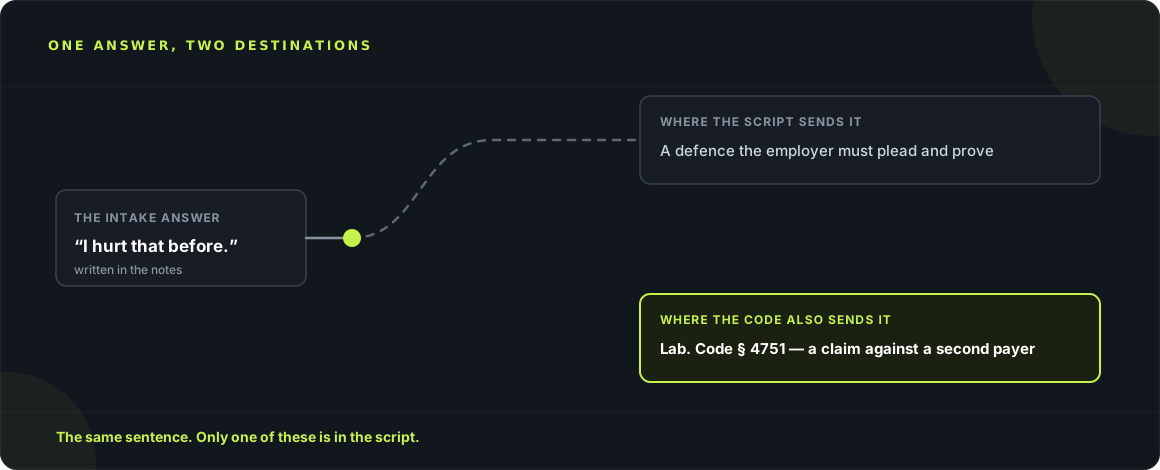
That reflex is not irrational. We have written about why the prior-injury fact is weaker evidence against a case than the industry believes: in California it names an affirmative defence the employer has to plead and prove, not a fact about the claim. But the deeper problem with the reflex is not that it overweights a defence. It is that the same sentence has a second destination in the Labor Code, and almost no firm’s intake routes it there.
This article is about that second destination: what it pays, who qualifies, what changed on 13 July 2026, what it looks like in five other states, and — the part that matters on a Monday — why the question you ask at intake today determines whether the answer is admissible in four years.
The question every comp intake asks, and what it does with the answer
The disclosure is treated as information about risk. It is also information about value, and only one of those readings is in the script.
Sit with a comp intake team for a morning and you will hear the prior-injury question asked perhaps thirty times, in perhaps four phrasings, and you will hear the answer handled identically every time. A yes gets written down. Sometimes it triggers a follow-up about which doctor, more often it does not. Then the call moves on to the parts the script treats as decisive: when, where, has it been reported, has anything been denied.
What makes this worth examining is not that the handling is careless. It is that it is consistent, across firms that agree on almost nothing else, which usually means everyone inherited the same assumption rather than each arriving at it. The assumption is that the prior injury is a fact about the strength of the case. In a liability system that would be right: a pre-existing condition is something the other side will use.
But workers’ compensation is not a liability system, and the prior injury does a different job inside it. A comp act has to answer a question that a tort system never asks, which is what happens when a worker who was already partly disabled gets hurt again and the combination is worse than the sum of its parts. Every state that bothered to answer that question built an institution to absorb the difference. Most of them built it to protect the employer. California built one that pays the worker.
The claim of this piece is narrow and, I think, checkable. In California the prior-injury disclosure is the trigger condition for a claim against a second payer; that claim has grown roughly threefold in a decade; it now carries a filing deadline that runs off two dates every firm already has on the file; and the evidence it requires has to pre-date the injury that produced the call. None of that is a legal insight. All of it is an intake-design problem.
The payer nobody in comp marketing talks about
The Subsequent Injuries Benefits Trust Fund was built for returning veterans in the 1940s. It is now one of the fastest-growing lines in California workers’ compensation.
The Legislative Analyst’s Office describes the fund’s origin plainly: California enacted it to offset employers’ workers’ compensation costs for veterans and other workers whose serious pre-existing disabilities made a new work injury more disabling. An employer who hired a man with one arm did not want to carry the cost of total disability if he lost the other. The fund took that part of the bill and spread it across all employers.
The mechanic survives in § 4751 almost unchanged. The employer pays for the subsequent injury. The fund pays the worker “in addition to the compensation due under this code” — the remainder of the combined permanent disability. It is a second cheque, from a different payer, on the same body.
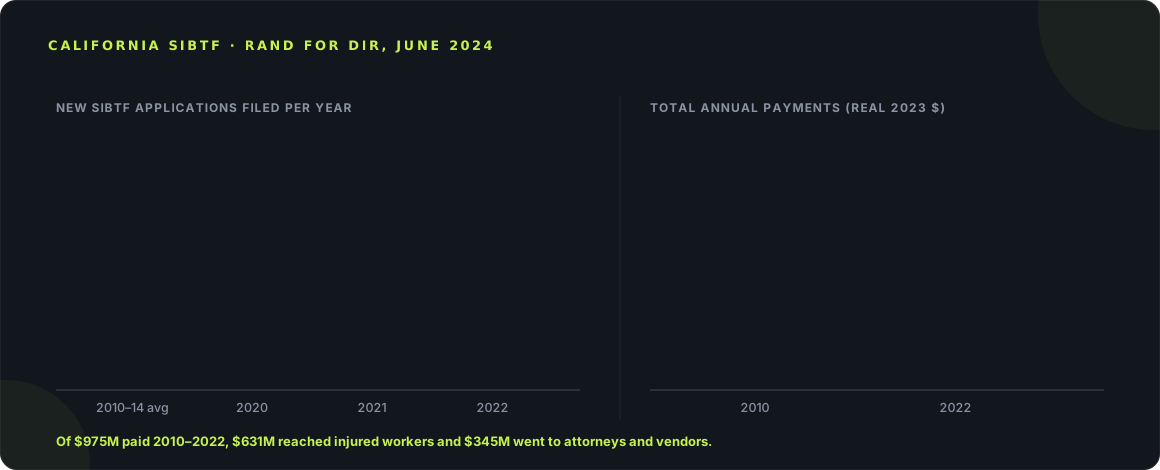
What has changed is the volume. RAND, in a study prepared for the Department of Industrial Relations and published in June 2024, counted around 850 new applications a year across 2010 to 2014, rising to 2,650 in 2021 and 2,448 in 2022. Payments over the same period went from $13.6 million in 2010 to $232 million in 2022, in real 2023 dollars. The LAO, writing in July 2025, put recent filings at around 3,000 a year and the employer assessment that funds it at $848 million for 2024–25, against $35 million a decade earlier.
That last figure is the one a firm should sit with. RAND found the average combined rating on benefit-resolving cases was 96 per cent, with 73 per cent of them at 100 per cent, and that seven in ten of those workers were owed permanent total disability. The LAO notes the top benefit rate is $1,704 a week for life. This is not a marginal supplement being argued over at the edges of a file. For the cases that qualify, it is frequently the larger of the two recoveries.
The gate: seventy per cent combined, and one of two ways in
Both tests are arithmetic. Neither of them needs a lawyer to run at the point of first contact.
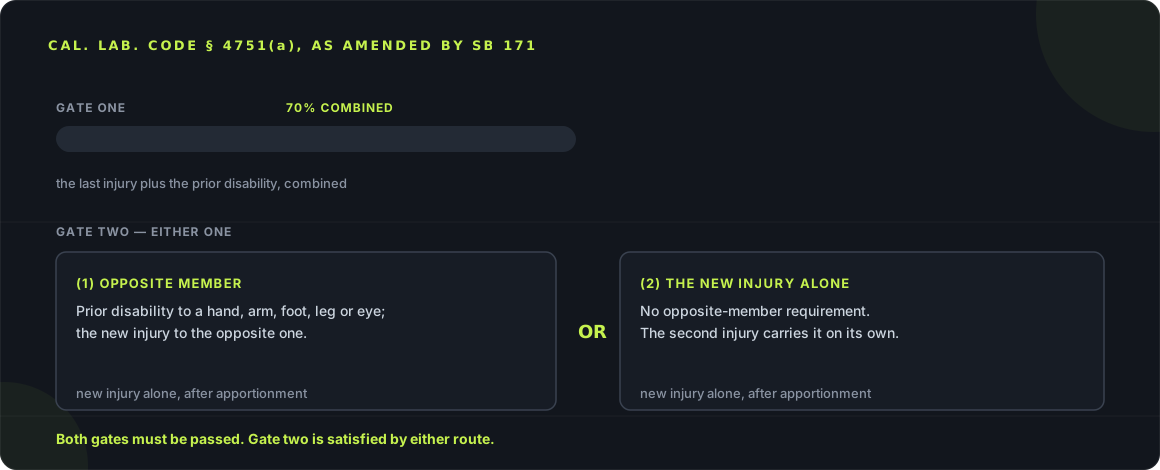
Section 4751(a) sets one threshold and then offers two alternative routes through it. The threshold is that the combined effect of the last injury and the pre-existing disability must be “a permanent disability equal to 70 percent or more of total.” That is the gate everything else hangs off, and it is the reason this is a severe-injury question rather than a general one.
Then one of two circumstances has to exist. The first is the opposite-member route: the prior disability was to “a hand, an arm, a foot, a leg, or an eye,” the new injury struck the opposite one, and the new injury’s whole person impairment alone, after apportionment, is 5 per cent or more. The second route dispenses with the body-part symmetry entirely and asks only that the new injury, considered alone and after apportionment, reach 35 per cent.
| Route | What the prior disability has to be | What the new injury has to reach |
|---|---|---|
| § 4751(a)(1) — opposite member | “a hand, an arm, a foot, a leg, or an eye”, with the new injury to the opposite one | whole person impairment “when considered alone, after apportionment” of 5 per cent or more |
| § 4751(a)(2) — the new injury alone | any qualifying pre-existing disability; no symmetry requirement | whole person impairment “when considered alone, after apportionment” of 35 per cent or more |
SB 171 also added a definition section, § 4750, and it contains a piece of precision that no intake script in the state currently has. For the purposes of the opposite-member test, “arm” now expressly includes the wrist, elbow and shoulder but not the hand; “leg” includes the ankle, knee and hip but not the foot. A prior shoulder and a new opposite shoulder is one thing. A prior hand and a new opposite arm is something else. That is a two-line addition to a screening sheet, and it is the sort of distinction that is cheap to capture at the first call and expensive to reconstruct at the second.
13 July 2026: the evidence moves backwards in time
SB 171 did not close the fund. It moved the proof to a date before the injury, which is a harder problem for a firm than a higher threshold would have been.
SB 171 was approved by the Governor on 13 July 2026 and chaptered the same day as Chapter 83. It is a budget trailer bill that takes effect immediately, and the workers’ compensation portion of it is a substantial rewrite of the subsequent-injuries article.
The centre of the rewrite is the new definition of “labor disabling” in § 4750(e). A pre-existing impairment now qualifies only if it “resulted in a loss of earnings, interfered with the employee’s work activity in the occupation or occupations in which the employee was employed, or otherwise had a demonstrable impact on the employee’s ability to perform work activity.” And then the sentence that does most of the work: a pre-existing disability “is not labor disabling if treatable by medication or the use of a medical device so that the employee engaged in employment without incapacity to do work.”
The Legislature was explicit about what it was overturning. Subdivision (e)(3) states that, “Notwithstanding Ferguson v. Industrial Accident Commission (1958) 50 Cal.2d 469, and its progeny,” the revision is intended “to restore the Subsequent Injuries Benefits Trust Fund to its original intent.” Both the LAO and RAND had identified the same drift: RAND found the share of benefit-resolving cases based on chronic conditions rose from 29 per cent of those resolved in 2010–2015 to 55 per cent of those resolved in 2020–2022, with acid reflux and high blood pressure prominent among them.
Then the evidentiary provisions, and these are the ones with an operational edge. Section 4754(b)(1) requires the prior disability’s existence and its effect on the worker’s ability to work to be found by a medical evaluator in a report that constitutes substantial evidence and be “documented in medical evidence in existence prior to the subsequent industrial injury.” New § 4754.1(b) adds that a pre-existing disability “shall not be established by a retroactive prophylactic work restriction.” Section 4754.1(c) confines medical-legal evidence to what was obtained in the course of the underlying claim, and § 4754.1(e) makes vocational evidence obtained solely for the fund claim inadmissible and its cost unrecoverable.
Read those together and the shape of the change is clear. Before SB 171, a fund claim could be assembled after the fact from a sympathetic evaluation. After it, the proof has to be contemporaneous records that already existed on the day of the injury — and it has to be found by an evaluator inside the ordinary claim, not by a specialist retained afterwards.
For a firm, that relocates the decisive moment. It is no longer the decision to file. It is the intake call, because the intake call is where you learn that there are records to go and get, and from whom. A worker who mentions a decade-old back course of treatment at a clinic he can half-remember is handing over the only thread to evidence the statute will accept. If nobody writes down the clinic’s name, there is no reconstructing it later from a work restriction written today — § 4754.1(b) now says so in terms.
The deadline that is not in anybody’s calendar
New § 4754.2 sets a date, and tells the courts that the comp act’s liberal-construction rule may not stretch it.
Before SB 171 the timing of a subsequent-injuries application was argued rather than stated. It is now stated. Section 4754.2 provides that an application “shall be made five years from the date of the subsequent industrial injury … or six months from a resolution of the issue of permanent disability in the subsequent injury claim whether by compromise and release, stipulations with request for award, or findings and award, whichever date is later.”
And then, in the same section, a sentence worth reading twice: “Section 3202 shall not be applied to extend the time for filing an application for SIBTF benefits beyond the limitations period established by this section.” Section 3202 is the liberal-construction rule — the instruction that the comp act be construed with the purpose of extending benefits. The Legislature switched it off for this one deadline.
And it applies forwards rather than backwards. Where the rest of SB 171 reaches every claim without a final determination — § 4757(a) calls the changes “procedural” and says so — subdivision (b) of the same section expressly exempts § 4754.2 from that treatment. The evidentiary tightening sweeps in work already in progress; the deadline does not.
Here is why that belongs in a marketing article rather than a practice-management one. Both of those dates are fields a firm already holds on every file it has ever opened. The date of injury is on the intake record. The date permanent disability resolved is on the closed file. The question “which of our closed cases are still inside the window” is therefore not a judgement call requiring file review. It is a query. One query, run once, against a case-management system the firm is already paying for.
Two honest caveats on that. The first is that “plausibly reaches 70 per cent combined” is not a field in anybody’s CRM, so the query is a filter that produces a review list rather than an answer. The second is that this is new law and the sensible posture on a five-month-old statute is that its edges are not settled. The point is not that every file on the list is a claim. It is that the list exists, is computable, and currently is not computed.
Five other states, and the thing they actually have in common
Multi-state firms cannot run one script here, and the reason is not the threshold. It is who the fund was built to pay.
It would be convenient to report that a second-injury fund is a general feature of American comp acts. It is not, and the variation is not a matter of degree. The question each legislature answered was who should bear the cost of the combined disability, and they split on it.
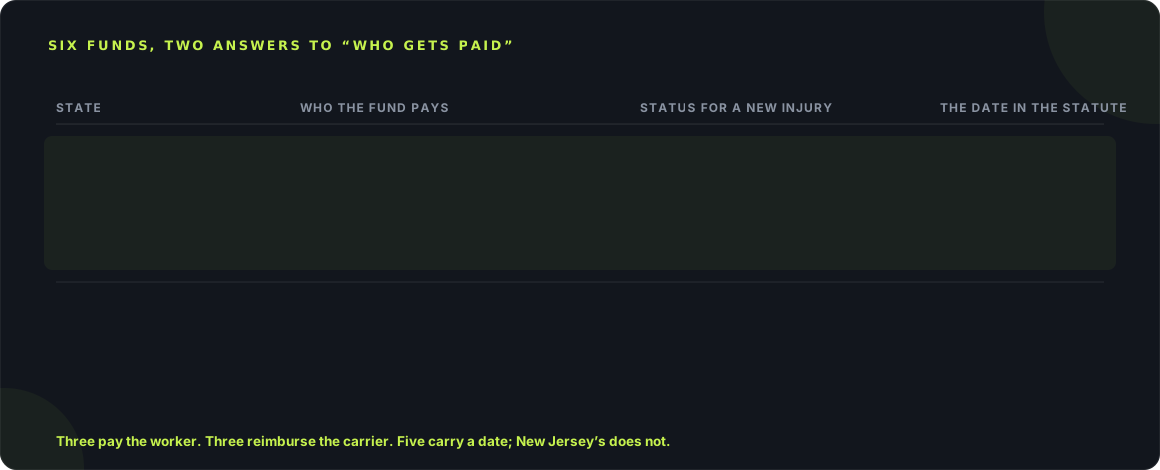
New York’s Special Disability Fund, under Workers’ Compensation Law § 15(8), reimburses the carrier: subdivision 8(d) provides that the employer or carrier “shall be reimbursed from the special disability fund.” Florida’s section is titled “Limitation of liability for subsequent injury through Special Disability Trust Fund” and speaks of reimbursing “employers or carriers.” South Carolina’s remaining provision, § 42-9-400, likewise has the employer or carrier “reimbursed from the Second Injury Fund.” In none of those three does the fund ever write a cheque to the injured worker.
California, Missouri and New Jersey went the other way. Section 4751 has the employee “paid in addition to the compensation due under this code.” Missouri’s § 287.220 has the employee “paid the remainder of the compensation that would be due for permanent total disability … out of the second injury fund.” New Jersey’s Department of Labor describes its Second Injury Fund as one that “makes benefit payments to injured workers who are totally and permanently disabled as a result of their last work-related injury combined with the workers’ pre-existing disabilities.”
And three of the six carry a date past which a new injury cannot reach the fund at all. Florida’s § 440.49(10) bars any case “in which the accident causing the subsequent injury… occurred on or after January 1, 1998.” New York’s § 15(8)(h)(2)(A) bars a reimbursement claim “for an injury or illness with a date of accident or date of disablement on or after July first, two thousand seven.” South Carolina’s § 42-7-320(B) provides that the fund “shall not consider a claim for reimbursement for an injury that occurs on or after July 1, 2008,” stopped accepting claims after 31 December 2011, and terminated the fund’s programmes and appropriations “on and after July 1, 2013.” Missouri did not close its fund but narrowed it hard: “No claims for permanent partial disability occurring after January 1, 2014, shall be filed against the second injury fund,” leaving only permanent total claims, behind a threshold of a documented prior disability worth at least fifty weeks of compensation.
| State | Who the fund pays | Status for a new injury | The date in the statute |
|---|---|---|---|
| California | The worker | Open; narrowed by SB 171 | 13 July 2026 |
| New Jersey | The worker | Open | No closing date in the text |
| Missouri | The worker | Permanent total disability only | 1 January 2014 |
| New York | The carrier | Closed to new injuries | 1 July 2007 |
| Florida | The carrier | Closed to new injuries | 1 January 1998 |
| South Carolina | The carrier | Closed; fund terminated | 1 July 2008 |
So the generalisation a firm would reach for — there is usually a second fund worth asking about — is false in half of this sample and was never true at all in New York, Florida or South Carolina, where the fund existed to make the employer whole rather than the worker. The thing that is common to all six is less convenient and more useful: every one of them is an answer to the question of who absorbs the combined disability, and the answer was a drafting choice made state by state. Five of the six wrote a date into the statute. New Jersey’s, so far as we could find, did not.
For a firm advertising across state lines, that is a direct instruction about scripting. A single national intake sheet with one prior-injury question is wrong in both directions: it collects a fact that has no second use in three of these states, and collects it too thinly to be usable in the three where it does.
What a second matter on an existing file is worth
The acquisition cost of the second claim is zero, and the acquisition cost of everything else the firm does is not.
Across the campaigns I have run inside live workers’ comp firms — roughly $16.5 million of managed Meta spend, around 219,000 injured-worker leads at about $75 each, and around 21,000 signed cases at about $775 per signed case — the single most stubborn number is the last one. Those are our own aggregate figures, not an industry benchmark, and the implied lead-to-signed rate is a derivation from them rather than a separately measured result. But the shape holds: a signed workers’ comp case costs the firm several hundred dollars to acquire, and that cost is almost entirely media.
A subsequent-injuries application on a file the firm already has costs nothing to acquire. There is no impression, no click, no lead, no intake call that would not have happened anyway. The marginal cost is the twenty seconds it takes to ask two more questions, plus the query from the last section. Measured against cost per signed case, it is the cheapest additional matter available to a comp firm in California, and it is sitting inside files the firm has already paid for.
Now the counterweight, because a piece that stopped there would be selling something. This is slow money, and slow in a way that bears directly on a firm’s working capital rather than its revenue. RAND counted just over 15,000 pending subsequent-injuries cases at the start of 2023; the LAO put the backlog at roughly 25,000 in July 2025 and observed that a claimant filing today may wait around a decade for resolution. That is the same arithmetic as the case float: the constraint on a comp firm is rarely the size of the eventual fee and frequently the number of days between spending and collecting. A matter that resolves in year nine does not fund this year’s media.
There is a second honest deduction. Of the $975 million the fund paid across 2010–2022, RAND attributes $631 million to injured workers and $345 million to attorneys and vendors — medical-legal reports, copy services and fees. That is a cost structure, not a margin, and a firm modelling this as free revenue has read the wrong line.
One more point, which is really about positioning. A firm that can say, accurately, that it checks every file for a second claim against the fund has a differentiator that survives the usual what a signed case is actually worth every comp firm makes. It is specific, it is checkable, and competitors cannot copy it by rewriting a headline — they would have to change their intake.
Monday
Three changes, none of which needs a budget or a lawyer.
Change the question from a screen to a capture. “Any prior injuries to that area?” produces a yes or a no, which after 13 July 2026 is worth almost nothing. What were you treated for, who treated you, and did it change what you could do at work — that produces the three things § 4754(b)(1) and § 4750(e) actually require. It adds perhaps twenty seconds to a call that already runs ten minutes.
Run the closed-file query once. Date of injury within five years, or permanent disability resolved within the last six months. Whatever comes back is the firm’s current inventory under § 4754.2, and it is the only part of this that has an expiry date attached.
Stop letting the prior-injury answer move the file down the queue. This is the behavioural change and it is the hardest, because the reflex is twenty years old and nobody wrote it down. The disclosure should move the file sideways, into a second question, rather than downwards. The firms that get this right will not be the ones that read a new statute fastest. They will be the ones whose intake sheet had a place to write the answer down.
Key takeaways
The prior-injury disclosure has two destinations in California law. Intake scripts route it to apportionment and stop. Section 4751 routes it to a second payer.
The gate is arithmetic. Seventy per cent combined, plus a new injury worth 35 per cent alone — or 5 per cent if it struck the opposite limb or eye.
SB 171 moved the proof backwards in time. Since 13 July 2026 the prior disability must be documented in records that existed before the new injury. It cannot be built afterwards.
There is now a deadline, and § 3202 cannot stretch it. Five years from the injury, or six months from the resolution of permanent disability, whichever is later.
This is not a national mechanic. Of six funds checked, three pay the worker and three reimburse the carrier; three are shut to new injuries entirely.
It is a case-value lever, not a case source. Zero acquisition cost, but slow: the backlog runs to tens of thousands of files and waits of years.
WorkersComp Marketing is a marketing agency, not a law firm. This article describes statutes — California Labor Code §§ 4750, 4751, 4753, 4754, 4754.1 and 4754.2 as amended or added by SB 171 (Stats. 2026, Ch. 83), together with New York Workers’ Compensation Law § 15(8), Florida Statutes § 440.49, South Carolina Code §§ 42-7-320 and 42-9-400, Missouri Revised Statutes § 287.220 and N.J.S.A. 34:15-95 — and it describes them in order to explain what a firm should capture at intake and when. Nothing here is legal advice, nothing here is advice about whether any particular worker qualifies for any fund, and nothing here is advice about your professional-conduct or advertising obligations. Whether a given file supports a subsequent-injuries claim, and whether it falls inside one of SB 171’s exemptions, are questions for the lawyer handling it.
Frequently asked questions
Does this mean we should advertise for workers with pre-existing conditions?
No, and the arithmetic is against it. The fund sits behind a 70 per cent combined permanent disability threshold, which means it attaches to the most severe end of a firm’s existing case mix rather than to a separately targetable audience. There is no ad platform targeting option for “had a prior back injury,” and the health and sensitive-category rules on the major platforms would be the governing constraint if there were. The change this article argues for is downstream of media entirely: it is about what the intake record captures and which signed files get a second look before they close. Treat it as a case-value input, not a case source.
What exactly changed on 13 July 2026?
SB 171 (Stats. 2026, Ch. 83) took effect that day as a budget trailer bill. It added a definition of “labor disabling” at Labor Code § 4750(e) requiring the prior impairment to have caused a loss of earnings, interfered with work, or had a demonstrable impact on the ability to work — and it excludes a condition “treatable by medication or the use of a medical device” where the worker kept working without incapacity. It requires the prior disability to be documented in medical evidence that existed before the new injury (§ 4754(b)(1)), bars proof by retroactive prophylactic work restriction (§ 4754.1(b)), confines medical-legal evidence to the underlying claim (§ 4754.1(c)), and adds a filing deadline (§ 4754.2). New § 4757 declares the changes procedural and applies them to every claim without a final determination, but expressly exempts the new deadline from that retroactive reach.
Is the deadline really five years, or is it six months?
It is the later of the two. Section 4754.2 sets the period as five years from the date of the subsequent industrial injury, or six months from the resolution of the issue of permanent disability in the subsequent injury claim — by compromise and release, stipulations with request for award, or findings and award — “whichever date is later.” So a case that resolves its permanent disability seven years after the injury still opens a six-month window at that point. The same section instructs that Labor Code § 3202, the liberal-construction rule, may not be used to extend it. Both dates are fields a firm already holds, which is what makes this a query rather than a file review.
We practise in New York and Florida. Does any of this apply?
Not in the way it applies in California. Both states’ funds reimburse the employer or carrier rather than paying the injured worker, and both have been closed to new injuries for years — Florida for accidents on or after 1 January 1998 (Fla. Stat. § 440.49(10)), New York for dates of accident or disablement on or after 1 July 2007 (WCL § 15(8)(h)(2)(A)). South Carolina’s fund is likewise shut and formally terminated. Missouri and New Jersey do pay the worker, though Missouri has been limited to permanent total disability claims for injuries after 1 January 2014. The practical conclusion for a multi-state firm is that one national intake script is wrong in both directions.
How long does a subsequent-injuries claim actually take?
Long enough that it should be modelled as a balance-sheet item rather than revenue. RAND counted just over 15,000 pending cases at the start of 2023. The Legislative Analyst’s Office put the backlog at roughly 25,000 in July 2025 and estimated that a worker filing now may wait around ten years for resolution, on a chain of roughly five years to finalise the underlying claim, a year to file, and five more to process. Those LAO figures are its own estimates and labelled as such. A firm that books these as near-term income will be wrong; a firm that ignores them because they are slow is leaving the largest recovery on several files unclaimed.
Is the fund likely to survive in its current form?
Unclear, and a firm should plan on the assumption that it keeps narrowing. The LAO’s July 2025 report recommended six separate tightenings, including stricter criteria for which pre-existing conditions count, resetting the entry threshold, and requiring documentation predating the subsequent injury. SB 171 adopted several of those in substance within a year. Per the Legislative Counsel’s Digest the package is scheduled to become inoperative on 1 July 2031 and be repealed on 1 January 2032, which means the Legislature has booked itself a review date. Treat current eligibility as a moving target and the intake-capture change as the part that holds its value regardless.
Sources
- 01SB 171 (Stats. 2026, Ch. 83) — the chaptered text
Approved and filed 13 July 2026, effective immediately. Every quoted phrase from §§ 4750, 4751, 4754, 4754.1, 4754.2 and 4757 was read on the official site; §§ 4754.2 and 4757 were also read a second time in the codified sections. The separate § 4578, which the digest describes as carrying the older-claim exemptions and the 2031 sunset, does not display in the online code and was not read.
- 02RAND for the Department of Industrial Relations, June 2024
California’s Subsequent Injuries Benefits Trust Fund: Recent Trends and Policy Considerations. Source of every filing count, payment figure and rating distribution in this article, in real 2023 dollars. Only the first ~40,000 characters were returned verbatim; figures drawn from later sections carry that limitation.
- 03Legislative Analyst’s Office, July 2025
Refocusing the Workers’ Compensation Subsequent Injury Program. Source of the veterans origin, the ~25,000 backlog, the ~10-year wait, the $1,704/week top rate, the assessment rising from $35M to $848M, and the finding that the growth “was not the result of deliberative steps by the Legislature.” Its liability and wait estimates are the LAO’s own and labelled as such.
- 04Business Insurance, 16 July 2026
Used only to corroborate SB 171’s exemption structure independently of the digest. A trade publication, not an official source, and it states no effective date of its own.
- 05New York — WCL § 15(8)
Official NY Senate text. Subdivision 8(h)(2)(A) bars a claim “for reimbursement from the special disability fund” for a date of accident or disablement “on or after July first, two thousand seven”; 8(d) confirms the fund reimburses the carrier. Page states it shows the revision of 8 September 2023.
- 06Florida — Fla. Stat. § 440.49
Official Online Sunshine text of the 2026 Florida Statutes, read in full. Subsection (10) bars reimbursement for any case in which the accident causing the subsequent injury “occurred on or after January 1, 1998.” The section’s own title confirms it reimburses employers and carriers.
- 07South Carolina — S.C. Code §§ 42-7-320, 42-9-400
Official SC Legislature text. Section 42-7-320(B): the fund “shall not consider a claim for reimbursement for an injury that occurs on or after July 1, 2008”; (A) terminates it “on and after July 1, 2013.” Section 42-9-400 confirms reimbursement runs to the carrier. The code states no single dissolution date.
- 08Missouri — RSMo § 287.220
Official Missouri Revisor text, marked effective 28 August 2021. Subsection 3(2): “No claims for permanent partial disability occurring after January 1, 2014, shall be filed against the second injury fund.” Subsection 2 confirms the employee is paid out of the fund. The 2013 SB 1 bill text itself was not read.
- 09New Jersey — N.J.S.A. 34:15-95 and the NJ Department of Labor
Two official Department pages: the Division “administers” the fund, which “provides benefit payments to workers who are already partially disabled” and later suffer a work injury rendering them totally disabled. The statute itself was read only on Justia, a third-party reproduction; no official page states the fund is currently accepting claims, and we infer it is open from the absence of closing language.
- 10Our own campaign figures
~$16.5M managed Meta ad spend, ~219,000 injured-worker leads at ~$75 CPL, ~21,000 signed cases at ~$775 per signed case. These are our aggregate figures across live client accounts, not an industry benchmark, and the implied lead-to-signed rate is a derivation from them rather than a separately measured result.
Every statutory quotation above was read on the state’s own official publication except New Jersey’s, which is noted. California’s was read in the chaptered bill text rather than in the codified section. This is a marketing article about what to capture at intake; it is not legal advice and it is not a view on any particular claim.