Read your own intake script end to end and count the questions. When did it happen. What were you doing. Did you report it. Who have you seen. Has anyone denied anything. Are you back at work. Did you get a letter. Every single one of them is a question about the caller, answered by the caller, verified by nothing.
That is not a criticism. It is the only way to run a phone call. But it has a consequence that almost nobody has noticed, which is that comp intake has no mechanism at all for a fact that is not about the caller — and the most consequential fact in the file is one of those.
Every question in your intake is about the worker
The caller usually does not know whether his employer carried a policy. The firm does not need him to know.
Ask an injured worker whether his employer has workers’ compensation insurance and you will get one of three answers: yes, I think so; I don’t know; and they told me I’m not covered. The first is a guess, the second is honest, and the third is frequently wrong in both directions — sometimes the employer is lying, sometimes the worker has confused being told he is a contractor with being told there is no policy. We wrote about that second confusion at length in the piece on worker misclassification, where the caller screens himself out before intake ever hears from him.
None of those three answers is useful, and none of them has to be. Coverage is not a private fact. It is filed with the state, in every state, and in most of them it is published. A firm that treats “does your employer have insurance” as a question for the caller is asking the wrong person.
No policy, no exclusive remedy
Four states, four statutes, one structure: the exclusive remedy is conditional, and the condition is a filed policy.
Start with California, because it is the bluntest. Labor Code § 3706 provides that if an employer fails to secure the payment of compensation, the injured employee may bring an action at law against that employer for damages, as though the compensation division did not apply to him at all. § 3708 then says what that action looks like: “it is presumed that the injury to the employee was a direct result and grew out of the negligence of the employer, and the burden of proof is upon the employer, to rebut the presumption of negligence.” The same section bars the employer from arguing contributory negligence, assumption of risk or the negligence of a fellow servant, and adds that “no contract or regulation shall restore to the employer any of the foregoing defenses.”
New York frames it as an election. WCL § 11 provides that where an employer fails to secure the payment of compensation, the injured employee “may, at his or her option, elect to claim compensation under this chapter, or to maintain an action in the courts for damages on account of such injury” — and in that action “it shall not be necessary to plead or prove freedom from contributory negligence,” nor may the defendant plead fellow-servant negligence, assumption of risk or the employee’s contributory negligence.
Florida puts the election in one section and the defences in another. Fla. Stat. § 440.11(1)(a): if an employer fails to secure payment of compensation as required, an injured employee “may elect to claim compensation under this chapter or to maintain an action at law or in admiralty for damages.” § 440.06 then bars that employer from defending on fellow-servant negligence, assumption of risk, or the employee being comparatively negligent.
Texas is the odd one, and the odd one is the interesting one. There, declining to carry workers’ compensation is lawful — the state calls those employers non-subscribers. But Lab. Code § 406.033(a) still removes exactly the same three defences in an action by an employee who is not covered: contributory negligence, assumption of risk, and the negligence of a fellow employee. Subsection (e) voids any pre-injury waiver of that cause of action outright.
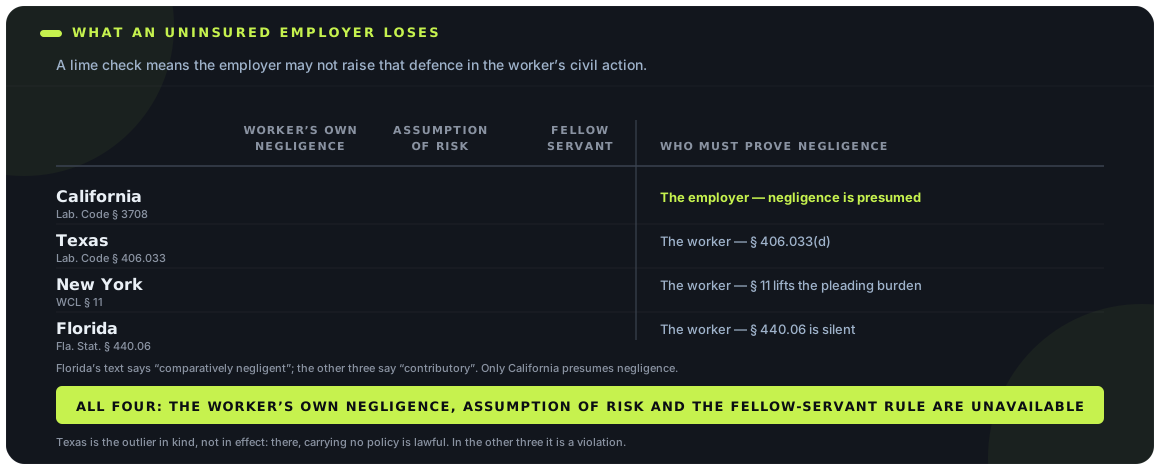
Those four statutes do not say the same thing. Two of them hand the worker an explicit election of forum; California reaches the same place by a different route; Texas has no comp claim to elect into, because there is no policy and no obligation to have one. What all four share — and this is the claim worth carrying out of this section — is that the absence of secured compensation deletes the same three defences from the employer’s answer. A note on wording: Florida’s text says “comparatively negligent” where the other three say “contributory.” That is a real difference in the underlying doctrine and we are not papering over it; the point is that in none of the four can the employer blame the worker, the job or a co-worker.
| State | Is carrying no policy lawful? | What the worker may do | Operative provision |
|---|---|---|---|
| California | No — a violation | Bring a damages action “as if this division did not apply,” and separately pursue the claim through the Uninsured Employers Benefits Trust Fund | Lab. Code § 3706; § 3708; § 3716 |
| New York | No — a violation | Elect, at the worker’s option, between a comp claim and an action in the courts for damages | WCL § 11 |
| Florida | No — a violation | Elect between a comp claim and an action at law or in admiralty for damages | Fla. Stat. § 440.11(1)(a); § 440.06 |
| Texas | Yes — the employer is a non-subscriber | Sue in negligence. There is no election, because there is no comp system for that employer to be in | Lab. Code § 406.033 |
Stripped defences are not a won case
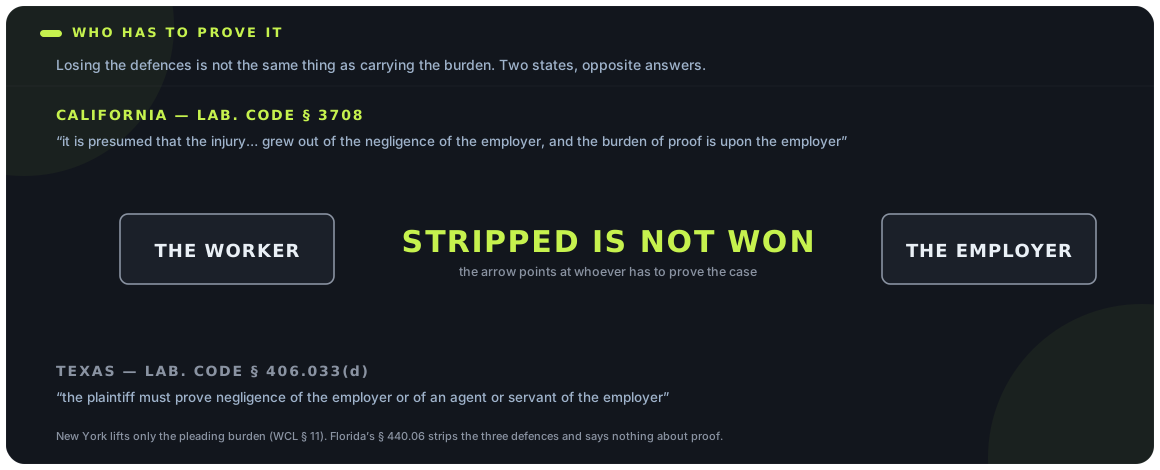
Only one of these four states also moves the burden of proof. That difference decides whether this is a practice line or a referral.
It is easy to read the section above and conclude that an uninsured employer is a free case. It is not, and the statutes themselves say so if you read the next subsection down.
California presumes negligence and makes the employer rebut it. Texas does the reverse in the same statute that strips the defences: § 406.033(d) provides that “the plaintiff must prove negligence of the employer or of an agent or servant of the employer acting within the general scope of the agent’s or servant’s employment.” New York lifts only the pleading burden on contributory negligence. Florida’s § 440.06 says nothing about proof at all.
Then there is collectability, which is the real objection and deserves a straight answer. An employer with no policy is, quite often, an employer with no money. California built an entire fund around that problem — the Uninsured Employers Benefits Trust Fund, Lab. Code § 3716 — precisely because judgments against uninsured employers were not being paid. The fund is live: the Department of Industrial Relations sets a UEBTF assessment rate every year, and the 2026 rate was published in December 2025. The most detailed public account of how the fund actually works in practice is still the Commission on Health and Safety and Workers’ Compensation’s background paper on the UEBTF — which sets out the service requirement under § 3716(d), the joinder sequence, and the written demand that follows an unpaid award. That paper is dated 2007. We have not found a current equivalent, and nineteen-year-old procedural detail should be checked against today’s rules before anybody relies on it.
Texas: where it is lawful, and a quarter of employers do it
Everywhere else this is an enforcement story about outliers. In Texas it is a quarter of the employer base, by design.
The Texas Department of Insurance surveys employer participation every few years. The 2022 estimates, published in April 2023 off a survey of 1,619 year-round private-sector employers, put 75% of Texas employers in the comp system and 25% outside it — roughly 108,382 non-subscribing employers. On the employee side the split is 83% / 17%: about 1.4 million Texas employees work for an employer with no workers’ compensation policy. Of those, about 73% are in some employer-provided alternative benefit plan and about 27% — roughly 0.4 million people — are in nothing at all.
The distribution by employer size is the part a firm should sit with, because it is not a straight line. Non-subscription runs at 31% among employers with one to four staff, falls to 7% at 50–99, and then climbs back to 20% at 500-plus. The smallest employers are out because a policy is expensive relative to payroll; the largest are out because they can self-fund an alternative plan and would rather. Everything in the middle is in. By industry the spread is wider still: 38% in “other services,” 37% in health care and educational services, 29% in agriculture, 27% in accommodation and food services, against 16% in mining, utilities and construction.
The list exists — and it is free
Three recent pieces on this site ended at the same wall. This one does not.
A recurring finding in this series is that the list you want does not exist. The direct-mail piece ran aground on it: personal injury mail runs on public crash reports and workers’ compensation has no equivalent public incident record. The piece on the medical-legal examination reached the same conclusion for a different reason — claim files are confidential, so the dated event it described can only be captured at intake. Each time, the honest conclusion was: this is a routing rule, not a campaign.
This is the exception. For Texas, the list is published.
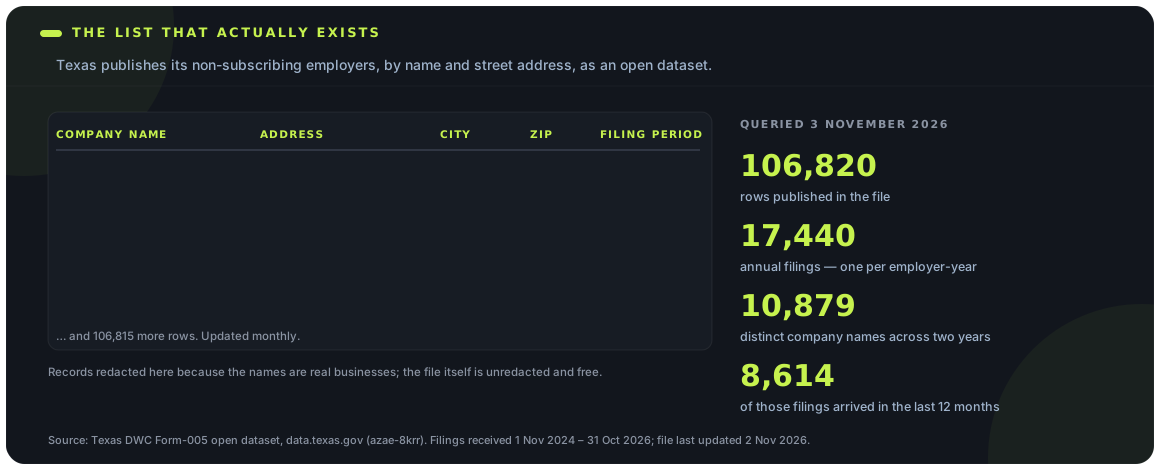
Non-subscribers are required to file DWC Form-005, the Employer’s Notice of No Coverage or Termination of Coverage, each year between 1 February and 30 April, or within ten days of telling a carrier they intend to end coverage. The Division of Workers’ Compensation then publishes a monthly report of those filings as an open dataset on the Texas open data portal, free, with no registration, in CSV, JSON and XML.
We queried it on 3 November 2026. The file then held 106,820 rows covering filings received between 1 November 2024 and 31 October 2026, and had last been refreshed on 2 November 2026. Its columns are: filing ID, filing date received, record type, company name, address line 1, address line 2, city, state, ZIP code, date type, start date and end date. Of those rows, 17,440 are “Parent” records — one per employer filing, carrying the filing period — and 89,380 are “Location” records, one per worksite named on a filing. Across the two years there are 10,879 distinct company names, and 8,614 of the parent filings arrived in the trailing twelve months.
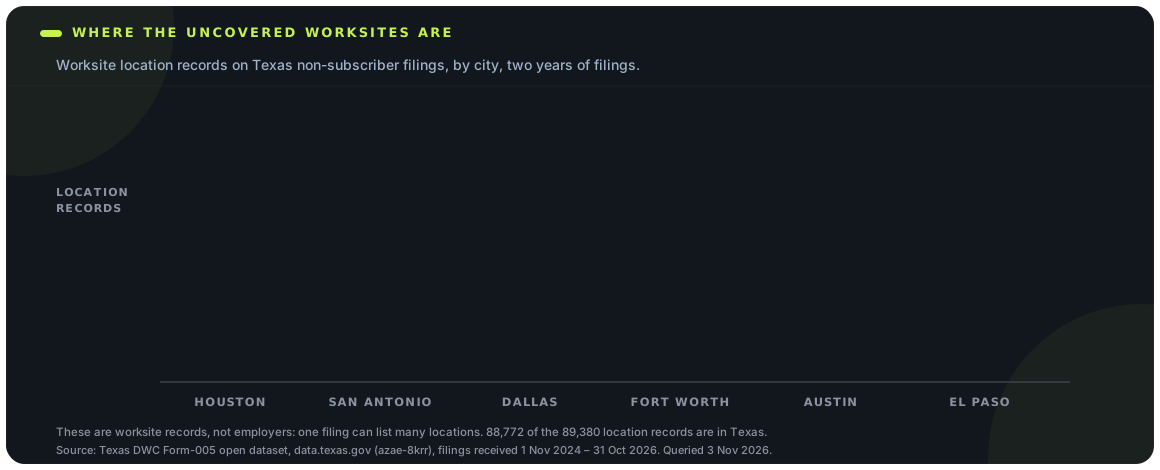
Those location records are where the operational value sits, because they carry street addresses. Grouped by city, the two years of filings put 7,939 uncovered worksites in Houston, 6,062 in San Antonio, 4,839 in Dallas, 3,072 in Fort Worth, 2,977 in Austin and 2,284 in El Paso. Of all 89,380 location records, 88,772 are in Texas; the remainder are out-of-state head offices on filings for Texas operations.
Texas is unusual in publishing the non-subscribers themselves, but it is not unusual in publishing coverage. TDI’s own coverage verification page points to four separate lookups — the TXCOMP search run by NCCI for carrier-insured employers, a certified self-insurers list, a self-insured government employer search, and the non-subscriber dataset — and gives an email address, coverage.verification@tdi.texas.gov, with a stated response time of one business day for an employer you cannot find. California runs a free public coverage inquiry through the Workers’ Compensation Insurance Rating Bureau. New York’s Workers’ Compensation Board publishes an employer coverage search. Florida publishes both a proof-of-coverage database and — this one is unusual — a searchable stop-work order database of the employers it has caught operating without coverage.
Florida’s enforcement numbers give a sense of how many of those there are in a state where it is unlawful. In fiscal year 2024–25 the Division of Workers’ Compensation conducted 24,861 investigations and issued 2,312 enforcement actions — 1,806 stop-work orders and 506 orders of penalty assessment — collecting $15,136,389 in penalties and bringing 7,817 employees under coverage, according to the joint annual report of the Division and the Criminal Investigations Division.
What the list is not
Two years of filings name 10,879 employers. The state’s own survey estimates there are roughly ten times that many.
Here is the arithmetic that keeps this honest. TDI’s 2022 survey estimates about 108,382 non-subscribing employers in Texas. Two years of Form-005 filings contain 10,879 distinct company names. The register therefore accounts for roughly one in ten of the employers the state itself believes are out there.
| Measure | Figure | What it is |
|---|---|---|
| TDI survey estimate, 2022 | ~108,382 employers | Statewide estimate of non-subscribing employers, grossed up from a survey of 1,619 year-round private employers |
| Distinct names in the register | 10,879 | Company names appearing on Form-005 filings received 1 Nov 2024 – 31 Oct 2026 |
| Coverage of the estimate | ~10% | Arithmetic on the two figures above. The gap is unfiled notices, name variants and employers outside the form’s scope — not a correction to either number |
| Filings in the trailing year | 8,614 | Parent filings received 1 Nov 2025 – 31 Oct 2026. The filing window is February to April, so a single year under-counts |
Treat that ten percent as a floor, not as a measurement of compliance. Some of the gap is employers who simply never file; some is the same business appearing under two spellings; some is scope, since Form-005 is a private-employer form. We are not in a position to decompose it, and anyone who tells you they can should show their work.
Two fields, one lookup, one routing rule
The whole implementation fits on an index card, and the cost of running it is about one percent of media spend.
Start with the two fields, because they are the part that has to happen on the call.
Now the cost, because every intake change competes with every other intake change. Assume the lookup takes ninety seconds and is only run where the caller cannot confirm coverage. Across 1,000 leads — which at our own blended figure of roughly $75 per injured-worker lead is $75,000 of media — running it on every single call would be about 25 hours of intake time. Costed at $30 an hour that is $750: one percent of the media that produced the calls. Run selectively, it is a fraction of that.
The verification costs about one percent of the media that produced the call. The thing it detects changes which act governs the case.
We have deliberately not put a number on how often this will fire in your lead flow, because we do not have a defensible one and neither does anybody else. Nobody publishes the share of injured-worker enquiries involving an uninsured employer. What we can say is directional and worth stating as such: in Texas, where a quarter of employers and seventeen percent of employees are outside the system, it will fire materially more often than in a state where it is a violation — and in a state where it is a violation, the cases it finds are worth more attention per case, not less.
The last decision is a business one rather than a marketing one, and it should be taken before the first of these calls arrives rather than during it. A negligence action against an employer is a different practice line from a comp claim: different pleadings, different discovery, different cost exposure, a different fee structure and a real question about whether the defendant can pay. Decide in advance whether your firm tries these, co-counsels them, or refers them out — and if it refers them out, what the referral is worth. A firm that has not made that decision will make it badly, at speed, on a Tuesday afternoon, with a client already in the room.
Where this stops
Four states is not fifty, the register is a floor, and none of this is a campaign.
We looked at four states closely. There are forty-six more, plus the District of Columbia and the federal system, and the differences between comp acts are not decorative — the structure described here holds in broad outline across the country but the specifics will not survive transplanting. Check your own act and, where it matters, check it with counsel rather than with us.
The register is a floor and we have said why. The UEBTF procedure we cited is from a 2007 paper and may have moved. The Florida enforcement figures are one fiscal year and one state, and the ratio of stop-work orders to actual uninsured employers is not knowable from them. The Texas survey is a sample grossed up to a population, and TDI presents it that way.
And the honest scope of the recommendation: this is two intake fields, a lookup and a routing rule. It is not a campaign, it is not a new practice area on its own, and in forty-nine states it will not change where you spend a dollar of media. Texas is the exception, where the scale of non-subscription is large enough to be a genuine input into market selection and landing-page copy. Everywhere else the value is simpler and still worth having: you will stop declining a small number of callers whose cases are the most interesting ones you were offered that week.
Key takeaways
-
The exclusive remedy is conditional. It protects an employer that secured the payment of compensation. Where none was secured, Cal. Lab. Code § 3706, NY WCL § 11 and Fla. Stat. § 440.11(1)(a) all open a damages action against the employer itself.
-
The same three defences fall in all four states we checked. The worker’s own negligence, assumption of risk and the fellow-servant rule are unavailable under § 3708, § 11, § 440.06 and § 406.033(a) alike. Florida’s text says “comparatively” where the others say “contributory.”
-
Only California also moves the burden. § 3708 presumes the injury grew out of the employer’s negligence and makes the employer rebut it; Tex. Lab. Code § 406.033(d) expressly leaves proof with the plaintiff. Stripped defences are not a won case.
-
Texas is a quarter of the employer base, lawfully. TDI’s 2022 estimates: 25% of employers and 17% of employees — about 1.4 million people — outside the system. Non-subscription peaks at 31% among employers with one to four staff and rises again to 20% at 500-plus.
-
For once, the list exists. Texas publishes Form-005 filings as an open dataset: 106,820 rows when we queried it on 3 November 2026, with company name, street address, city, ZIP and filing period, refreshed monthly, free.
-
It is a floor, not a census. 10,879 distinct names across two years of filings against a state estimate of about 108,382 non-subscribing employers — roughly one in ten. And it names employers, never injured workers.
-
Every state we checked publishes a coverage lookup. WCIRB’s inquiry in California, the Board’s employer coverage search in New York, proof-of-coverage and a stop-work order register in Florida, TXCOMP and the non-subscriber file in Texas. Florida issued 1,806 stop-work orders in FY 2024–25.
-
The build is small and the cost is about 1% of media. Employer legal name off a document, a three-way coverage question, a lookup, a routing rule to attorney review rather than a decline, and one disposition code.
-
Decide the referral economics before the first call. A negligence action against an employer is a different practice line with different costs, a different fee and a real collectability question. Try it, co-counsel it or refer it — but choose in advance.
WorkersComp Marketing is a marketing agency, not a law firm, and nothing here is legal advice about any claim, any employer or any firm’s case-selection policy. Whether a particular employer has secured the payment of compensation, what follows if it has not, and what a firm may lawfully do with public coverage data are all questions of state law and of your own jurisdiction’s rules of professional conduct. Statutes are amended: the provisions cited here were read on 3 November 2026 and the CHSWC procedural account of the California uninsured-employer fund dates from 2007. Verify the current rule, and the current coverage position of any particular employer, before acting.
Frequently asked questions
Why would a comp firm care whether the employer is insured?
Because it decides which body of law applies. Workers’ compensation is the worker’s exclusive remedy only where the employer secured the payment of compensation. Where it did not, California (Lab. Code § 3706), New York (WCL § 11) and Florida (Fla. Stat. § 440.11(1)(a)) all open a damages action against the employer, and all three — along with Texas — strip the employer of contributory negligence, assumption of risk and the fellow-servant defence. The same caller is a different matter depending on a fact nobody asked about.
Can intake actually check coverage during a call?
In most states, yes. California has a free public coverage inquiry run by the WCIRB; New York’s Workers’ Compensation Board publishes an employer coverage search; Florida publishes a proof-of-coverage database; Texas points to TXCOMP for insured employers and an open dataset for non-subscribers, and gives an email address with a stated one-business-day response for employers you cannot find. The practical constraint is not access, it is that these are name-matching tools — so capture the employer’s legal name off a pay stub, not the name on the sign.
Does “no insurance” mean the worker gets nothing?
No, and that assumption is the reason these callers get declined. Most states maintain a fund for exactly this situation — in California the Uninsured Employers Benefits Trust Fund under Lab. Code § 3716, financed by an annual assessment the Department of Industrial Relations publishes each December. The funds come with their own procedure, including service on the employer in the manner of a civil summons before the fund can be joined in California, so they are not automatic. We are a marketing agency, not a law firm; check your own state’s fund rules with counsel.
Is being uninsured the same as being self-insured?
No, and they point in opposite directions. A certified self-insured employer is inside the system: it has posted security, it is on a state register and it pays its own claims, usually through a third-party administrator. We covered that market separately in the self-insured employers piece. An uninsured employer has secured nothing. Texas adds a third category, the non-subscriber, which is lawful but outside the act entirely.
How big is the Texas non-subscriber market?
TDI’s 2022 estimates, published April 2023 from a survey of 1,619 year-round private employers, put 25% of Texas employers and 17% of employees outside the system — about 108,382 employers and roughly 1.4 million workers. Around 73% of those employees are in an employer-provided alternative benefit plan; about 0.4 million are in nothing. The rate is highest among the very smallest employers (31% at one to four staff) and rises again at 500-plus (20%).
What exactly is in the Texas non-subscriber dataset?
Filings of DWC Form-005, the Employer’s Notice of No Coverage or Termination of Coverage, which non-subscribers must file annually between 1 February and 30 April. The published file carries filing ID, filing date, record type, company name, two address lines, city, state, ZIP, and the start and end dates of the filing period. On 3 November 2026 it held 106,820 rows covering filings received from 1 November 2024 to 31 October 2026: 17,440 employer filings, 89,380 worksite location records and 10,879 distinct company names.
Can we mail or advertise to the employees of these employers?
Not on the strength of this data, and the question conflates two different things. The register names employers, not injured workers, so it tells you nothing about who has been hurt. And the professional conduct rules on solicitation do not relax because the underlying data is public — a live, person-to-person approach to someone known to need legal services remains prohibited in most jurisdictions. The legitimate uses are market selection, landing-page messaging and coverage verification on a caller who has already contacted you.
What is the single change worth making this week?
Add one disposition code to your intake system: “employer coverage not verified.” It costs nothing, it changes no script, and in ninety days it will tell you how often this is actually happening in your own market — which is the only way to decide whether the rest of the build is worth it for your firm rather than in the abstract. Our intake playbook covers how to add a code without breaking the reporting you already run.
Does this apply outside the four states you looked at?
The structure — exclusive remedy conditional on securing compensation, defences stripped where it was not secured, a state fund as backstop — is broadly common across US comp acts. The specifics are not. Whether the worker gets an election, whether the burden shifts, how the fund is joined and what the filing deadlines are all vary, and Texas is genuinely different in kind because non-subscription there is lawful. Treat this piece as a map of the mechanism, not as a statement of your state’s law.
Sources & further reading
-
01
California — the damages action and the presumption of negligence
Cal. Lab. Code § 3706 provides that where an employer fails to secure the payment of compensation, an injured employee may bring an action at law against that employer for damages as if the division did not apply. § 3708 adds that in such an action “it is presumed that the injury to the employee was a direct result and grew out of the negligence of the employer, and the burden of proof is upon the employer, to rebut the presumption of negligence,” bars contributory negligence, assumption of risk and fellow-servant defences, and provides that “no contract or regulation shall restore to the employer any of the foregoing defenses.”
-
02
New York — the worker’s election of forum
NY Workers’ Compensation Law § 11: where an employer fails to secure the payment of compensation for injured employees, the employee “may, at his or her option, elect to claim compensation under this chapter, or to maintain an action in the courts for damages on account of such injury.” In that action “it shall not be necessary to plead or prove freedom from contributory negligence,” nor may the defendant plead that the injury was caused by the negligence of a fellow servant, that the employee assumed the risk of employment, or that the injury was due to the employee’s contributory negligence.
-
03
Florida — the election, the stripped defences, and the enforcement numbers
Fla. Stat. § 440.11(1)(a) (2026): if an employer fails to secure payment of compensation as required, an injured employee “may elect to claim compensation under this chapter or to maintain an action at law or in admiralty for damages.” § 440.06 bars such an employer from defending on the negligence of a fellow servant, assumption of risk, or the employee being comparatively negligent. Enforcement, FY 2024–25: 24,861 investigations, 2,312 enforcement actions comprising 1,806 stop-work orders and 506 orders of penalty assessment, $15,136,389 in penalties collected, and 7,817 employees brought under coverage.
-
04
Texas — the non-subscriber statute, including the waiver timing
Tex. Lab. Code § 406.033. Subsection (a): in an action against an employer by an employee not covered by workers’ compensation insurance, it is not a defence that the employee was guilty of contributory negligence, assumed the risk, or that the injury was caused by the negligence of a fellow employee. Subsection (c) preserves defences of self-inflicted injury and intoxication. Subsection (d): “the plaintiff must prove negligence of the employer or of an agent or servant of the employer.” Subsection (e) voids any pre-injury waiver. Subsection (f) permits a post-injury waiver only if voluntary, knowing, made no earlier than the tenth business day after the initial report of injury, and preceded by a medical evaluation from a non-emergency-care doctor; subsection (g) requires the waiver terms to be conspicuous.
-
05
Texas — how many employers and employees are outside the system
Texas Department of Insurance, Employer Participation in the Texas Workers’ Compensation System: 2022 Estimates (published April 2023), from a survey of 1,619 year-round private-sector employers. 75% of employers subscribe (about 322,406) and 25% do not (about 108,382). 83% of employees are covered (about 6.7 million) and 17% are not (about 1.4 million), of whom about 73% are in an employer-provided alternative benefit plan. Non-subscription by size: 31% at 1–4 employees, 18% at 5–9, 13% at 10–49, 7% at 50–99, 12% at 100–499 and 20% at 500-plus. By industry it ranges from 16% in mining, utilities and construction to 38% in other services.
-
06
The Texas non-subscriber register — our own query of the primary file
Texas Department of Insurance, Division of Workers’ Compensation, “Workers’ compensation non-subscriber employer information,” Texas Open Data Portal dataset azae-8krr, sourced from DWC Form-005 filings and published monthly. Queried by us on 3 November 2026, when the file had last been updated on 2 November 2026: 106,820 rows covering filings received 1 Nov 2024 – 31 Oct 2026; 17,440 “Parent” filing records and 89,380 “Location” worksite records; 10,879 distinct company names; 8,614 parent filings received in the trailing twelve months; 88,772 of the location records in Texas. Location records by city: Houston 7,939, San Antonio 6,062, Dallas 4,839, Fort Worth 3,072, Austin 2,977, El Paso 2,284. Figures are counts of filings and records, not of employers: a single filing may name many worksites, and name variants inflate distinct-name counts.
-
07
California — the uninsured employer fund and its procedure
Commission on Health and Safety and Workers’ Compensation, background paper on the Uninsured Employers Benefits Trust Fund, dated 27 April 2007 — the most detailed public account we have found of how the fund operates, including the Lab. Code § 3716(d) requirement that the application and special notice of lawsuit be personally served before joinder, the written-demand step, and recoveries under § 3717. Figures in that paper (1,794 new claims and $29.2M in claim costs in FY 2005–06; a 9% system-wide uninsured-employer estimate from a 1998 study) are two decades old and are cited here only as background, not as current measurement. The fund itself remains live: DIR publishes a UEBTF user-funding assessment rate annually.
-
08
Our own acquisition figures, and what they are used for here
The ~$75 average cost per injured-worker lead used in the cost-of-verification calculation is our own, across approximately $16.5M of managed workers’ compensation Meta ad spend, about 219,000 leads and about 21,000 signed cases at roughly $775 blended cost per signed case. It is a figure from our own book, not an industry benchmark, and it varies by market and channel. The $30 hourly intake cost and the ninety-second lookup are illustrative inputs, stated so the reader can substitute their own. We have deliberately published no estimate of how frequently uninsured employers appear in a comp firm’s lead flow, because no defensible figure exists.