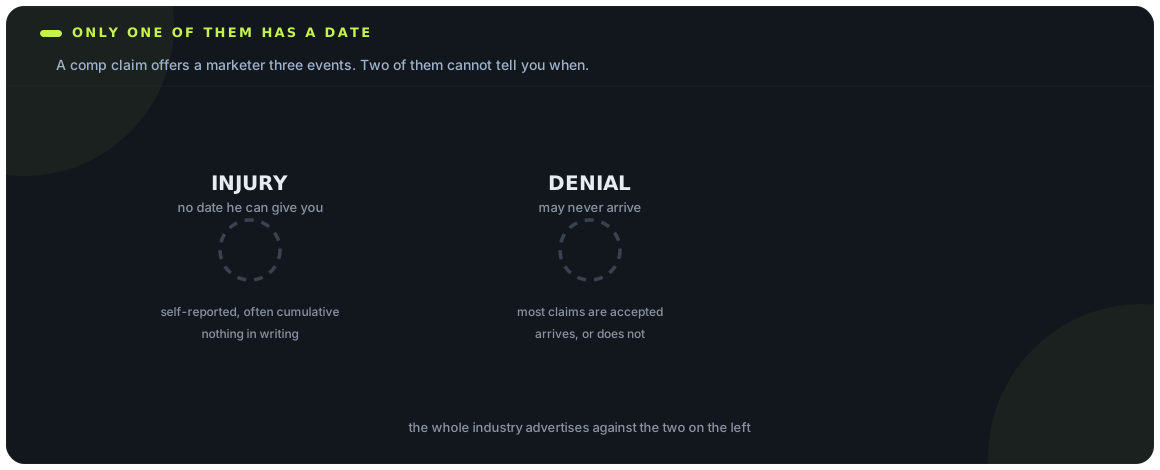
Ask a workers’ comp marketer what triggers a case, and you will get one of two answers. The injury: somebody got hurt, and the advertising needs to be in front of him when it happens. Or the denial: somebody got refused, and the advertising needs to be in front of him when the letter lands.
Both answers are reasonable and both have the same defect. Neither event comes with a date you can act on.
The injury is self-reported, frequently cumulative, and in a great many claims the worker could not tell you which day it started even if you asked him — which is a problem we have written about on its own. The denial is better, because it does arrive as a document, but it is conditional: most claims are accepted, so for most of the market the denial never comes at all. Marketing to it means waiting for an event that may not happen, to a person you cannot identify in advance.
There is a third event. It happens in a very large share of contested claims. It arrives as a letter, on a named date, at a named address, at a stated time. It is generated by the opposing party or by the state itself rather than by the worker. And it determines what the claim is worth.
It is the medical-legal examination, and I have never seen a comp firm’s marketing built around it.
Comp marketing is built on two events with no dates
An acquisition system is a timing system. Comp’s two canonical events are the two with the worst timing information in the file.
Strip the tactics away and every acquisition system is the same machine: it decides when to spend attention on a person. Everything else — channel, creative, bid, script — is downstream of that. A channel is a guess about where somebody is; a date is a fact about when.
This is why personal injury marketing works the way it does. A crash produces a police report on a date, in a public record, and an entire mail industry has been built on that one fact. Comp has no such record, and the attempt to invent one is the subject of its own piece here: the claim file is confidential in essentially every state, which is why nobody can sell you a list of injured workers.
So comp firms do the next best thing, which is to buy presence against intent — search, social, LSA — and hope to be visible on the day the worker decides to look. That works. It is most of what we do. But it means the firm is buying a probability distribution rather than a calendar, and the distribution is wide.
The exam is different in kind. It is not something the worker reports; it is something done to him, on a schedule somebody else sets, and the schedule is written down.
The third event is the one that decides
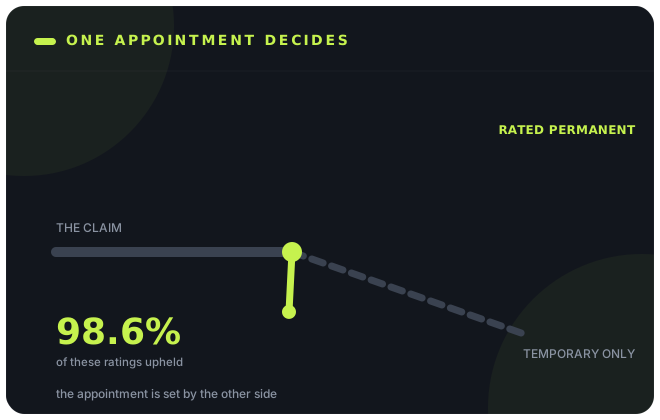
An evaluation whose rating survives dispute 98.6% of the time is not a stage in the decision. It is the decision.
Every state’s comp act contains a mechanism for resolving a medical dispute — whether the worker has reached maximum medical improvement, what his impairment is, whether the condition is work-related, whether he can return to work — by sending him to a physician who is not his treating doctor. The names differ. New York calls it an independent medical examination. California runs a panel of qualified medical evaluators. Texas assigns a designated doctor. The function is the same: one examination, one report, and the report becomes the evidence the case turns on.
How much does that report actually settle? Texas publishes the answer. The Texas Department of Insurance’s Division of Workers’ Compensation released its designated doctor report in April 2026, covering 2020 to 2024. In 2024, 304 designated doctors conducted 27,866 appointments, and when those ratings were disputed, 98.6% of them were upheld.
Read that second number as a marketer rather than as a lawyer. A finding that survives challenge 98.6% of the time is, for practical purposes, final. Whatever happens at that appointment is what the claim is going to be worth. Everything the firm can do for the client afterwards is operating on a number that was set in a room the firm was never in.
This is also why the exam is the honest answer to a question comp firms get asked constantly and answer badly: is it too late for me to get a lawyer? The statutory deadlines are mostly generous and mostly misunderstood. The practical deadline is often this appointment, and it is printed on a letter the caller has in his hand.
The line the exam moves a claim across
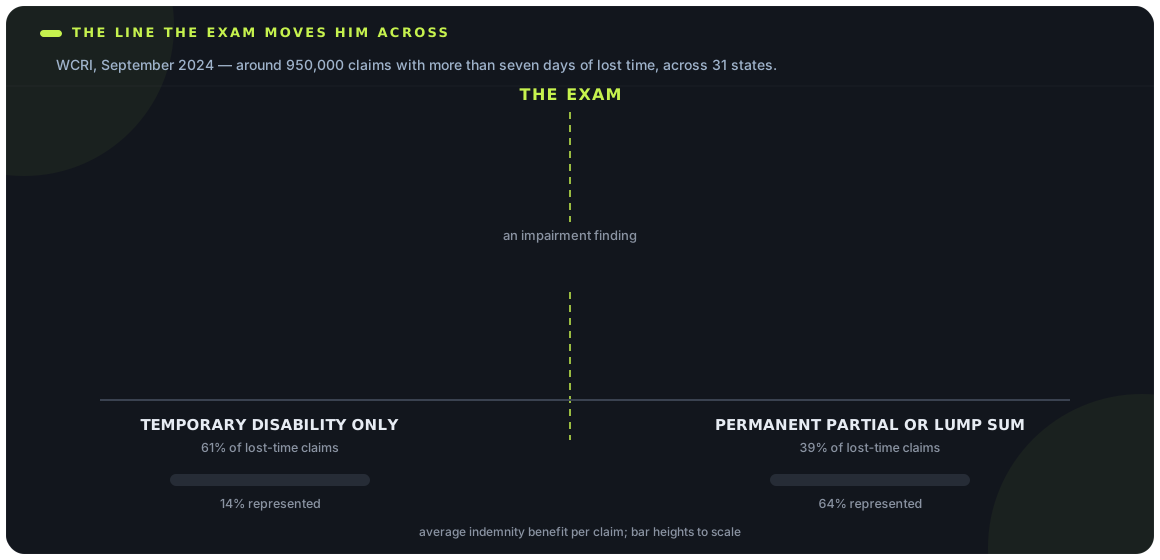
WCRI measured representation on both sides of the permanent-impairment line across 31 states. The gap is 14% against 64%.
In September 2024 the Workers Compensation Research Institute published Impact of Attorney Representation on Workers’ Compensation Payments, by Bogdan Savych and David Neumark. It looked at close to a million claims with more than seven days of lost time across 31 states. Overall, 34% of those workers had an attorney.
That headline number conceals the thing worth knowing. Split the sample by what the claim became:
| Claim type | Share of the sample | Represented | Average indemnity benefit | Median |
|---|---|---|---|---|
| Temporary disability only | 61% | 14% | $6,918 | $2,198 |
| Permanent partial disability and/or lump sum | 39% | 64% | $39,150 | $22,653 |
| — PPD only | — | 38% | $22,292 | — |
| — PPD and lump sum | — | 79% | $55,001 | — |
| — Lump sum only | — | 76% | $45,583 | — |
Fourteen per cent against sixty-four. Six thousand nine hundred dollars against thirty-nine thousand. Those are two different markets with two different economics, and the thing that decides which one a given worker is in is a medical finding about permanent impairment.
Which is produced at the exam.
Work the shares and the market appears. Sixty-one per cent of roughly 950,000 claims is about 579,000 temporary-disability files, of which some 81,000 are represented. Thirty-nine per cent is about 370,000 permanent-partial or lump-sum files, of which about 237,100 are represented. Add those and you get about 318,000 represented claims — close enough to the published 34% that the arithmetic holds together.
Now take the remainder. Roughly 133,000 claims a year, in this sample alone, carry a permanent impairment and average $39,150 in indemnity benefits, and nobody is acting for the worker. That is not a lead-generation problem. Those workers are in the system. They have adjusters, claim numbers and appointment letters. They are simply not being spoken to at the moment the appointment letter arrives.
The statute makes the other side give warning
New York requires seven business days’ notice in writing. Texas has the Division itself post the order. The window is in the rules.
Here is the part that should interest a marketer more than any of it. The worker does not learn about this appointment on the day. The rules require that he be told in advance, in writing, and they say how far in advance.
New York’s rule is explicit. Under 12 NYCRR 300.2(d)(1), the claimant must receive notice of an independent medical examination at least seven business days before it happens, with a copy to the Board the same day. If the claimant disputes that he received it in time, the party that scheduled the exam has to show it was mailed at least twelve business days beforehand, or sent by overnight delivery at least eight. The notice cannot be waived by an employment agreement or a collective bargaining agreement. The Board’s own IME Advisory Committee set the scale: the Board receives roughly 250,000 IME reports a year, corresponding to about 160,000 unique examinations, from a pool of more than 7,700 authorised providers.
Texas goes further and does the scheduling itself. Under 28 Tex. Admin. Code §127.5, the Division issues an order within ten days of approving a valid request, and that order names the doctor, the licence number, the examination address, the telephone and fax numbers, and the date and time — and it goes to the injured employee, the employee’s representative if there is one, the treating doctor and the carrier. A rescheduled exam must happen within twenty-one days of the original date and cannot be moved earlier.
Compare that to what comp firms currently buy. An ad served to everybody in a county who has shown some interest in injury content is a guess about a population. A page that ranks for the exact name of the examination in that state reaches a person who has the letter open in front of him. One of those is targeting; the other is the thing targeting is trying to approximate.
The ten days the unrepresented worker does not know he has
California gives an unrepresented worker ten days to pick the evaluator. If he does nothing, the employer may pick instead.
California makes the point sharper than any other state, because it writes the consequence of inaction into the statute.
Under Labor Code §4062.1, an unrepresented employee in a medical dispute gets a panel of three qualified medical evaluators. Subsection (b) limits the employer: it may submit the panel request form only if the employee has not done so within ten days of being given the form and asked to. Subsection (c) then gives the employee ten days from the issuing of the panel to select a physician, make the appointment and tell the employer. And if he does not — in the statute’s own words — “the employer may select the physician from the panel to prepare a medical evaluation.”
Set aside the legal consequences, which are not ours to assess. As a marketing fact this is remarkable: there exists, in the largest comp system in the country, a statutory ten-day window in which an identified injured worker either acts or loses a choice to his opponent, and the entire content output of the claimant bar on this subject is a handful of national blog posts that do not name the state.
The same shape recurs elsewhere in different clothing. New York’s seven business days is a window. Texas’s twenty-one-day reschedule limit is a window. The exam is surrounded by clocks, and clocks are what content and intake are good at.
How big this is, and what it is called where you are
Three states, three names, and something on the order of 300,000 scheduled adversarial examinations a year between them.
The volume is not marginal. Three states that publish their numbers:
| State | What it is called | Published volume | The clock in the rules |
|---|---|---|---|
| New York | Independent medical examination (IME) | ~250,000 reports a year to the Board, about 160,000 unique exams; 7,700+ authorised examiners | 7 business days’ written notice to the claimant (12 NYCRR 300.2(d)(1)); report due in 10 business days in-state |
| California | Panel QME, or AME where the parties agree | 131,106 panel requests in 2016, up from 70,730 in 2007 (CHSWC) | 10 days for an unrepresented worker to select from the panel, after which the employer may select (Lab. Code §4062.1) |
| Texas | Designated doctor (also required medical examination) | 27,866 appointments in 2024 across 304 designated doctors | Division order issued within 10 days, naming doctor, address, date and time; reschedule within 21 days (28 TAC §127.5) |
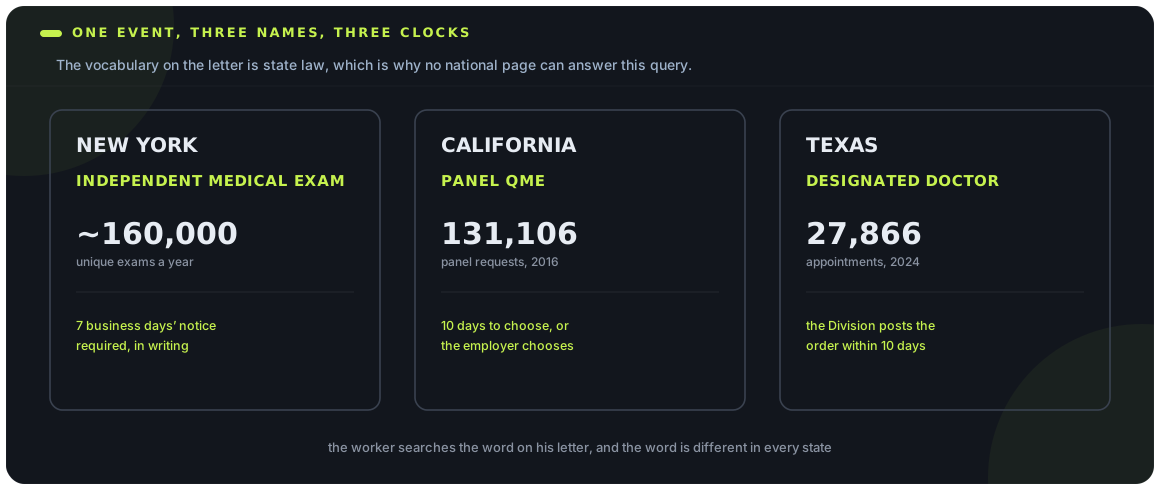
That last column is the opening and the obstacle at the same time. A worker in Fresno is not searching for an “independent medical examination.” He is searching for whatever word is printed on his letter, which is QME panel. A worker in Houston is searching for designated doctor. National legal-content sites, which dominate most comp queries, structurally cannot serve all three well, because the terms are mutually exclusive and the procedures do not transfer. A single well-made page naming one state’s procedure, its form numbers and its actual deadlines will outrank a national page written for nobody in particular — the same mechanism we described in the content engine piece.
One honest caveat on the table: the California figure is from the CHSWC trend report and ends at 2016, which is the most recent panel-request series I could find published. It was rising steeply at the time — 70,730 in 2007 to 131,106 in 2016 — so the current number is very unlikely to be lower, but I am not going to assert a 2026 figure I cannot source.
What you build against a dated event
One field in the CRM, one page per state, one script branch, and a routing rule. None of it is a new channel.
The reason this has gone unbuilt is not that it is hard. It is that nothing in the standard comp marketing stack has a place to put a date that belongs to the prospect rather than to the campaign.
| Change | Where it lives | What it does | Effort |
|---|---|---|---|
| One intake field: “Has anyone scheduled you for an examination? What is the date on the letter?” | Intake script and CRM | Turns an undated enquiry into a dated one. Also qualifies better than “were you denied?”, because an exam means the claim is live and contested without requiring a denial that may never come. | An afternoon |
| A routing rule on that date | CRM / callback queue | An enquiry with an exam eight days out goes to the top of the queue ahead of one with no date at all. This is the first genuinely principled priority rule most comp intakes will ever have. | A day |
| One page per state, named in the state’s own vocabulary | Site | Captures the search the letter produces: the exam’s local name, what it decides, the notice rule, the clock, what the worker may bring and whether he may record it. Information, not advice. | A week per state |
| A reactivation pass over declined and dormant enquiries | Email / SMS / dialler | Every firm has a list of people who called once and did not sign. A material share of them now have an exam date. One question re-qualifies the whole list. | A day, then monthly |
Note what is absent from that table. No new channel. No new budget line. No media test. The entire build is an intake field, a sort order and a page — which is the same conclusion we reached from a different direction in the Intake Playbook, where almost every repairable loss turned out to live in the script rather than in the media.
Then the arithmetic, which is the part that decides whether any of this is worth an afternoon. Across our own book — about $16.5M in managed workers’ comp Meta spend, roughly 219,000 injured-worker leads at around $75 cost per lead, and roughly 21,000 signed cases at around $775 each — the blended close rate is about 9.6%. That $775 figure is not a media number. It is $75 divided by 9.6%.
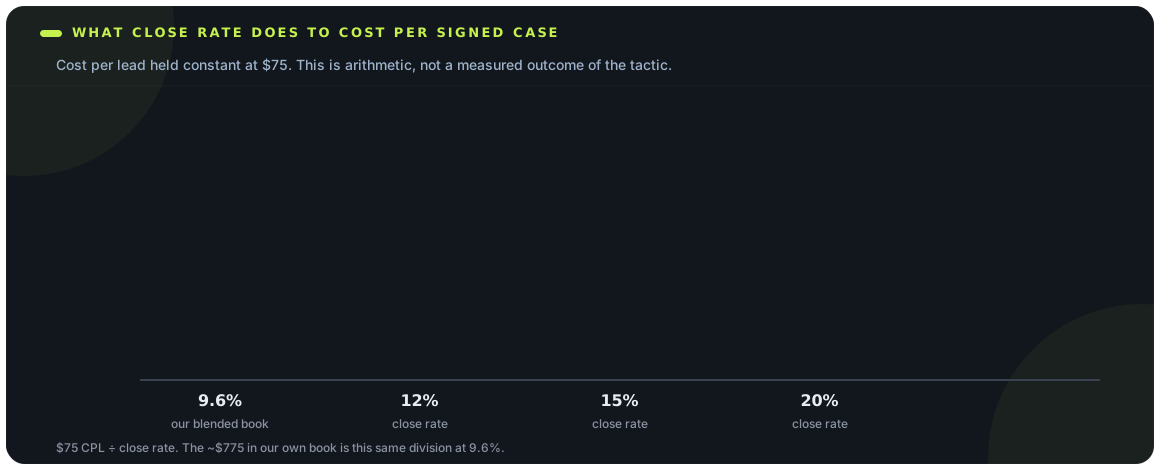
Every point of close rate is worth more than any plausible reduction in lead price, which is the argument of the cost-per-signed-case piece and the reason we keep returning to intake. A segment that arrives already dated, already in the system, already holding a document, and already past the “do I even have a claim” question should close better than a cold enquiry from an interest-targeted ad. How much better is an empirical question about your firm, and you can answer it in a quarter by tagging the segment.
Where this stops
Four limits, and one of them is the thing that would get a firm into trouble.
There is no list. Exam notices are claim-file documents, and claim files are confidential in essentially every jurisdiction. There is no vendor who can sell you the names of workers with an examination next week, and a vendor who says otherwise is describing something you should not buy. Everything in this article is about being findable by a person who is holding a letter, and about asking a better question of people who already called you. It is not about obtaining the letters.
The exam is not a promise. A page about what an examination decides must not shade into a prediction about what it will decide, or into a suggestion that representation changes the medical finding. We have written about what comp firms can and cannot say; this sits squarely inside it. The defensible proposition is that a worker should understand what the appointment is before he attends it, and that is true whether or not he hires anybody.
The representation figures are associations. WCRI’s authors are explicit that the link between attorney involvement and higher payments needs more work before it can be called causal. The 14%-against-64% split is a description of who happens to be represented in each claim type, not evidence that representation created the difference. The timing argument in this piece does not need it to be causal.
And this is a marketing argument, not legal advice. We are a marketing agency, not a law firm. The procedures described here vary by state and are amended often; the California panel-request series ends in 2016, the Texas data are for 2024, and the New York figures come from a 2019 Board advisory committee report. Verify the current rule in your own jurisdiction before you publish a page that quotes a deadline.
Key takeaways
-
Comp marketing is built on two undated events. The injury has no date the worker can reliably give you; the denial may never arrive. The medical-legal exam has a date, a document and a consequence.
-
The exam is not a step towards the decision. Texas reported 27,866 designated-doctor appointments in 2024 and 98.6% of those ratings upheld when disputed. Whatever happens at the appointment is, in practice, what the claim is worth.
-
It sits on the line that separates two markets. WCRI, September 2024: temporary-disability claims are 61% of lost-time claims, 14% represented, averaging $6,918. Permanent-partial and lump-sum claims are 39%, 64% represented, averaging $39,150.
-
Roughly 133,000 impaired, unrepresented claims a year sit in that one sample. They are not a lead-generation problem — they are already in the system, with adjusters and claim numbers and appointment letters.
-
The notice period is written into the rules. Seven business days in New York under 12 NYCRR 300.2(d)(1); a Division order within ten days naming the doctor, address and time in Texas under 28 TAC §127.5.
-
California puts a price on silence. Labor Code §4062.1(c) gives an unrepresented worker ten days to choose the evaluator from the panel; if he does not, the employer may choose instead.
-
The build is an intake field, a sort order and a page. Ask for the exam date, route on it, publish one page per state in that state’s own vocabulary, and re-ask the question of every dormant enquiry you already paid for.
-
There is no list, and there is no promise. Exam notices are confidential claim-file documents; nobody can sell them to you. And a page explaining what an appointment decides must never imply what it will decide.
WorkersComp Marketing is a marketing agency, not a law firm. Nothing here is legal advice and none of it is a prediction about any particular claim. Medical-legal procedure is state law and is amended frequently: the California panel-request series cited ends at 2016, the Texas designated-doctor figures are for 2024, and the New York volumes come from a 2019 Board advisory committee report. Check the current rule in your jurisdiction before publishing any deadline.
Frequently asked questions
What exactly is a “medical-legal examination”?
It is the mechanism a comp act uses to resolve a medical dispute by sending the injured worker to a physician who is not his treating doctor. The names vary by state: New York calls it an independent medical examination, California runs a panel of qualified medical evaluators (or an agreed medical evaluator where both sides consent), Texas assigns a designated doctor. The function is constant. One examination produces one report, and that report becomes the evidence on whether the worker has reached maximum medical improvement, what his impairment is, whether the condition is work-related and whether he can return to work.
Why call the exam the decision rather than evidence?
Because of what happens when it is challenged. The Texas Division of Workers’ Compensation’s April 2026 designated doctor report found that 98.6% of designated doctor ratings were upheld when disputed in 2024, across 27,866 appointments conducted by 304 doctors. A finding that survives challenge 98.6% of the time is, for operational purposes, final. That is a Texas figure about one state’s mechanism and should not be generalised to every state, but it is the clearest published measurement of the point.
Isn’t the denial still the bigger marketing moment?
The denial is a good moment and we are not arguing against marketing to it — we have a whole piece on it. The problem is coverage: most claims are accepted, so most of the market never produces a denial, and the ones that do produce it on no schedule you can see. The exam is different on both counts. It is routine in contested claims, and it is announced in advance in writing. The two are complements, not alternatives: a firm should market to both, and almost every firm markets to only one.
How much advance notice does the worker actually get?
It depends on the state and it is written into the rules. In New York, 12 NYCRR 300.2(d)(1) requires the claimant to receive notice at least seven business days before the examination, with a copy filed with the Board the same day; if the claimant disputes timely receipt, the scheduling party must show mailing at least twelve business days beforehand or overnight delivery at least eight. In Texas, 28 Tex. Admin. Code §127.5 has the Division issue an order within ten days of approving a valid request, naming the doctor, the examination address and the date and time, sent to the injured employee directly. Other states differ and some are less specific.
What is the California ten-day rule?
Labor Code §4062.1 governs medical disputes for unrepresented employees. Subsection (b) lets either party request a panel of three qualified medical evaluators, with the employer barred from submitting the request unless the employee has not done so within ten days of being given the form. Subsection (c) then gives the employee ten days from issuance of the panel to select a physician, schedule the appointment and inform the employer — and provides that if he does not, the employer may select the physician from the panel instead. We are a marketing agency and this is not legal advice; the significance here is that the statute publishes a deadline that an unrepresented worker is unlikely to know about.
How many of these examinations happen?
More than most people assume, though no national count exists. New York’s Board receives roughly 250,000 IME reports a year, corresponding to about 160,000 unique examinations, from a pool of more than 7,700 authorised providers. California’s CHSWC trend report recorded 131,106 QME panel requests in 2016, up from 70,730 in 2007; that series ends at 2016 and we have not found a more recent published figure. Texas reported 27,866 designated doctor appointments in 2024. Those three states alone are on the order of 300,000 scheduled adversarial examinations a year.
Can we buy a list of workers with an exam scheduled?
No, and you should not try. Examination notices are claim-file documents and comp claim files are confidential in essentially every jurisdiction, which is the same reason nobody can sell a list of injured workers for direct mail. Everything in this article works the other way around: being findable by a worker who is holding the letter and searching the word printed on it, and asking a better question of the enquiries your firm has already paid for.
What is the smallest version of this a firm can do this week?
Add one question to the intake script — has anyone scheduled you to see a doctor who is not your own, and what is the date on the letter — and one field in the CRM to hold the answer. Then sort your callback queue by it. That costs an afternoon, requires no new spend, and within a quarter tells you what share of your enquiry volume is already dated and how that segment closes relative to everything else. The page-per-state build is the second step and should be informed by what the first one finds.
Sources & further reading
-
01
Texas — designated doctor volume and how often the rating survives dispute
Texas Department of Insurance, Division of Workers’ Compensation, Research and Evaluation Group, designated doctor report (April 2026), covering 2020–2024. For 2024: 304 designated doctors and 27,866 appointments; 98.6% of designated doctor ratings upheld on dispute; 94% of designated doctors received an average or high performance rating; 84% of reschedule requests arose because the designated doctor was unavailable. The Division notes some 2020 results may reflect COVID-era temporary policy changes.
-
02
Representation and benefits either side of the permanent-impairment line
Bogdan Savych and David Neumark, Impact of Attorney Representation on Workers’ Compensation Payments, Workers Compensation Research Institute (September 2024). Sample of more than 950,000 claims with over seven days of lost time across 31 states. 34% represented overall. Temporary disability claims: 61% of the sample, 14% represented, average benefit $6,918, median $2,198. Permanent partial disability and/or lump sum: 39% of the sample, 64% represented, average $39,150, median $22,653. PPD only 38% represented at $22,292; PPD and lump sum 79% at $55,001; lump sum only 76% at $45,583. Attorney involvement associated with $7,700–$12,400 higher indemnity payments, with the authors cautioning that further research is needed before treating the relationship as causal.
-
03
New York — IME volume, the examiner pool and the seven-business-day notice rule
New York State Workers’ Compensation Board, IME Advisory Committee Recommendations (December 2019). The Board receives approximately 250,000 IME reports a year, corresponding to roughly 160,000 unique examinations; 395,713 IMEs were performed over the 2014–2016 study period; more than 7,700 providers are authorised to perform IMEs. Under 12 NYCRR 300.2(d)(1) the claimant must receive notice at least seven business days before the examination, with proof of mailing at least twelve business days beforehand (or overnight delivery at eight) where receipt is disputed; reports are due within ten business days for in-state examinations; and under 300.2(d)(7) the claimant may be accompanied by a person of his own choosing and the examination may be recorded.
-
04
California — the unrepresented worker’s ten days, and the panel-request series
California Labor Code §4062.1. Subsection (b): the employer may submit the panel request form only if the employee has not submitted it within ten days of being given the form. Subsection (c): the employee has ten days from issuance of the panel to select a physician, arrange the appointment and inform the employer, failing which “the employer may select the physician from the panel to prepare a medical evaluation.” Volume from the Commission on Health and Safety and Workers’ Compensation, Qualified Medical Evaluators: Updating Trends in Evaluations (2017): panel requests rose from 70,730 in 2007 to 131,106 in 2016, against 2,649 registered QMEs in 2016; average cost per QME report rose from $979 in 2007 to $1,654 in 2016. The panel-request series ends at 2016.
-
05
Texas — how the designated doctor appointment is scheduled and notified
28 Tex. Admin. Code §127.5, Scheduling Designated Doctor Appointments. The Division must issue an order within ten days after approving a valid request, notifying the designated doctor, the treating doctor, the injured employee, the employee’s representative and the insurance carrier; the order states the doctor’s name, licence number, examination address, telephone and fax, and the examination date and time or a date range. A rescheduled examination must occur no later than twenty-one days after the original date and may not be moved earlier.
-
06
Our own book — the cost-per-signed-case arithmetic
WorkersComp Marketing managed account data: approximately $16.5M in workers’ compensation Meta ad spend, approximately 219,000 injured-worker leads at an average of roughly $75 cost per lead, and approximately 21,000 signed cases at roughly $775 per signed case — a blended close rate of about 9.6%. The close-rate sensitivity in the fourth figure is arithmetic at a constant $75 CPL ($75 ÷ close rate) and is not a measured outcome of the tactic described in this article.