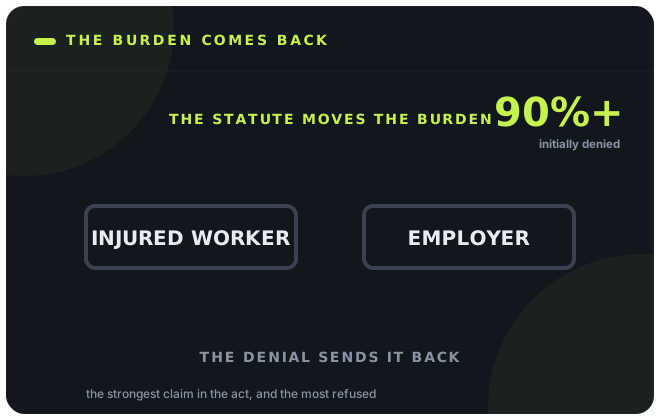
Every piece of workers’ compensation marketing in this country is built on an event. Something happened, on a date, at a place, and it went wrong afterwards. The ad shows the moment. The landing page asks when it was. The intake script opens with a version of tell me what happened. The whole apparatus assumes that the thing being marketed to is an incident, and that the worker knows he had one.
There is one population in American workers’ compensation for which none of that is true, and it is the only population the law has deliberately put ahead of the starting line.
What follows is an argument about that population, and it has an uncomfortable shape. The claim is not that presumption-eligible workers are underserved because nobody has noticed them. It is that they are underserved because the statute looks like it already solved their problem — and that the data from four states and one 222-page government study says it has not.
The only head start the act gives anybody
Every other advantage in comp is won after the fact. This one is written into the act before anything happens.
A workers’ compensation presumption is a rule of proof. In an ordinary claim the worker must establish that the condition arose out of and in the course of employment; if the medical evidence is genuinely balanced, he loses, because the person carrying the burden loses a tie. A presumption inverts that. For a defined worker with a defined condition, the act treats work causation as established and requires the employer to prove otherwise. If the evidence is balanced, the worker wins.
That is a larger structural advantage than anything marketing can manufacture, and it exists because the underlying science made the ordinary rule unworkable. In 2022 the International Agency for Research on Cancer reclassified occupational exposure as a firefighter as Group 1, carcinogenic to humans. The exposure is real, it is cumulative over a career, and it is impossible for any individual firefighter to trace his bladder cancer to a particular fire. Legislatures responded by moving the burden rather than asking for proof nobody can produce. Congress did the same thing for its own workforce with the Federal Firefighters Fairness Act of 2022.
So: a legally privileged class of claimant, identified by occupation, named in a statute, in every state in the union. If that population were being served, you would expect to see it in the claim counts.
And it is the most refused claim in the system
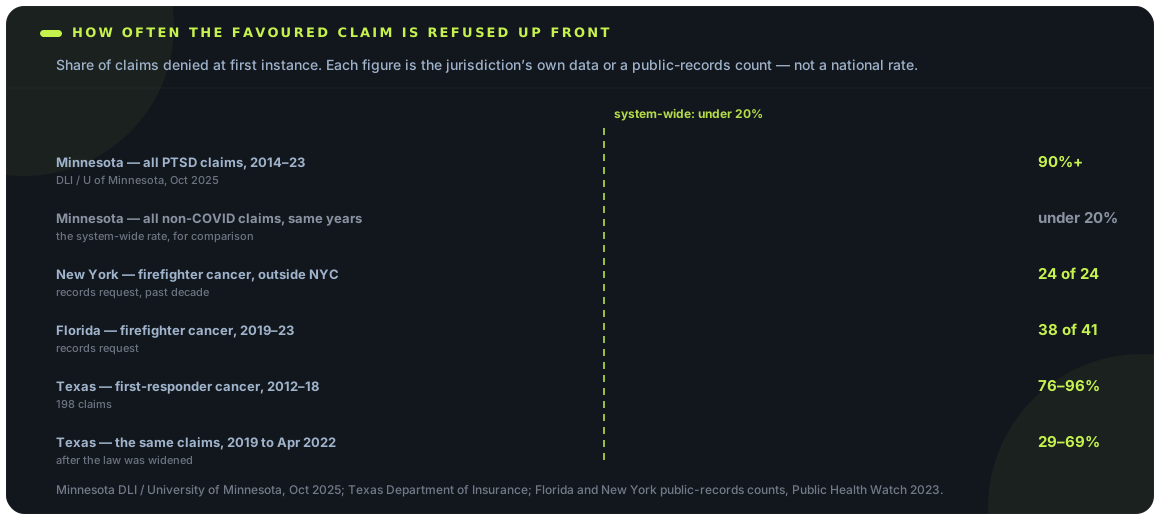
Four jurisdictions measured it independently. The claim the statute favours is denied at rates the rest of the system never approaches.
The strongest evidence comes from Minnesota, because Minnesota studied itself. The legislature ordered the work in 2023; the Department of Labor and Industry and the Midwest Center for Occupational Health and Safety at the University of Minnesota delivered a 222-page report in 2025 covering 1,786 PTSD claims with injury dates from January 2014 to June 2023.
The headline finding is the one that should be read twice. Insurers issued an initial denial of primary liability on more than 90% of PTSD claims over those years. Over the same period, the initial denial rate for all non-COVID claims in the system did not exceed 20%. Minnesota enacted a first-responder PTSD presumption in 2019. The denial rate for the presumption occupations did not fall afterwards — and from 2017 onwards those workers were denied at a higher rate than PTSD claimants in other occupations.
Minnesota is not an outlier, and the other evidence comes from a different direction entirely: public-records counts of firefighter cancer claims, compiled by Public Health Watch in 2023.
Texas. Between 2012 and 2018, employers initially rejected between 76% and 96% of the 198 cancer claims filed by first responders. Texas broadened its presumption in 2019 — and from 2019 through April 2022, Texas Department of Insurance data show first responders were still denied between 29% and 69% of the time. Widening the statute halved the refusal rate and did not remove it.
New York. Over the past decade, 24 salaried firefighters outside New York City filed cancer claims. Every single one was initially denied. Four were ultimately approved.
Florida. From 2019 to early 2023, 41 cancer claims were filed and 38 were initially denied. Four of those produced some benefits.
It also takes a long time to undo. San Jose’s own data, obtained by records request, put the average cancer claim at two years to resolve, with some running to six. A career-ending diagnosis and a two-year argument about whether the job caused it is the actual service problem here, and it is the reason the gap matters to anybody selling marketing.
Why the favour produces the refusal
Two mechanisms, neither of which requires anybody to be acting in bad faith.
The first is who pays. Presumption occupations are overwhelmingly public employees, and public employers are the most heavily self-insured segment of the comp system — cities, counties, fire districts and the public risk pools they join. We have written about what it means when there is no insurance company; this is that article’s sharpest case. When a city is self-insured, the decision to accept a cancer claim and the budget that pays for it sit in the same building, and the person making the decision reports to the people who set the levy. A presumption does not change that arithmetic. It changes the paperwork.
The second is stakes. A presumption attaches to conditions that are expensive: occupational cancers, cardiac events, career-ending psychiatric injuries. Ordinary comp claims are mostly small — three in four never pay a day of wage benefit at all. The claims a presumption covers are at the other end of the distribution, and expensive files get contested, which is a different sentence from saying they get contested unfairly. The statute moved the burden of proof. It did not move the decision about whether to pay, which still begins with the employer and its administrator.
There is one more finding in the Minnesota data that bears directly on case value, and we flag it carefully because the report gives it without numbers. It observes that early denials may lead to more claims being resolved through legal settlements, and that claims in the presumption occupations settle at a higher rate. Read against the denial figures, that describes a population whose claims are refused first and litigated later — which is to say, a population that ends up represented, eventually, by somebody.
A presumption is a test, not a grant
Five conditions, every one of which moves between states, and the marketing that gets this wrong is worse than no marketing.
If a firm takes one operational thing from this article, it should be this. A presumption is not a statement that a firefighter’s cancer is covered. It is a conditional, and the conditions are specific, numerous and wildly inconsistent across state lines.
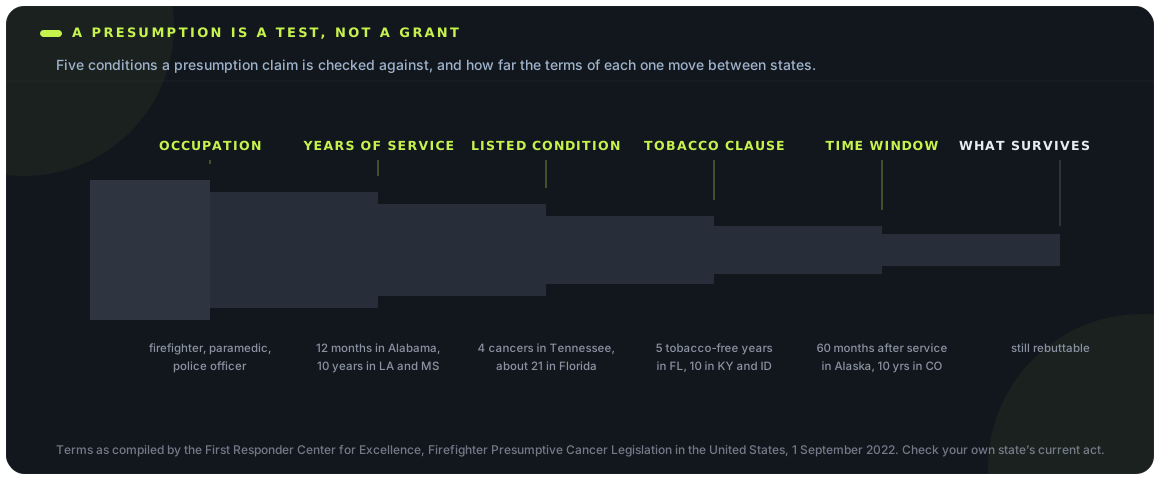
Take the service requirement alone. Alabama’s presumption reaches a firefighter who has served twelve consecutive months. Colorado requires ten years of continuous service for part-time firefighters. Louisiana and Mississippi require ten or more years. Pennsylvania requires four or more years of continuous firefighting duties. A worker in his third year is inside the statute in one state and outside it in the next one over.
The condition lists diverge just as sharply. Tennessee and Utah name four cancers. Alaska names nine. Alabama names about twenty. Florida names about twenty-one. The tobacco clauses are their own trap: Florida requires no tobacco use for at least the preceding five years, Kentucky ten years before diagnosis, Idaho bars the presumption after ten or more years of use, and Vermont excludes any use within ten years of diagnosis. NCCI counted nine of its thirty-eight jurisdictions with an explicit non-smoker clause limiting the lung-cancer presumption.
| The gate | What it tests | How far the terms move | Why it matters to intake |
|---|---|---|---|
| Occupation | Whether the worker is inside the statutory definition at all | Firefighters nearly everywhere; police, paramedics, EMTs, correctional officers and dispatchers only in some states and only for some conditions | It is a question about identity, not about an event — and no standard comp script asks it |
| Years of service | Tenure in the covered role | 12 consecutive months in Alabama; 4+ continuous years in Pennsylvania; 10 years in Louisiana and Mississippi, and for part-time firefighters in Colorado | A single follow-up question separates a presumption claim from an ordinary one |
| Listed condition | Whether the diagnosis is on the state’s schedule | 4 cancers in Tennessee and Utah; 9 in Alaska; about 20 in Alabama; about 21 in Florida | Determines whether the answer is “presumed” or “prove it” — two different cases |
| Tobacco clause | Smoking history, where the statute makes it disqualifying | No use for the preceding 5 years in Florida; 10 years in Kentucky; 10+ years of use bars it in Idaho; no use within 10 years of diagnosis in Vermont. NCCI counted 9 of 38 jurisdictions with an explicit clause | The single most common reason a presumption a firm advertised does not apply to the caller in front of it |
| Time window | How long after service ends the presumption still runs | 60 months after the last date of employment in Alaska; 10 years after employment ends in Colorado; 5 years in Massachusetts; the first 300 weeks in Pennsylvania, with claims allowed to 600 | Retired members are inside or outside depending on a number nobody publishes in plain language |
Where it exists, and for what
Universal for firefighter cancer. Much narrower for everything else, and newest where the denial rates are worst.
Coverage depends entirely on which condition you mean. For firefighter cancer, the First Responder Center for Excellence reported in September 2022 that every state, the District of Columbia and the federal system had some form of presumptive legislation — a remarkable shift, given that not long before, more than half the states had none.
For everything else the picture thins out fast. Across the thirty-eight jurisdictions NCCI provides ratemaking services for, as at 1 November 2022, twenty had a cancer presumption available to firefighters, nineteen a heart or vascular presumption, eighteen a lung or respiratory presumption and thirteen a blood or infectious disease presumption.
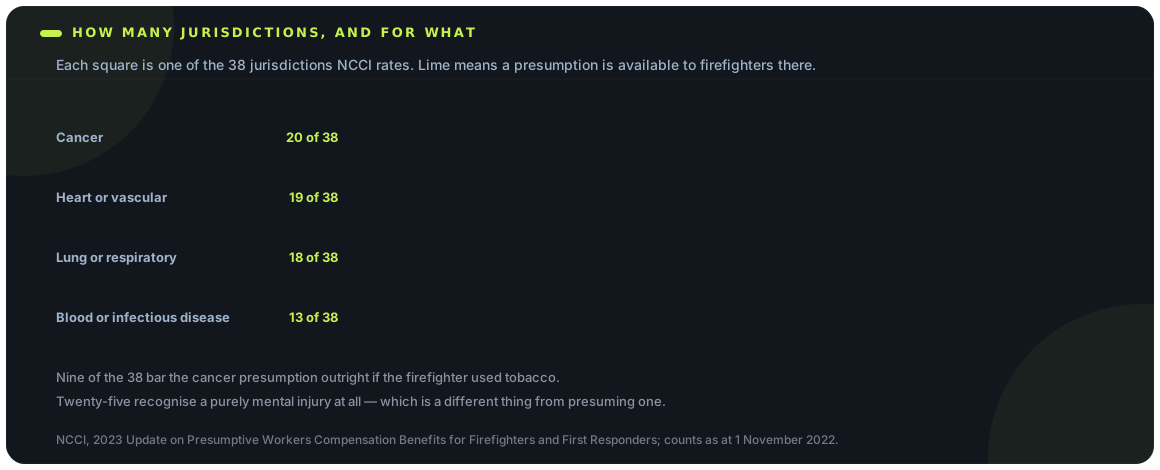
Mental injury is the newest and the most uneven. NCCI noted that at least twenty-five of its jurisdictions recognise a purely mental injury as compensable at all — which is a different and weaker thing than presuming one — and that six jurisdictions had added firefighter mental-injury presumptions since its 2018 review, five of which also covered other first responders. Minnesota’s 2019 presumption sits in that recent wave, and Minnesota’s is the one that produced a 90% denial rate. The newest presumptions are the most contested, which is what you would expect and which argues against treating a statutory amendment as the end of a problem.
An audience that exists before the injury does
Every other comp prospect is invisible until something happens to him. This one is identifiable today, by what he does for a living.
Here is the part that is actually novel for a marketer, and it follows from the structure rather than from the denial data.
Comp marketing has no pre-need audience. You cannot address a warehouse worker as a future claimant, because until the pallet falls he is not one, and nothing distinguishes him from the hundred million other people who will never file. That is why comp is an event-triggered, high-intent, bid-against-everybody market: the only moment a prospect becomes visible is the moment every competitor can see him too.
Presumption populations break that rule. They are defined by occupation, which is a durable identity rather than an event. A firefighter is a firefighter for twenty years. He belongs to a station, a department, a local, an association and a conference circuit. He can be reached continuously, in channels that exist for reasons unrelated to law, long before the diagnosis that would make him a client — and the thing he needs to hear is not an advertisement but a fact about his own statute that nobody has told him.
That third number is the honest limit on all of this. The Bureau of Labor Statistics counted 655,890 police and sheriff’s patrol officers, 321,450 firefighters and 167,720 EMTs in May 2022. Against a national workforce in the order of 160 million, the core presumption occupations are well under one per cent of workers — and Minnesota found PTSD claims were likely about one per cent of all non-COVID claims reported in 2022. This is a narrow audience with deep cases, not a volume channel, and anybody who tells you otherwise is selling you something.
What to build, and what it costs
Two things that cost no media, one measurement that costs an afternoon, and an honest warning about the third thing.
One. The page that answers the actual query. A worker who hears that his state presumes his cancer is job-related does what everybody does: he searches for the terms. What comes back is national content that cannot name his state, defence-side advisories written for employers and carriers on how the presumption is rebutted, and advocacy material celebrating that the law passed. Almost nothing states, plainly, for one state and one occupation: these are the covered conditions, this is the service requirement, this is the tobacco clause, this is how long after you retire it still runs, and here is what happens next if it is denied. That page is cheap to build, it ages slowly, and it is the only asset in this article that compounds.
Two. The branch in the intake script. This is close to free and it is where the recoverable volume is. A presumption claim fails a standard comp screen for the same structural reason a cumulative trauma claim does: there is no accident and no date, so the first two questions produce nothing usable and the call is dispositioned out. We have argued before that the largest output of a firm’s marketing is the enquiries it turns away. These are the ones most worth re-reading.
| What the script asks now | What this caller answers | What to ask instead | Why it finds him |
|---|---|---|---|
| “What happened, and when?” | Nothing happened. There is no date. | “What do you do for a living, and how long have you done it?” | Tests the two facts a presumption actually turns on: occupation and tenure |
| “Was your claim denied?” | He has not filed one. | “Has anything been filed with your employer or the board yet?” | Separates a non-claim from a denied claim — two completely different calls |
| “Are you off work?” | He may be working, retired, or on treatment leave. | “When were you diagnosed, and are you still in the job?” | Captures the diagnosis date and the post-service window in one question |
| (not asked) | — | “Has anyone told you your state has a presumption for this?” | Establishes whether the caller knows the single fact that changes his case, which is usually no |
Three, and here is the warning. Buying media against this audience is the expensive move, not the cheap one, and the arithmetic says so. Across the book we manage — roughly $16.5M of workers’ comp Meta spend, about 219,000 injured-worker leads at an average $75 cost per lead and about 21,000 signed cases — a thousand leads costs $75,000 and produces around 96 signed cases at a blended close rate near 9.6%, which is about $775 per signed case. That number depends on buying a broad injured-worker audience cheaply. Narrowing to an occupational audience that is under one per cent of the workforce moves cost per lead in the wrong direction, and it has to be paid back by a higher close rate or a larger case. It may well be. But it is a hypothesis to test after the page and the script branch are in place, not before — and the honest version of cost per signed case is the only place that test can be settled. The Growth Library has the intake and measurement material in longer form.
Where this stops
Four limits, including one that rules out the obvious shortcut and one that constrains the data in this article.
You cannot buy the list. There is no public register of firefighters with a new diagnosis, and direct solicitation of identified injured people is restricted in most jurisdictions however the names were obtained. Union and association channels are relationship channels, not list channels, and they are governed by their own rules and their own gatekeepers. What is available is being findable, being accurate, and being ready when somebody calls.
The denial figures are not a national rate. Minnesota’s is a state-commissioned study of one state’s PTSD claims. The Texas, Florida and New York figures are counts obtained by records request and reported by a non-profit newsroom, covering different periods and different definitions of “denied”. They point the same way, consistently, which is why we treat the pattern as real — but no single percentage in this article should be quoted as the American denial rate for presumption claims, because no such figure exists.
The presumption lists move. The state-by-state terms here come from a compilation dated 1 September 2022, and the NCCI counts are as at 1 November 2022. Presumption statutes are among the most actively amended provisions in workers’ compensation; several states have changed theirs since. Check the current act before you publish a page that names a number.
And this is a marketing argument, not legal advice. We are a marketing agency, not a law firm. Whether any particular worker is inside any particular presumption is a question of law applied to facts no article can know.
Key takeaways
-
A presumption is the only head start in the act. For a listed worker with a listed condition the statute does not ask him to prove work caused it — it requires the employer to prove it did not. If the evidence is balanced, he wins instead of losing.
-
It is universal for firefighter cancer. All fifty states, the District of Columbia and the federal system had some form of presumptive cancer coverage for firefighters as at September 2022. For other conditions it is far narrower.
-
And those claims are the most refused in the system. Minnesota: more than 90% of PTSD claims initially denied, 2014–23, against under 20% for all non-COVID claims. Texas: 76–96% of 198 first-responder cancer claims. Florida: 38 of 41. New York: 24 of 24.
-
Widening the statute halved the refusal, not removed it. After Texas broadened its presumption in 2019, Department of Insurance data still show first responders denied 29–69% of the time through April 2022.
-
The right is barely exercised. NCCI observed roughly 180 firefighter cancer claims across its 38 jurisdictions since 2004, and only 30 of more than 25,000 federal firefighter claims since 2013 involved a cancer or tumour diagnosis.
-
It is a test, not a grant. Five gates, all of which move: occupation, years of service (12 months in Alabama to 10 years in Louisiana), listed condition (4 cancers in Tennessee to about 21 in Florida), tobacco clauses, and a post-service window.
-
This is the only comp audience that exists before the injury. It is defined by occupation rather than by an event, so it can be reached continuously — but it is also well under one per cent of the workforce, which makes it a page-and-script problem before it is a media one.
WorkersComp Marketing is a marketing agency, not a law firm. Nothing here is legal advice and none of it is a prediction about any particular claim. Presumption statutes are among the most frequently amended provisions in workers’ compensation; the state-by-state terms cited here come from a compilation dated 1 September 2022 and the NCCI jurisdiction counts are as at 1 November 2022, and several states have amended theirs since. The denial figures are from one state-commissioned study and from public-records counts in three states, covering different periods and different definitions of denial; none of them is a national rate and no national rate exists. The cost-per-signed-case figures are our own measured cost per lead and close rate across the book we manage, and are not a forecast of any firm’s results. Check your own state’s current act and your own data before acting on any of it.
Frequently asked questions
Is a presumption the same thing as an automatic win?
No, and treating it as one is the mistake that costs the claim. Almost every presumption in American workers’ compensation is rebuttable: it moves the burden of production and in most states the burden of persuasion onto the employer, so the worker does not have to prove that the job caused the condition and the employer has to prove that it did not. What happens in practice is that the employer contests it. Minnesota’s own study of 1,786 PTSD claims with injury dates between January 2014 and June 2023 found that insurers issued an initial denial of primary liability on more than 90% of them, while the initial denial rate for all non-COVID claims over the same years did not exceed 20%.
Which workers actually have a presumption?
In the main, first responders: firefighters, police officers, paramedics and EMTs, and in some states correctional officers, dispatchers and other public employees. The conditions covered vary. For firefighter cancer the First Responder Center for Excellence reported in September 2022 that all fifty states, the District of Columbia and the federal system have some form of presumptive cancer coverage. For other conditions the coverage is narrower: across the 38 jurisdictions NCCI rates, 20 had a cancer presumption available to firefighters as at 1 November 2022, 19 a heart or vascular presumption, 18 lung or respiratory and 13 blood or infectious disease. Mental-injury presumptions are newer and patchier.
Why would the employer deny a claim the statute favours?
Two reasons, and neither requires bad faith. The first is who pays: first responders are public employees, and public employers are heavily self-insured or sit inside public risk pools, so the denial decision and the money are in the same building rather than at an insurer. The second is that a presumption raises the stakes of the individual claim — an occupational cancer or a career-ending psychiatric injury is an expensive file — and expensive files get contested. The statute changed who has to prove causation. It did not change who decides, in the first instance, whether to pay.
What are the conditions attached to a presumption?
Typically five, and all of them vary by state. Occupation, which is usually defined by statute rather than by job title. Years of service: Alabama requires twelve consecutive months, while Colorado’s part-time firefighters and Louisiana and Mississippi require ten years. The condition itself must be on a list: Tennessee and Utah name four cancers, Alaska nine, Alabama about twenty and Florida about twenty-one. Tobacco clauses bar the presumption in some states — Florida requires no tobacco use for the preceding five years, Kentucky, Idaho and Vermont ten. And there is a window after service ends: sixty months in Alaska, ten years in Colorado, five years in Massachusetts, and in Pennsylvania the presumption applies within the first three hundred weeks with claims allowed up to six hundred.
How big is this audience?
Small, and that is the point. The Bureau of Labor Statistics counted 655,890 police and sheriff’s patrol officers, 321,450 firefighters and 167,720 EMTs in May 2022. Against a national workforce in the order of 160 million, the presumption-eligible occupations are well under one per cent of workers. Minnesota found PTSD claims were likely about one per cent of all non-COVID claims reported in 2022. This is not a volume play and we would not sell it as one. It is a small, named, continuously reachable audience whose claims carry an unusual ratio of entitlement to receipt.
Why does our intake never sign these callers?
Because a comp intake script asks what happened and when, and a presumption claim has no answer to either question. A firefighter with bladder cancer cannot name an accident. A dispatcher with PTSD cannot name a date. There is no injury event, no denial letter in hand at the moment of the call, and frequently no claim filed at all — NCCI observed roughly 180 firefighter cancer claims across its jurisdictions since 2004, which is not what a Group 1 occupational carcinogen produces in two decades. The questions that find this caller are about identity and diagnosis: what do you do for a living, how long have you done it, when were you diagnosed, and has anyone filed anything.
Is this a campaign or a page?
A page and a script branch, not a campaign. The honest build is one page per occupation per state setting out that state’s actual terms — the covered conditions, the service requirement, the tobacco clause, the window after service — because that is the query this audience has and it is currently answered mostly by defence-side material and by national pages that cannot name a state. Then an intake branch that asks occupation, tenure and diagnosis date. Buying media against a sub-one-per-cent occupational audience is a separate decision and usually a later one.
Sources & further reading
-
01
Minnesota — the denial rate on the claims the statute favours
Minnesota Department of Labor and Industry with the Midwest Center for Occupational Health and Safety, University of Minnesota, Evaluating PTSD claims in Minnesota’s workers’ compensation system: Findings and recommendations (October 2025), commissioned by the legislature in 2023. Analytic cohort of 1,786 PTSD claims with injury dates January 2014 to June 2023, plus 1,030 other mental injury claims. Insurers issued an initial denial of primary liability on more than 90% of PTSD claims over 2014–2023; the initial denial rate for all non-COVID claims over the same period did not exceed 20%. Police officers were the largest occupation group among presumption workers in the study, presumption-occupation claims settled at a higher rate, and PTSD claims were likely about 1% of all non-COVID claims reported in 2022.
-
02
Texas, Florida and New York — public-records counts of firefighter cancer claims
Public Health Watch, State Laws Favor Workers’ Comp Benefits for Firefighters With Cancer. Cities and Counties Keep Denying Them. (3 March 2023). Texas: employers initially rejected 76% to 96% of 198 cancer claims filed by first responders between 2012 and 2018; after the 2019 broadening of the presumption, Texas Department of Insurance data show first responders still denied 29% to 69% of the time through April 2022. New York: 24 salaried firefighters outside New York City filed cancer claims over the past decade and every one was initially denied, with four ultimately approved. Florida: 38 of 41 cancer claims filed from 2019 to early 2023 were initially denied, four producing some benefits. Federal: more than 25,000 claims since 2013, only 30 involving a cancer or tumour diagnosis. San Jose: cancer claims averaged two years to resolve, some up to six.
-
03
How many jurisdictions, and for what
NCCI, 2023 Update on Presumptive Workers Compensation Benefits for Firefighters and First Responders. As at 1 November 2022, of the 38 jurisdictions in which NCCI provides ratemaking services: 20 had a cancer presumption available to firefighters, 19 a heart or vascular presumption, 18 a lung or respiratory presumption and 13 a blood or infectious disease presumption. Nine jurisdictions limit the lung-cancer presumption with an explicit non-smokers clause. At least 25 recognise “mental-mental” injuries as compensable, which is general compensability rather than a presumption. Six jurisdictions added firefighter mental-injury presumptions after NCCI’s 2018 update, five of them covering other first responders too. The brief also reports approximately 180 firefighter cancer claims and approximately 500 firefighter heart attack claims occurring since 2004 across those jurisdictions.
-
04
The state-by-state terms of the firefighter cancer presumption
First Responder Center for Excellence, Firefighter Presumptive Cancer Legislation in the United States (1 September 2022). Reports that all 50 states, the District of Columbia and federal firefighters have some type of presumptive cancer law. Service requirements cited include 12 consecutive months (Alabama), 4+ continuous years (Pennsylvania), 10 years (Louisiana, Mississippi, and Colorado part-time firefighters). Condition lists range from 4 types (Tennessee, Utah) to 9 (Alaska), about 20 (Alabama) and about 21 (Florida). Tobacco look-backs include 5 years (Florida) and 10 years (Kentucky, Idaho, Vermont). Post-service windows include 60 months (Alaska), 10 years (Colorado), 5 years (Massachusetts) and the first 300 weeks with claims to 600 (Pennsylvania). The provisions excerpted are predominantly rebuttable.
-
05
Why the presumptions exist — the underlying classification
International Agency for Research on Cancer, Monograph 132, Occupational exposure as a firefighter, summarised in The Lancet Oncology (2022). The IARC working group classified occupational exposure as a firefighter as Group 1, carcinogenic to humans. Federal firefighters obtained a statutory presumption under the Federal Firefighters Fairness Act of 2022.
-
06
How many people are in these occupations
US Bureau of Labor Statistics, Occupational Employment and Wage Statistics, May 2022, as presented in the agency’s TED note recognising first responders: 655,890 police and sheriff’s patrol officers, 321,450 firefighters and 167,720 emergency medical technicians. Paramedics are reported separately and the note gives no combined first-responder total.