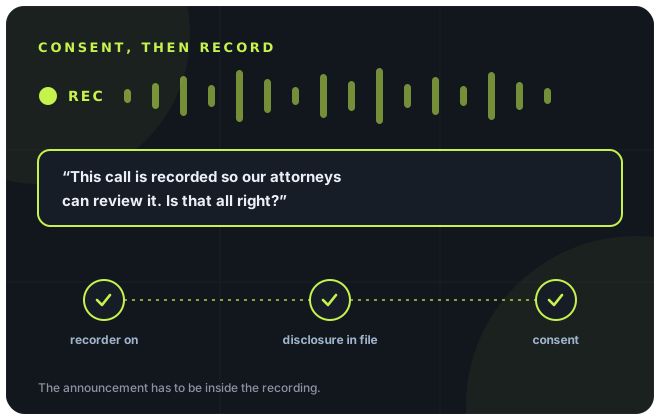
There is a single file that decides whether a workers’ compensation firm’s marketing can be improved or merely spent. Not the ad account, not the analytics dashboard, not the CRM report. The recorded intake call — eight minutes of audio in which an injured worker explains what happened and a human being either signs them or loses them.
Everything downstream of that file is an interpretation of it. The quality scorecard is a reading of recordings. The attribution that decides where next month’s budget goes is, in the end, somebody listening to calls and marking which ones were real. The creative feedback loop — the thing that tells an ad account that one video produces callers who sign and another produces callers who wanted a free consultation about a car accident — cannot exist without the audio. Switch off recording and a firm does not lose a feature. It loses the instrument.
Which is why it is worth knowing that this one asset, alone among everything in the marketing stack, carries a price per unit written into statute by a legislature. And that the legislature in question is probably not the one in your state.
So the claim of this article, stated plainly: a comp firm’s recorded intake calls are governed by the law of the place the caller is sitting, not the place the firm is sitting — which makes all-party consent, announced inside the recording, the only posture that survives a market that crosses a state line. And the two ways firms get it wrong are both defaults nobody chose: a beep instead of a sentence, and a recorder that starts after the greeting instead of before it.
What rests on a recording
Start with why this is a marketing article and not a compliance memo.
A firm spending $20,000 a month on injured-worker leads has, broadly, two levers: what it pays per lead and what share of those leads it signs. The first is set by an auction and by the quality of the audience. The second is set almost entirely by what happens on the phone — who answers, how fast, in what language, with what script, at what hour.
You cannot work on the second lever without listening. Not metaphorically: literally, somebody has to play the calls. A missed-call report tells you a call was missed. It does not tell you that the caller said “my supervisor told me not to file” in the first thirty seconds and the intake specialist moved straight to collecting an email address. That finding lives in the audio and nowhere else, and it is worth more than any change you can make in the ad account.
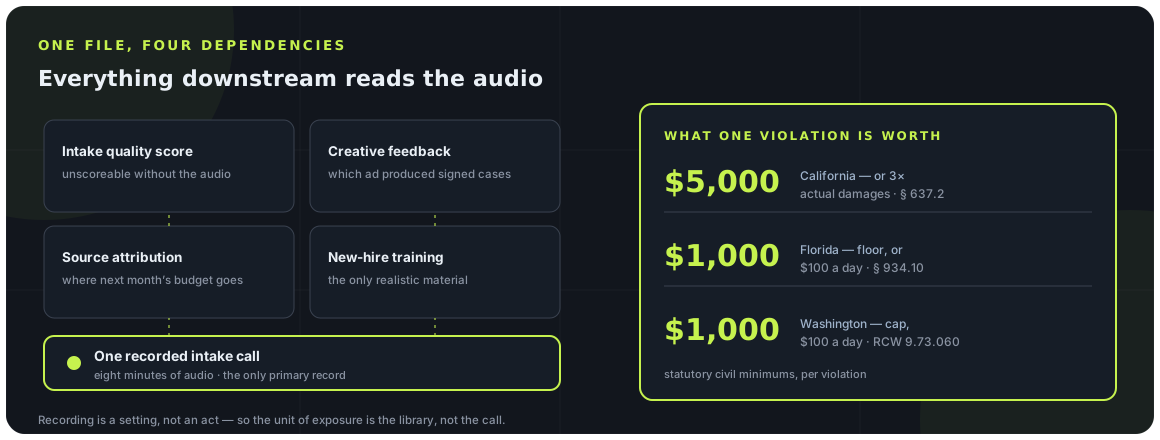
The figure is also a warning about concentration. One artefact underpins four functions, which is efficient right up to the point where a single configuration mistake makes that artefact a liability rather than an asset. Nothing else in the stack has that property. A badly tagged conversion event costs you accuracy. A badly consented recording is a different category of object.
The map that applies is the caller’s
Federal law sets a floor that is easy to clear. The states set ceilings that are not uniform, and you do not get to pick which one you are under.
The baseline is simple and it is permissive. Federal law requires the consent of at least one party before recording a phone call, and a party to the call supplies that consent itself. That is the national minimum, and states are free to be stricter.
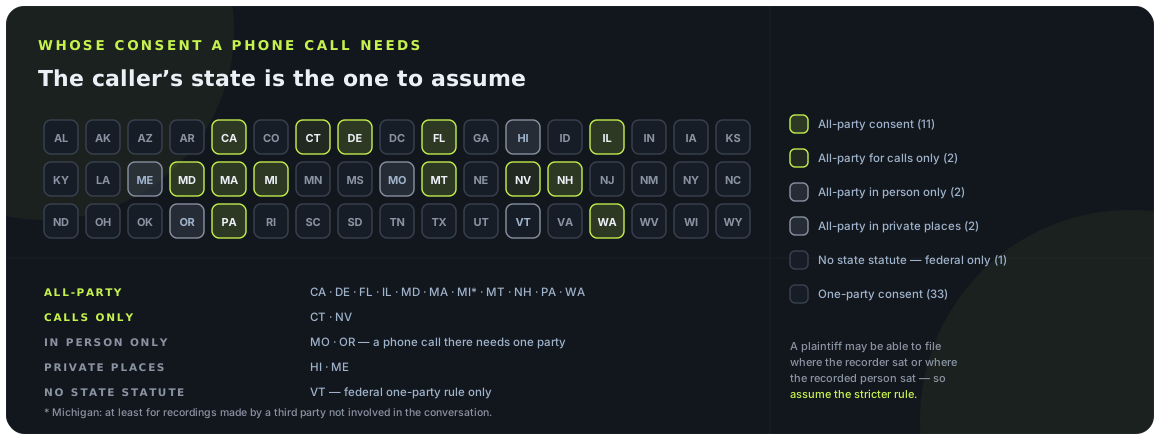
Many are. On the Reporters Committee for Freedom of the Press’s reading, about eleven states primarily have all-party consent requirements — California, Delaware, Florida, Illinois, Maryland, Massachusetts, Michigan (at least for recordings made by a third party who is not involved in the conversation), Montana, New Hampshire, Pennsylvania and Washington. Two more, Connecticut and Nevada, require all parties’ consent for phone calls while needing only one party’s for in-person conversations. Missouri and Oregon are the mirror image: all-party in person, one-party on the phone. Hawaii and Maine require all parties’ consent only in particularly private places. Vermont has no state recording statute at all, so the federal rule is the only one that applies there.
| Group | Jurisdictions | What it means for an inbound intake line |
|---|---|---|
| Federal floor | Everywhere, 18 U.S.C. §§ 2510, 2511 | One party’s consent; as a party to the call, you are it |
| All-party, primarily | CA, DE, FL, IL, MD, MA, MI (qualified), MT, NH, PA, WA | Every participant must consent — so the caller must be told and must continue |
| All-party for calls only | CT, NV | Same requirement on the phone; looser in person |
| All-party in person only | MO, OR | Phone calls need one party — the common error is listing these as all-party |
| All-party in private places | HI, ME | Fact-dependent; treat an injury conversation as private |
| No state statute | VT | Federal rule only |
Now the part that matters for a firm rather than a journalist. The Reporters Committee’s own guidance on interstate calls is to assume the stricter state’s law applies, and it explains why the question is genuinely unsettled: some courts have held that the law of the state where the recording device sits governs, others that it is the state where the recorded person sits — so an aggrieved party may be able to file in either, choosing whichever rule is more favourable.
Hold that against how comp firms actually buy media. A Philadelphia firm runs ads that serve into South Jersey. A Chicago firm’s map pack results show up for searchers in Indiana. A firm in Kansas City, Missouri — a one-party state for calls — takes half its calls from Kansas, and a Spanish-language campaign reaches whoever it reaches. There is no configuration of a call platform that reads the caller’s statute and applies it. There is only a decision about which standard the firm meets for everybody.
The provision with no privacy test
California has two statutes, and the one everybody quotes is the softer of the two.
The familiar California provision is Penal Code § 632, which makes it an offence to record a confidential communication without the consent of all parties. The word doing the work there is “confidential”: the section defines it as a communication carried on in circumstances indicating a party wanted it confined to the parties, and expressly excludes circumstances in which the parties could reasonably expect to be overheard or recorded. That is a test, and tests can be argued about.
There is a second provision, and it has no such test. Penal Code § 632.7 applies to any communication transmitted between two cellular phones, or between a cellular phone and a landline, or involving a cordless phone — and it prohibits intercepting or receiving and intentionally recording such a communication without the consent of all of the parties. Read it again and notice what is missing: there is no confidentiality requirement, no reasonable-expectation inquiry, no carve-out for a conversation the caller might have expected to be recorded. The category is defined by the handset, not by the content.
Injured workers call from mobile phones. They call from a truck cab, a hospital car park, a break room. In practice, a comp firm’s California inbound is overwhelmingly § 632.7 traffic, which means the provision that applies to it is the one with no argument available about expectations.
A beep is a sound a court was invited to treat as consent, and did not. A sentence the caller can act on is a different object.
The recorder runs first
This is the operational finding, and it is one line of a statute that almost nobody implementing a call platform has read.
Washington’s recording statute, RCW 9.73.030, makes it unlawful to record a private communication transmitted by telephone without first obtaining the consent of all the participants. Then subsection (3) tells you how that consent may be obtained, and attaches a proviso:
“Where consent by all parties is needed pursuant to this chapter, consent shall be considered obtained whenever one party has announced to all other parties engaged in the communication or conversation, in any reasonably effective manner, that such communication or conversation is about to be recorded or transmitted: PROVIDED, That if the conversation is to be recorded that said announcement shall also be recorded.”
Two things are being specified there, and the second is the one that gets missed. The first is that an announcement in a reasonably effective manner is enough — you do not need a signed form, you need to tell people. The second is a sequencing requirement: if the call is going to be recorded, the announcement has to be in the recording. Which means the recorder has to be running before the sentence is spoken.
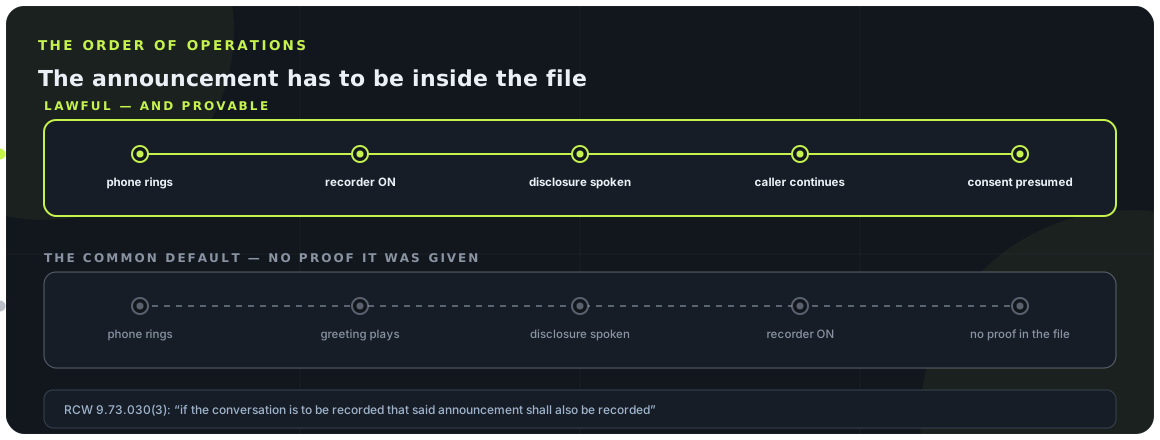
Now go and look at how a call-tracking stack is usually configured. The inbound call hits a tracking number. A whisper message or an IVR greeting plays. The call is routed. Recording begins when the call connects to the agent — because that is the part anybody wanted to listen to, and because starting the recorder earlier fills your storage with hold music. The disclosure, if it exists at all, is in the greeting that played before the recorder started.
The result is a firm that is doing the right thing and has no evidence of it. Every recording in the library begins at the moment the intake specialist says hello, and nothing in any file shows the caller was told. That is not a technicality in a state whose statute names the requirement explicitly.
Who else is on the call
Your consent as a party covers your conduct. It does not obviously cover the software.
Almost no firm records calls itself. The audio runs through a call-tracking platform, often a second platform for transcription, increasingly a third for AI summarisation or scoring, and then into the CRM. Each of those is a separate entity receiving the contents of a conversation between a law firm and an injured worker.
There is an active strand of California litigation built on exactly that observation. The theory runs through Penal Code § 631, the older wiretapping provision, and treats a third-party service that receives communication contents as an eavesdropper in its own right — a party’s own consent being beside the point, because the party is not the one being complained about. In Ambriz v. Google, a federal court in the Northern District of California declined in February 2025 to dismiss claims against the provider of an AI contact-centre product used by businesses’ customer service lines, on the reasoning that the provider was a third party because it had the capability to use the call data for its own purposes — model training among them — whether or not it actually did.
Be careful about how much weight that carries. It is a district-court ruling on a motion to dismiss, not a judgment, and courts are genuinely split: some require that the vendor actually used the data for its own benefit, others that it merely could. The honest summary is that the question is open and that the answer currently depends on which courthouse you are in. What is not open is the practical implication for a firm choosing vendors.
| Question | What a good answer looks like | Why it matters |
|---|---|---|
| Can recording start before the greeting? | Yes, configurable per number | The announcement has to be inside the file |
| Is the disclosure a spoken sentence or a tone? | Spoken, and editable by us | A tone was argued as notice and rejected |
| What may you do with the audio? | Process it for us only; no training, no secondary use | “Capability” is the contested test in § 631 claims |
| Who else touches it? | A named, short list of sub-processors | Every hop is another party to the conversation |
| How long is it kept, and can we set that? | A retention period the firm chooses | Exposure accumulates with the library |
| Who inside the firm can play a call? | Role-based, logged | The caller is a prospective client, not a lead |
What the statutes say it is worth
Three numbers, all of them legislated rather than estimated.
This is the section where an article about legal exposure usually reaches for a scary settlement figure. We are not going to, because we could not find a reported action against a workers’ compensation firm’s call-tracking stack and we are not going to invent one. What we can do is read what three legislatures have already written down.
California. Penal Code § 637.2 gives a person injured by a violation of the chapter a civil action for the greater of $5,000 per violation or three times actual damages, and states that actual damages are not a prerequisite to bringing the action. The criminal provision in § 632 is separately a fine of up to $2,500 per violation, rising to $10,000 for a repeat.
Florida. § 934.10 gives a civil cause of action in which actual damages may not be less than liquidated damages computed at $100 for each day of violation or $1,000, whichever is higher, plus punitive damages and reasonable attorney’s fees and costs. The action must be brought within two years of the first reasonable opportunity to discover the violation — which, for a recording the caller never knew about, is a clock that starts late.
Washington. RCW 9.73.060 allows actual damages, including mental pain and suffering, or liquidated damages of $100 a day up to a maximum of $1,000, plus a reasonable attorney’s fee and costs.
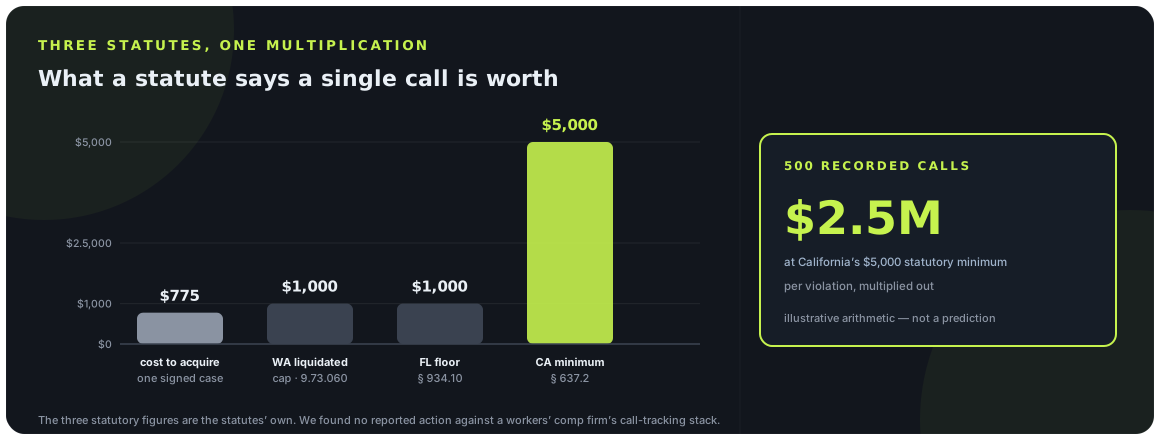
The point of the chart is the shape, not the headline. Three of the four bars are what a single violation is worth under three statutes. The fourth is multiplication, and we have labelled it as such: five hundred recorded California calls at the statutory minimum. It is not a prediction, no case is referenced, and we have no basis for one. It is there to make a structural point that matters more than any individual figure: recording is a setting, not an act. Nobody decides to record a particular call. A platform is configured once and then records everything, which means the unit of exposure is not the call, it is the library.
Hold that beside the acquisition arithmetic. Across the book we manage — roughly $16.5M of workers’ comp Meta spend, about 219,000 injured-worker leads at around $75 each, and about 21,000 signed cases at around $775 apiece — one signed case costs about $775 to acquire. One statutory minimum under California’s civil provision is $5,000. The comparison is not meant to frighten anybody; it is meant to put a compliance task on the same page as a cost per signed case number, which is the only page a managing partner reads.
The consent architecture
Seven steps, none of them expensive, in the order that makes each one useful.
One. Decide the posture once, and make it all-party. Write it down as a policy sentence: every inbound and outbound call on a marketing number is treated as requiring the consent of every participant, regardless of where the caller is. This removes every subsequent argument about area codes.
Two. Move the recorder to the front of the call. Before the whisper, before the greeting, before the queue. This is a setting in every serious call platform and it is the single highest-value change in this article.
Three. Replace the tone with a sentence, and make continuing the consent. Spoken, under eight seconds, asking rather than announcing. Then make sure it is captured in the file — which step two has already arranged.
Four. Do the same for outbound. Speed-to-lead dialling is outbound calling, and every rule above applies to it identically. This is the half that gets forgotten, because the disclosure was built into the inbound greeting and nobody wrote one for the callback.
Five. Ask the vendor the six questions. The table above is the list. Get the answers in the contract rather than in a sales email, particularly the one about what may be done with the audio.
Six. Set retention deliberately and give access a shape. Choose how long recordings are kept rather than inheriting a default of forever, and make playback role-based and logged, because the files hold prospective clients’ accounts of their injuries. If you are rebuilding the intake tech stack anyway, this belongs in that project.
Seven. Measure what the disclosure costs you. This is the step nobody runs, and it is the one that turns a compliance change into a marketing decision.
On that last point, the honest limit, stated plainly. We could find no credible published figure for how often a caller abandons a call during a recording disclosure. We looked. There is no study we would put in print, and any agency that quotes you a hang-up rate for a recording notice is quoting you something it made up. What is available is directional reasoning: the disclosure is the first thing an injured worker hears, the population is anxious and sometimes afraid of their employer, and a sentence that sounds like surveillance plausibly costs more calls than a sentence that sounds like a law firm being straight with them. Directional, and we are labelling it as such.
The measurement, though, is trivially available to any firm that wants it. Your platform logs duration on every call. Count the calls that ended inside the first eight seconds this month, change the wording of the disclosure, and count again next month. That is a within-firm number on a within-firm question, it costs nothing, and it is the only evidence on this subject that will ever be specific to you. It is also the kind of thing that belongs in the intake playbook rather than in a legal memo, which is rather the point of the whole article: this is not a compliance chore that marketing has to tolerate. It is a configuration question sitting directly on top of the lever that decides what a signed case costs.
One last word for firms in one-party states who have read this far and concluded it does not apply to them. It applies the moment one caller dials from across a state line, which for most urban comp markets is this afternoon. And the strict posture costs a sentence. There are very few places in this business where the safe answer and the cheap answer are the same answer. This is one of them.
Key takeaways
-
The recorded intake call is the only instrument you have on close rate. Quality scoring, creative feedback, source truth and training all read the same file — which carries a legislated price per unit.
-
The statute that applies is the caller’s, not the firm’s. About eleven states primarily require all parties’ consent, two more for phone calls specifically, and courts split on which state governs — so assume the stricter one.
-
California’s cellular provision has no confidentiality test. § 632.7 is defined by the handset, not the content, and in Smith v. LoanMe the Supreme Court held it binds parties to the call, not just eavesdroppers.
-
A beep is the argument that lost. A trial court accepted a three-second tone as notice, and the judgment built on that reading was reversed. A spoken sentence is a different object.
-
Washington requires the announcement to be recorded. RCW 9.73.030(3) is a sequencing rule: the recorder has to be running before the disclosure is spoken, which few call-tracking configurations do by default.
-
The unit of exposure is the library, not the call. A platform is configured once and records everything. California’s civil minimum is $5,000 per violation against roughly $775 to acquire a signed case.
WorkersComp Marketing is a marketing agency, not a law firm. Nothing here is legal advice, and nothing here is advice about your professional-conduct obligations. Recording statutes, their judicial interpretation and lawyer-advertising and confidentiality rules are set state by state, they vary, and they change; the statutes quoted here are quoted to show that they exist, that they differ and that the differences are operational, not to tell any firm what it may record. Read the current text of your own state’s statute and ask your own counsel before you change — or keep — a recording configuration.
Frequently asked questions
Is it illegal for us to record our own intake calls?
Not as a general matter. Federal law requires the consent of at least one party to record a call, and as a party to the call your firm supplies that consent — that is the national floor, 18 U.S.C. §§ 2510 and 2511. The complication is that about eleven states primarily require the consent of every party, and two more require it for phone calls specifically. So the answer depends less on where your office is than on where the person calling you is, and the Reporters Committee’s own guidance for interstate calls is to assume the stricter law applies. For a firm that advertises across a metro area straddling a state line, or runs ads in several states, there is only one posture that is defensible everywhere, and it is all-party consent everywhere.
We play a beep. Isn’t that notice?
A California trial court accepted exactly that argument and the state Supreme Court reversed the judgment built on it. In Smith v. LoanMe the call carried a beep three seconds in, the caller was never told the call was being recorded and was never asked, and the Court held that Penal Code § 632.7 reaches parties to a call and not only outside eavesdroppers. Read the beep for what it is: a sound that a court was invited to treat as consent and did not. A spoken sentence the caller can act on — and a recording that contains that sentence — is a different object.
Does the recording have to start before the disclosure?
In Washington, by statute, yes. RCW 9.73.030(3) says consent is considered obtained where one party announces to the others, in any reasonably effective manner, that the conversation is about to be recorded, and then adds a proviso: if the conversation is to be recorded, the announcement shall also be recorded. That is a sequencing requirement, and it is the detail most call-tracking configurations get wrong, because the recorder is commonly started after the greeting rather than before it. Go and listen to the first three seconds of ten of your own recordings. Either the disclosure is in the file or your proof that you gave it does not exist.
Our call-tracking vendor handles compliance. Doesn’t that cover us?
A vendor can give you a configuration. It cannot give you consent, and it is not the party a complaint names. There is also a live question about the vendor’s own position: a strand of California litigation treats a third-party service that receives call content as a separate eavesdropper under Penal Code § 631, and in Ambriz v. Google in February 2025 a federal court declined to dismiss on the reasoning that the provider was a third party because it had the capability to use the call data for its own purposes, whether or not it did. Courts are split between that capability test and a narrower one. Read your vendor’s contract for what it is allowed to do with the audio, and read your state’s rule yourself.
The caller is not a client yet. Does confidentiality even apply?
Under the model rules, a person who consults a lawyer about the possibility of forming a client-lawyer relationship is a prospective client, and the duty not to use or reveal what you learned in that consultation attaches even if no representation follows. That has a plain consequence for marketing: an intake recording is not simply a marketing asset, it is a file containing a prospective client’s account of an injury, an employer and sometimes an immigration or medical fact. Where it is stored, who can play it, how long it is kept and which vendors it passes through are questions that belong to the firm, not to the ad account.
What does an unlawful recording actually cost?
The statutes set it, not a plaintiff’s estimate. California gives a person injured by a violation the greater of $5,000 per violation or three times actual damages, and says actual damages are not a prerequisite. Florida puts a floor under actual damages of $100 for each day of violation or $1,000, whichever is higher, plus punitive damages and fees, with a two-year limit running from a reasonable opportunity to discover. Washington allows actual damages or liquidated damages of $100 a day to a maximum of $1,000, plus fees. The arithmetic that matters is not one call — it is that recording is a default setting, so the exposure is counted in calls.
So should we stop recording?
No, and that would be the expensive conclusion. Recordings are how a firm finds out that half its paid leads reach a voicemail at 4:50pm, which script line loses callers, and which ad set produces people who sign. Switching them off to avoid a compliance question removes the only instrument you have for improving close rate, which is the term in the acquisition arithmetic that a capped-fee practice has to win on. The answer is to record everything, consent properly everywhere, and put the disclosure inside the recording.
How do we know the disclosure is not costing us calls?
Measure it, because nobody has published a figure we would print. We looked for a credible number on how often a caller hangs up during a recording disclosure and found nothing worth citing, and any agency quoting you one is quoting something invented. What you can do is cheap: your call platform logs call duration, so count the calls that ended inside the first eight seconds, before and after you change the wording. That is a number about your firm, and within a month it is the only evidence on this question that will ever be specific to you.
Sources
-
01
The statutes that make the call all-party
California Penal Code § 632, which turns on whether the communication is confidential, and § 632.7, which does not — it covers any communication involving a cellular or cordless phone and requires the consent of all parties.
-
02
The sequencing requirement
RCW 9.73.030, Washington’s consent statute, whose subsection (3) permits consent by announcement “in any reasonably effective manner” and then provides that if the conversation is to be recorded, the announcement shall also be recorded.
-
03
The state-by-state map, and the interstate rule
The Reporters Committee for Freedom of the Press’s introduction to its recording guide: the federal one-party floor, the roughly eleven primarily all-party states, Connecticut and Nevada for calls, Missouri and Oregon for in-person conversations only, and the advice to assume the stricter state’s law on an interstate call.
-
04
What a violation is worth
Florida’s civil remedy, § 934.10, with its floor of $100 per day of violation or $1,000 whichever is higher, punitive damages, fees, and a two-year limit from the first reasonable opportunity to discover the violation.
-
05
The vendor question, and where it is unsettled
Analysis of Ambriz v. Google (N.D. Cal., February 2025), in which the court declined to dismiss California Invasion of Privacy Act claims against an AI contact-centre provider on a “capability” theory — and of the split between that test and a narrower one. A district-court ruling on a motion to dismiss, not a judgment.
-
06
Further reading
The call this whole article is about, the measurement system the recordings feed, and the plumbing the configuration lives in.
Recording statutes are decades old, they are amended, and courts read them differently — confirm the current text of the statute in your state and in your callers’ states, and ask your own counsel, before relying on anything here. General marketing information, not legal advice. Case descriptions are summaries of reported decisions read in October 2026, not advice about your facts.