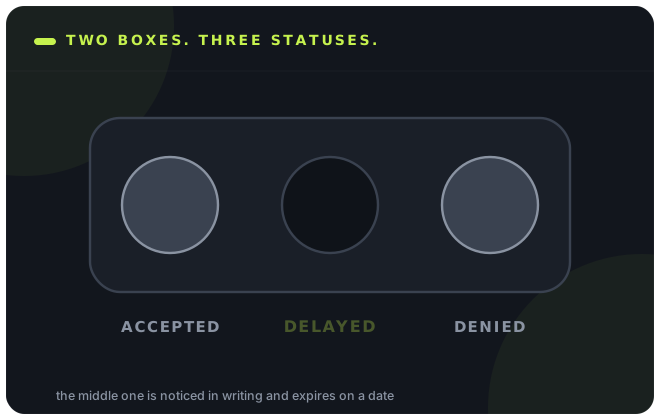
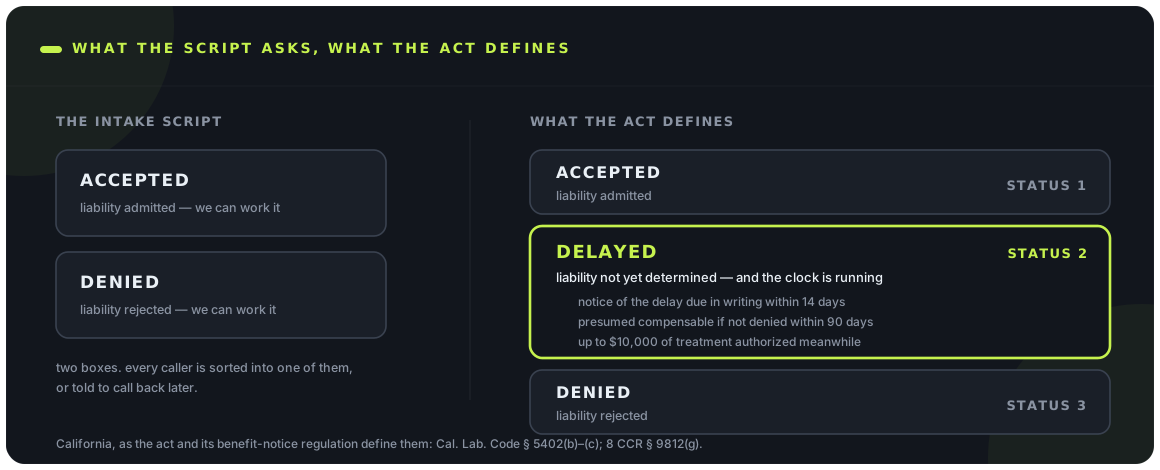
Pick up any workers’ comp firm’s intake script and find the qualifying question. It will be some version of has your claim been denied? Occasionally it is softer — what has the insurance company told you? — but the branch logic underneath is identical. There are two answers that open a case file and a third that routes to a polite exit. Accepted means something to work with. Denied means something to work with. Anything else means call us back when you hear something.
That third branch is where a large share of the day’s callers actually are. The man on the phone reported an injury, or thinks he did. Someone at work took a report. A nurse called him. A form arrived. Nobody has said yes and nobody has said no, and he is ringing a law firm precisely because the silence is the frightening part. The script has no box for him, so it improvises one: not yet.
It is worth being blunt about what that costs, because the act he is covered by does have a box for him, and the box has a date printed on it.
The binary your script inherited from personal injury
In a liability case, contested and conceded really are the two states that matter. Workers’ comp runs on administrative status, and administrative status has three values, not two.
The two-box script is not stupid. It is a transplant. In a motor-vehicle or premises case, the carrier’s position on liability is the hinge, and it is usually either taken or not taken. Comp firms that grew out of general personal-injury practices carried the question across, and comp firms that never did still bought their intake training, their lead vendors and their ad copy from people who had.
What makes the transplant fail is that comp is not a liability system. It is a benefits-administration system with a statutory calendar, and the thing a caller is in the middle of is not an argument about fault but a position in a process. Accepted and denied are two positions in that process. They are also the only two that generate a document the caller recognises as news, which is exactly why a phone script reaches for them: both are events, and events are easy to ask about.
The third position is defined by the absence of an event. That is the kind of thing phone scripts are bad at capturing and statutes are unusually good at pinning down — we have made the same observation about the deadline that runs before anyone is a prospect and about the examination date the other side mails out. Comp marketing keeps organising itself around the events that produce paper. The status with no event in it produces paper too. It just produces it from the other direction.
The third status is formal, not a gap
The act names it by implication; the benefit-notice regulation names it outright, and gives it a deadline, a form and a reason code.
Start with the statute, which is written from the carrier’s side of the table:
“If liability is not rejected within 90 days after the date the claim form is filed under Section 5401, the injury shall be presumed compensable under this division. The presumption of this subdivision is rebuttable only by evidence discovered subsequent to the 90-day period.”
Read from the firm’s side, that sentence does something the two-box script cannot represent. It establishes that between the filing of a claim form and day 90 there is a defined interval in which liability is undetermined, and it sets the default at the end of that interval in the worker’s favour. It also closes the door behind it: after day 90 the presumption is rebuttable “only by evidence discovered subsequent to the 90-day period,” so a carrier that sat on what it already had does not get to produce it later. For a particular class of injuries and illnesses — the ones covered by Labor Code sections 3212 to 3212.85 and 3212.9 to 3213.2 — subdivision (b)(2) shortens the same clock to 75 days.
Then the regulation makes it an administrative status rather than an inference. 8 CCR § 9812(g), the benefit-notice rule, provides that where the claims administrator “cannot determine whether the employer has any liability for an injury… within 14 days after the date of knowledge of injury,” it “shall advise the employee within the 14-day period of the delay, the reasons for the delay, the need, if any, for additional information required to make a determination, and when a determination is likely to be made.” If the stated date passes without a determination, or the reason changes, another notice is due — “not later than the determination date specified in the previous notice” — explaining the reason for the additional delay.
So the status has a name, a trigger, a deadline, a required content set and a renewal mechanic. A separate provision, § 9812(a)(2), runs the same machinery for temporary disability indemnity on its own 14-day clock, which means a worker whose wage benefit is in question can be holding two delay notices about two different things.
None of that is obscure. It is the ordinary operating procedure of every claims department in the state. It is simply invisible from inside a firm, because nothing in a comp firm’s acquisition stack is pointed at it.
The letter the other side is required to mail
It is due inside 14 days, and the regulation — not the claims administrator’s discretion — dictates what has to be in it.
This is the part that should change what an intake agent says. The delay notice is not a form letter the carrier writes however it likes. Three of its contents are specified, and all three are facts the worker is better off knowing and usually does not.
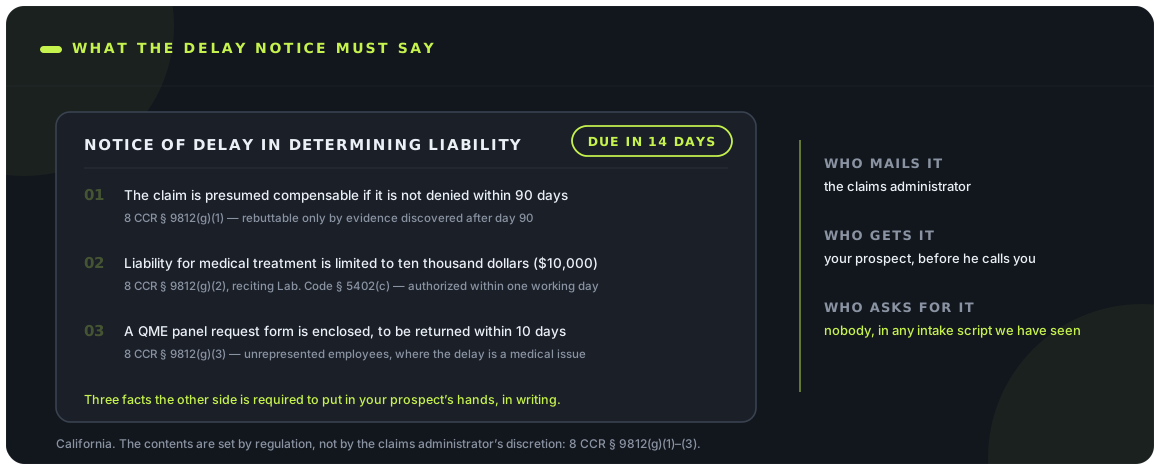
The first required recital is the 90-day presumption. Under § 9812(g)(1), a delay notice “shall include an explanation that the claim is presumed to be compensable if not denied within 90 days from the filing of the claim form, and that this presumption can be rebutted only with evidence discovered after the 90-day period.” The opposing party is required to explain to the worker the rule that runs against the opposing party.
The second is the $10,000. Under § 9812(g)(2), the notice must explain that Labor Code § 5402(c) requires the employer, within one working day of the claim form, to authorize all treatment for the alleged injury and continue it until liability is rejected, and “shall advise the employee that the employer’s liability for medical treatment under this Labor Code section is limited to ten thousand dollars ($10,000).”
The third is the one most likely to be sitting unopened on a kitchen table. Where the worker is unrepresented, the delay is medical, and the claims administrator is requesting a comprehensive medical evaluation, § 9812(g)(3) requires the notice to arrive with the panel-request form prescribed by the DWC Medical Unit, and to carry this statement with the phrase “10 days” in bold:
“Enclosed is a form that you must submit to the state Division of Workers’ Compensation (DWC) within 10 days to request a panel of three Qualified Medical Evaluators (QMEs). If you do not submit the form within 10 days, we will have the right to submit the form… If you do not inform us of your choice, we may choose the QME who will examine you and arrange the appointment.”
Set aside, for a moment, what any of that means for the merits of a case — that is a question for the firm’s lawyers and it turns on facts a marketing article does not have. Look at it purely as acquisition signal. An unrepresented injured worker has been mailed, by the party on the other side of his claim, a document containing a ten-day instruction, a ninety-day deadline and a dollar figure. He is the most time-sensitive prospect in the category. And the standard qualifying question in the industry — has your claim been denied? — returns no for him.
Three acts, three clocks, three starting guns
California, Texas and Florida all put an outer limit on the carrier’s silence and all penalise it for running past. Not one of them starts counting from the same event.
If you work one state, the number is the number. If you work several, or you buy media across a footprint, the differences are the whole problem: there is no single figure a national intake script can calendar, because the three acts do not agree on what starts the clock, how long it runs, what has to be paid while it runs, or how easily the carrier escapes the consequence of missing it.
| California | Texas | Florida | |
|---|---|---|---|
| What starts the clock | The claim form being filed under § 5401 | The carrier being notified of the injury | The initial provision of compensation or benefits |
| First dated duty | Authorize treatment within one working day; notice of delay within 14 days of knowledge of injury (8 CCR § 9812(g)) | Begin paying benefits or notify the division and the employee in writing of refusal, not later than the 15th day after written notice of injury | Pay the first installment of total disability or death benefits, or deny compensability, no later than the 14th calendar day after the employer receives notification, where disability is immediate and continuous for 8 days or more |
| Outer deadline | 90 days (75 for injuries and illnesses under §§ 3212–3212.85, 3212.9–3213.2) | 60 days | 120 days |
| What missing it costs the carrier | The injury “shall be presumed compensable” | The carrier “waives its right to contest compensability” | The carrier “waives the right to deny compensability” |
| The escape hatch | Presumption rebuttable “only by evidence discovered subsequent to the 90-day period” | None stated in § 409.021(c); and under (a-1) a late first payment does not by itself waive the right to contest | Unless the carrier establishes material facts it “could not have discovered through reasonable investigation within the 120-day period” |
| Paid while it runs? | Medical treatment, capped at $10,000 (§ 5402(c)); treatment creates no presumption of liability (§ 5402(d)) | Benefits begin by day 15 unless refusal is filed; starting payment does not affect the right to keep investigating during the 60 days | Yes — benefits paid “as if the claim had been accepted as compensable, without prejudice and without admitting liability” |
Drawn to one axis, the divergence is the point. The bars below all measure days, and every one of them starts from a different thing.
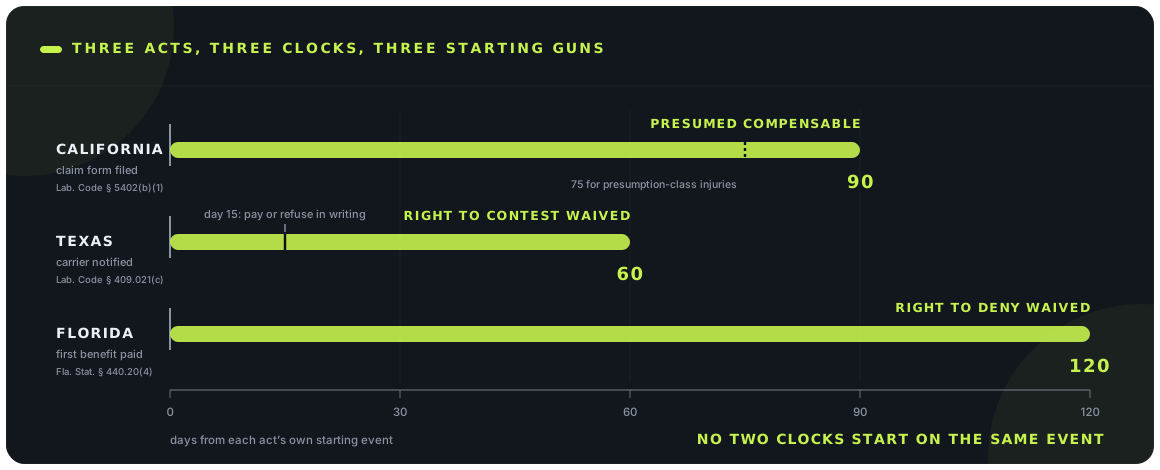
It is worth stating precisely what is and is not common to the three, because the tempting sentence here is a generalisation that does not survive contact with the text. What is true of all three: the carrier’s silence has an outer limit written into the act, and crossing that limit costs the carrier the ability to fight compensability. What is not true of all three: the trigger, the length, the obligation to pay meanwhile, and how escapable the consequence is. Florida requires benefits to be paid during the investigation “as if the claim had been accepted”; California requires treatment only, and caps it; Texas requires payment to begin by day 15 but expressly provides, in § 409.021(a-1), that failing that does not by itself waive the right to contest under subsection (c). A script that tells a Florida caller what the California rule says is worse than a script that says nothing.
The $10,000 nobody on the call knows about
California requires treatment to be authorized within one working day of the claim form and to continue until liability is decided, capped at ten thousand dollars — and the statute makes paying it safe for the employer, which is why it happens.
Labor Code § 5402(c) is short enough to read in full: “Within one working day after an employee files a claim form under Section 5401, the employer shall authorize the provision of all treatment, consistent with Section 5307.27, for the alleged injury and shall continue to provide the treatment until the date that liability for the claim is accepted or rejected. Until the date the claim is accepted or rejected, liability for medical treatment shall be limited to ten thousand dollars ($10,000).”
Subdivision (d) is the sentence that makes the whole arrangement work: treatment provided under (c) “does not give rise to a presumption of liability on the part of the employer.” The employer can pay for care during the delay without conceding anything, which is precisely why the obligation is practicable and why the money moves. California’s own Division of Workers’ Compensation puts it to employers in operational language on its FAQ page: “Within one working day of receiving the employee’s claim, authorize up to $10,000 in appropriate medical treatment.”
Now consider what the caller in delay status usually believes. In our experience of listening to comp intake calls, the near-universal assumption is that nothing is owed until someone decides — that treatment, like wage benefits, waits for the acceptance letter. For the first ten thousand dollars of medical care in California, the statute says the opposite, and says it in the letter he was mailed. That is a specific, checkable, immediately useful thing a firm can be right about on a first call, at no media cost, in a category where almost every first call consists of the same four claims about being aggressive and experienced.
The population the state decided not to count
Nobody publishes how many claims are sitting in delay. In California the legislature wrote the reason into the statute, and conditioned fixing it on an appropriation.
The obvious next question is how big this is. We cannot tell you, and the reason is more interesting than the answer would have been. Subdivision (e) of the same section reads:
“Upon appropriation by the Legislature, the Division of Workers’ Compensation shall identify and amend its existing data collection processes to include collection of the date on which the claimant is notified of acceptance, denial, or conditional denial of liability for a claim, consistent with this section.”
Read the premises in that sentence rather than the instruction. It is drafted on the understanding that the Division’s existing data collection does not capture the date a claimant is told his claim was accepted, denied or conditionally denied — and it makes closing that gap contingent on money being appropriated for it. California has written into its own labour code that it does not systematically know when the decision was communicated.
Two consequences follow, and they point in opposite directions. The first is that nobody can hand you a market size for this, including us; any number you see for “claims in delay” is an estimate from a carrier’s own book or a researcher’s sample, not a published national statistic. The second is that nobody is competing for this population on the strength of data either, because there is no data to compete on. That is an unusual position for a category as thoroughly measured as paid legal acquisition.
What is counted is the flow the delay population is drawn from. The Bureau of Labor Statistics reported 2.5 million nonfatal workplace injuries and illnesses in private industry in 2024 — 2,488,400 total recordable cases, at an incidence rate of 2.3 per 100 full-time equivalent workers. Over the two-year 2023–2024 period there were 1,834,600 cases involving days away from work and 1,148,510 involving days of job transfer or restriction, with a median of 8 days away and 15 days restricted. Every one of those cases that became a claim passed through a window in which liability was either determined quickly or was not. What share sat in the window long enough to generate a delay notice is exactly the number nobody collects.
Three lines and one field
None of this requires new media spend, a new channel, or a new vendor. It requires the qualifying question to stop being a yes-or-no.
The change is small enough to be suspicious of, so here it is written out. The point of each line is not to give advice on the call — it is to capture a fact the firm currently throws away.
| Now | Instead | What it captures |
|---|---|---|
| “Has your claim been denied?” | “Has anyone told you in writing whether your claim is accepted, denied, or still being decided?” | Three-way status instead of two-way, in the caller’s own words, with “in writing” doing the work of distinguishing a letter from a rumour at the jobsite. |
| — (no equivalent line) | “Do you have any letters from the insurance company or the claims office? What is the date at the top?” | The dated document. A delay notice, a denial, a benefit notice: whichever it is, the date is the only hard fact in the call and it is sitting on the caller’s table. |
| “Call us back when you hear something.” | “Let’s get that letter in front of one of our attorneys today — can you photograph it and text it to this number?” | A same-day document hand-off instead of a deferred callback that mostly does not happen. The slow-yes problem is largely a problem of giving the caller nothing to do. |
| Disposition field: signed / not signed | Disposition field: signed / not signed, plus claim status and letter date | The measurement. Without it, the third status stays invisible in your reporting for exactly the reason it is invisible in the state’s. |
Two cautions about the second line. It asks for a photograph of a document, which means the firm needs somewhere lawful and sensible to put it and a policy about what happens to it if the caller does not sign — that is a question for the firm’s own counsel and its data retention rules, not for its marketing department. And it is an invitation, not an instruction: a caller who does not want to send anything on a first call should not be pushed, because the fastest way to lose a comp prospect is to make the first conversation feel like a form.
What it does to the media plan, and where it stops
The category’s default hook selects against this population by construction. The arithmetic of fixing that is modest, and it is worth being honest that it is an assumption rather than a finding.
Look at the ad copy running in any comp market and count how much of it is built on the word denied. It is the category’s default hook for a good reason: denial is concrete, it is emotionally loaded, and it maps cleanly to a service. It is also, read literally, a disqualifying headline for a man whose claim has not been denied. He sees “Claim denied?”, concludes the ad is addressed to somebody else, and scrolls. That is not a failure of creative quality. It is the creative working exactly as written, on the wrong third of the audience.
The testable change is a parallel ad set keyed to the silence rather than the refusal — language that matches the state the prospect is actually in, without making any claim about what his letter means. Treat it as a creative test with a real sample-size problem, not as a certainty; we have written at length about why most law-firm creative tests cannot produce a trustworthy answer, and that caution applies here with full force.
The intake-side arithmetic is easier to reason about, because it does not require any new impressions. If some share of the leads you already pay for are in the third status and your script currently closes none of them, then recovering part of that share reduces cost per signed case without changing spend at all. The size of the effect depends entirely on a number nobody publishes, so the chart below varies it rather than asserting it.
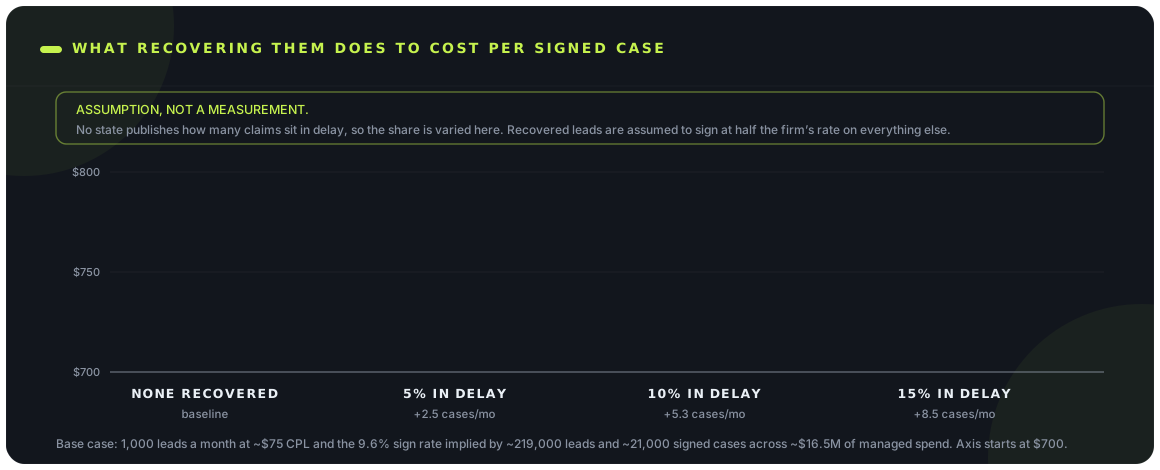
Three things about that chart deserve saying out loud rather than being buried in a footnote. The share of leads in delay is varied because it is unknown, not estimated. The half-rate assumption is a guess, chosen to be pessimistic: a caller with no decision yet is plausibly harder to sign than one holding a denial, because the urgency he feels is diffuse. And the baseline sign rate is derived from our own managed book — roughly 219,000 injured-worker leads at about $75 average cost per lead and around 21,000 signed cases across about $16.5M of managed Meta spend — which is a real number from real accounts but is still one agency’s book, not an industry benchmark.
Where this stops is worth marking clearly. This is not a claim that delay-status callers are better cases; they may well be worse ones on average, and a firm that signs them indiscriminately will find out the expensive way. It is not advice about what any particular letter means, which is a legal question. It is not a national rule: the three acts we read diverge on every operative dimension, and the forty-seven we did not read will diverge further. And it is not a growth strategy on its own — it is a correction to a qualifying question, which is the sort of thing that moves a number by single-digit percentages and costs nothing, and those are usually the best trades available to a firm that has already bought all the media it can afford.
What it is, is a gap between how a comp act is written and how comp firms qualify callers, sitting in plain sight in a published statute and a published regulation, affecting a population the state has not funded itself to count. That gap is unusually wide for something so easy to check.
Key takeaways
-
Comp acts define three claim statuses, not two. Accepted, denied, and liability not yet determined. The third is a formal administrative status with its own notice requirements and its own expiry date, and a yes-or-no qualifying question cannot record it.
-
California presumes compensability at day 90. Lab. Code § 5402(b)(1): if liability is not rejected within 90 days of the claim form being filed, “the injury shall be presumed compensable,” and the presumption is rebuttable “only by evidence discovered subsequent to the 90-day period.” Subdivision (b)(2) shortens it to 75 days for the §§ 3212–3213.2 classes.
-
A delay notice is due in writing within 14 days. 8 CCR § 9812(g) requires the claims administrator to advise the employee of the delay, the reasons, any further information needed and when a determination is likely — and to send a fresh notice if the stated date passes.
-
That letter is required to recite the 90-day rule and the $10,000. § 9812(g)(1) and (g)(2). The opposing party has to explain to your prospect both the deadline that runs against it and the treatment money available meanwhile.
-
Unrepresented workers in a medical delay get a ten-day instruction. § 9812(g)(3) requires the QME panel-request form to accompany the notice, with a bolded statement that failure to submit it within 10 days lets the claims administrator submit it and potentially choose the evaluator.
-
Treatment is owed before the decision, and paying it concedes nothing. § 5402(c) requires authorization within one working day of the claim form, continuing until liability is accepted or rejected, capped at $10,000 — and § 5402(d) provides that the treatment “does not give rise to a presumption of liability.”
-
Do not generalise one state’s clock. California runs 90 days from the claim form; Texas 60 days from the carrier being notified; Florida 120 days from the first payment. What is common is only that silence has an outer limit and crossing it costs the carrier the right to fight compensability.
-
Florida pays while it investigates; California does not. Fla. Stat. § 440.20(4) requires benefits to continue “as if the claim had been accepted as compensable, without prejudice and without admitting liability” during the 120 days. California’s equivalent obligation covers medical treatment only, and caps it.
-
Nobody counts this population, by statute. § 5402(e) directs the Division to amend its data collection to capture the acceptance, denial or conditional-denial notification date — “upon appropriation by the Legislature.” Any market-size figure you are quoted is an estimate, ours included.
-
The fix is a field, not a budget. Change the qualifying question to a three-way, ask for the date on any letter, and log both. Ninety days of that gives you the only number that matters — the share of your own leads in the third status, by campaign.
WorkersComp Marketing is a marketing agency, not a law firm, and nothing here is legal advice about any claim, any caller or any firm’s intake practices. Whether a particular claim is in a delay status, what any notice a worker has received means, whether a presumption or a waiver has arisen on a given set of facts, what a ten-day panel-request instruction requires of a particular person, and what medical treatment is owed in any individual case are questions of state law that turn on circumstances we do not have. The provisions cited here — California Labor Code § 5402 and 8 CCR § 9812, Texas Labor Code § 409.021 and Florida Statutes § 440.20 — were read on 6 November 2026 and are amended from time to time; the current official versions govern, and the sources block below records which route each text came from. Rules of professional conduct on solicitation and client communication vary by state and are not addressed here. Verify the current rule, and any ethical question, with counsel before putting any of it into a script.
Frequently asked questions
Is “delayed” actually a defined status, or just a claim nobody has got to yet?
In California it is defined, and it has its own paperwork. 8 CCR § 9812(g) provides that where the claims administrator “cannot determine whether the employer has any liability for an injury, other than an injury causing death, within 14 days after the date of knowledge of injury,” it “shall advise the employee within the 14-day period of the delay, the reasons for the delay, the need, if any, for additional information required to make a determination, and when a determination is likely to be made.” If the determination date it gave passes, or the reason changes, a further notice is due “not later than the determination date specified in the previous notice.” A separate provision, § 9812(a)(2), runs the same 14-day machinery for delays in temporary disability indemnity. So it is an administrative state with a trigger, a deadline, a required content set and a renewal rule — not an administrative silence.
What happens in California if the carrier never denies within 90 days?
Labor Code § 5402(b)(1): “If liability is not rejected within 90 days after the date the claim form is filed under Section 5401, the injury shall be presumed compensable under this division. The presumption of this subdivision is rebuttable only by evidence discovered subsequent to the 90-day period.” The second sentence is the operative one for timing: evidence the carrier already had during the 90 days does not rebut the presumption afterwards. Subdivision (b)(2) applies a 75-day version to injuries and illnesses defined in sections 3212 to 3212.85 and 3212.9 to 3213.2. Whether the presumption has arisen on any particular claim, and what follows if it has, is a legal question for the firm’s lawyers — the marketing point is only that the date exists and is calendarable.
Is the worker entitled to any treatment while the claim is undecided?
In California, yes, up to a cap. Lab. Code § 5402(c): “Within one working day after an employee files a claim form under Section 5401, the employer shall authorize the provision of all treatment, consistent with Section 5307.27, for the alleged injury and shall continue to provide the treatment until the date that liability for the claim is accepted or rejected. Until the date the claim is accepted or rejected, liability for medical treatment shall be limited to ten thousand dollars ($10,000).” Subdivision (d) adds that this treatment “does not give rise to a presumption of liability on the part of the employer,” which is what makes the obligation workable in practice. The Division of Workers’ Compensation states the same rule to employers on its own FAQ: “Within one working day of receiving the employee’s claim, authorize up to $10,000 in appropriate medical treatment.” Other states handle the question differently — Florida requires benefits generally, California requires treatment only.
Does this work the same way in Texas and Florida?
No, and the differences matter more than the similarity. Texas Lab. Code § 409.021(a) requires the carrier, not later than the 15th day after receiving written notice of an injury, either to begin paying benefits or to notify the division and the employee in writing of its refusal; subsection (c) provides that a carrier which “does not contest the compensability of an injury on or before the 60th day after the date on which the insurance carrier is notified of the injury… waives its right to contest compensability.” Florida Stat. § 440.20(4) runs a 120-day “pay and investigate” period from the initial provision of benefits, during which the carrier must pay “as if the claim had been accepted as compensable, without prejudice and without admitting liability,” and a failure to deny within it waives the right to deny unless the carrier can establish material facts it “could not have discovered through reasonable investigation within the 120-day period.” Three different triggers, three different lengths, three different escape hatches.
Does a late first payment in Texas waive the carrier’s right to fight the claim?
Not by itself, and the act says so expressly. Tex. Lab. Code § 409.021(a-1): “An insurance carrier that fails to comply with Subsection (a) does not waive the carrier’s right to contest the compensability of the injury as provided by Subsection (c) but commits an administrative violation subject to Subsection (e).” The 15-day duty and the 60-day waiver are separate mechanisms, and conflating them is an easy error to make from a summary. It is worth flagging because it is the kind of detail a well-meaning intake script gets wrong when somebody writes it from a blog post rather than from the act.
How many claims are actually in this status at any one time?
Nobody publishes it, and in California the legislature said why. Lab. Code § 5402(e): “Upon appropriation by the Legislature, the Division of Workers’ Compensation shall identify and amend its existing data collection processes to include collection of the date on which the claimant is notified of acceptance, denial, or conditional denial of liability for a claim, consistent with this section.” That provision is drafted on the premise that the existing collection does not capture the notification date, and it conditions the fix on an appropriation. For scale on the flow it is drawn from, BLS reported 2,488,400 total recordable cases in private industry in 2024 and 1,834,600 cases involving days away from work over 2023–2024. What share of claims generate a delay notice is not in that data and we have not found a national figure for it. Treat any number you are given as directional.
Should we change our ads, or just our intake?
Intake first, because it costs nothing and the evidence is immediate. Changing the qualifying question and adding a status field tells you, within a quarter, what share of the leads you are already buying sit in the third status. Only then is an ad test worth running, and it should be run as a test: most law-firm creative tests at ordinary volume cannot distinguish a real effect from noise, which we worked through in detail in our piece on the sample-size problem in ad testing. Running the creative change first means paying for the answer twice — once in media and once in the time it takes to realise the sample was never going to settle it.
Is there a risk of signing worse cases this way?
Yes, and it should be planned for rather than waved away. A claim with no decision yet is, by definition, a claim whose compensability nobody has confirmed, and some share of them will be denied for good reasons. A firm that treats the third status as a volume opportunity rather than a timing opportunity will sign cases it should not have. That is why the arithmetic in this article deliberately assumes recovered leads sign at half the firm’s normal rate, and why the right internal framing is “stop discarding a dated prospect before a lawyer has seen the letter,” not “sign everyone who is waiting.” The screening judgement stays with the lawyers; what changes is that they get to make it.
What is the single smallest version of this we can do this week?
Change one question and add one field. Replace “has your claim been denied?” with “has anyone told you in writing whether your claim is accepted, denied, or still being decided?”, and add a three-value status field plus a letter-date field to the intake form. That is a twenty-minute change in most CRMs and it does not touch media, creative, budget or staffing. Everything else in this article — the ad test, the follow-up cadence, the same-day document hand-off — is downstream of having the data, and you cannot get the data without the field. Our Intake Leak Score covers the wider set of places enquiries disappear without leaving a record.
Where should a firm go to confirm its own state’s rule?
The act first, the agency second, and a commercial publisher only as corroboration. Find the section of your comp act that governs the carrier’s acceptance or denial of liability, then look for the companion notice regulation — in California that pairing is Lab. Code § 5402 with 8 CCR § 9812, and the regulation is where the operational detail lives. State agency FAQ and employer-guidance pages are useful because they restate the rule in the carrier’s own operating language, which is closer to what your caller was actually told. Get two independent routes to the text that agree word for word before anything goes into a script; we had to do exactly that for the Texas section cited here, because the official statutes site would not return it.
Sources & further reading
-
01
California — the 90-day presumption, the $10,000 of treatment, and the uncollected date
Cal. Lab. Code § 5402(b)(1): “If liability is not rejected within 90 days after the date the claim form is filed under Section 5401, the injury shall be presumed compensable under this division. The presumption of this subdivision is rebuttable only by evidence discovered subsequent to the 90-day period.” (b)(2) applies a 75-day period to injuries and illnesses defined in sections 3212 to 3212.85 and 3212.9 to 3213.2. (c): “Within one working day after an employee files a claim form under Section 5401, the employer shall authorize the provision of all treatment, consistent with Section 5307.27, for the alleged injury and shall continue to provide the treatment until the date that liability for the claim is accepted or rejected. Until the date the claim is accepted or rejected, liability for medical treatment shall be limited to ten thousand dollars ($10,000).” (d): treatment under (c) “does not give rise to a presumption of liability on the part of the employer.” (e): “Upon appropriation by the Legislature, the Division of Workers’ Compensation shall identify and amend its existing data collection processes to include collection of the date on which the claimant is notified of acceptance, denial, or conditional denial of liability for a claim, consistent with this section.” Read 6 November 2026 on two independent publishers of the code whose texts agree word for word in every subdivision: California Public Law (marked verified 2 November 2026) and FindLaw (stating it is current as of 1 January 2026). A third, onecle, carries the pre-2016 text — it has the same 90-day and $10,000 language but lacks (b)(2) and (e) — and was used only as a check on the older wording. The official text at leginfo.legislature.ca.gov returned a client error on every attempt on 6 November 2026 and was not read; the official version governs.
-
02
California — the delay notice itself, and what the regulation makes it say
8 CCR § 9812(g): “If the claims administrator cannot determine whether the employer has any liability for an injury, other than an injury causing death, within 14 days after the date of knowledge of injury, the claims administrator shall advise the employee within the 14-day period of the delay, the reasons for the delay, the need, if any, for additional information required to make a determination, and when a determination is likely to be made,” with a further notice due “not later than the determination date specified in the previous notice.” (g)(1) requires the notice to “include an explanation that the claim is presumed to be compensable if not denied within 90 days from the filing of the claim form, and that this presumption can be rebutted only with evidence discovered after the 90-day period.” (g)(2) requires it to explain Labor Code section 5402(c) and to “advise the employee that the employer’s liability for medical treatment under this Labor Code section is limited to ten thousand dollars ($10,000).” (g)(3) requires the QME panel-request form to accompany the notice for unrepresented employees where the delay is a medical issue, carrying the bolded statement: “Enclosed is a form that you must submit to the state Division of Workers’ Compensation (DWC) within 10 days to request a panel of three Qualified Medical Evaluators (QMEs).” § 9812(a)(2) imposes the parallel 14-day delay notice for temporary disability indemnity. Read 6 November 2026 on the Department of Industrial Relations’ own site and corroborated word for word against Cornell’s Legal Information Institute; the only differences are typographic.
-
03
Texas — the 15-day duty and the 60-day waiver
Tex. Lab. Code § 409.021(a): “An insurance carrier shall initiate compensation under this subtitle promptly. Not later than the 15th day after the date on which an insurance carrier receives written notice of an injury, the insurance carrier shall: (1) begin the payment of benefits as required by this subtitle; or (2) notify the division and the employee in writing of its refusal to pay…” (a-1): “An insurance carrier that fails to comply with Subsection (a) does not waive the carrier’s right to contest the compensability of the injury as provided by Subsection (c) but commits an administrative violation subject to Subsection (e).” (c): “If an insurance carrier does not contest the compensability of an injury on or before the 60th day after the date on which the insurance carrier is notified of the injury, the insurance carrier waives its right to contest compensability. The initiation of payments by an insurance carrier does not affect the right of the insurance carrier to continue to investigate or deny the compensability of an injury during the 60-day period.” A sourcing caveat we think readers should have. The official Texas statutes site returned only its navigation shell on every attempt on 6 November 2026, for both the chapter URL and the section-lookup URL, and Justia returned a client error. The text above therefore comes from two commercial publishers — FindLaw (current as of 1 January 2026) and LawServer (current as of 2024) — whose texts agree word for word. As an official corroboration of the substance rather than the text, a Texas Division of Workers’ Compensation Appeals Panel decision of 12 June 2023 (Appeal No. 230503) states both rules in the Division’s own words: that § 409.021(a) requires the carrier, “not later than the 15th day,” to begin payment or notify refusal, and that under § 409.021(c) a carrier which does not contest compensability “on or before the 60th day after the date on which the insurance carrier is notified of the injury… waives its right to contest compensability.”
-
04
Florida — pay and investigate, and the 120-day waiver
Fla. Stat. § 440.20(4): “If the carrier is uncertain of its obligation to provide all benefits or compensation, the carrier shall immediately and in good faith commence investigation of the employee’s entitlement to benefits under this chapter and shall admit or deny compensability within 120 days after the initial provision of compensation or benefits… Additionally, the carrier shall initiate payment and continue the provision of all benefits and compensation as if the claim had been accepted as compensable, without prejudice and without admitting liability… A carrier that fails to deny compensability within 120 days after the initial provision of benefits or payment of compensation… waives the right to deny compensability, unless the carrier can establish material facts relevant to the issue of compensability that it could not have discovered through reasonable investigation within the 120-day period.” § 440.20(2)(a): “The carrier must pay the first installment of compensation for total disability or death benefits or deny compensability no later than the 14th calendar day after the employer receives notification of the injury or death, when disability is immediate and continuous for 8 calendar days or more after the injury.” Read 6 November 2026 on the Florida Legislature’s own site, headed “The 2026 Florida Statutes,” and corroborated against Justia’s 2025 edition, which carries the same text with formatting differences only.
-
05
Scale — the injury flow the delay population is drawn from
U.S. Bureau of Labor Statistics, “Employer-Reported Workplace Injuries and Illnesses — 2023–2024,” USDL-26-0101, released 22 January 2026. “Private industry employers reported 2.5 million nonfatal workplace injuries and illnesses in 2024, down 3.1 percent from 2023” — Table 1 gives the exact 2024 figure as 2,488.4 thousand total recordable cases. “In 2024, the incidence rate of total recordable cases (TRC) in private industry was 2.3 cases per 100 full-time equivalent (FTE) workers, down from 2.4 cases in 2023.” “Over the 2-year 2023–2024 period, there were 1.8 million cases involving days away from work (DAFW) in private industry, representing 61.5 percent of the total cases involving days away from work, job restriction, or transfer (DART)” — Table 2 gives 1,834,600 DAFW cases at a median of 8 days, and 1,148,510 DJTR cases at a median of 15 days. These are injury counts, not claim counts, and BLS does not report claim status; they are used here only to size the flow, not the delay population.
-
06
The firm figures behind the arithmetic
The base case in the final chart is drawn from WorkersComp Marketing’s own managed book: approximately $16.5M of managed workers’ compensation Meta ad spend, approximately 219,000 injured-worker leads at an average cost per lead of about $75, and approximately 21,000 signed cases at about $775 per signed case. The implied sign rate of roughly 9.6 percent is derived from the first two of those figures. Everything else in that chart — the share of leads sitting in the third status, and the assumption that recovered leads sign at half the firm’s rate on everything else — is an assumption stated on the chart itself, not a measurement, and is varied rather than asserted for that reason.