
Think about how a workers’ compensation firm actually finds a client. Something goes wrong in a claim, the worker receives a piece of paper telling him so, and somewhere in the next few days he types a sentence into a search box. That sequence is the engine under every media plan in this category. It is why the keyword list is full of the word denied, why the ad creative shows a letter, and why the intake script opens by asking what the insurance company has told him.
It is a good engine, with one structural property nobody says out loud: it only runs after somebody has made a decision. Each of those decisions is a human act, each one generates a document, and the document is the starting gun. A firm cannot know when the gun will go off, so it buys continuously and waits.
There is exactly one exception in the California act, and it is hiding in plain sight. Temporary disability does not end because anyone decides it should. It ends because a counter runs out.
That sounds like a technicality, and for the lawyer handling the file it more or less is. For the person buying the media it is the one demand event in this practice area whose timing is arithmetic rather than news, and almost everything interesting about it follows from the fact that no human being is involved.
Every trigger in this market is somebody’s decision
Which is why they all arrive as paperwork, and why none of them can be anticipated.
Run through the events a comp firm’s marketing is organised around. A denial of liability: a claims examiner’s decision, in writing. A utilisation-review refusal: a reviewing physician’s decision, in writing, with an independent medical review appeal attached. A termination of temporary disability on a treating physician’s report: a decision, in writing, with a route to a panel of qualified medical evaluators. A delay while the carrier investigates: a decision, in writing, with a 90-day presumption behind it.
We have written about most of these individually — the third claim status, the benefit rate error, the late payment with no letter. What they have in common is more interesting than what separates them. Each is an act of judgement by a party on the other side, and each converts into demand when the paperwork lands.
An obvious objection, and it is worth answering before going further. A comp act is full of dates anybody can compute: the fourteen days § 4650(a) allows for the first payment, the ninety days § 5402 allows before the presumption bites, the five-year wall on reopening. All computable. But each of those is a deadline for somebody else to act, and when it is met nothing happens to the worker at all. What follows is narrower, and it is the combination that is unusual: an event that changes the injured worker’s own income, on a date computable in advance, with nobody deciding it.
That is the backdrop. Now consider an event that has all three.
The one that is a count
Labor Code § 4656 does not describe a condition, a dispute or a finding. It describes arithmetic.
The operative words, for every California injury on or after 1 January 2008, are these: aggregate disability payments for a single injury causing temporary disability “shall not extend for more than 104 compensable weeks within a period of five years from the date of injury.” That is subdivision (c)(2). It contains no reference to the worker’s condition, no reference to a medical opinion, and no decision for anybody to make. When the 104th compensable week is paid, entitlement to temporary disability is spent.
Two qualifications sit next to it, and both matter if you are going to build anything on the number.
| Authority | Applies to | The count | The window |
|---|---|---|---|
| Lab. Code § 4656(c)(2) | Injuries on or after 1 Jan 2008 | 104 compensable weeks | Five years from the date of injury |
| Lab. Code § 4656(c)(3) | Nine named conditions, injuries on or after 19 Apr 2004 | 240 compensable weeks | Five years from the date of the injury |
| Lab. Code § 4656(d) | An injury or condition defined in § 3212.1, injuries on or after 1 Jan 2023 | 240 compensable weeks | No five-year clause in the text as published |
Subdivision (c)(3) names its nine conditions exactly and the list is closed: acute and chronic hepatitis B, acute and chronic hepatitis C, amputations, severe burns, human immunodeficiency virus, high-velocity eye injuries, chemical burns to the eyes, pulmonary fibrosis, chronic lung disease. The DWC’s own fact sheet describes the same rule as covering “a few long-term injuries, such as severe burns or chronic lung disease” — a reminder that the agency’s plain-language materials corroborate the rule rather than supply it.
Subdivision (d) is newer, added by SB 1127 for injuries on or after 1 January 2023, and works differently: rather than listing conditions it points at § 3212.1. Two independent publishers carry it without the five-year window (c)(2) and (c)(3) both have. We have not resolved whether that omission is deliberate, and flag it rather than paper over it.
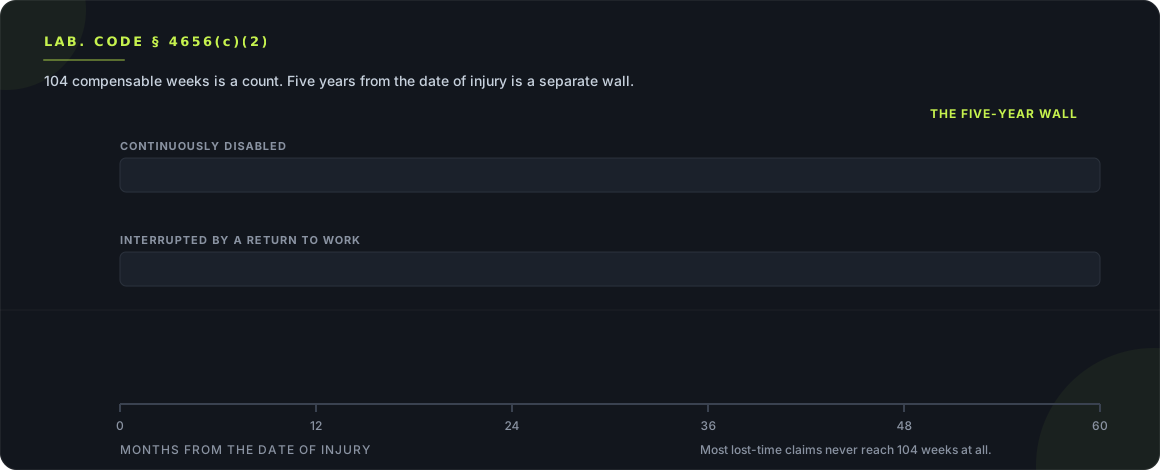
How many claims get there? Nobody publishes the number, and we are not going to invent one. What is published points the other way: over the 2023–2024 period the Bureau of Labor Statistics recorded 1.8 million private-industry cases involving days away from work, and those cases “resulted in a median of 8 days away from work.” A median of eight days is a very long way from 728. The overwhelming majority of lost-time claims close long before the counter becomes relevant.
That is not a weakness in the argument; it is the shape of it. The population that reaches week 104 is small, severely injured, and by definition still disabled two years after the event. What a firm wants here is not volume. It is the date.
The notice with no next step on it
Something does arrive in the post. It is what the letter cannot say that is unusual.
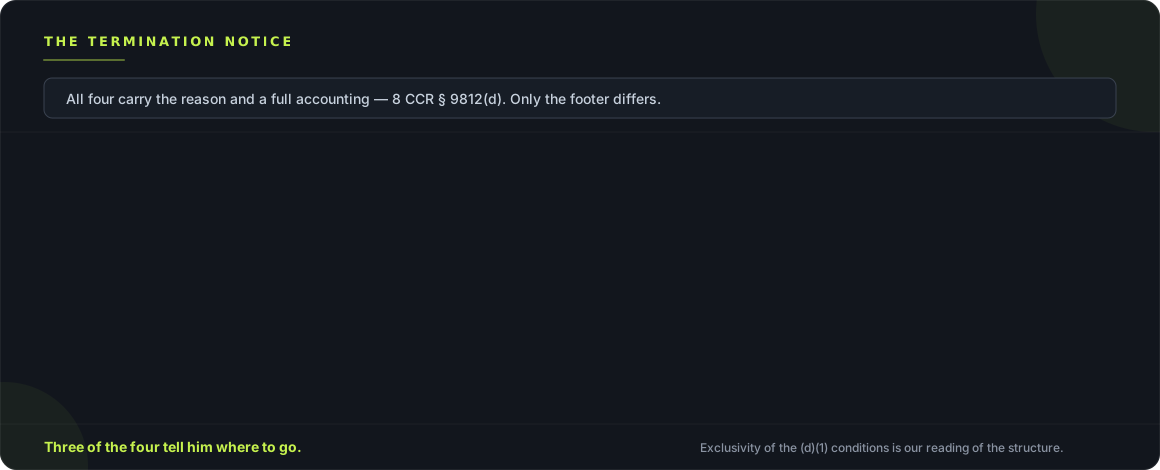
It would be convenient for the argument if benefit exhaustion produced no paperwork at all. It does. California’s benefit-notice regulation, 8 CCR § 9812(d), requires that at the same time as the last payment of temporary disability indemnity the claims administrator advise the employee that indemnity is ending and the reason for it, together with an accounting of all compensation paid in that species of benefit, including dates and amounts. If the decision to end payments was made after the last payment went out, the notice and the accounting follow within fourteen days.
So the worker gets a letter: the general remedies statement every benefit notice carries under § 9810(e)(1), the one beginning “You have a right to disagree with decisions affecting your claim,” and a number for a DWC Information and Assistance officer. What he does not get is the part that matters.
Subdivision (d)(1) is where the regulation tells an unrepresented worker what to actually do, and every one of its instructions is conditioned on the basis of the termination. If the termination is based on a comprehensive medical evaluation and the employee disagrees, the notice must tell him he may file an Application for Adjudication with the Appeals Board. If it is based on the treating physician’s evaluation of temporary or permanent disability status, the notice must tell him to contact the claims administrator, or to download the form himself, to obtain a panel of qualified medical evaluators within the § 4062(a) limit — and it must print the URL.
An exhaustion termination is based on neither. It is based on a count of weeks. The conditions in (d)(1) are written as conditions, and on their face neither of them is satisfied, which means the notice that ends a worker’s wage replacement after two years carries a reason, an accounting, a generic statement of rights, and no instruction at all about what to do next.
There is a second document, and it is in some ways more striking than the first. Section 9812(e)(1) covers the case where the employee is not yet permanent and stationary when temporary disability ends — which is the ordinary case at week 104, because a worker who was already permanent and stationary would ordinarily have stopped receiving temporary disability for that reason instead. In that case the notice issued at the last temporary disability payment must say that permanent disability may be payable, that the amount is not yet determinable, that the claims administrator will continue to monitor, and must give an estimated date for the determination.
Read those two letters as the worker reads them. Your payments have ended, here is the arithmetic, something may be payable later, we will be in touch, here is a number for general information. That is not a denial and not a refusal. There is nothing in it to appeal, because nothing has been decided. It is a correct, compliant, entirely proper notice that an income has stopped.
What the count does to the money
The statute does not leave the worker with nothing. It leaves him with something arithmetically different.
Labor Code § 4650(b)(1) anticipates exactly this. Where the last temporary payment was made under § 4656(c), the employer “nevertheless shall commence the timely payment required by this subdivision” — the first permanent disability payment, within fourteen days — “regardless of whether the extent of permanent disability can be determined at that date,” and must continue “until the employer’s reasonable estimate of permanent disability indemnity due has been paid.”
So money generally keeps moving. The question is how much, and the answer sits in two provisions that have drifted apart for twelve years.
Temporary disability is indexed. Labor Code § 4453(a)(10) carries an escalator tied to the state average weekly wage, and the Division of Workers’ Compensation announces the result each autumn. For injuries on or after 1 January 2026 the maximum temporary total disability rate is $1,764.11 a week and the minimum is $264.61, up from $1,680.29 and $252.03, following a 4.98826 per cent rise in the state average weekly wage from $1,704 to $1,789.
Permanent disability is not indexed. Subdivision (b) of the same section sets the earnings limits used for permanent partial disability, and for injuries on or after 1 January 2014 it reads “not less than two hundred forty dollars ($240) nor more than four hundred thirty-five dollars ($435).” The weekly payment is two-thirds of those earnings, which produces a ceiling of $290.00 a week and a floor of $160.00. There is no escalator anywhere in subdivision (b); the only one in § 4453 sits in (a)(10) and is confined by its own words to temporary disability and permanent total disability.
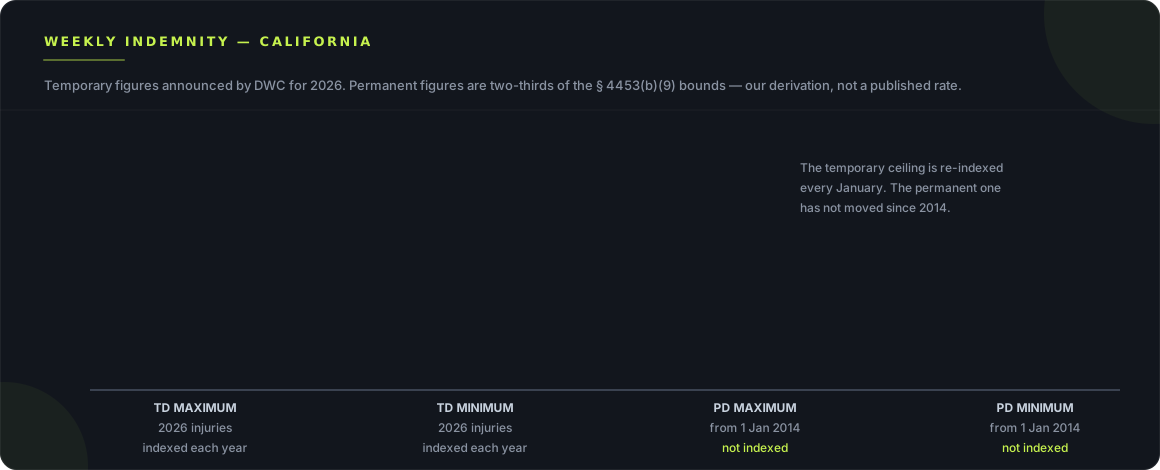
The arithmetic is blunt. A worker earning enough to reach the temporary ceiling receives $1,764.11 a week until the counter runs out, and then, at most, $290.00 a week. That is a reduction of $1,474.11 a week, or 83.6 per cent, produced by nothing but the passage of 104 compensable weeks. And because § 4453(d) fixes the limits in effect on the date of injury for the duration of the disability, the gap is structural: the temporary ceiling is re-indexed every January and the permanent one is not, so the drop gets deeper every year by construction.
Three acts, three instruments, one number
The same figure turns up in three states doing three different jobs. The common thread is not the money.
It would be easy, and wrong, to write that American comp acts stop paying temporary disability at 104 weeks. The number recurs; the mechanism does not.
| State | Authority | What the 104 weeks is | Anchor |
|---|---|---|---|
| California | Lab. Code § 4656(c)(2) | A cap on aggregate temporary disability payments | Within five years of the date of injury |
| Texas | Lab. Code § 401.011(30)(B) | One prong of the statutory definition of maximum medical improvement, which is “the earlier of” three things; temporary income benefits continue until MMI under § 408.102(a) | From the date on which income benefits begin to accrue |
| Florida | Fla. Stat. § 440.15(2)(a) | A cap on temporary disability on the face of the statute: “not to exceed 104 weeks,” subject to its own cross-references | The statute cross-refers to ss. 440.12(1) and 440.14(3) |
Read the middle row carefully, because it is the one that defeats the easy generalisation. Texas does not cap the benefit at 104 weeks. It defines maximum medical improvement as the earlier of a clinical judgement, the expiry of 104 weeks from accrual, and a date determined under another section — and then ends temporary income benefits at maximum medical improvement. The count is a ceiling on how long the clinical question can stay open, not a limit on the benefit as such.
Florida’s statute is a cap, and it says so: temporary disability runs “not to exceed 104 weeks except as provided in this subsection, s. 440.12(1), and s. 440.14(3),” and once the maximum number of weeks is reached or maximum medical improvement arrives, whichever is earlier, “temporary disability benefits shall cease and the injured worker’s permanent impairment shall be determined.” That is the current statute’s own language, read on the Legislature’s site. Florida’s limit has been litigated, and we could not reach any copy of the relevant decision during this run; a reader relying on the face of § 440.15(2)(a) should check the case law before doing so.
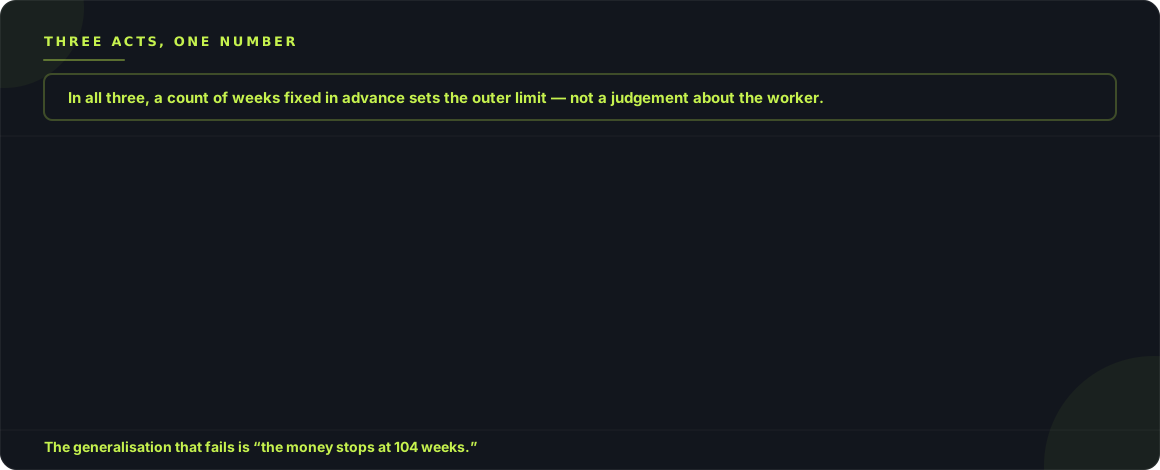
That narrower claim is the one to build on, and it is the one that does the work. Whatever else differs, in each of these acts the end of temporary wage replacement is bounded by a number the legislature wrote down before anybody was injured. The state pages for California, Texas and Florida carry the same figures as reference data; what none of them does, and what this article is for, is say what the figure is worth to a marketing plan.
A date you can put in a calendar
Start with what this does not let you do, because that is where most of the value gets thrown away.
No advertising platform sells claim age. There is no audience segment for “injured 23 months ago,” there is no interest category for it, and there never will be, because the fact lives in a claims file nobody publishes. If the hope was a targeting parameter, there is not one, and a plan built on the assumption that there might be is a plan that will not run.
What exists instead is better and much less convenient: a date on a list you already own.
Four things follow, in rough order of how cheap they are.
One: add a question to the intake script. Not a legal question — a date. When were you hurt? Every script in this category asks what has gone wrong, which is a question about a decision, and a worker at week 104 has nothing to report. Asking how long ago he was injured costs four seconds and produces the one fact that changes what the call is about. Our intake playbook treats source capture as the cheapest line in the whole script; this is the same logic applied to time.
Two: work the archive on a delay. This is lead reactivation with a statutory clock instead of a guess. Pull the enquiries you declined, or that went quiet, with injury dates twenty to thirty months old. That is not a random slice of dormant records; it is the slice whose circumstances the act is about to change. Same consent rules, same cadence limits, same measurement as any other reactivation campaign.
Three: write to the money, not to the dispute. A worker whose temporary disability has exhausted does not describe himself as denied, because he has not been. He describes a payment that stopped. Copy built around refusal language is, for this cohort, aimed at a word he would not use. We are not suggesting bidding on the statutory phrases: that query space is crowded with consumer explainer content and the people in it are mostly researching rather than hiring. The language insight belongs in the creative and the landing page, not the bid.
Four: time a window, not an impression. The retargeting apparatus a firm already runs is built on recency, which is backwards here: the useful audience visited two years ago. Most pixel-based audiences expire long before that, so this is an owned-list job — another reason the CRM, not the ad account, is where it lives.
One more consequence, and it is the one a managing partner should care about most. Because the date is computable for a cohort rather than an individual, it is computable for a market. A firm that knows how many lost-time claims were filed in its counties two years ago knows something about the exhaustion cohort arriving this quarter. It will not be precise — the share that uses all 104 weeks is unpublished — but it is the only forward-looking demand signal in this practice area, and keyword tools only ever report the past. Our Intelligence Center covers the first half of that calculation; the second half nobody has built.
Monday
Four things, none of which requires a budget conversation.
First, run one query against your CRM: enquiries with an injury date between twenty and thirty months ago, where the outcome was anything other than signed. You may have a hundred. You may have four thousand. Either answer is worth knowing, and no firm we have worked with has ever run it.
Second, read your own intake script and find the place where a date of injury would go. If it is not in the first ten questions, it is not being used for anything.
Third, take ten declined records at random from that cohort and check whether the date of injury is actually populated. In most CRMs it is a field that exists and is empty, because nobody has ever needed it.
Fourth, decide whether you want to be the firm whose follow-up arrives the month the arithmetic bites, or the firm whose advertising arrives with everybody else’s in response to an event nobody could predict. That is the whole choice, and it is a cheap one, because the date was always there.
Key takeaways
The triggers comp media is built around are all somebody’s decision. Benefit exhaustion is a count of weeks, so its timing is arithmetic rather than news.
The honest answer is a band, not a date. 104 compensable weeks within five years of injury means exhaustion lands between about month 24 and the five-year wall.
Its termination notice has no next step on it. The instructions in 8 CCR § 9812(d)(1) are each conditioned on a medical basis, and an exhaustion termination has none.
The ceiling falls 83.6 per cent. $1,764.11 a week in 2026 against a permanent disability ceiling of $290 that has not moved since 2014.
The number recurs; the mechanism does not. In Texas 104 weeks defines maximum medical improvement rather than capping the benefit.
The addressable list is your own. Declined enquiries with injury dates 20 to 30 months old, unrepresented, worked under the usual consent rules.
WorkersComp Marketing is a marketing agency, not a law firm. This article reads California Labor Code §§ 4453, 4650, 4656 and 4658, California Code of Regulations title 8 §§ 9810 and 9812, Texas Labor Code §§ 401.011 and 408.102, and Florida Statutes § 440.15, and it reads them in order to explain when demand appears and what a firm should record at intake. Nothing here is legal advice, nothing here is advice about any particular claim, and nothing here is a view on whether a given worker’s temporary disability has in fact exhausted or what he is owed afterwards. Those are questions for the lawyer handling the file, and the interaction between § 4650(b)(1) and § 4650(b)(2) flagged above is one we expressly do not resolve.
Frequently asked questions
Can we actually target people whose benefits are about to run out?
Not through an ad platform. No network sells claim age, injury date or benefit status, and none ever will, because the information sits in a claims file nobody publishes. What is targetable is a list you already hold: enquiries in your own CRM with an injury date roughly twenty to thirty months old. That is an owned-audience and reactivation exercise, run under the same consent and cadence rules as any other, rather than a media-buying one.
How many claims actually reach 104 weeks?
We could not find a published figure and we have not estimated one. The direction is clear enough: BLS recorded 1.8 million private-industry cases involving days away from work across 2023–2024 with a median of 8 days, so the overwhelming majority of lost-time claims end nowhere near two years. BLS does not publish a distribution of cases at 31 days or more in that release, so the size of the long tail is genuinely unmeasured. The cohort is small. It is also, by definition, the most severely injured part of the distribution.
Is this a California-only argument?
The mechanics are. The claim that travels is narrower: in each of the three acts we looked at, a count of weeks fixed in advance sets the outer limit on temporary wage replacement, rather than a judgement about the worker. But the instruments differ — Texas uses 104 weeks as one prong of its definition of maximum medical improvement rather than as a benefit cap, and Florida’s cap has been litigated in ways we could not verify for this article. Do not carry California’s arithmetic across a state line without reading that state’s act.
Doesn’t the worker just move onto permanent disability?
Usually, and that is the point rather than an objection to it. Labor Code § 4650(b)(1) requires the employer to begin paying on a reasonable estimate of permanent disability within fourteen days of the last temporary payment, even where the extent of disability is not yet known. But the permanent disability ceiling for injuries since 2014 is $290 a week against a 2026 temporary ceiling of $1,764.11, so the transition is a fall of up to 83.6 per cent rather than a continuation. There is also a branch in § 4650(b)(2) under which no permanent payment is required before an award, which we flag and do not resolve.
Why would a firm want cases this far into their life?
Two reasons. The cohort is severely injured by definition — still disabled two years after the event — which puts it at the valuable end of the case value distribution. And the competitive position is unusual: there is no auction for a date nobody else is reading, which is close to the opposite of the newly-injured market where every firm bids on the same week. The honest caveat is that a meaningful share will already be represented, and the campaign has to establish that before anything else.
Are you sure the notice really carries no next step?
We are sure about the regulation’s structure and we have flagged the inference. 8 CCR § 9812(d) requires the reason and a full accounting for any termination. Its subdivision (d)(1) then attaches two sets of instructions — file an Application, or obtain a QME panel within the § 4062(a) limit — and conditions each on the termination being based on a medical evaluation. An exhaustion termination is based on a count of weeks. We read the conditions as exclusive, which is how conditions usually work, but the regulation does not say so expressly and the copy we read carries a history ending in 2016. A reader who thinks that reading is wrong should say so; it is the load-bearing inference in the article.
Sources
- 01Cal. Lab. Code § 4656 (c)(2), (c)(3), (d)
“104 compensable weeks within a period of five years from the date of injury”; 240 for the nine conditions in (c)(3); 240 under (d) for a § 3212.1 injury from 1 Jan 2023. Official leginfo unreachable; four third-party reproductions agree word for word. (d) appears without a five-year clause; we have not resolved whether that is deliberate.
- 028 CCR §§ 9810, 9812 — benefit notices
§ 9812(d) requires the reason and an accounting at the last payment; (d)(1)(A) and (B) attach the Application and QME-panel instructions to medically-based terminations; (e)(1) covers the not-yet-P&S case. Read on the Department’s own site, history ending with the amendment operative 1 Jan 2016. That the (d)(1) conditions exclude an exhaustion termination is our inference from structure, not express wording.
- 03Cal. Lab. Code § 4650(b)
After a last temporary payment under § 4656(c) the employer “nevertheless shall commence the timely payment required by this subdivision… regardless of whether the extent of permanent disability can be determined at that date,” until its “reasonable estimate” is paid. Two reproductions agree; official text not read. Whether (b)(2)’s 85 per cent carve-out reaches an exhaustion case we raise and expressly do not answer.
- 04The 2026 rates — DWC release 2025-116, 21 Nov 2025
Maximum temporary total disability $1,764.11, minimum $264.61, for 2026 injuries. The $290.00 and $160.00 permanent figures are ours: two-thirds of the “$240…$435” bounds in § 4453(b)(9), the fraction taken from § 4658. A derivation, not a rate the Division publishes; its rate tables were unreachable.
- 05DWC Fact Sheet C (April 2024)
Agency corroboration: those injured on or after 1 Jan 2008 “are eligible to receive 104 weeks of disability payments within a five-year period,” with up to 240 for “a few long-term injuries.” Plain-language material naming no conditions and citing no section: it corroborates the rule rather than supplying it.
- 06Tex. Lab. Code §§ 401.011(30), 408.102
MMI is “the earlier of” three things, one being “the expiration of 104 weeks from the date on which income benefits begin to accrue”; temporary income benefits “continue until the employee reaches maximum medical improvement.” Single-sourced: the Texas Legislature’s own site returned a navigation shell. § 408.121 not read, so nothing here says what impairment income benefits pay.
- 07Fla. Stat. § 440.15(2)(a)
Legislature’s own site, 2026 Florida Statutes: “not to exceed 104 weeks except as provided in this subsection, s. 440.12(1), and s. 440.14(3),” after which benefits “shall cease and the injured worker’s permanent impairment shall be determined.” Florida’s limit has been litigated; every route to the decision failed this run, so the article confines itself to the statute’s face.
- 08BLS, Survey of Occupational Injuries and Illnesses, 2023–2024
Released 22 Jan 2026 (USDL-26-0101): 1.8 million private-industry cases involving days away from work, which “resulted in a median of 8 days away from work,” at 86.6 per 10,000 FTE workers. A two-year biennial estimate, private industry only. BLS publishes no 31-days-or-more distribution here, so the long tail is unmeasured and we have not estimated it.
- 09Our own figures
~$16.5M of managed workers’ comp Meta spend, ~219,000 leads at ~$75, ~21,000 signed cases at ~$775. Aggregate across client firms, ours and not an industry benchmark. No figure appears here for how many week-104 workers a declined list contains: we have not measured it.
Statutes were read on third-party reproductions where the official source was unreachable, flagged per entry. Two readings here are inferences from structure rather than express wording — the exclusivity of the § 9812(d)(1) conditions and the widening ceiling gap — and both are marked where they appear. A marketing article about demand timing, not legal advice.