Ask a comp intake coordinator what makes a file worth escalating and you will get a list of events. The claim was denied. Treatment was refused. The benefits stopped. He was fired after he reported it. Every item on that list is a thing that happened on a particular day and generated a particular piece of paper, which is exactly why it is on the list: a script can ask about it, a caller can remember it, and a note can record it.
Now ask the same coordinator a different question. Were the payments on time? The caller will almost certainly say yes, or say they do not know, and both answers mean the same thing, which is that nobody counted. Lateness is not an event. It is an interval between two dates, one of which — the date the payment was due — is a legal conclusion the client has never been told.
We have written about the sibling defect: the check that is on time and wrong, where an arithmetic error in the average weekly wage produces a payment of the wrong amount and no letter at all. This is the mirror image. The amount is right. The date is wrong. And unlike almost anything else in a comp file, the statute has already decided what it costs.
The defect that leaves no trace
A denial is an event with a document. A late payment is a pattern across a series, and the series lives on a printout nobody at the firm has.
Think about what the firm actually possesses at the end of an intake call. It has a description of an injury, a date, an employer, a body part, and a story about what went wrong. If something went wrong in a way that generated a letter, the firm will usually hear about it, because the client is holding the letter and the letter is the reason they called.
What the firm does not possess is the payment history. The client has it — in a bank app, in a stack of stubs, in a benefit printout from the carrier — but it is not a story, it is a table, and nobody asks for tables on a first call. So the single most checkable defect in the file is the one piece of information the intake process is structurally designed not to collect.

This matters more than it sounds, because the asymmetry is not about severity. A denial is a bigger event than a fortnight’s delay, obviously. But a denial is also contested, defended and expensive to litigate, whereas lateness is arithmetic: either the payment landed inside the statutory window or it did not, and the window is published. The defect that is hardest to see is the one easiest to prove.
Labor Code § 4650: fourteen days, fourteen days, then every two weeks
The schedule is short enough to memorise, which is the point — anyone in the office can check a payment history against it.
Section 4650 sets three deadlines and nothing else complicated. Under subdivision (a), the first payment of temporary disability indemnity is due “not later than 14 days after knowledge of the injury and disability,” unless liability for the injury has earlier been denied. Under subdivision (b)(1), the first payment of permanent disability is due within 14 days after the date of the last payment of temporary disability. Under subdivision (c), everything afterwards “shall be made as due every two weeks on the day designated with the first payment.”
There is one carve-out on the permanent disability side worth knowing, because it explains a payment gap that is lawful rather than late: before an award, no permanent disability payment is required if the employer has offered the worker a position paying “at least 85 percent” of pre-injury wages and compensation, or if the worker is already “employed in a position that pays at least 100 percent” of them. A firm checking dates needs to know whether a return-to-work offer sits in the file before it concludes anything from a gap.
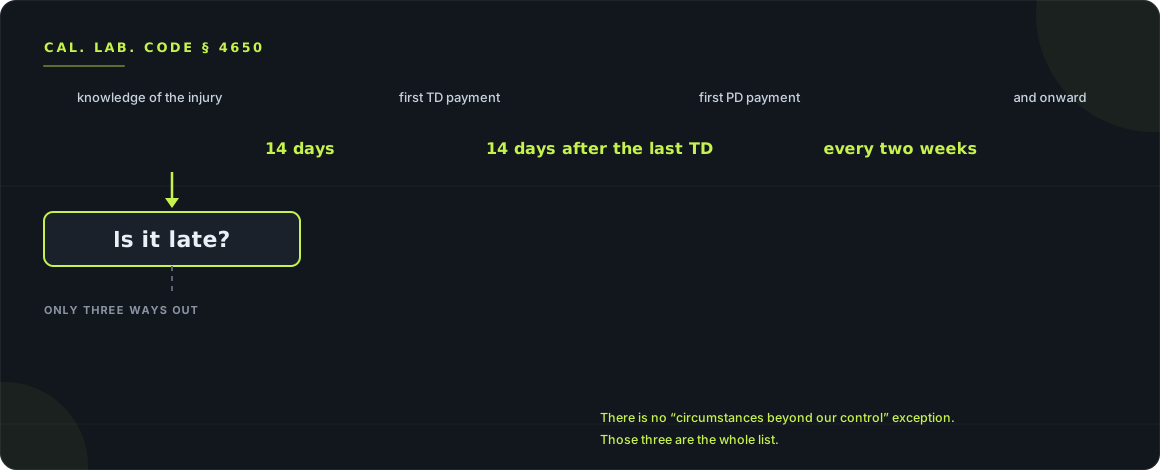
Then subdivision (d). If a payment required by (a) or (b) is not made on time, “the amount of the late payment shall be increased 10 percent and shall be paid, without application, to the employee.” Read those last four words again. The increase is not a remedy the worker applies for, not relief a judge grants, and not something a lawyer has to raise. It is supposed to arrive by itself, attached to the late payment, because the payment was late.
The exceptions are three, and they are the entire list. There is no increase where the employer continues the worker’s wages under a salary continuation plan as defined in subdivision (g). There is none for payments that fell due before the claim form was submitted under § 5401, or within fourteen days after it. And there is none where, inside the fourteen-day window, the employer genuinely cannot yet determine whether temporary disability is owed and tells the worker so in the form the administrative director’s rules prescribe — why payment cannot be made, what information is needed, and when the employer expects to have it.
Labor Code § 5814: up to 25 per cent, and why it is smaller than it looks
Section 5814 is the famous one. It is also discretionary, capped, offsettable and short-lived — and the quiet ten per cent is the more reliable instrument.
Practitioners talk about § 5814, not § 4650(d), and at first glance that looks right: twenty-five per cent beats ten. But the two provisions are built differently, and the differences all run the same way.
Section 5814(a) provides that where payment of compensation has been unreasonably delayed or refused, “the amount of the payment unreasonably delayed or refused shall be increased up to 25 percent or up to ten thousand dollars ($10,000), whichever is less.” Three things in that sentence do work. Up to — it is a ceiling, not a rate, and the same subdivision directs the appeals board to “use its discretion to accomplish a fair balance and substantial justice between the parties.” Whichever is less — the dollar cap bites on anything over $40,000 of delayed payment. And unreasonably — the delay has to be litigated as unreasonable, which is a question of fact rather than a question of dates.
Then the rest of the section chips away at it. Subdivision (b) lets the employer pre-empt the whole thing: if it discovers the potential violation before the worker claims a penalty, it may within 90 days pay a self-imposed penalty of ten per cent of the delayed payment, and that is “in lieu of” the subdivision (a) penalty. Subdivision (d) reduces any (a) award by whatever has already been paid under § 4650(d) on the same delayed benefit. Subdivision (e) takes medical treatment disputes out of the section where the treatment was authorised in time and the argument is only about paying the provider’s bill. Subdivision (f) says nothing in the section creates a civil cause of action. And subdivision (g) shuts the door after two years from the date the payment was due.
| § 4650(d) | § 5814 | |
|---|---|---|
| What triggers it | The payment was late | The delay or refusal was unreasonable |
| Amount | 10%, flat | Up to 25%, or up to $10,000, whichever is less |
| Who decides | Nobody — it attaches | The appeals board, in its discretion |
| Does anyone apply? | No — “without application” | Yes |
| Exceptions | Three, exhaustive | Medical-billing disputes carved out by subd. (e) |
| Can the employer pre-empt it? | No | Yes — a self-imposed 10% within 90 days, subd. (b) |
| Interaction | — | Reduced by anything paid under § 4650(d) on the same benefit |
| Time limit | Not stated in the section | Two years from the date the payment was due |
Put the two together and the shape is clear. Section 5814 is a weapon for a bad case of delay, and it has to be argued. Section 4650(d) is a meter. It does not care why, it does not need anyone to raise it, and it runs on every single late payment in the file rather than on the one worth fighting about. For a firm reviewing a caseload rather than litigating a motion, the meter is the more useful instrument — and it is the one nobody reads.
What the state found when it went looking
California audits claims administrators at random and publishes the results. The 2025 report is the closest thing to an independent measurement of this problem that exists.
The Division of Workers’ Compensation’s Audit & Enforcement Unit reports to the Legislature every year under Labor Code § 129(e). Its 2025 report — the thirty-sixth — covers audits conducted in calendar year 2025 across 2,747 claim files, of which 2,730 were randomly selected and 17 came from complaints. Forty-four routine audits, plus two target audits of administrators that had failed before.
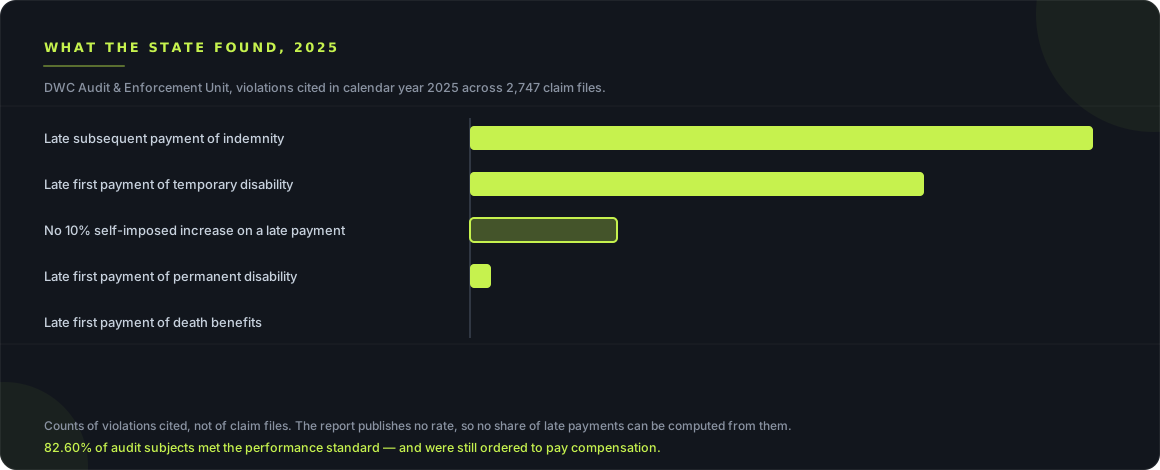
Among the 3,472 violations it cited, the late-payment rows are these: 724 for late subsequent payment of indemnity, 528 for late first payment of temporary disability, 24 for late first payment of permanent disability, and none at all for death benefits. Separately, 171 violations for “failure to pay any 10% self-imposed increase for any late paid indemnity benefits.”
The figure that stops you is a different one. Of the $371,380.02 of compensation the Unit found due and ordered paid across 307 Notices of Compensation Due, $42,447.77 was self-imposed increases. That is money the statute says attaches by itself, without application, that a state auditor had to go and find in a random sample of files.
The performance line is the one to hand a sceptical partner. Thirty-eight of the forty-six audit subjects — 82.60 per cent — met the 2025 performance standard and were assessed no penalties under § 129.5(c), and were nonetheless ordered to pay compensation that was owed on the files. Passing the state’s audit is compatible with owing money on the claims inside it. Whatever comfort a firm takes from the fact that the carrier on the other side is a large, competent, audited organisation, that comfort does not extend to the dates.
The trapdoor under the whole thing
Everything above accrues quietly on the file. One routine act erases all of it, and the statute says so in terms.
Here is the part that turns this from an interesting statutory detail into a case-handling rule. Section 5814(c) provides that upon approval of a compromise and release, findings and awards, or stipulations and orders, “it shall be conclusively presumed that any accrued claims for penalty have been resolved,” whether or not a petition for penalty has ever been filed — unless the order expressly excludes liability for the penalty. The same presumption attaches on submission of an issue for determination at a regular trial hearing, unless the penalty issue is submitted at the same time or expressly excluded.
Conclusively presumed is not a default or a waiver that can be argued around later. It is the end of the question.
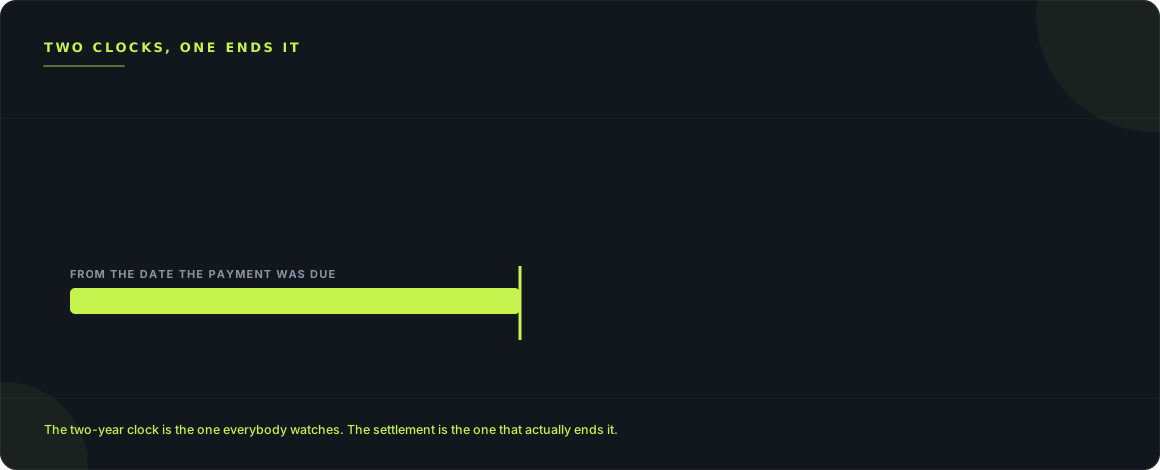
So the accrual picture looks like this. Every late payment adds its ten per cent to the file, silently, over months. Section 5814(g) gives two years from the date each payment was due to bring an action for the penalty. And then the case settles — which is the outcome everyone is working towards, and which the firm schedules — and unless somebody wrote the exclusion into the order, every accrued claim is gone at once.
There is a second-order point here for anybody who thinks about case value. A penalty claim that is identified before settlement is not only collectible; it is also a term. It can be excluded from the order and pursued, or it can be left in and priced into the number. Either is a decision. Discovering it afterwards is not a decision, and discovering it never is the current default.
Do not carry this across a state line
Two of the three systems we checked attach the money to the lateness itself. The third attaches it to an order, which is a different thing entirely.
New York goes further than California on the face of its statute. Workers’ Compensation Law § 25(1)(e) provides that where an employer or carrier fails to pay “any installments of compensation within twenty-five days after the same become due,” there shall be paid to the injured worker “an additional amount of twenty percent of the compensation then due,” plus “the sum of three hundred dollars, which shall be paid to the claimant.” The escape route runs only one way: the delay may be excused by the board “upon the application of the employer or insurance carrier.” The worker applies for nothing; the payer does. A related provision, § 25(3)(f), adds a twenty per cent penalty where compensation under an award is not paid within ten days.
Texas, on the evidence we could reach, is built the other way. Labor Code § 408.064 provides that “an order to pay income or death benefits accrued but unpaid must include interest on the amount of compensation due” at the rate set by § 401.023 — the one-year Treasury constant maturity rate plus 3.5 per cent, published quarterly by the Division. Interest, not a penalty; a rate tied to the Treasury rather than a percentage of the benefit; and, critically, attached to an order rather than to the lateness. Somebody has to get an order first.
| State | What attaches | To what | Who has to ask |
|---|---|---|---|
| California | 10%, flat | The late payment itself | Nobody — “without application” |
| New York | 20% + $300 | An installment 25 days overdue | The employer, to be excused |
| Texas | Interest at the Treasury rate + 3.5% | An order to pay accrued, unpaid benefits | Somebody has to get the order |
That table carries one claim that spans all three rows, so it was written last and checked against each state’s text separately: in California and New York the money attaches to the lateness, and in Texas it attaches to an order. California § 4650(d): “the amount of the late payment shall be increased 10 percent.” New York § 25(1)(e): failure to pay within twenty-five days produces “an additional amount of twenty percent of the compensation then due.” Texas § 408.064(a): “An order to pay income or death benefits accrued but unpaid must include interest.” The Texas row is the one with a limitation attached, and it is a real one: we could not reach 28 TAC chapter 124 or the chapter 415 administrative penalties, so a rule we did not read could qualify it.
What this changes about intake
One question, one document request, and a field in the CRM. The rest is arithmetic somebody junior can do.
The practical change is small and entirely within a firm’s control, which is unusual for anything with a statute attached.
The question is not “were your payments on time?” — the client does not know, and asking an unanswerable question trains intake to record a meaningless yes. The question is “do you have a printout or a list of the dates your benefit payments arrived, and how much each one was?” That is answerable. It is also the single request most likely to produce a document the firm can use, because carriers and self-insured employers generate benefit printouts routinely and injured workers can usually get one by asking.
From there it is a three-column spreadsheet: date due under § 4650, date received, difference. Anyone can run it. The output is not a legal opinion, it is a list of candidate dates for whoever is handling the file — and a list is exactly what the current process does not produce.
There is a marketing consequence too, and it is not the obvious one. This is not a reason to advertise for late-payment cases: there is no searchable audience of people who know their checks were late, and a campaign built on it would be fishing in a puddle. The consequence is on the conversion side. An enquiry that arrives as “something feels wrong but I don’t know what” is the hardest kind to sign, because the firm cannot tell the caller anything specific. A payment history turns that call into a dated, priced, checkable fact pattern — and specificity is the thing that converts. The same enquiry, same case, different conversation.
Monday
Three things, and none of them needs a decision above office-manager level.
Add the document request to intake. One question, one field, one follow-up in the sequence you already run. Ask for the payment printout, not for the client’s opinion about whether the payments were timely.
Run the three-column check on open files before they settle, not after. Date due, date received, difference. The useful moment is while the file is still open and the order has not been drafted, because that is the last point at which § 5814(c) can be answered with an express exclusion rather than silence.
Decide, once, what the firm does with the output. Pursue it, price it into the settlement, or let it go — all three are defensible, and the difference between them and the status quo is that they are choices. Right now the default is that nobody looks, so the answer is always the same one, and nobody ever picked it.
Key takeaways
A late indemnity payment carries 10% automatically in California. Section 4650(d) says it is paid “without application” — nobody has to raise it.
The schedule is short enough to check by hand. 14 days to the first TD payment, 14 days from the last TD to the first PD, then every two weeks.
There are exactly three exceptions, and none of them is an administrative problem at the carrier.
Settlement closes it, conclusively. Section 5814(c) presumes accrued penalty claims resolved on approval unless the order expressly excludes them.
The state finds this at random. 1,276 late-payment violations cited in 2025, and $42,447.77 of self-imposed increases ordered paid.
It is not a national rule. New York adds 20% after 25 days; Texas attaches Treasury-rate interest to an order, so somebody has to get one.
WorkersComp Marketing is a marketing agency, not a law firm. This article describes statutes — California Labor Code §§ 129, 129.5, 4650, 5401 and 5814, together with New York Workers’ Compensation Law § 25 and Texas Labor Code §§ 401.023 and 408.064 — and it describes them in order to explain what a firm should capture at intake and when. Nothing here is legal advice, nothing here is advice about whether any particular payment was late or any particular penalty is payable, and nothing here is advice about your professional-conduct obligations. Whether a given file carries a penalty claim, and how it should be handled at settlement, are questions for the lawyer handling it.
Frequently asked questions
If the 10% is automatic, why would it ever be missing?
Because “automatic” describes the legal consequence, not the payment system. Section 4650(d) makes the increase due without an application; it does not make it appear. Somebody at the claims administrator still has to notice the payment was late, calculate ten per cent and issue it. The California Audit Unit’s 2025 report cited 171 violations for failing to pay the self-imposed increase on late-paid indemnity, and found $42,447.77 of such increases due across 307 Notices of Compensation Due in randomly selected files — which is the practical answer to the question.
Is this worth chasing? Ten per cent of a two-week benefit payment is not much money.
On one payment, no. The arithmetic only becomes interesting across a series, which is also the reason it is invisible: a single late payment is a rounding error, and a file with fourteen of them is a pattern with a price. We have deliberately not published an illustrative total, because the honest inputs — how often payments run late on a given carrier’s files, and by how much — are exactly what the published data does not give. The case for looking is not a number we can give you; it is that the check costs almost nothing and the current answer is unknown.
Does this mean we should advertise for workers whose payments were late?
No, and we would argue against it. There is no meaningful search audience for it — a worker who knows their payments were late describes the problem as “they stopped paying me” or does not describe it at all — and a campaign built on the premise would be targeting a condition the audience cannot self-identify. The value here is on the conversion and case-value side, not the acquisition side: it changes what a firm does with enquiries it is already receiving.
What is the difference between this and the benefit rate error?
They are the two halves of the same blind spot. The benefit rate error is a payment that is on time and for the wrong amount, usually because the average weekly wage was computed from incomplete earnings. This is a payment for the right amount that arrived on the wrong day. Both are invisible to an intake script built around events, both are detectable from documents the client can obtain, and neither produces a letter. The rate error needs a wage reconstruction; the late payment needs nothing but two dates and subtraction.
How confident are you in the audit figures?
The counts come straight from the Division’s own report and we quote them as counts. We are explicitly not turning them into rates: the report gives no per-file denominator for violations, and it contains at least three internal inconsistencies we found while reading it — a per-file figure computed against the violation count rather than the file count, an $800 difference between two exhibits’ assessable totals, and a sentence referring to “five (5) of the seven (7)” where the surrounding text describes eight failing subjects. None of those touches the late-payment counts themselves, but they are a reason to read the report rather than our summary of it.
Sources
- 01California Labor Code § 4650
Source of the 14-day deadlines, the every-two-weeks interval, the 85%/100% return-to-work carve-out and the 10% increase “without application” with its three exceptions. Read on two independent publishers whose texts match: California.Public.Law (verified 11 Nov 2026) and FindLaw (current to 1 Jan 2026). Neither is the state’s own publication; leginfo was not read.
- 02California Labor Code § 5814
Source of the “up to 25 percent or up to ten thousand dollars ($10,000), whichever is less” cap, the employer’s 90-day self-imposed 10% in subd. (b), the § 4650(d) offset in (d), the medical-billing carve-out in (e), and the two-year limit in (g). Same two publishers, matching. Operative 1 June 2004; neither publisher shows a later amendment, and we could not confirm one.
- 03§ 5814(c) — the settlement presumption
“It shall be conclusively presumed that any accrued claims for penalty have been resolved” on approval of a compromise and release, findings and award, or stipulations and order, unless the order expressly excludes the penalty claim. This is the statute’s own wording; we have not surveyed the case law on how it is applied, and reported decisions could qualify it.
- 04DWC Audit & Enforcement Unit, 2025 Audits
The thirty-sixth annual report to the Legislature under Lab. Code § 129(e). Source of all violation counts, the $371,380.02 and $42,447.77, the 307 Notices and the 82.60% figure. Counts of violations, not claim files, with no published denominator — no rate can be derived. The report has internal inconsistencies: a per-file figure divided by violations, an $800 gap between two exhibits, and a “five of the seven” sentence against eight stated failures.
- 05New York Workers’ Compensation Law § 25
Read on the New York State Senate’s official site. § 25(1)(e) gives the 20% and the $300 after twenty-five days, excused only “upon the application of the employer or insurance carrier”; § 25(3)(f) adds 20% on an unpaid award after ten days. Automatic on the face of the text; we did not establish Board practice or read 12 NYCRR, and the page’s latest revision is dated 2 July 2021.
- 06Texas Labor Code §§ 408.064 and 401.023
Interest on accrued but unpaid benefits attaches to “an order to pay,” at the one-year Treasury constant maturity rate plus 3.5 per cent, published quarterly. Read on texas.public.law, a mirror, because the official capitol site returned only a navigation shell. We could not reach 28 TAC ch. 124 or the ch. 415 administrative penalties, so a rule we did not read could qualify the Texas row.
- 07Our own figures
~$16.5M of managed workers’ comp Meta spend, ~219,000 leads at ~$75, ~21,000 signed cases at ~$775. Aggregate across client firms, ours and not an industry benchmark. No illustrative penalty total is published in this article, because the inputs it would need are the ones the public data does not supply.
Every statutory quotation was read either on a state’s own site or on two independent publishers that agree, with the exceptions flagged in bold. This is a marketing article about what a firm should capture at intake; it is not legal advice and it is not a view on any particular file.