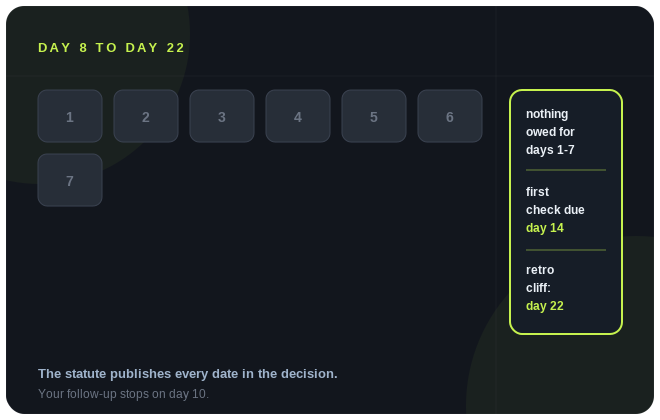
Every workers’ comp firm’s marketing is organised around an event it can name. The denial. It is in the ad copy, it is the first question on the intake form, and it is the premise of an entire category of landing page. It is also, measured against the whole body of lost-time claims, the smaller story.
The bigger one is quieter, and it is not a wrong done to anybody. It is the statute functioning exactly as drafted, with a cooperative employer, an accepted claim and a carrier paying on schedule — and declining, by design, to replace most of the wages the typical injured worker actually loses. The mechanism is called the waiting period. Every state has had one since the first comp acts, every state publishes its terms, and almost nothing in a law firm’s marketing stack knows it exists.
This article puts the statutory calendar next to the CRM calendar. They do not overlap. The gap between them is where the cases are.
The median claim is eight days long
Before the statute, the denominator. Most comp marketing is written for a case that is not the typical one.
Start with the population, because everything downstream depends on getting it right. The Bureau of Labor Statistics’ employer-reported injury and illness survey counted roughly 1.83 million private-industry cases involving days away from work across its 2023–24 reference period, and reports that those cases produced a median of eight days away from work.
Eight. Not eight weeks, not eight months. Half of the absences that the American workplace reports as lost-time injuries are a week and a day or shorter.
That is not the case a comp firm pictures. The case a firm pictures — the surgery, the permanent impairment rating, the two-year fight over apportionment — is real, is where the fee is, and is a thin slice of the top of the distribution. The person your Meta ads reach is far more likely to be nine days into something that hurts, has already been back to work once, and has just noticed that the money is wrong.
What the statute pays for an eight-day absence
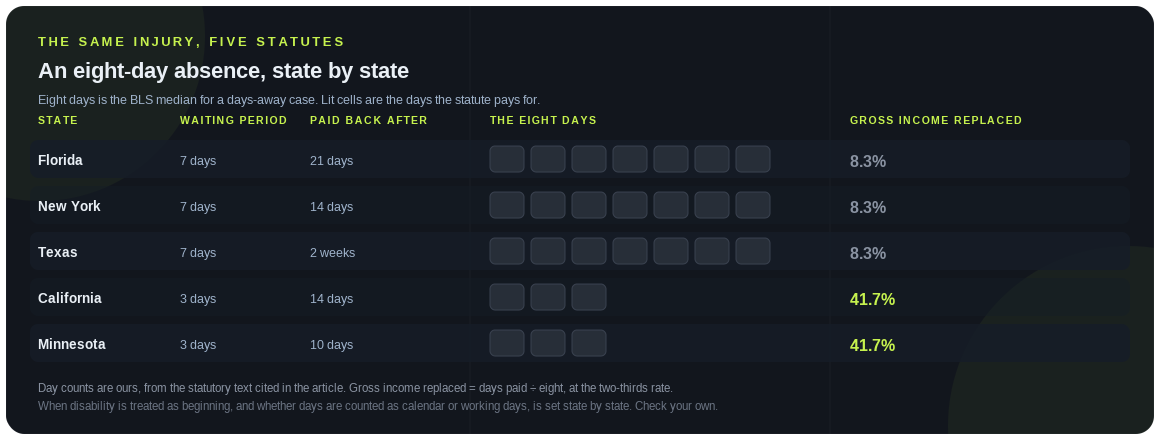
Five statutes, five different answers, and not one of them is “all of it.”
A waiting period is a provision that disallows compensation for an initial span of disability, and then restores those days if the disability runs past a longer threshold. The structure is the same everywhere. The numbers are not, and the differences are large enough to change what a firm should say in each market.
Florida’s is the starkest. Fla. Stat. § 440.12(1) provides that compensation is not allowed for the first seven days of the disability, and that where the injury results in more than twenty-one days of disability, compensation is allowed from the commencement of the disability. New York’s Workers’ Compensation Law § 12 is the same shape with a shorter tail: no compensation for the first seven days, but “in case the injury results in disability of more than fourteen days, the compensation shall be allowed from the date of the disability.” Texas Labor Code § 408.082 phrases it as accrual rather than disallowance — income benefits begin to accrue on the eighth day after the injury, and are computed from the date disability began only if disability lasts two weeks or longer — which produces the same seven unpaid days.
Two states in the table below are gentler. California Labor Code § 4652 disallows temporary disability indemnity for the first three days and pays from the first day once the disability continues more than fourteen days or the worker is admitted as an inpatient. Minnesota waits three calendar days under Minn. Stat. § 176.121 and pays them back once the disability reaches ten.
Now put the median absence through each one.
| State | Waiting period | Paid back if disability runs longer than | Days paid of an 8-day absence | Share of gross income replaced |
|---|---|---|---|---|
| Florida | 7 days | 21 days | 1 of 8 | 8.3% |
| New York | 7 days | 14 days | 1 of 8 | 8.3% |
| Texas | 7 days (benefits accrue on the 8th) | 2 weeks | 1 of 8 | 8.3% |
| California | 3 days | 14 days | 5 of 8 | 41.7% |
| Minnesota | 3 days | 10 days | 5 of 8 | 41.7% |
The last column is the one to sit with. It is not the share of days paid; it is the share of lost gross income replaced, because the days that are paid are paid at two-thirds. Florida fixes temporary total disability at 66⅔ per cent of the average weekly wage and most states are at or near the same rate. So a Florida worker who misses eight days of work keeps about eight cents of every dollar he would have earned — and every actor in that transaction has complied with the law.
The retroactive cliff
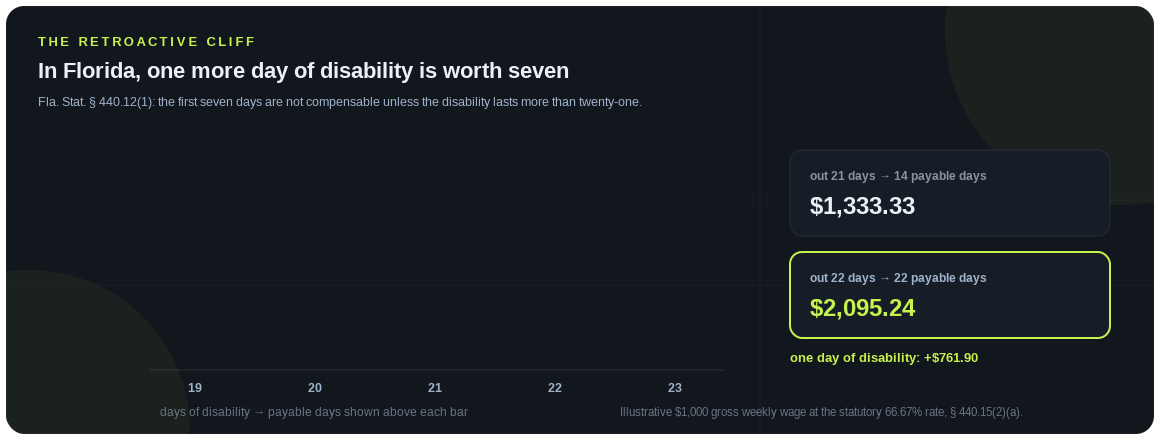
In Florida the twenty-second day of disability is worth roughly eight times what the twenty-first is.
Retroactive thresholds create a discontinuity, and in Florida it is a large one sitting in exactly the part of the distribution where claims resolve. Take a worker earning a $1,000 gross weekly wage, which makes the statutory rate $666.67 a week, or $95.24 a calendar day.
Out twenty-one days, he is paid for days eight through twenty-one: fourteen days, $1,333.33. Out twenty-two days, the disability has run more than twenty-one, the waiting week is restored, and he is paid for all twenty-two: $2,095.24. One additional day of disability is worth $761.90 to him, against $95.24 for the day before it.
Two things follow for a firm. The first is that this is a fact an injured worker in Florida would want to know and almost certainly does not, which makes it the most useful sentence a Florida comp firm can put on a page. The second is subtler: the cliff is a reason a worker who is not in a dispute picks up the phone. He is not calling because somebody wronged him. He is calling because the number changed and nobody explained it.
The second published date: when the check is due
The waiting period says what is owed. A different provision says when it has to arrive — and one state publishes how often it doesn’t.
Firms conflate these two provisions constantly, and they are separate. One decides entitlement; the other decides timing, and the timing provision is the one with a penalty attached.
California Labor Code § 4650(a) requires the first payment of temporary disability indemnity not later than fourteen days after knowledge of the injury and disability, unless liability has been denied. Subdivision (d) adds that a late payment “shall be increased 10 percent and shall be paid, without application, to the employee” — a self-executing penalty the worker does not have to ask for, subject to exceptions where the employer has notified him that it cannot yet determine whether benefits are owed.
Fla. Stat. § 440.20(2)(a) requires the first installment no later than the fourteenth calendar day after the employer receives notification of the injury, where disability is immediate and continuous for eight calendar days or more — note how precisely that threshold sits on top of the median absence — and § 440.20(6)(a) adds a twenty per cent penalty to an installment unpaid seven days after it becomes due. New York’s board tells workers plainly that payments “should begin within 18 days of the day that you were injured”, or within ten days after the employer learns of the injury, whichever is later.
| State | Provision | First payment due | If it is late |
|---|---|---|---|
| California | Lab. Code § 4650(a), (d) | 14 days after knowledge of injury and disability | payment increased 10%, paid without application |
| Florida | Fla. Stat. § 440.20(2)(a), (6)(a) | 14th calendar day after the employer is notified, where disability is immediate and continuous for 8+ days | 20% penalty on an installment unpaid 7 days after due |
| New York | WCB guidance to injured workers | 18 days from injury, or 10 days after the employer learns of it, whichever is later | board process; disputed claims wait for a judge |
| Wisconsin | DWD 80.02(3)(a) | first indemnity payment mailed within 14 days | measured publicly against an 80% promptness standard |
That last row is the one worth dwelling on, because Wisconsin does something almost nobody else does: it counts. The Department of Workforce Development publishes a promptness indicator for first indemnity payments, holds the industry to a standard of 80 per cent or better, and reported industry performance of 83 per cent for the second quarter of 2026 and 81 per cent across twelve quarters.
Read that properly. It is a pass. Wisconsin’s carriers are clearing the state’s own bar. And it also means that in the one jurisdiction we found that publishes a measurement, roughly one first indemnity payment in six arrives late. We have not found an equivalent published series elsewhere and we are not going to extrapolate Wisconsin’s rate onto states that do not measure. But a rate of that order, applied to any firm’s lead flow, describes a predictable and dated population: people who expected money on a specific day, by law, and did not get it.
Nobody calls a lawyer because the statute has a waiting period. They call because the week the waiting period covered was the week the rent was due.
Two triggers, both dated
One is “nothing came.” The other is “something came, and it is two-thirds.”
The first trigger is the late or missing payment. It has a date, because the deadline has a date, and it affects a minority of claims.
The second trigger affects every single one, and firms almost never speak to it. The check arrives, on time, correctly calculated — and it is two-thirds of the pre-tax average weekly wage, against a household whose rent, truck payment and insurance are all still at one hundred per cent. For a worker with any overtime in his baseline, the gap is wider still. The first benefit check is the moment an injured worker learns what the system is actually going to do for him, and for most of them it is worse than they assumed.
Whether that is survivable depends on reserves, and the Federal Reserve measures those. In its Report on the Economic Well-Being of U.S. Households in 2025, 63 per cent of adults said they would cover a hypothetical $400 expense exclusively with cash, savings or a credit card paid off at the next statement; 12 per cent said they would be unable to pay it by any means; and 30 per cent said they could not cover three months of expenses by any means available to them. Those are national figures across all adults, not a measurement of injured workers, and the population that fills a comp firm’s lead flow skews toward hourly and physical trades. Treat the direction as reliable and the exact share as indicative.
This figure is also where the argument has a boundary, and it is worth marking it. In a state with a three-day wait and a ten-day threshold, the median absence nearly clears the cliff and the shock is materially smaller. The claim in this article is strongest in the seven-day, long-threshold states and weakest in the short ones. Say that out loud internally, because a targeting rule nobody has drawn a boundary around is a rule that gets applied to people it was never about.
Your sequence ends before the calendar starts
The standard cadence is built around the firm’s patience, not the worker’s bank account.
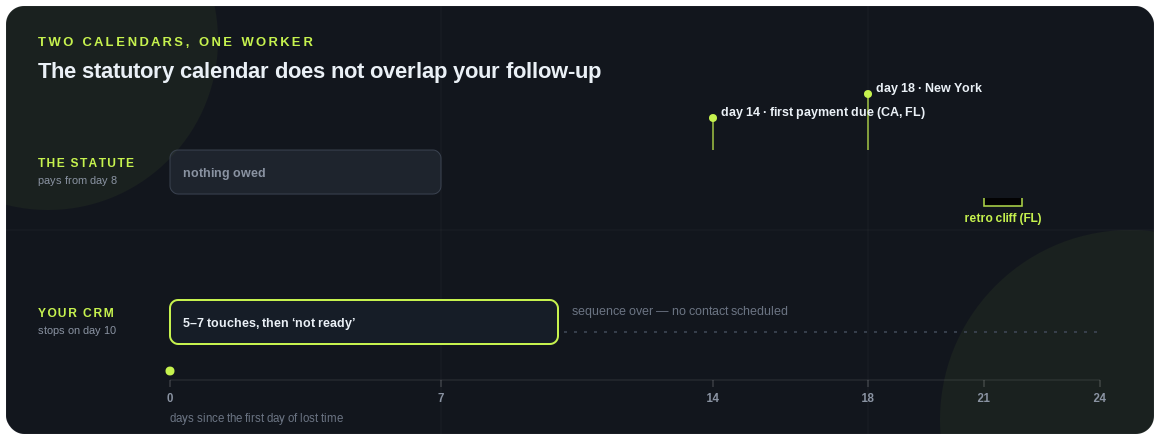
Here is the part that is directional, and we are flagging it as directional because there is no published census of law-firm follow-up cadences and we are not going to invent one. What we can say is what we see in the lead systems we work inside: the sequence is normally measured in days. A call within minutes, two or three more that day, a text, an email, one more call, and somewhere between day seven and day ten the record is dispositioned — “not interested,” “not ready,” “no answer” — and the automation stops.
The statutory calendar is measured in weeks. The first payment is not even due until day fourteen in California and Florida, or day eighteen in New York. The waiting week is not restored until day fifteen in New York and California, or day twenty-two in Florida. The moment the household actually feels the hole is later than both.
So the typical sequence runs its entire course during the one stretch of the claim when nothing has gone wrong yet, and then switches off at precisely the point where the evidence starts arriving. We have written before about the case for the slow yes and about the leads you already paid for. This is the mechanism underneath both of them, and it has the useful property of being a date rather than an attitude.
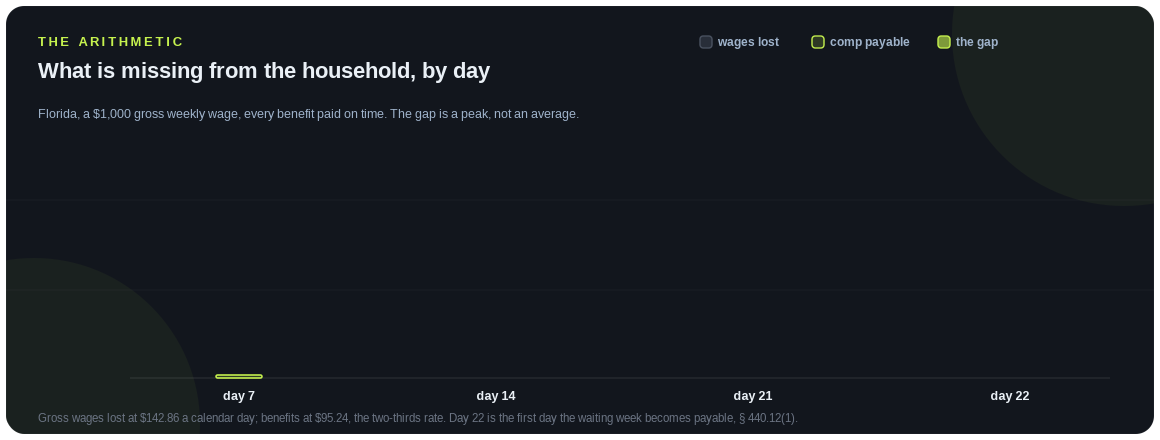
That peak is the whole point. The worst day in the household’s cash position is day twenty-one — nearly $1,700 short on an illustrative $1,000-a-week wage, with every payment made on time and nothing in dispute. It is also, in most firms, the eleventh consecutive day on which nobody from the firm has made contact.
The two fields that make this work
Date of injury and first day of lost time. Your intake form probably has one of them.
None of this requires new software. It requires two fields captured on every enquiry — including, and especially, the ones you do not sign — and one scheduled task per lead.
Field one: date of injury. Most intake forms have it. Most CRMs store it as decoration.
Field two: first day of lost time, and whether the worker is still out. This is the one that is usually missing, and it is the one the whole calendar hangs on, because the waiting period runs from disability, not from injury. A worker hurt on the third who finished his shift and stopped working on the fifth is on a different clock than the form implies.
From those two fields and one lookup table of your own states’ provisions, the CRM can compute the three dates for each lead at the moment it arrives, and schedule the contacts. If you are already running the five-piece stack we described in the intake tech stack, this is a calculated field and three automation rules, not a project.
Three boundaries, stated plainly, because a rule applied past its edge becomes a nuisance:
- Medical-only claims have no waiting period to wait through. If the worker never lost time, none of these dates exist for him. Flag it and exclude him from the sequence.
- Cumulative trauma and occupational disease break the date. In those matters the date of injury is a legal conclusion, often fixed by the date of disability or of knowledge, and it is not something an intake form establishes. Route those to a human, not to an automation.
- Intermittent disability breaks the count. The arithmetic in this article assumes a continuous absence. A worker who goes back, fails, and goes out again is on a sequence your lookup table will get wrong.
One compliance note, and it is a real one. Re-contacting a person who previously enquired is not the same as contacting a stranger, but what a firm may send, how often, and on what consent is set by its own state’s rules on solicitation and on texting. We have covered the general shape of that in what comp firms can and can’t say. The statutory calendar is a timing input to contact you are already permitted to make. It is not permission for a new kind of contact.
The calendar nobody has published for your state
The content side, and it is one page.
Everything above is also a content strategy, because the injured worker is searching for exactly this and the results he gets are bad. “When will I get my first workers’ comp check” is a question with a partly statutory answer, and the pages that rank for it are overwhelmingly generic, undated, and written for whichever state the publisher happens to sit in — which is the single most harmful property a page about a state-specific statute can have.
The page that beats them is not long. It is your state, with the four numbers: the waiting period, the retroactive threshold, the date the first payment is legally due, and the benefit rate. It cites the sections. It shows one worked example on a plain weekly wage. It says what happens if the payment is late, and it says the date it was last checked.
That page is also, not incidentally, the kind of thing an answer engine will quote, for the reasons we set out in how to be the answer, not the tenth link: it is original, dated, specific, and the claims in it are traceable to a primary source. Most pages competing for the query are none of those things.
If you want the state-level demand picture behind it before you write, the Workers’ Compensation Intelligence Center has the BLS and Census data by state and county, and the Growth Library has the longer-form material on intake and follow-up that this article sits alongside.
Key takeaways
-
The median lost-time case is eight days. BLS reports that median across roughly 1.83 million private-industry days-away cases. The fee is in the catastrophic claim; the lead flow is not.
-
For that absence, the statute pays almost nothing — by design. Florida, New York and Texas each withhold the first seven days and restore them only past a threshold the median case never reaches.
-
The retroactive threshold is a cliff, not a slope. In Florida the twenty-second day of disability restores the whole waiting week — about $761.90 to a $1,000-a-week worker, against $95.24 the day before.
-
A second provision sets when the money must arrive. Fourteen days after knowledge in California, with a 10% uplift if late; day fourteen after notification in Florida, with a 20% penalty; eighteen days in New York.
-
One state counts, and publishes it. Wisconsin measures first-payment promptness against a 14-day mailing rule and an 80% standard, and reported 83% for Q2 2026 — about one first payment in six arriving late.
-
The fix is two fields and three dates. Capture date of injury and first day of lost time; compute the payment-due date, the retroactive threshold and the first-full-week date, and schedule a contact on each.
WorkersComp Marketing is a marketing agency, not a law firm. Nothing here is legal advice, and nothing here is advice about any firm’s professional-conduct obligations. Workers’ compensation waiting periods, retroactive thresholds, payment deadlines and benefit rates are set state by state, they are amended, and the rules for counting days and for when disability is treated as beginning differ between them; the provisions quoted here are quoted to show that they exist, that they differ and that the differences are operational. Read the current text of your own state’s act, and have counsel at the firm confirm any figure before it goes in front of an injured worker.
Frequently asked questions
Isn't the denial still the real trigger?
A denial is a strong trigger and nothing here says otherwise. The point is about volume and timing. Most lost-time claims are not denied, and the Bureau of Labor Statistics puts the median days-away case at eight days. For that worker there is no denial letter to react to; there is a payroll week that produced no money, which the statute explains and nobody explains to him. Marketing organised entirely around the denial is organised around the smaller population, and it has no date attached to it. The waiting period has three.
What exactly is a waiting period?
Every state comp act disallows compensation for an initial span of disability, usually three or seven days, and then provides that those days become payable if the disability runs past a longer threshold. Florida's section 440.12(1) disallows the first seven days and allows compensation from the start of the disability only if the injury causes more than twenty-one days of disability. New York's Workers' Compensation Law section 12 disallows the first seven and pays from the date of disability if the disability runs more than fourteen days. California's Labor Code section 4652 disallows the first three and pays from the first day once temporary disability continues for more than fourteen days. They are all the same shape with different numbers.
Where did the one-day-in-eight figure come from?
It is arithmetic, and we would rather you check it than take it. BLS reports a median of eight days away from work for days-away cases over 2023-24. Florida, New York and Texas each withhold the first seven days of disability and only repay them past a threshold the median case does not reach — twenty-one days in Florida, fourteen in New York, two weeks in Texas. Seven unpaid days out of eight leaves one. California and Minnesota, with three-day waiting periods, leave five of eight. The one thing the arithmetic depends on is when the state treats disability as beginning, and that is a rule you should read for your own state before you print a number.
When is the first check actually due?
That is a separate provision from the waiting period and it is also published. California requires the first payment of temporary disability not later than fourteen days after knowledge of the injury and disability, and adds ten percent to a late payment automatically, without the worker having to ask. Florida requires the first installment by the fourteenth calendar day after the employer receives notification where disability is immediate and continuous for eight calendar days or more, with a twenty percent penalty on an installment unpaid seven days after it is due. New York's board tells workers that payments should begin within eighteen days of the injury, or ten days after the employer learns of it, whichever is later.
Do carriers actually hit those deadlines?
Mostly, and one state publishes the measurement. Wisconsin's Department of Workforce Development sets a promptness standard under DWD 80.02(3)(a) that first indemnity payments be mailed within fourteen days, holds the industry to eighty percent, and reported industry performance of eighty-three percent for the second quarter of 2026 and eighty-one percent across twelve quarters. That is a pass. It also means that in the one state that counts, roughly one first payment in six arrives late. We have not found an equivalent published series in other states and we are not going to extrapolate Wisconsin's rate onto them.
What do we actually change on Monday?
Two fields and one scheduled task. Capture date of injury and first day of lost time on every enquiry, including the ones you do not sign. Then, for each lead, compute three dates from your own state's statute: the day the first payment is legally due, the day the waiting period becomes repayable, and the day after the first full benefit week should have landed. Schedule a contact on each. You are not inventing urgency; you are arriving on the days the legislature already put in the worker's calendar.
Is contacting an old enquiry on a statutory date a solicitation problem?
It may be, and that is a question for your own counsel and your own state's rules, not for a marketing agency. Re-contacting a person who previously enquired is a different thing from contacting a stranger, and the rules on direct solicitation, on texting consent and on what a follow-up message may claim vary state to state. We have written separately about where those lines sit in general terms. Treat the statutory calendar as a timing input to whatever contact you are already permitted to make, not as permission to make a new kind of contact.
Who does this not apply to?
Anyone who did not lose time. A medical-only claim never reaches a waiting period, so none of these dates exist for that worker and the calendar is simply irrelevant. It is also weaker where disability is intermittent rather than continuous, where the claim is a cumulative-trauma or occupational-disease matter and the date of injury is a legal conclusion rather than a fact, and in states whose waiting periods and thresholds are short enough that the median absence clears them. Say so internally. A targeting rule that nobody has drawn a boundary around becomes a rule that gets applied to people it was never about.
Sources
-
01
The denominator: how long a lost-time absence actually is
The Bureau of Labor Statistics’ employer-reported injury and illness release. Days-away-from-work cases resulted in a median of 8 days away from work, across roughly 1,834,600 private-industry cases in the 2023–24 reference period. BLS measures employer-reported days away, which is a related but not identical instrument to a comp indemnity claim file.
-
02
Florida: the seven-day wait and the twenty-one-day threshold
§ 440.12(1) disallows compensation for the first 7 days of the disability and allows it from the commencement of the disability where the injury causes more than 21 days of disability. § 440.15(2)(a) sets temporary total disability at 66⅔% of the average weekly wage, capped at 104 weeks.
-
03
New York: seven days, restored past fourteen, paid by day eighteen
WCL § 12: “No compensation shall be allowed for the first seven days of disability … provided, however, that in case the injury results in disability of more than fourteen days, the compensation shall be allowed from the date of the disability.” The Workers’ Compensation Board tells workers payments should begin within 18 days of the injury or 10 days after the employer learns of it, whichever is later.
-
04
California: three days, fourteen days to pay, and a self-executing penalty
Lab. Code § 4652 disallows temporary disability indemnity for the first three days and pays from the first day once disability continues more than 14 days or the worker is admitted as an inpatient. § 4650(a) requires the first payment not later than 14 days after knowledge of the injury and disability; § 4650(d) increases a late payment by 10 percent, paid without application.
-
05
Texas: accrual on the eighth day, reach-back at two weeks
Lab. Code § 408.082: income benefits may not be paid for an injury that does not result in disability for at least one week; where it lasts longer, benefits begin to accrue on the eighth day, and where disability lasts two weeks or longer, compensation is computed from the date disability began.
-
06
Minnesota: three days, restored at ten
The Department of Labor and Industry’s own explanation of Minn. Stat. § 176.121: a three-calendar-day waiting period from the first day of lost time, with those days payable if the disability lasts at least ten calendar days.
-
07
Florida’s payment deadline and penalty
§ 440.20(2)(a): the first installment is due no later than the 14th calendar day after the employer receives notification of the injury, where disability is immediate and continuous for 8 calendar days or more. § 440.20(6)(a): an installment not paid within 7 days after it becomes due carries a penalty of 20 percent.
-
08
The only published measurement of whether carriers pay on time
Wisconsin DWD’s promptness indicator for first indemnity payments under DWD 80.02(3)(a) — payment mailed within 14 days, measured against a 80% or better standard. Reported industry performance: 83% in Q2 2026 and 81% across twelve quarters. We found no equivalent published series in another state and have not extrapolated this one.
-
09
How much of a shock a two-week income gap is
The Federal Reserve’s Report on the Economic Well-Being of U.S. Households in 2025: 63% of adults would cover a $400 expense exclusively with cash, savings or a card paid at the next statement; 12% would be unable to pay it by any means; 30% could not cover three months of expenses. National figures across all adults, not a measurement of injured workers.
Statutes are amended and administrative rules change. Every provision above was read in October 2026 and is cited so you can check it rather than take our word for it. The day counts, the replacement shares and the dollar figures in this article are our arithmetic from that text on a stated illustrative wage — they are not measurements of any firm’s claims and they are not legal advice. Where a claim here is directional rather than sourced, we have said so in the text.