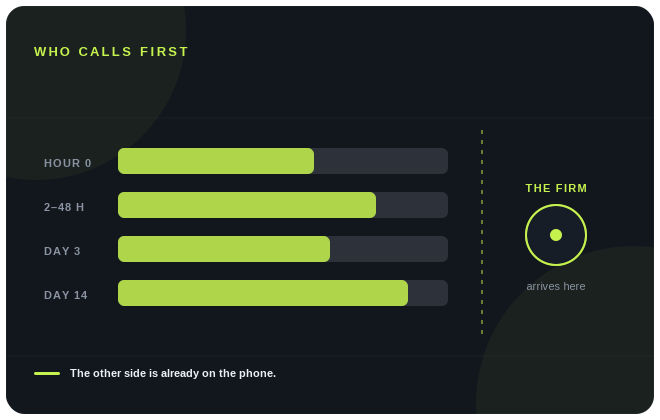
Every comp firm in America is competing with another comp firm. That is the assumption underneath the whole media plan — the conquesting budget, the five-minute callback, the after-hours cover, the one-firm-per-market exclusivity we sell. It is a reasonable assumption and in most legal markets it is correct. In workers’ compensation it is wrong in a specific, structural way, and the structure is written into the statute.
Here is the thing nobody in legal marketing seems to have noticed. In a car-crash case, nobody from the other side calls the victim. The adverse carrier has no duty to him, frequently does not know his name, and if its adjuster did ring him unprompted in week one, that call would be the subject of a bar complaint and a very good ad campaign. The injured party is, genuinely, unrepresented and uncontacted. He is in the market.
In a workers’ compensation claim, the opposite is true, and it is true by design. The comp bargain traded the worker’s right to sue for a system that pays automatically, and a system that pays automatically has to make contact automatically. So the acts impose deadlines: give him the form, send him the brochure, mail him the statement of rights, authorise the treatment, start the cheque. Every one of those duties lands on the employer or the carrier — which is to say, on the party whose financial interest is in the claim costing less.
So the claim of this article, stated plainly: a comp firm’s first competitor is not another firm. It is a claims adjuster with a statutory head start, a direct line and a reassuring script — and almost every piece of comp creative in the market is addressed to an angry, abandoned worker who, in the week the ad reaches him, does not exist yet.
That is not an argument against speed. We have written the speed-to-lead piece and we stand behind it; once an enquiry exists it perishes in hours. It is an argument about what the speed race is for, because the first race in a comp claim was run and won before any firm was allowed on the track.
The only legal market where the other side calls first
Reconstruct the first fortnight from the statutes, and the firm appears nowhere in it.
Lay the mandated touches end to end and the shape of the problem becomes hard to unsee. A worker hurts his back on a Monday. He tells his supervisor that afternoon. In California, his employer must give or mail him the DWC-1 claim form within one working day of learning about the injury, and within one day of that form being filed must authorise appropriate medical treatment — up to $10,000 of it while the carrier decides whether to accept the claim at all. The claims administrator then has, in the state’s own phrasing, generally 14 days to mail him a letter telling him the status of his claim. If nobody denies it within 90 days, Labor Code § 5402 presumes it covered.
Count the touches in that paragraph. A form, a treatment authorisation, a status letter, and a presumption that quietly works in his favour. Four events, none of them hostile, all of them delivered by the employer or the carrier, all inside two weeks. Now count the firm’s touches in the same fortnight. On a well-run account the firm’s first touch is an impression — a paid social placement he scrolls past, a search result he never queried, because he has not yet formed the question. Nothing in the statute requires it, and nothing in the statute makes room for it.
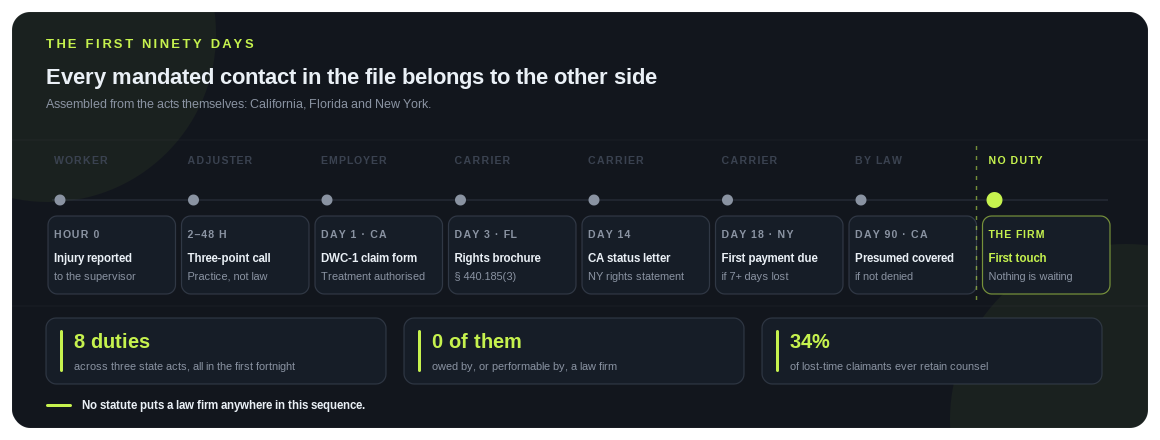
This is a different problem from the one the category thinks it has. The familiar version is a race: two firms, one worker, whoever rings back first wins. The real version is a displacement problem. By the time any firm is in contact, the worker has a named human being at the insurance company who called him, gave him a direct line, got his treatment approved and told him the cheque is coming. That is not a competitor’s ad. It is an established relationship, created by law, at zero acquisition cost, with a two-week head start.
Three acts, three deadlines, one direction of travel
The deadlines differ by state. The direction never does.
It would be easy to read California as a quirk, so it is worth checking the pattern against two other large comp states that structure their systems differently. They do not agree on the clock. They agree completely on who has to make the call.
Florida is the most explicit of the three, because Florida requires the carrier to be the worker’s teacher. Under Fla. Stat. § 440.185(3), within 3 business days of being told about the injury, the carrier must mail or email the injured employee a department-approved informational brochure explaining his rights, his benefits, the procedures for obtaining benefits and assistance, the criminal penalties, and his obligations under Florida’s workers’ compensation law. The employer has 7 days to report the injury to the carrier; the carrier has 14 days from the employer’s receipt of the form to report to the state. Read that sequence as a marketer: the first document the injured worker receives explaining what workers’ compensation is arrives from the entity that will be paying — or not paying — his claim.
New York reaches the same place by a different route. The Board’s own summary of carrier responsibilities requires the insurer to send the injured worker a written Statement of Rights, Form C-430S, within 14 days of the employer’s notice of injury or with the first cheque, whichever comes first, and to begin paying benefits within 18 days of the first day of disability where lost time exceeds seven days. And here is the detail worth sitting with. The Board’s claimant-facing explainer, Understanding the Claims Process, walks the worker through treatment, the 30-day notice, the C-3, the insurer’s statement of rights, the start of payments and the two-week cycle — and does not explain how to hire an attorney or representative at all. It mentions counsel only in passing, as something that may already exist: if you have an attorney, they may file a Request for Further Action on your behalf.
| Jurisdiction | Source | The duty, and the deadline | Whose duty |
|---|---|---|---|
| California | Lab. Code § 5401; DWC | Give or mail the employee the DWC-1 claim form within one working day of learning about the injury. | Employer |
| California | DWC, How to file a claim | Authorise appropriate medical treatment within one day of the claim form being filed; up to $10,000 of treatment while the claim is being decided. | Employer / carrier |
| California | DWC, How to file a claim | Generally 14 days to mail the employee a letter stating the status of the claim. | Claims administrator |
| California | Lab. Code § 5402 | If the claim is not denied within 90 days, the injury is presumed compensable. | Operates against the carrier |
| Florida | Fla. Stat. § 440.185(3) | Mail or email a department-approved brochure explaining rights, benefits, procedures, penalties and obligations within 3 business days of being informed of the injury. | Carrier |
| Florida | Fla. Stat. § 440.185(2) | Employer reports the injury to its carrier within 7 days of actual knowledge; carrier reports to the department within 14 days of the employer’s receipt of the form. | Employer, then carrier |
| New York | WCB, carrier responsibilities | Send the worker a written Statement of Rights (Form C-430S) within 14 days of the employer’s notice of injury, or with the first cheque, whichever comes first. | Carrier |
| New York | WCB, carrier responsibilities | Begin benefit payments within 18 days of the first day of disability where lost time exceeds seven days. | Carrier |
Eight duties across three states. Not one of them is owed by, assigned to, or capable of being performed by a law firm. The statutory architecture of this category hands the opening conversation to the other side, and then hands them the explanatory material too.
Three-point contact, and why a voicemail doesn’t count
The fastest touch in the file is the one with no statute behind it.
The statutory deadlines are the slow part. The fast part is a claims-handling convention that most comp marketers have never heard of, and it is the single most important operational fact in this article.
It is called three-point contact: on receiving a new claim, the adjuster makes voice contact with three parties — the injured employee, the employer (usually the claims coordinator, and the supervisor if needed) and the medical provider. The claims-management literature is specific about two things. First, the deadline: each insurer or third-party administrator sets its own, and they range from 2 or 4 hours of the accident to 24 or 48 hours of assignment, with same-day contact treated as the practice that most improves outcomes. Second, and this is the part that should sting: a voicemail does not count. Contact means an exchange of information between the principals. If the adjuster cannot reach the worker, the guidance is two voicemails that day, a contact letter if there is no response, and then try again every day.
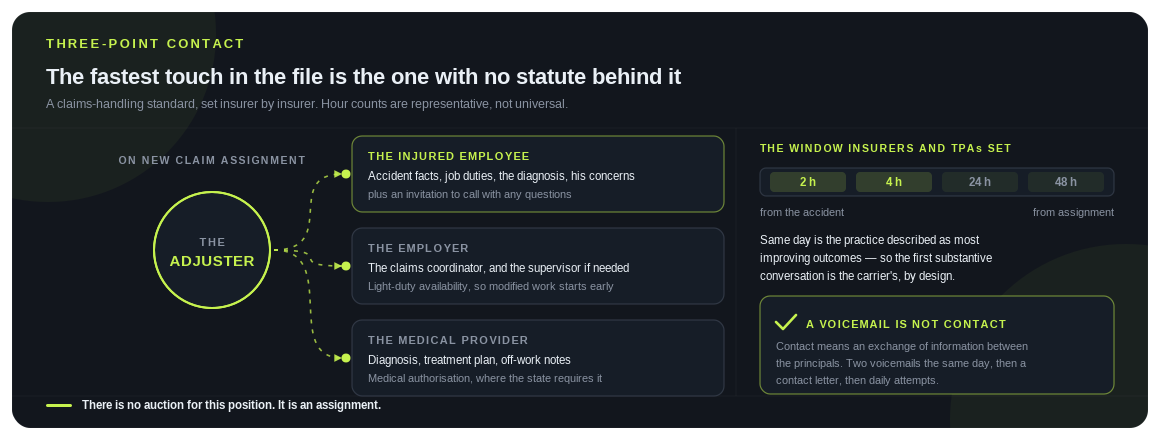
Hold that against the metric our own industry argues about. Comp marketing has spent a decade establishing that an inbound enquiry answered in five minutes converts far better than one answered in an hour, and that is true and worth every dollar it costs to fix. But notice the asymmetry it conceals. The firm’s five minutes is measured from the moment the worker reaches out. The adjuster’s four hours is measured from the moment the worker gets hurt — and the adjuster does not have to wait to be contacted, because he already has the phone number, off the first report of injury.
There is no amount of money a firm can spend to acquire that position. It is not an auction. It is an assignment.
Two in three: the conversation you never entered
The head start is only interesting if it is decisive. Mostly, it is.
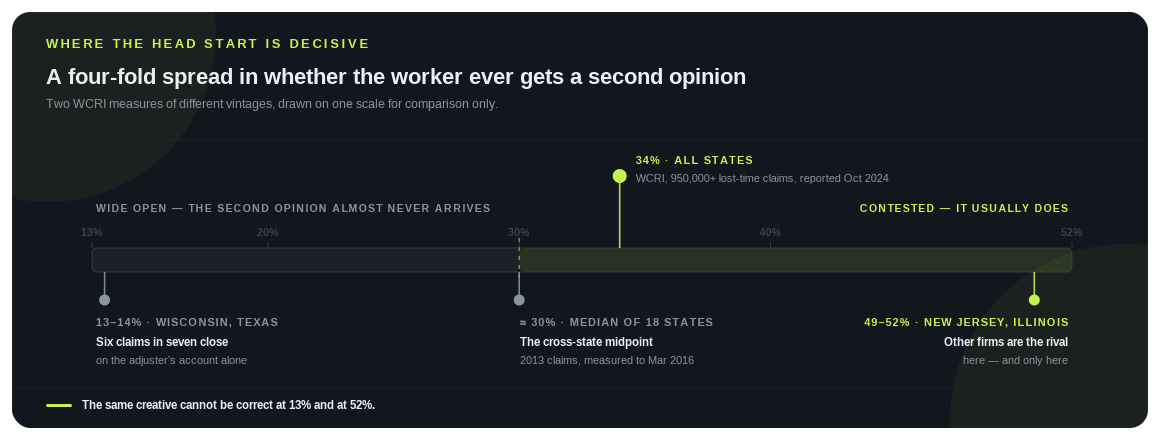
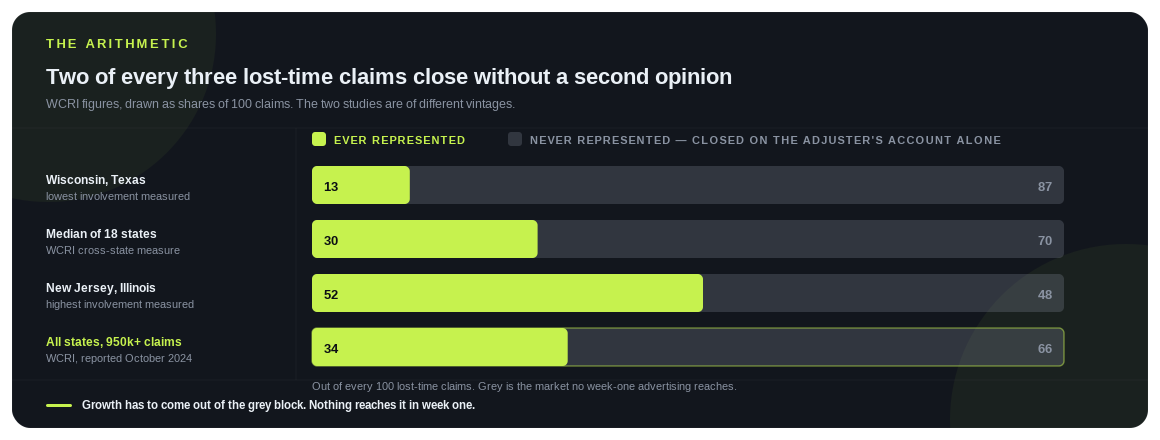
A head start does not matter if everyone catches up later, so the number to find is how often the worker ever gets a second opinion. The best public figure we can find is from the Workers Compensation Research Institute. In research reported in October 2024, across more than 950,000 claims with more than seven days of lost time, 34% of workers had an attorney represent them at some point during the claim. WCRI also measured what representation did to the money: indemnity benefits higher by $7,700 to $12,400, with the authors cautioning that more focused research is needed to establish direct causation.
Read the complement. In roughly two of every three lost-time comp claims — the serious ones, the ones with wages at stake — the adjuster’s first conversation was the only substantive conversation the worker ever had about his own claim. Not the first of several. The only one.
That share moves enormously by state, and the spread is the most useful planning fact in this section. WCRI’s cross-state measure of worker attorney involvement, published in 2017 on 2013 claims with more than seven days of lost time and experience through March 2016, put Wisconsin and Texas lowest at about 13–14%, New Jersey and Illinois highest at about 49–52%, and the median of the eighteen states studied at nearly 30%. That measure is now a decade old and we are not going to pretend otherwise; treat it as the shape of the distribution rather than as this year’s level.
Why “aggressive” lands on the wrong week
The creative is written for a grievance the reader has not got yet.
Now put the two halves together, because the consequence is a creative problem rather than a media one. Comp advertising in almost every market we have audited is built on four notes: we fight for you, we are aggressive, the insurance company is not on your side, free consultation and no fee unless we win. Each of those is a response to a feeling of being wronged.
In week one, that feeling has nothing to attach to. Nobody has refused him anything. The treatment was authorised. The form arrived. A named adjuster rang him within a day or two, asked about his back and his job duties, and invited him to call with any questions, issues or problems — that invitation is item after item in the claims-handling checklist, not an accident. Against that lived experience, “the insurance company is not on your side” does not read as a warning. It reads as inaccurate, which is the one thing an ad cannot survive being.
| The ad assumes | What has actually happened by day 3 | What follows for the creative |
|---|---|---|
| He has been wronged. | Nothing has been refused. The claim is open and the treatment is authorised. | Grievance framing has no referent. It is answering a complaint he has not made. |
| Nobody is helping him. | A named adjuster called inside 48 hours and gave him a direct line. | “We’ll fight for you” is competing against “it’s handled,” which is more attractive. |
| He is looking for a lawyer. | He is looking for his cheque, his treatment and his job. | Explanation outperforms advocacy. Answer the benefit question, not the litigation question. |
| He does not know his rights. | Florida mailed him a state-approved brochure; New York mailed him a Statement of Rights. | The firm is not the first source of information. It can still be the first comprehensible one. |
| Speed decides it. | The first contact was made by the carrier, from the first report, before any ad served. | Speed still decides inbound enquiries. It does not decide first contact, and it never could. |
This is also, we think, the real explanation for a pattern every comp firm sees in its own numbers and misreads as a quality problem: week-one enquiries that go quiet. The common diagnosis is that the lead was weak or the follow-up too slow. A better one is that the enquiry was genuinely curious and the claim was genuinely fine, so there was nothing for the firm to do yet. Our own blended figures — ~219,000 injured-worker leads at ~$75 average CPL producing ~21,000 signed cases — carry no field distinguishing a claim that is going well from one that has already broken, which is a limitation of our data and not a finding in it.
The firm is not the first voice in the file. It is the second opinion — and it is arguing against a conversation it never heard.
The second window, and where it opens
Reassurance is a claim about the future. Dates are when it gets tested.
If week one belongs to the carrier, the firm needs a different moment, and the statutes helpfully publish several. Everything the adjuster said in that first call is a forecast: treatment will be approved, the cheque will arrive, we will sort the light duty. A forecast can be checked, and the dates on which it gets checked are knowable in advance.
Three of them come straight out of the sequence above. California’s status letter lands around day 14 and either accepts, delays or denies. California’s $10,000 interim treatment cap is an amount, which means it is a moment: the claim either resolves before the carrier’s exposure runs out or it reaches a decision point. New York’s first payment is due within 18 days of the first day of disability, so day 19 with no cheque is a fact the worker can observe without anyone explaining it to him. Add the dates we have written about elsewhere — the end of the waiting period, the first independent medical examination, the first light-duty offer, the first denied treatment request — and you have a calendar of moments at which a reassured worker becomes an unreassured one.
What that implies for the media plan is unusual, and it is the opposite of the instinct. The injury-week audience is the one every competitor is bidding on and the one least likely to convert on a grievance message, because the grievance has not happened. The weeks-two-to-twelve audience is cheaper, less contested, and arrives at the exact moment the carrier’s forecast is being tested against reality. A firm that moves spend from the first group to the second is not retreating from speed. It is pointing its budget at the week its message is actually true.
What this changes on Monday
Four changes, in the order they pay back.
None of this requires a new channel or a bigger budget. It requires knowing which week an asset is for, which almost no comp account records.
One: date the enquiry. Add one intake field — how long ago were you hurt? — with buckets at under a week, one to four weeks, one to three months and longer. It costs nothing, it goes in today, and within a quarter it will tell you something no amount of argument can: whether your signed cases are coming from the week you are buying. Nothing else in this article can be tested against your firm until that field exists.
Two: ask what the carrier has already done. Two more questions, at intake: has an adjuster contacted you, and has anything been denied? The answers sort the enquiry into the two populations this article is about, and they change the call immediately. A caller whose claim is fine needs orientation and a reason to come back. A caller who has just been denied something needs the firm today, and the first ninety seconds of that call are worth more than any media change on this list.
Three: build the later-week asset. Most comp accounts have only one landing page, and it opens on the injury. Write a second that opens on the denial, the IME, the light-duty offer or the short cheque. Our Growth Library edition on intake is the companion to this; the asset is the easy part, and the hard part is admitting the existing page only speaks to week one.
Four: set the market expectation by state. Before you set a target cost per signed case, find out roughly how often claimants in your state retain counsel at all. A firm in a 13% state and a firm in a 52% state face different competition, different close rates and different honest promises, and planning both from the same national benchmark will make one of them look broken when it is not. Our Intelligence Center has the state and county data; the representation rate you will have to source from your own bar and your own experience, because the public cross-state measure is a decade old.
What this does not prove
Three honest gaps, because the argument is structural and the evidence is partial.
The first and largest: we have shown that the carrier contacts the worker first and that most lost-time claimants never retain counsel. We have not shown that the first conversation causes the second never to happen. Those two facts are consistent with our reading and also consistent with a much duller one — that two-thirds of lost-time claims simply go well enough that nobody needs a lawyer, which is roughly what a working comp system is supposed to look like. We think the sequence matters, and we cannot prove how much from public data.
The second: vintage and mixing. The 34% representation figure and the 13–52% state spread come from different WCRI research of different ages, and we have drawn them in the same figure for comparability. They are not one series and should not be quoted as one. The state-level numbers in particular describe 2013 claims measured through March 2016.
The third: three-point contact is a practice, not a law. Our source is claims-management trade literature, the hour counts are set insurer by insurer, and we have no way to audit compliance across the industry. A firm that wants to know what actually happens in its own market has a better instrument than our citation: ask the next twenty callers whether an adjuster rang them, and when. That takes a fortnight and it settles the question locally, which is the only place it matters.
Key takeaways
-
Comp is the only legal market where the other side is required to call your prospective client. California gives the claim form in one working day and treatment in one; Florida a rights brochure in three days; New York a Statement of Rights in fourteen.
-
The fastest touch in the file has no statute behind it. Three-point contact puts the adjuster on the phone with worker, employer and doctor on insurer-set deadlines of two to forty-eight hours — and a voicemail does not count.
-
Two in three lost-time claimants never hire anyone, and the rate varies four-fold by state. WCRI puts attorney involvement at 34% overall: about 13–14% in Wisconsin and Texas against 49–52% in New Jersey and Illinois.
-
Fight-framing lands on the wrong week. In week one nothing has been refused, the treatment is approved and a named adjuster has given him a direct line. “The insurance company is not on your side” reads as inaccurate then.
-
The reachable window opens when the forecast fails. The status letter, the first payment deadline, the IME, the light-duty offer, the first denied request — published dates, a real grievance, and almost nobody bidding.
-
One field makes all of it testable. Weeks since injury, in four buckets, plus two questions: has an adjuster contacted you, and has anything been denied.
WorkersComp Marketing is a marketing agency, not a law firm. Nothing here is legal advice, and nothing here is an opinion about any particular claim or about how any particular adjuster has behaved. Statutory duties are summarised from published state material for a marketing audience and are not a substitute for the act that governs your jurisdiction or for counsel who practises in it. Representation rates are WCRI’s, of two different vintages, and the three-point-contact timings are a claims-handling practice rather than a legal requirement.
Frequently asked questions
Is the adjuster really the competitor? He isn’t selling anything.
He is not selling, and that is exactly why the position is so strong. What a comp firm needs from an injured worker is attention and trust, and the adjuster acquires both for free, by statute, days before any ad can serve. He has the worker’s phone number off the first report of injury, he calls inside a day or two under his employer’s three-point-contact standard, he gets the treatment authorised, and he invites the worker to call him with any questions, issues or problems. None of that is a sales pitch and none of it needs to be. It occupies the slot a firm is bidding for — the role of the person who explains what is happening — and it occupies it first. Calling him the first competitor is a statement about sequence and about the job he ends up doing in the worker’s mind, not an accusation about his conduct.
So should we stop advertising to recently injured workers?
No, and we would argue hard against anyone who read it that way. Two-thirds of lost-time claimants never retain counsel, which means the newly injured audience contains every future case the firm will ever sign — it is the only place they come from. The argument is about what you say to them and what you expect back. A week-one impression bought with a grievance message is competing against a claim that is, so far, going fine; the same impression bought with an explanatory message can establish the firm as the place he returns to when it stops going fine. Keep the audience. Change the asset, and stop grading week-one spend on same-week signings, because that is not what it is doing.
Does this mean speed to lead doesn’t matter?
Speed to lead matters enormously and nothing here touches it. The two things are measured from different events, which is the whole point. Speed to lead is the interval between a worker contacting your firm and your firm answering, and in that interval the enquiry really does perish in hours — a firm that cannot answer the phone will lose cases no matter what else it gets right. First contact is a different interval entirely: between the injury and the first substantive conversation about the claim. That one is decided by the first report of injury and a claims-handling standard, before any firm has a chance to enter. Fix your speed to lead. Just stop believing it put you first in the file, because it cannot.
Which states should we treat as the easiest markets, then?
“Easiest” depends on which problem you would rather have, and the representation rate tells you which one you are buying. In a low-involvement state — WCRI’s decade-old measure put Wisconsin and Texas at about 13–14% — roughly six claims in seven close with the carrier’s account unchallenged. There is very little competing advertising and a very large untouched market, but the firm’s job is to persuade people that a second opinion is a thing that exists, which is slow, educational work. In a high-involvement state — New Jersey and Illinois at about 49–52% — the market already understands the product and the fight is with other firms, which means auctions are expensive and differentiation does the work. Neither is easy. They are different businesses, and a national benchmark will mislead you in both.
Can we say “the insurance company called you first” in an ad?
You can say true, verifiable things about how the system works, and that sentence is one of them — but we would write it flatter than that, because the sharp version invites a reading you cannot support. “The person who explained your rights works for the company paying your claim” is accurate in Florida and New York by statute and is accurate almost everywhere in practice. “The insurance company is lying to you” is not, it fails the false-or-misleading standard in most states, and it will not match the reader’s experience of an adjuster who has so far returned his calls. Check your own state bar’s advertising rules before running any version of this, and keep every claim about the system rather than about his case.
What about workers whose claims are denied outright?
That population is reachable in the ordinary way and most comp marketing is already pointed at it, which is why we have written about denied claims separately. The point of this article is the much larger group in between: claims that are accepted, paid, and then degrade — a treatment request refused, an independent medical examination that disagrees with the treating physician, a light-duty offer the worker cannot physically perform, a cheque that is short because the average weekly wage was computed without the overtime. None of those produce a denial letter. All of them produce a moment at which the adjuster’s first reassurance stops matching what the worker can see, and that moment is the one a firm can own.
How would we know whether any of this is true in our market?
Ask the callers, which costs a fortnight and settles it locally. Add one field to intake for weeks since injury, in four buckets, and two questions: has an adjuster contacted you, and has anything been denied yet. Then wait ninety days and cut signed cases by the first field. If your signings cluster in the later buckets while your media buys the first one, the mismatch is in the report rather than in this article. If they cluster in week one, we are wrong about your market and you should keep doing what you are doing. Either way you will be the only firm in your market that knows, which is worth more than agreeing with us.
Is any of this legal advice about workers’ rights?
No. WorkersComp Marketing is a marketing agency, not a law firm, and nothing here is legal advice to anyone. The statutory duties described are summarised from published state material — California’s Division of Workers’ Compensation, the Florida Statutes and the New York Workers’ Compensation Board — for the purpose of planning marketing, and deadlines, amounts and procedures differ by state and change. No ad or landing page built from this article should tell an injured worker what his rights are in his own claim, and no part of it should be read as a characterisation of how any identifiable adjuster or carrier has behaved.
Sources
-
01
The California sequence
California Division of Workers’ Compensation, How to file a claim: the employer must give or mail the employee a claim form within one working day after learning about the injury and must authorise treatment within one day of the form being filed; up to $10,000 of treatment is available while the claim is being decided; the insurer has about 14 days to mail a letter stating claim status; and a claim not denied within 90 days is presumed covered (Lab. Code § 5402).
-
02
The Florida brochure duty
Fla. Stat. § 440.185(3): within 3 business days after the employer or employee informs the carrier of the injury, the carrier must mail or email the injured worker a department-approved brochure explaining his rights, benefits and the procedures for obtaining them. § 440.185(2): the employer must report the injury to its carrier within 7 days of actual knowledge, and the carrier to the department within 14 days of the employer’s receipt of the form.
-
03
The New York carrier duties, and what the claimant is told
New York Workers’ Compensation Board: the carrier must send the injured worker a written Statement of Rights (Form C-430S) within 14 days of the employer’s notice of injury or with the first cheque, whichever comes first, and must begin benefit payments within 18 days of the first day of disability where lost time exceeds seven days. The Board’s claimant explainer of the process does not explain how to hire an attorney or representative — counsel appears only conditionally, as something the claimant may already have.
-
04
Three-point contact
Amaxx, 18 Items in Your Work Comp Adjuster’s Three-Point Contact: voice contact with the injured employee, the employer and the medical provider, contact being an exchange of information between the principals, so a voicemail does not count; deadlines set by each insurer or TPA from 2 or 4 hours of the accident to 24 or 48 hours of assignment, with same-day contact described as having the most positive effect. This is claims-management trade literature describing a practice, not a statutory requirement.
-
05
Representation rates, and their vintages
WCRI research reported by Claims Journal on 3 October 2024: across more than 950,000 claims with more than seven days of lost time, 34% of workers had an attorney represent them, and attorney involvement was associated with indemnity benefits higher by $7,700 to $12,400 — the authors noting that more focused research is needed to confirm a direct causal link. WCRI, Worker Attorney Involvement: A New Measure (2017), on 2013 claims with experience through March 2016: about 13–14% in Wisconsin and Texas, about 49–52% in New Jersey and Illinois, a median of nearly 30% across the eighteen states studied. These are different studies of different vintages and are not a single series.
-
06
Our own figures, and further reading
The agency figures quoted are our own records across managed workers’ comp Meta spend: ~$16.5M managed, ~219,000 injured-worker leads at ~$75 average CPL, ~21,000 signed cases at ~$775 each. They are blended across all claim stages; our intake records carry no weeks-since-injury field, which is the limitation described in the article.
Statutory duties and deadlines are summarised from published state material for a marketing audience, differ by jurisdiction and change over time; they are not legal advice. Three-point-contact timings are a claims-handling practice set insurer by insurer, not a legal requirement, and we have no means of auditing compliance. The two representation figures come from separate WCRI research of different vintages and are drawn together only for comparison. Nothing here characterises the conduct of any identifiable adjuster or carrier.