Ask a comp firm why a qualified enquiry did not sign and you will get a theory. He went with the firm on the billboard. He thought he could handle it himself. The adjuster got to him first. Every one of those is plausible and every one of them is a guess, because nothing in a comp firm’s stack actually records the reason for a no. Cost per lead is measured. Speed to lead is measured. Contact rate, qualification rate, signed rate, cost per signed case — all measured, all dashboarded, all argued about in the Monday meeting. The reason the person on the other end of the call said no lives in a free-text field somebody stopped filling in two years ago.
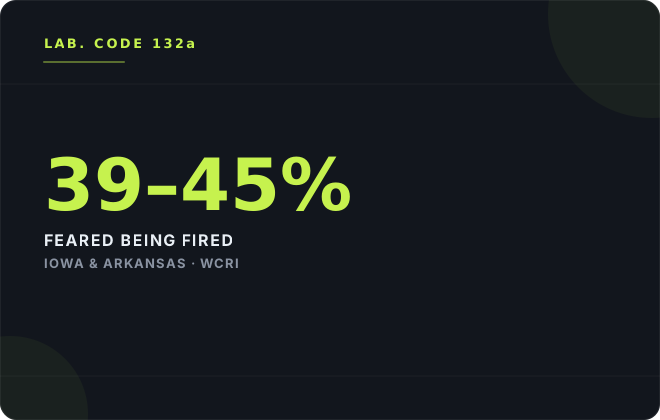
There is one reason that is not a guess, because somebody surveyed it. In 2014 the Workers Compensation Research Institute ran telephone interviews with injured workers in a series of states, asking — among much else — whether they had been concerned about being fired as a result of the injury. In Iowa, 412 workers, all of whom had received workers’ compensation benefits and all of whom had more than seven days of lost time, 39% said they were somewhat or very concerned they would be fired or laid off. In Arkansas, on the same instrument with 401 workers, 45% said so.
The striking thing is not the percentage. It is who was asked. Everyone in those samples had already filed and already received benefits. The fear did not stop them, and it was still there two and three years later when the interviewer called. Whatever the figure is among those who were hurt and did not file, it is not lower — and nobody has it, because a person who never enters the system never enters anybody’s dataset.
The objection that never reaches your CRM
Every comp funnel is built to find people who are hurt. None of them is built to find out what is stopping the ones who are.
A comp firm’s qualification script is a short list of facts: injury, date, place, employer, any denial, any existing lawyer. It is a good script, and it establishes whether there is a case. What it cannot establish is whether there is a client — because what stands between a qualified injury and a signed retainer is often not a fact about the claim at all. It is a fact about the man’s life, and the one he is least likely to volunteer to a stranger on a recorded line.
He is still employed. He may be on modified duty, standing in the same building, next to the same supervisor, with a mortgage payment that does not care how the claim resolves. The firm on the other end of the phone is asking him to sign something that will arrive at his employer’s office with a law firm’s name on it. Nothing in the standard script addresses that, and the reassurance most intake teams offer when it comes up — “they can’t fire you for filing” — is the single weakest sentence in the conversation. It is an assertion from an interested party, offered without a mechanism, to a person who has spent his working life watching what actually happens to people who make trouble.

Hold the two halves of that figure apart, because the temptation to multiply them is strong and the result would be meaningless. The WCRI percentages are measured on people with lost-time claims in Iowa and Arkansas. They are not a measurement of any firm’s lead pool, and we are not claiming that two in five of our 198,000 unsigned enquiries were afraid of their employer. What the survey establishes is narrower and still large: among injured workers who went all the way through the system, a fear of losing the job was common enough that an institute studying claim outcomes treated it as a leading predictor rather than a footnote.
It is worth being precise about why the institute was asking at all, because it was not studying marketing. WCRI put the question in because it was looking for predictors of how claims turn out, and workplace trust came back as one of the stronger ones it had not previously examined. That is a different and more useful finding than “workers are nervous”: an organisation whose business is explaining claim outcomes to payers decided that whether the worker thought he was about to lose his job was worth putting on the same page as his comorbidities. The fear is not a soft factor sitting alongside the real ones. On the evidence available, it behaves like one of the real ones.
Why no firm can see it in its own data is a separate and more fixable problem. A comp intake form captures the injury, the employer, the body part, the date, the insurer if the caller knows it, and whether anybody has said no yet. Almost none of them capture whether the caller is currently working for the employer he is describing — which is strange, because it is the single fact that most changes what the conversation should be. Without that field, the segment this article is about is not merely unmeasured; it is unqueryable. You cannot pull a list of people who hesitated because of their job if you never recorded which of them had one.
What is worth noticing is the shape of the problem rather than its size. Price objections get handled. Doubt about the injury gets handled — that is what the medical file is for. This one is handled with a sentence, and the sentence is an opinion. Every other objection in the category has a document behind it. This one has a document behind it too. Almost nobody uses it.
The remedy lives inside the case
California wrote a remedy for exactly this, then put it somewhere the person who needs it cannot reach.
California Labor Code § 132a opens with a declaration: “It is the declared policy of this state that there should not be discrimination against workers who are injured in the course and scope of their employment.” Then it does four things. Paragraph (1) makes it a misdemeanour for an employer to discharge, threaten to discharge, or “in any manner” discriminate against an employee because he has filed or made known his intention to file a claim, or because he has received a rating, award or settlement — and provides that “the employee’s compensation shall be increased by one-half, but in no event more than ten thousand dollars ($10,000), together with costs and expenses not in excess of two hundred fifty dollars ($250).” The same paragraph adds that the employee “shall also be entitled to reinstatement and reimbursement for lost wages and work benefits caused by the acts of the employer.”
Paragraph (2) is the one nobody quotes and it is the most interesting sentence in the section. An insurer that advises, directs or threatens an insured — “under penalty of cancellation or a raise in premium or for any other reason” — to discharge an employee for those same reasons is itself guilty of a misdemeanour, and is subject to the same increased compensation and costs. The legislature anticipated that the pressure to get rid of an injured worker might not originate with the employer at all, and said so in the statute.
So far this is a decent provision: a named wrong, a sum of money, a criminal backstop, and a tribunal with “full power, authority, and jurisdiction to try and determine finally all matters specified in this section.” Then you read the Division of Workers’ Compensation’s own guide to filing one, and the architecture comes apart. The guide tells the worker that the petition “can only be filed if you have a pending Workers’ Compensation Appeals Board (WCAB) case” — which means an Application for Adjudication of Claim has to exist first. The remedy for being punished over a comp claim is a document you file inside a comp case.
Put that next to the survey and the shape is unmistakable. The man afraid to file is afraid of precisely the act that unlocks the thing protecting him from what he fears. It is not a drafting error — the appeals board can only hear what is in front of it — but the effect is a protection whose entry condition is the fear itself.
The asymmetry underneath it is worth saying out loud, because it is what makes the argument land with a lawyer rather than just with a marketer. On the day the claim is made, the employer has an insurer, that insurer has a claims operation, and in California that insurer is on notice from ¶(2) that it must not direct a discharge. All of that machinery is professional, salaried and already in motion. On the other side is a man deciding whether to post a form, with the state’s own guide telling him the thing he might later need is “very difficult to prove.” The rules are not unfair. The distribution of people who understand them is.
That is the gap, and it is a marketing gap before it is anything else. A firm that can describe it plainly, in sixty seconds, without promising anything, is not reassuring a prospect. It is explaining a mechanism he can verify on a state website — and telling him something neither his employer, his adjuster, nor the pamphlet in the break room will volunteer.
Four states, four machines
The same wrong, in four jurisdictions, produces four different forums, four different sums and one clause that no other state in this set has.
It is tempting to say that every state protects an injured worker from being fired for filing. Something in that neighbourhood is probably true nationally, and we are not going to assert it, because the four states we actually read do not agree about anything except that the conduct is prohibited. They disagree about who hears it, what it is worth, when it expires, who writes the cheque, and — this is the one that matters commercially — what the protected act even is.
| California § 132a | New York WCL § 120 | Texas § 451.001 | Florida § 440.205 | |
|---|---|---|---|---|
| Heard by | The appeals board, on a petition inside an existing case | The Board | A district court | A civil court — the cause of action is judicial, not in the section |
| What the section pays | Compensation increased by one-half, max $10,000; costs max $250; reinstatement; lost wages and work benefits | Restoration to the position, compensation for loss, attorney or representative fees fixed by the Board; penalty of $100–$500 paid to the state treasury | “Reasonable damages incurred by the employee”; reinstatement to the former position; a district court may enjoin a violation | Nothing. The section is a prohibition with no stated remedy |
| Clock stated in the text | One year from “the discriminatory act or date of termination” | Two years from “the commission of such practice” | None stated in Chapter 451 | None stated in the section |
| Is hiring a lawyer a protected act? | Not listed. The listed triggers are filing, announcing an intention to file, and receiving a rating, award or settlement | Not listed. Claiming, attempting to claim, requesting a claim form, testifying | Yes — expressly. § 451.001(2): “hired a lawyer to represent the employee in a claim” | Not listed. A valid claim, or an attempt to claim |
| Does the carrier pay? | Section is silent. It does make an insurer that directs the discharge separately liable, under ¶ (2) | Expressly not. “The employer alone and not his or her carrier shall be liable”; a policy provision relieving the employer is “void” | Not addressed in the chapter | Not addressed in the section |
| Criminal exposure | Misdemeanour, for employer and for insurer, in all four paragraphs | Not in the section | Not in the chapter | Not in the section |
Five columns on a phone: the table scrolls sideways. The same comparison is in the figure below, which does not.

Start with Texas, because it hands a comp firm a sentence no copywriter could improve on. Section 451.001 lists the protected acts, and the second is “hired a lawyer to represent the employee in a claim.” That is the objection, answered by the legislature, in nine words. A Texas firm not quoting that clause in its intake script and on its site is leaving the strongest available answer unused — alongside the sentence an honest firm quotes in the same breath, § 451.002(c): “the burden of proof in a proceeding under this section is on the employee.”
New York goes somewhere else entirely. Beyond restoration and lost compensation, WCL § 120 adds two sentences no other section in this set contains: “The employer alone and not his or her carrier shall be liable for such penalties and payments,” and any policy provision relieving him “shall be void.” New York has made this uninsurable on purpose. And its penalty — one hundred to five hundred dollars — goes to the state treasury rather than to the worker, which tells you the Board treats it as a deterrent rather than a recovery.
Florida is the shortest and the strangest. Section 440.205 is one sentence long, and that sentence is the whole section: it creates no forum, names no damages and sets no deadline. The cause of action exists because the Florida Supreme Court said in 1983 that it does. Prohibited by statute, remedied by case law — exactly the distinction a marketing page should never flatten into “Florida law protects you.”
There is one more thing all four do share, and it is the one most useful to a caller who has not been fired and does not want to be. None of these sections is limited to an actual dismissal. California reaches an employer who “discharges, or threatens to discharge, or in any manner discriminates.” New York reaches a failure to reinstate “or in any other manner” discriminating “as to his or her employment,” and it protects a worker who merely “requested a claim form” — protection that attaches before any claim exists, which is a pointed contrast with California’s entry condition. Texas reaches discharge “or in any other manner” discriminating, and § 451.003 adds that “a district court may restrain, for cause shown, a violation” — relief available while the job is still there rather than only after it is gone. Florida’s short section names four verbs: discharge, threaten to discharge, intimidate, coerce. We checked that one against each section separately, because it is the only generalisation in this article that covers all four, and it holds in each.
That matters more than the damages do. The man on the phone is not asking what he could recover after losing his job; he is asking whether he is about to lose it. Every one of these sections says, in its own words, that the pressure itself is the prohibited thing. A firm that can say that accurately — and in Texas, that a court can be asked to stop it while it is happening — is answering the question he actually asked rather than the one the statute’s damages clause answers.
For a single-state firm that variety is a research task — one section, read once, copy settled for years. For anyone running the same creative across a footprint it is a live risk. An ad set saying “you cannot be fired for hiring a lawyer” quotes the statute in Texas and is an unsupported legal assertion everywhere else in this group; a page promising a two-year window is New York’s text and wrong by a factor of two in California. The dull rule: anything naming a number, a forum or a protected act is state-level creative, and national copy stays general while the state page does the specific work.
And California, as above, pays the most prescriptive sum and makes it hardest to reach. Four states; four machines. The only claim that survives contact with all four is the weak one: each of these states prohibits the conduct. Everything a firm would actually say in an ad — what it is worth, how long you have, who pays, whether calling us is itself protected — changes at the state line.
The clock that starts when he is fired
Comp marketing runs on one date. This runs on a second one, and your CRM is not holding it.
Every follow-up sequence in a comp firm is keyed, directly or indirectly, to the date of injury. The waiting period, the first indemnity cheque, the treatment authorisation, the permanent-and-stationary report, the deadline to file — all of them hang off it, which is why it is the one date every intake form captures and every nurture campaign counts from.
The retaliation clock does not hang off it at all. California’s runs from “the discriminatory act or date of termination of the employee.” New York’s runs from “the commission of such practice.” Neither has anything to do with when he got hurt. A worker injured in March, placed on modified duty in May and let go in October is sitting on a clock that started in October, and nothing in the firm’s system knows October happened.
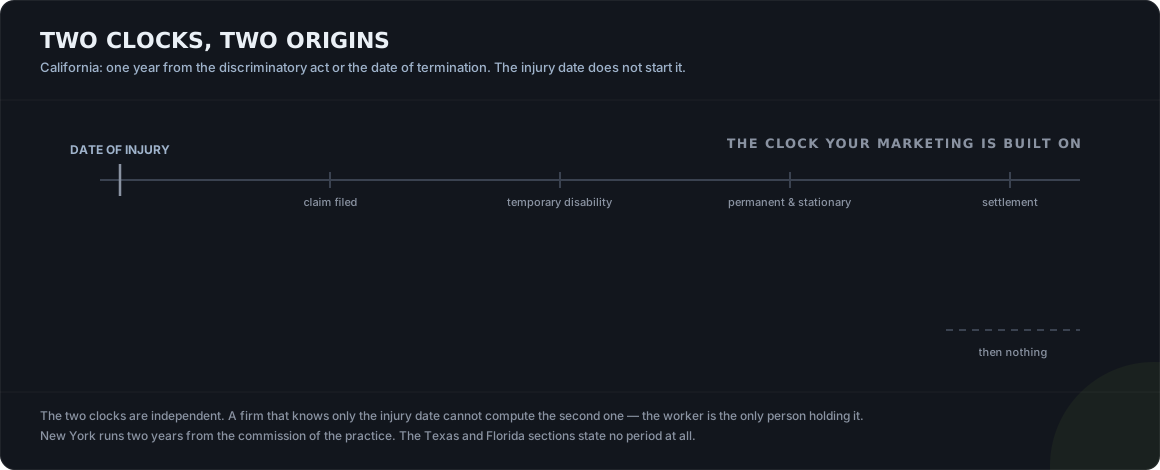
Work a single file through it. A warehouse picker hurts his back on 4 March and reports it. He is placed on light duty in May, which is when the modified-work paperwork starts and when the job stops feeling secure. He calls two firms in June, qualifies at both, signs with neither, and tells one of the intake coordinators that he would rather wait and see. In October the employer restructures the shift and he is let go. On the comp side nothing dramatic has happened: his claim is where it was. On the other side a one-year window has just opened that did not exist in June, and it closes next October — and because he is now out of the job, the reason he did not sign in June has gone as well. Two separate things changed on the same day, and both of them are good reasons for him to want a lawyer.
This is the most operationally useful thing in the article, and it is almost embarrassingly cheap to act on. A comp firm already holds a list of people who enquired, qualified and did not sign. That list is normally worked on a decay curve: call twice, email four times, and let it go cold. What the second clock says is that for a subset of that list, a new and dated event is going to occur after the firm has stopped paying attention — and that the event both resolves the objection that stopped them signing and creates a separate matter with its own deadline.
The firm that keeps a light, respectful touchpoint alive specifically to catch that moment is not nurturing in the usual sense. It is waiting for a trigger it knows is coming for some share of the list, with a reason to call that is about the prospect’s situation rather than about the firm’s pipeline. That is a materially different kind of follow-up from the fifth “just checking in” email, and it is the one case in comp where the slow yes has a date attached to it.
What the legislature priced it at in 1990
The California number is specific, and it is old. That is an argument for honesty in the copy, not against making the argument.
The ten thousand dollar ceiling in § 132a is not a drafting flourish; it is a legislative judgement about what this wrong is worth. The relevant fact is when the judgement was made. The section’s own amendment note reads “Amended by Stats. 1990, Ch. 1550, Sec. 13.” The cap has not moved since.
Put that through the Bureau of Labor Statistics’ consumer price index for all urban consumers. The 1990 annual average of that index was 130.65; the October 2026 figure, published on 13 November, is 337.511. On that basis ten thousand 1990 dollars is roughly $25,800 today, and today’s $10,000 cap is worth about $3,900 in the money the legislature was thinking in. Call it three-fifths of its real value gone. That conversion is our arithmetic, not a published figure, and reasonable people index differently — but no index puts the 1990 cap anywhere near $10,000 in 2026.
Before leaving the money, go back to paragraph (2), because it carries an implication that sits oddly with how comp marketing usually describes the opposition. The legislature wrote a criminal provision aimed at an insurer that pressures an employer to get rid of an injured worker — specifically “under penalty of cancellation or a raise in premium.” That is a legislature describing a mechanism it expected to see. Comp advertising almost always casts the employer as the antagonist and the carrier as a faceless payer; the statute contemplates the reverse, with the employer as the instrument. We are not claiming this is common, and we have no data on how often ¶(2) is invoked. What it does establish is that the question “who wanted this man gone?” is one the code itself thinks is worth asking.
Two things follow for a firm, and they point in opposite directions, which is why this section exists rather than a single breezy line about a ten-thousand-dollar remedy.
The first is that the in-system number is not the point and should not be the headline. A firm that builds a campaign around “get up to $10,000” is advertising an eroded cap, in a forum where the worker has to prove something hard, in a proceeding that only exists inside a case he has not opened. It will convert badly and it deserves to.
The second is that the in-system number is not the ceiling on the matter either. In City of Moorpark v. Superior Court the California Supreme Court held that “section 132a does not provide an exclusive remedy and does not preclude” Fair Employment and Housing Act and common-law wrongful discharge claims — a holding about those claims standing on their own feet alongside a comp case, not about § 132a generating a tort of its own. The operational consequence is commercially real: a firing may be worth more outside the comp file than inside it, and a firm that recognises and routes it is doing what it already does when it spots a third-party case inside a comp claim.
A firm that says “they can’t fire you for filing” has made an assertion. A firm that quotes § 451.001(2) has handed over a citation. Only one of those survives the prospect checking.
The state’s own guide says it is difficult
The honest version of this pitch includes the part where it is hard to win — and the hard part is a date.
The Division of Workers’ Compensation does not oversell its own remedy. Its injured-worker guide on the § 132a petition tells the reader that “employer discrimination can be very difficult to prove” and that “because of the technical nature of this petition, you may need legal advice.” A state agency, writing for unrepresented workers, saying out loud that this is hard and that a lawyer may be required. There is no stronger third-party warrant available for the proposition that this is work worth paying someone to do, and it costs a firm nothing to quote.
What makes it hard is worth understanding, because it changes what a firm should be doing in the first week rather than the first year. In Department of Rehabilitation v. WCAB — the case everyone calls Lauher — the California Supreme Court held that an adverse result on its own is not enough. Showing an injury and some detrimental consequence “is insufficient to establish a prima facie case”; the claimant “must also show that he or she had a legal right to receive or retain the deprived benefit or status, and the employer had a corresponding legal duty.” What the section prohibits, the court said, is “treating injured employees differently, making them suffer disadvantages not visited on other employees.” Lauher lost because “nothing suggests his employer singled him out” — every employee had to use sick leave for medical appointments. And an employer is not required, as Judson Steel put it and Lauher repeated, to “ignore the realities of doing business.”
One thing cuts the other way and is worth having straight, because it is routinely stated wrongly. The burden is on the worker to make out that prima facie case — but once he establishes discrimination by a preponderance, Lauher records that “the burden shifts to the employer to establish an affirmative defense.” And the court expressly declined an invitation to rewrite § 132a to require proof of discriminatory intent. So this is hard at the threshold, not hard all the way through, and the threshold is the part a firm can actually help with.
Now look at how the panel case actually came out. The employer’s termination process had begun on 24 August 2006. It received notice of the claim on 21 September 2006. The decision found the termination “unrelated to her claim,” and the petition failed. Twenty-eight days decided it.
Notice what evidence decided it: not the employer’s motive, which nobody can see, but the order of two administrative events. When did the termination process begin, and when did the employer learn of the claim? Those are dates on documents — a performance file opened, a supervisor’s email, the first report of injury, the claim form’s date stamp. They exist from the first week and they get progressively harder to reconstruct as people leave, systems are migrated and recollections firm up into stories. A worker on his own will not think to preserve any of it, because nothing about the first week tells him it will matter.
That twenty-eight days is the commercial point, and it is the rarest kind of argument in legal marketing: a reason to act early that is evidentiary rather than promissory. A firm cannot honestly tell a prospect that calling today improves his odds. It can accurately tell him that the sequence of dates — when the employer learned of the claim, when the paperwork on his file began, what was said and by whom — is what these cases turn on, and that those dates get harder to establish every month that passes. That is a true statement about evidence, it contains no guarantee, and it is the sort of thing that keeps a firm inside the lines that the advertising rules actually draw.
Monday
Two questions, one trigger, one page. None of it requires a new budget.
First, two questions in the intake script, placed after qualification rather than inside it, because they are not qualifying questions — they are the ones that find out whether there is a client behind the case.
“Are you still working for them?” and, if the answer is yes, “Is anything about the job making you hesitate?” The second question is deliberately open, because “are you worried about being fired?” is a question most people will answer no to, from a stranger, on a recorded line, about their own employer. Give the hesitation somewhere to go and it tends to come out — which is a point about how the call is run as much as about what is on the sheet. Log the answer as a field, not a note. A free-text note is how this disappeared in the first place.
Second, the trigger. For any enquiry that qualified, did not sign, and was still employed, the employment status is a thing worth asking about once more, later, in a way that gives the person a reason to reply. A firm that does this will also discover something about the enquiries it turns down: the ones who went quiet are not all the same, and the employed ones are a distinguishable segment with a distinguishable reason. Where in the funnel that segment is leaking is what the Intake Leak Score is built to locate.
Third, the page. One article on the firm’s own site, specific to its state, that quotes the section, names the forum, gives the deadline, says who pays, and says plainly that it is difficult to prove and that the burden is on the worker. In Texas it quotes § 451.001(2) and the nine words about hiring a lawyer. In New York it quotes the sentence making the policy provision void. In California it explains the entry condition — and it does not lead with $10,000. Write it so a reader can check every sentence against a state website in five minutes, because the whole value of the asset is that he can.
Fourth, decide now what would tell you this was wrong. The honest measure is not leads, because this adds no audience — it should move the signed rate within the segment it touches, and nothing else. Tag the enquiries where the new questions surface a job-related hesitation, and compare their eventual signed rate with the segment’s own history rather than with the book as a whole. Give it two quarters, because comp decisions are slow and the trigger this depends on arrives on somebody else’s schedule. If the segment does not move, the diagnosis was wrong for your market and you have lost one field and two sentences of script. That is a cheap experiment by the standards of anything else on a comp firm’s roadmap, and it is a real one, which is more than can be said for most intake changes that get made on instinct.
None of this turns a comp practice into an employment practice, and it should not. It changes one thing: the firm stops answering the biggest objection in the category with its own say-so, and starts answering it with the legislature’s.
Key takeaways
The fear is documented. 39% of injured workers in Iowa and 45% in Arkansas, all with lost-time claims, said they were concerned about being fired. Two states, self-reported, surveyed 2014.
California gates its own remedy. The Division says the § 132a petition “can only be filed if you have a pending” appeals board case — the act the frightened worker is avoiding.
Texas names the lawyer. § 451.001(2) protects an employee who “hired a lawyer to represent the employee in a claim.” Of the four states read here, only Texas does.
New York makes it uninsurable. The employer alone pays, and a policy provision relieving him is void. California’s section is silent on coverage.
The clock is not the injury date. California runs one year from the discriminatory act or termination; New York two years from the practice. Nothing in a comp CRM holds that date.
Do not lead with the money. The $10,000 cap dates from 1990 and the state’s own guide calls these cases very difficult to prove. Lead with the mechanism and the citation.
WorkersComp Marketing is a marketing agency, not a law firm. This article reads four anti-retaliation provisions — California Labor Code § 132a, New York Workers’ Compensation Law § 120, Texas Labor Code chapter 451 and Florida Statutes § 440.205 — together with one Division of Workers’ Compensation publication and one appeals board panel decision, and it reads them in order to explain what they mean for a firm’s intake script, its follow-up sequence and its unsigned-lead pool. Nothing here is legal advice, nothing here is an opinion on whether any particular firing was unlawful, and nothing here tells an injured worker what to do. Three statements in this article are ours rather than any court’s or agency’s — the 1990-to-2026 price-index conversion, the reading that the Texas and Florida limitation periods come from general civil law because those sections state none, and the characterisation of early engagement as evidentiary rather than outcome-improving — and each is flagged where it appears. Whether any provision applies to any particular set of facts is a question for your own counsel.
Frequently asked questions
Can our intake team say any of this without giving legal advice?
What is being described is the existence and shape of a statute, not an opinion about anybody’s case, and the safest version of it is also the most persuasive one: name the section, say where it is heard, give the deadline the text gives, and say that the burden is on the employee and that it is difficult to prove — which is the Division of Workers’ Compensation’s own characterisation in California. What crosses the line is predicting an outcome, promising that a worker will not be fired, or quantifying what a particular firing is worth. The honest script is shorter than the dishonest one and it is checkable, which is the point. Your own bar’s advertising rules govern the wording, and they are not uniform.
Which of our existing leads does this actually apply to?
The ones who qualified, did not sign, and were still working for the employer at the time. That is not the same as “everybody who went cold” and the distinction is the whole value of the exercise — a worker who is already out of the job has a different problem and, in California at least, may already be outside the one-year window. Most firms cannot run that segmentation today because employment status at the time of the enquiry was never captured as a field. Capturing it costs one line in the script and makes the segment addressable from the day it is added.
Is the $10,000 figure worth putting in an ad?
We would not. The cap was set by an amendment chaptered in 1990 and has not moved since; on the BLS consumer price index, ten thousand 1990 dollars is roughly $25,800 in October 2026 money, so the real value of the ceiling has fallen by about three-fifths. More to the point, it is a number attached to a proceeding that is hard to win, inside a case the prospect has not opened. The durable message is the mechanism — that the firing is separately actionable, in a named forum, on a clock that starts when it happens — not a headline figure that invites exactly the comparison it loses.
We are not in any of these four states. What do we do?
Read your own section, because the four here disagree with each other on every operational question and there is no reason to assume yours resembles any of them. Four things to write down: which acts the text protects — and specifically whether hiring a lawyer is one of them, which only Texas does among these four; where it is heard; what it says about a deadline; and whether it says anything about the carrier. Where the section is silent, say it is silent rather than filling the gap with another state’s answer. That is the error this article has been built to avoid, and it is easy to make.
Doesn’t this turn a comp firm into an employment firm?
No, and it should not. The comp firm’s job here is recognition and routing, which is what it already does when a comp file turns out to contain a third-party claim. The California Supreme Court held in City of Moorpark that § 132a “does not provide an exclusive remedy and does not preclude” FEHA and common-law wrongful discharge claims, so a firing can matter well outside the comp file. Whether the firm keeps that work, refers it, or declines it is a business decision; failing to notice it is not a decision at all.
What does this change about our media plan?
Less than you would think, and that is the appeal. No new audience, no new budget line, no new channel — the people this speaks to are already in the funnel and already paid for. What changes is the intake script, one segment in the follow-up, and one page on the site that can be checked against a government website. If you want the broader context for working the unsigned pool rather than buying more of it, the Growth Library material on intake and lead economics covers the mechanics.
Sources
- 01Cal. Lab. Code § 132a
Compensation “increased by one-half, but in no event more than ten thousand dollars ($10,000)”, plus costs, reinstatement and lost wages; one year from the act or termination; insurer liability at ¶(2). Footed “Amended by Stats. 1990, Ch. 1550, Sec. 13.” Official text, corroborated word for word against two independent copies.
- 02DWC Injured Worker Guide 7
The petition “can only be filed if you have a pending Workers’ Compensation Appeals Board (WCAB) case”; “very difficult to prove”; “you may need legal advice.” States no dollar figures — those are the statute’s. Footed Rev. 06/18.
- 03N.Y. Workers’ Comp. Law § 120
“Within two years of the commission of such practice”; restoration, lost compensation, Board-fixed fees; a $100–$500 penalty to the state treasury; “The employer alone and not his or her carrier shall be liable”, any contrary policy term “void.” Official text, revision of 10 Jan 2020.
- 04Tex. Lab. Code ch. 451
§ 451.001 protects an employee who has “(2) hired a lawyer to represent the employee in a claim.” § 451.002 gives reasonable damages and reinstatement, and puts “the burden of proof… on the employee.” Official text, current through the 89th 2nd Called Session, 2025. The chapter states no limitation period; that one comes from general civil law is our inference from its silence.
- 05Fla. Stat. § 440.205
The whole section: no employer shall “discharge, threaten to discharge, intimidate, or coerce” over a valid claim or an attempt to claim. It names no remedy, forum or deadline; the civil action is judicial, from Smith v. Piezo Technology (Fla. 1983), which we did not read in the original. The Senate’s site states its information is unverified.
- 06City of Moorpark v. Superior Court (1998) 18 Cal.4th 1143
“Section 132a does not provide an exclusive remedy and does not preclude” FEHA and common-law wrongful discharge claims. Read in a third-party reproduction, not the official reporter. It holds those claims survive alongside a comp case — not that § 132a itself supports a common-law tort, which this article does not reach.
- 07Dept. of Rehabilitation v. WCAB (Lauher) (2003) 30 Cal.4th 1281
Dept. of Rehabilitation v. WCAB (Lauher) (2003) 30 Cal.4th 1281: the claimant “must also show that he or she had a legal right to receive or retain the deprived benefit or status”; “disadvantages not visited on other employees”; and, once discrimination is shown by a preponderance, “the burden shifts to the employer to establish an affirmative defense.” The “realities of doing business” line is Judson Steel (1978), quoted there. The 2006 date sequence is from the WCAB panel decision below. Opinion text read in a third-party reproduction, not the official reporter; the panel decision is not precedential as a published opinion is.
- 08WCRI, Predictors of Worker Outcomes — Iowa and Arkansas
Iowa 39% of 412, Arkansas 45% of 401, “somewhat or very concerned that they would be fired or laid off.” Surveyed 2014, injuries 2010–11, all with benefits and 7+ days lost time. Self-reported, two states, not a national figure and not a measurement of any lead pool. WCRI’s own files decline automated access, so these are the trade press’s reproductions of its figures.
- 09BLS consumer price index, CPI-U
Series CUUR0000SA0: 1990 annual average 130.65 (half-years 128.7 and 132.6); October 2026 = 337.511, released 13 Nov 2026. The conversion of the cap is our arithmetic on those two figures, not a published one; another index gives another answer.
- 10WorkersComp Marketing account figures
~$16.5M managed Meta spend, ~219,000 leads at ~$75 CPL, ~21,000 signed at ~$775 each. Ours, aggregate, not an industry benchmark. The 9.6% rate is a derivation from the two counts, not a measured figure, and the one-point illustration is arithmetic, not an observed result.
Spanning claims were written last and checked section by section. One survives all four states: each prohibits the conduct. Everything else is stated per state — the “hiring a lawyer” clause is Texas alone, the carrier bar New York alone, Florida names no remedy. The WCRI percentages are Iowa’s and Arkansas’s, never national and never a pool figure.