There is a question that decides, more than almost any other single question, what a California comp case is worth at the end — and it is one that the firm handling the case usually cannot answer on the day it signs the client.
It is not whether the client is anxious. Intake captures that. Every CRM in this industry has a box for it, and the box gets ticked often enough that nobody treats it as information. It is whether the psychiatric component of the claim will be worth anything on the permanent disability rating — and the answer to that turns out to depend almost entirely on facts about the client’s body, collected in the first week, by people who are not thinking about permanent disability at all.
This article is about where that money actually sits in the statute, what the Appeals Board has said about it, and what a firm would have to write down on the first call to know which of its own signed cases are carrying the exception. It is a California article. Nothing in it is legal advice, and none of it is advice about any particular claim.
Two different legal objects, one intake note
The first thing to get straight is that “a psych claim” is not one thing in California. It is at least two, and they are governed by different statutes that do different jobs.
The first is the claim — whether a psychiatric injury is compensable at all. That lives in Labor Code § 3208.3, which sets a causation threshold, a minimum length of employment, a post-termination gate and a defence for good-faith personnel actions. Clear it and the psychiatric injury is part of the case: treatment, temporary disability, the lot.
The second is the rating — whether, having cleared all that, the psychiatric disorder adds anything to the permanent disability percentage at the end. That lives in § 4660.1(c), and the default answer since SB 863 is no.
These are separable. A worker can win the first and lose the second, and in the ordinary case that is exactly what happens: the psychiatric injury is accepted, the treatment is authorised, and the rating does not move by a single point. A firm that treats the two as one question — because the intake note says “psych” and nothing more — has no way to distinguish a case where the add-on is live from one where it never was. It is the same structural problem we found in the prior-injury screen: one checkbox standing in for a question the statute asks in several parts.
And the thing that distinguishes them is not psychiatric evidence. It is the physical injury.
The gate the claim has to clear
Start with § 3208.3, because it comes first in time and because one of its features is routinely misunderstood.
Subdivision (b)(1) sets the ordinary threshold. To be compensable, a psychiatric injury requires proof “by a preponderance of the evidence that actual events of employment were predominant as to all causes combined of the psychiatric injury.” Not the largest single cause. Predominant as to all causes combined — which the Appeals Board, in a 2026 panel decision, described as having “been interpreted to mean more than 50 percent.”
Subdivision (b)(2) lowers that bar in one circumstance. Where the psychiatric injury results from being a victim of a violent act or from direct exposure to a significant violent act, the employee need show only that the events of employment were “a substantial cause” of the injury. And subdivision (b)(3) defines that term so there is no argument about it: “‘substantial cause’ means at least 35 to 40 percent of the causation from all sources combined.”
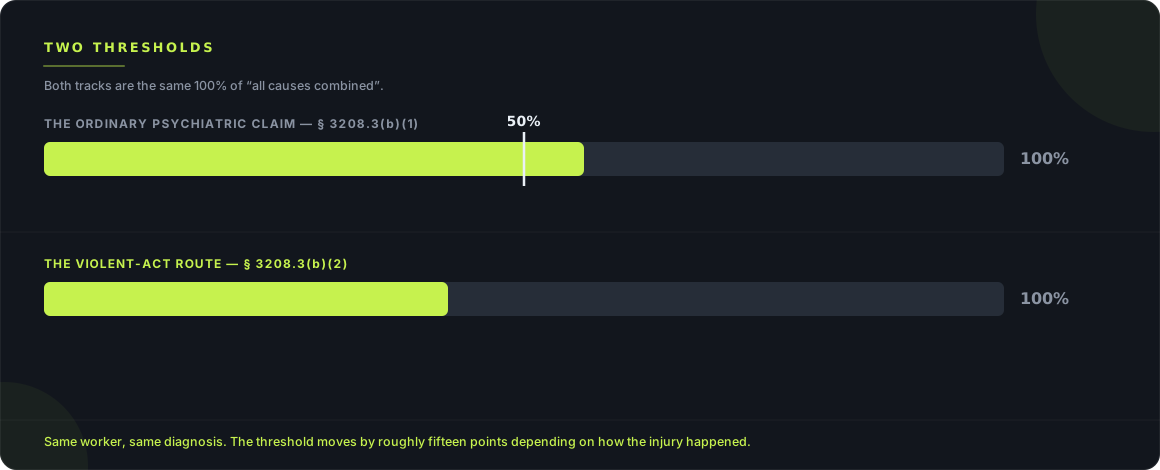
That is a substantial difference, and it is decided by a fact about the mechanism of injury rather than by anything a psychologist writes. Whether the client was the victim of a violent act is an intake question. It is also, as we will see, one of the two doors in the rating statute — which means the same fact is doing work in two places.
One point here is worth stating carefully, because it is easy to get wrong and we got it wrong in an earlier draft of this piece. It is tempting to assume that a psychiatric condition pleaded as a compensable consequence of a physical injury escapes the § 3208.3 threshold altogether — that because the physical injury is accepted, the psych follows automatically. The Appeals Board has not treated it that way. In a 2026 panel decision the Board stated that “the predominant causation threshold applies to psychiatric injuries pled as a compensable consequence of a physical injury.” Panel decisions are not binding precedent, and we flag that below. But a firm planning its file on the opposite assumption is planning on something the Board has recently said is not so.
What the rating statute bars, and what it gives back
Now the money. Labor Code § 4660.1(c)(1) is short and does a great deal of work:
Three conditions, one bar, and an important carve-out that the same paragraph preserves: nothing in it limits the employee’s entitlement to medical treatment for those conditions, or to temporary disability. The worker still gets treated. The rating simply does not move.
Then subdivision (c)(2) opens the door — for one of the three. It begins: “An increased impairment rating for psychiatric disorder is not subject to paragraph (1)” where the psychiatric disorder results from either (A) being a victim of a violent act or direct exposure to a significant violent act, or (B) “[a] catastrophic injury, including, but not limited to, loss of a limb, paralysis, severe burn, or severe head injury.”
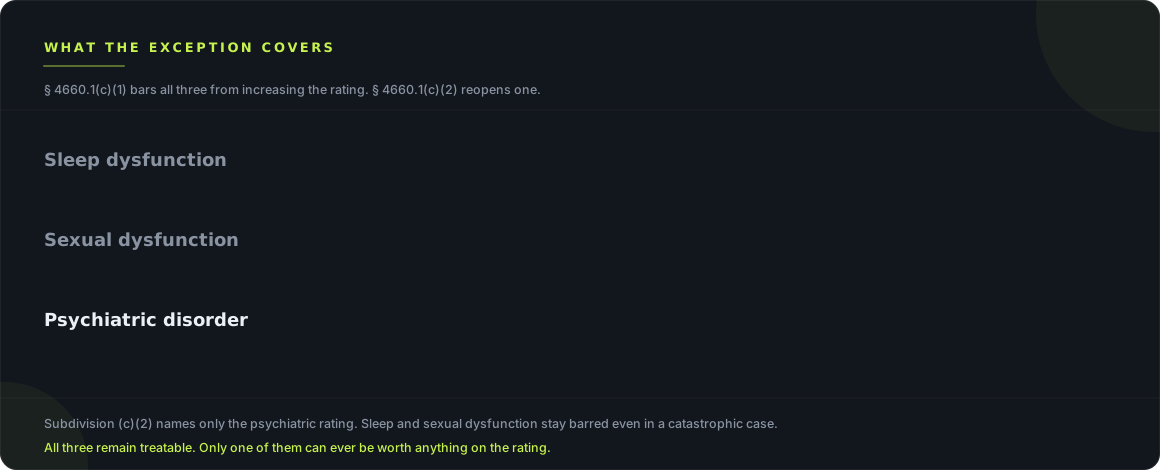
Read the two paragraphs side by side and the asymmetry is hard to miss. Subdivision (c)(1) bars three things. Subdivision (c)(2) excepts one. A worker with a catastrophic injury who also has sleep dysfunction and sexual dysfunction gets the psychiatric rating back and not the other two. That is what the words say, and it is the sort of detail that decides a final number without ever being argued about.
So the entire add-on, in every case that is not a violent act, comes down to a single word: catastrophic. Which the Legislature did not define, beyond four examples.
Wilson, twice
That definitional gap was filled by the Workers’ Compensation Appeals Board sitting en banc, in Kris Wilson v. State of CA Cal Fire, Case No. ADJ10116932 out of the San Luis Obispo district office. En banc matters: as the decision itself notes in a footnote, “En banc decisions of the Appeals Board are binding precedent on all Appeals Board panels and WCJs.”
The facts are worth setting out, because they are the whole argument of this article in miniature.
Wilson was a firefighter with the Department of Forestry. On 13 May 2014 he was assigned to a drainage area at a fire, “where he inhaled fumes and smoke from the fire” — and, the decision records, “he was not wearing a breathing apparatus.” He “remained in the hospital for approximately two weeks before being discharged.” He “was placed in a medically-induced coma.” He “suffered both renal and respiratory failure.” He was, the Board noted, “only 28 years old at the time of his injury.” The psychiatric evaluator “diagnosed applicant with post-traumatic stress disorder (PTSD) and a severe major depressive disorder.”
Now compare that against the statute’s four examples. Loss of a limb — no. Paralysis — no. Severe burn — he was at a wildfire, and no. Severe head injury — no. On the list the Legislature wrote, Kris Wilson scores zero out of four.
The Board found his injury catastrophic anyway, and explained why. The holding is one sentence: “Determination of whether an injury is catastrophic under section 4660.1(c)(2)(B) focuses on the nature of the injury and is a fact-driven inquiry.” It then set out factors the trier of fact may weigh, prefaced: “These factors include, but are not limited to, the following, as relevant.”
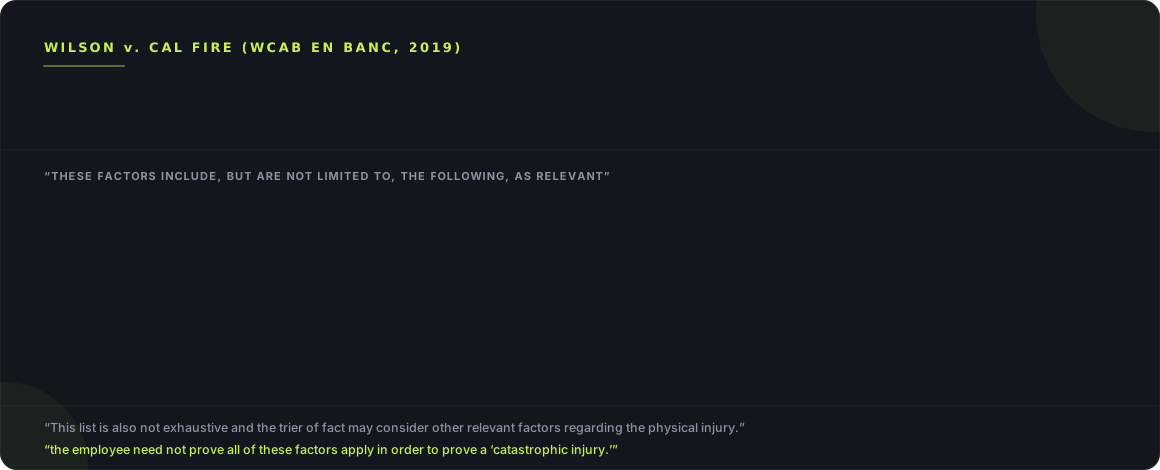
Look at the five and notice what is absent. Not one of them asks how severe the psychiatric condition is. Factor one asks about the intensity and seriousness of the treatment reasonably required. Factor two asks about the ultimate outcome when the physical injury is permanent and stationary. Factor three asks about severity and its impact on activities of daily living. Factor four asks whether the physical injury is closely analogous to one of the statutory examples. Factor five asks whether it is an incurable and progressive disease.
The decision says this explicitly: “This indicates that the inquiry into whether an injury is catastrophic is limited to looking solely at the physical injury, without consideration for the psychiatric injury in evaluating the nature of the injury.”
Two qualifications come straight from the opinion and matter for anyone building a file. “Not all of these factors may be relevant in every case and the employee need not prove all of these factors apply in order to prove a ‘catastrophic injury.’” And: “This list is also not exhaustive and the trier of fact may consider other relevant factors regarding the physical injury.” It is not a checklist with a passing grade. It is a frame for an argument that still has to be made on evidence.
The defendant did not accept it. It petitioned for reconsideration, arguing — in the Board’s words — that the five factors “are not authorized by section 4660.1(c)(2)(B) or legislative history, and that the Appeals Board exceeded its authority by promulgating these five factors.” On 15 July 2019 the Board, again en banc and over six commissioners’ signatures, denied the petition. It grounded its authority in Labor Code § 133, held that “Determination of whether an injury is catastrophic under section 4660.1(c)(2)(B) is therefore within the authority of the Appeals Board,” and characterised what it had done: “The factors provide an analytical framework to assist the trier of fact.” “The trier of fact is not required to consider these factors.” “Outlining five non-exhaustive factors the trier of fact may consider is not an exercise in impermissible rulemaking.”
The second decision also settled something the first did not address directly, and it is the single most useful line in either opinion for a firm looking at an older file: “Section 4660.1(c)(2)(B) contains no temporal restrictions on its application.” And: “The Legislature did not restrict the occurrence of the specified injuries to a specific timeframe and consequently, neither may the Appeals Board.”
An injury does not have to look catastrophic on day one. The factors ask about treatment intensity over time, about the outcome when the injury is permanent and stationary, about whether a disease is incurable and progressive — all of which are things that become visible months or years in. A file that was triaged as routine at intake can turn into a (c)(2)(B) case later, and the facts needed to prove it will be the ones nobody recorded at the start.
What an inadequate record costs: two decisions from 2026
Rules are abstract. Here is what the rule does to real files, taken from two Appeals Board panel decisions issued this year. Both of them are about the § 4660.1(c) exceptions. Neither of them decides the exception. Both of them were sent back.
A caution first, because it governs how much weight these carry. One of the decisions says so itself in a footnote: “Although panel decisions are not binding precedent on other Appeals Board panels and WCJs” — they are “citable authority” that panels “consider … to the extent that we find their reasoning persuasive.” They are not Wilson. They are illustrations of how the question is being worked in 2026.
| Decision | What was at issue | What happened |
|---|---|---|
| Guzman — ADJ12792074 Sacramento, filed 27 Apr 2026 | Violent act exception | “[N]ot supported by substantial medical evidence” — findings and award rescinded, returned to the judge |
| Strom — ADJ16435725 Van Nuys, 2026 | Increased psychiatric rating; violent act and catastrophic injury | Judge’s reasoning “flawed” — findings and order rescinded, “the record requires further development by way of further medical reporting” |
| Both | The exception itself | Not decided |
In Guzman, the applicant fell from a roof. The Board did not say he was wrong about the violent act; it said the record could not support a finding either way. The psychological QME’s “initial report … is not in evidence, and our review is limited.” The supplemental report “does not contain information regarding what history was taken nor information regarding an examination,” and was therefore “not substantial medical evidence upon which the WCJ may rely.” The treating psychologist had taken a history, examined him and done diagnostic testing — but “he does not provide an opinion regarding whether applicant’s injury arose from a violent act.” The Board’s summary of the position is the sentence every intake manager should read twice: “it is unclear whether applicant’s psychiatric injuries are a compensable consequence of his physical injuries, if they arose directly from the fall from the roof, or both.”
Strom is the mirror image. There the judge had found against the applicant, and the Board found the reasoning wrong — the panel decisions the judge relied on did not contain the requirement he read into them; “[r]ather, each of these decisions focused on the mechanism of injury and based its conclusion on whether there was a strong, extreme or intense physical force.” But the Board still did not decide it, because the medical reporting had its own holes: on causation apportionment the psychiatric evaluator “did not indicate what percentage of applicant’s psychological symptoms were actually symptoms” of the accepted injury, and on the erectile dysfunction claim the relevant physician “did not address causation” at all.
Two files, opposite outcomes below, same destination: back to the trial level, more reporting, more time. And in both the thing that failed was not the law and not the lawyering. It was the record — specifically, the absence from the record of a clear account of the mechanism and of what the physical injury did.
Both decisions also restate the burden in the same words: “An employee bears the burden of proving injury AOE/COE by a preponderance of the evidence,” and medical evidence “is required for this determination.” The burden sits with the applicant, which means it sits, in practice, with the applicant’s firm, which means it sits with whatever that firm wrote down.
The two bars that run on dates
Before leaving § 3208.3 there are two provisions that are pure intake, in the sense that they are decided by dates and nothing else, and that a claim can die on without anyone realising for months.
Subdivision (d) bars compensation for a psychiatric injury where the employee has been employed by that employer for less than six months — with one exception, for a psychiatric injury “caused by a sudden and extraordinary employment condition.” And it adds a clause that intake gets wrong constantly: “The six months of employment need not be continuous.” A worker who did four months last year and three this year has his six months. A screen that asks “how long have you worked there?” and takes the current stint will decline him.
Subdivision (e) is the post-termination gate. Where the claim is filed after notice of termination or layoff, it is barred unless one of a short list of things is already true by that date — among them that sudden and extraordinary events caused the injury, that the employer already had notice under § 5400, that medical records already existing contain evidence of treatment for it, or that the injury date falls after the notice but before its effective date.

Notice what kind of list that mostly is. Not all of it — one route turns on a finding a trier of fact makes later, and another on an injury that happens after the notice but before it bites. But the three routes a firm can do anything about all describe a state of affairs that had to exist before the notice arrived: the character of the event, the employer’s knowledge under § 5400, and a treatment record already in being. None of those three can be created afterwards. A firm that takes the call a week after the layoff and does not ask whether there is an existing treatment record has not merely missed a question — it has missed the only window in which the answer could have been secured.
And one more, subdivision (h): no compensation where the psychiatric injury was “substantially caused by a lawful, nondiscriminatory, good faith personnel action.” The statute allocates that one explicitly: “The burden of proof shall rest with the party asserting the issue.” That is the defence’s burden, not the applicant’s — a distinction worth knowing before an intake coordinator talks a caller out of a claim because he was written up before he got sick.
The questions that answer the statute
Put the two statutes and the two en banc decisions together and the list of facts that decide a psychiatric add-on turns out to be short, concrete and almost entirely collectable by a non-lawyer on a first phone call. Here it is, mapped to the provision each answer serves.
| Ask on the first call | What it answers |
|---|---|
| How did it happen — in the client’s own words, not a category | § 3208.3(b)(2) and § 4660.1(c)(2)(A): the violent-act route, in both statutes at once |
| How many nights in hospital? Intensive care, intubation, coma? | Wilson factor 1 — intensity and seriousness of treatment required |
| What can he no longer do at home? Dressing, bathing, stairs, driving | Wilson factor 3 — impact on activities of daily living |
| Has anyone said it will get worse rather than better? | Wilson factor 5 — incurable and progressive disease |
| Limb lost? Paralysis? Severe burn? Head injury? | Wilson factor 4 — analogy to the four statutory examples |
| Total months with this employer, across every stint | § 3208.3(d) — and “need not be continuous” |
| Notice of termination yet? Any existing record mentioning the symptoms? | § 3208.3(e) — the list that closes on the notice date |
The first row carries more weight than it looks. Strom turned on the Board’s observation that the panel decisions on the violent-act question “focused on the mechanism of injury” and asked “whether there was a strong, extreme or intense physical force.” Mechanism is a narrative fact. It survives in a client’s own sentences and dies the moment an intake coordinator converts it into a dropdown value — “fall,” “MVA,” “lifting.” Those categories are built for reporting, not for § 4660.1(c)(2)(A), and a file that contains only the category has already lost the fact that decides the exception.
Seven questions. They belong wherever your script already asks about the mechanism of injury — see what the first call should cover. None of them requires a legal opinion and none takes more than a minute. Two of them — what the client can no longer do, and whether anyone expects it to worsen — actually get easier to answer as the case ages, which is part of why § 4660.1(c)(2)(B) has no deadline. The other five decay. Hospital nights become “a while.” Employment stints get rounded. The existence of a pre-notice treatment record stops being a thing anyone can confirm without a subpoena.
What intake records instead, almost universally, is a tick in a box marked psych — the one fact out of all of these that the statute and the case law tell us is not the deciding one.
What this is actually worth to a firm
Two honest limits before the argument. First, we could not find reliable published data on how often the § 4660.1(c)(2) exceptions are invoked or granted in California; we looked, and we are not going to invent a number to make the point land harder. Second, this is not an advertising opportunity. No injured worker searches for “catastrophic injury psychiatric add-on.” There is no campaign here, and any agency that tells you otherwise is selling you keywords nobody types.
What it is, is a conversion-side and case-value finding — which is the cheaper of the two places to find money, because it operates on enquiries a firm has already paid for.
Across the campaigns we have run — roughly $16.5M in managed Meta spend, about 219,000 injured-worker leads at around $75 per lead, and about 21,000 signed cases at around $775 in acquisition cost per signed case — the one thing that number conspicuously does not tell you is what any of those cases was worth. Acquisition cost is flat by construction. Case value is not. A firm buying at a flat cost per lead is implicitly treating every signed case as interchangeable, and the segment where that assumption is most wrong is precisely this one: the catastrophic physical injury, where the psychiatric component can be rated rather than merely treated.
This is the gap between acquisition cost and what a case is actually worth, and it is wider in this segment than anywhere else. That has a practical consequence for how a firm spends. If you cannot tell, at the point of signing, which cases are carrying a live (c)(2) exception, you cannot tell which lead sources are producing them, which means you cannot bid differently for the ones that do. Seven intake questions are what turn that from a guess into something you can report on.
And there is the back file. Because § 4660.1(c)(2)(B) “contains no temporal restrictions,” and because the factors ask about treatment intensity and about the outcome at permanent and stationary — things that are only knowable with time — a case triaged as routine eighteen months ago may look different now. A firm that has never asked these questions of its open files has no way of knowing which ones.
None of which is a reason to tell anybody their claim is worth more. It is a reason to write down, on the first call, the handful of facts that the Appeals Board has twice said are the ones that decide it — and then to let the lawyers argue about them with a record that can carry the argument. The rest of our work on what intake records, and what it costs when it does not, sits in the Growth Library and the Intelligence Center.
Key takeaways
The rating does not move. § 4660.1(c)(1) bars sleep dysfunction, sexual dysfunction and psychiatric disorder from increasing a permanent disability rating. Treatment is still owed.
One of the three gets an exception. § 4660.1(c)(2) names only the psychiatric rating, through two doors: a violent act, or a catastrophic injury.
The four examples are not the test. Wilson held the inquiry “focuses on the nature of the injury” and is “limited to looking solely at the physical injury.” Wilson matched none of the four.
There is no deadline on becoming catastrophic. The Board held on reconsideration that § 4660.1(c)(2)(B) “contains no temporal restrictions on its application.”
Both 2026 panel decisions we read went back. Not on the law — on the record. In one, the Board could not tell whether the psych injury was direct, consequential, or both.
Seven questions close the gap. Hospital nights, ICU, ADLs, prognosis, mechanism, total months employed, notice date. All answerable on the first call.
WorkersComp Marketing is a marketing agency, not a law firm. This article describes California Labor Code §§ 3208.3 and 4660.1, two en banc decisions of the California Workers’ Compensation Appeals Board in Wilson v. State of CA Cal Fire (ADJ10116932, 10 May 2019 and 15 July 2019) and two 2026 WCAB panel decisions, in order to explain what a firm should capture at intake. Nothing here is legal advice, nothing here is advice about whether any particular psychiatric claim is compensable or rateable, and nothing here is a prediction about how any pending matter will come out. Whether a given injury is catastrophic within § 4660.1(c)(2)(B) is a question for the lawyer handling it, on medical evidence. Our own campaign figures are ours alone and are not an industry benchmark.
Frequently asked questions
Does this mean a psychiatric claim is worthless unless the injury is catastrophic?
No, and the distinction matters. § 4660.1(c)(1) bars the psychiatric condition from increasing the permanent disability rating. The same paragraph preserves the employee’s entitlement to medical treatment and to temporary disability. A compensable psychiatric injury outside the exceptions is still a real part of the claim; it simply does not add points at the end. Conflating “not rateable” with “not compensable” is one of the commoner errors we see in intake scripts, and it leads to clients being told things that are not true.
Is a psychiatric injury that follows a physical injury exempt from the predominant-cause test?
We would not assume so. In a 2026 panel decision the Appeals Board stated that “the predominant causation threshold applies to psychiatric injuries pled as a compensable consequence of a physical injury,” and that “predominant as to all causes” under § 3208.3(b)(1) “has been interpreted to mean more than 50 percent.” Panel decisions are not binding precedent on other panels or judges — that is in the decisions themselves — so this is not the last word. But it is the Board’s recent language, and a file built on the opposite assumption is built on sand.
Is Wilson still good law?
It remains on the Appeals Board’s own list of en banc decisions as 2019-EB-1 and 2019-EB-2, and en banc decisions are binding precedent on Board panels and judges. We did not find, and did not confirm the absence of, any California appellate decision reviewing it, and we are not in a position to say what the appellate courts would make of the five factors if asked. Anyone relying on Wilson for a live matter should check its current status in a proper citator rather than on this page.
Should we run ads for catastrophic-injury psych cases?
No. There is no audience searching for this. An injured worker does not know the phrase “impairment rating,” let alone § 4660.1(c)(2)(B), and a campaign built on it would spend money reaching lawyers and adjusters. The value sits entirely on the conversion and case-value side: it changes what a firm records about enquiries it is already paying for, and therefore what it knows about which of its own lead sources produce the heaviest cases.
Does any of this apply outside California?
The statutes, the Appeals Board and both decisions discussed here are Californian, and we have not surveyed any other state for this article. Several states restrict mental-health claims in some way, and the restrictions differ sharply; nothing here should be carried across a state line without checking. What does travel is the operational finding: wherever the rules sit, they are likely to turn on concrete facts about the injury and the employment that a standard intake note does not contain.
Sources
- 01Cal. Lab. Code § 3208.3
Source of every quotation about the causation threshold, the “substantial cause” definition, the six-month bar, the post-termination list and the good-faith personnel action defence. Read on two publishers whose text matches word for word. Both are secondary publishers, not the official California Legislative Information site; one is marked verified as of 11 November 2026, the other current through 1 January 2026.
- 02Cal. Lab. Code § 4660.1
Source of the bar in (c)(1), the preservation of medical treatment, and the two exceptions in (c)(2) including the four named examples. Read on the same two publishers, again matching. Same limitation: secondary publishers, with the currency dates above. The observation that (c)(2) excepts only the psychiatric rating and not sleep or sexual dysfunction is ours, read off the text of the two paragraphs.
- 03Wilson v. State of CA Cal Fire — 2019-EB-1, filed 10 May 2019
“Opinion and Decision After Reconsideration (En Banc),” Case No. ADJ10116932, San Luis Obispo. Source of the holding, the five factors, the “solely at the physical injury” sentence, the binding-precedent footnote and every fact about the applicant’s injury and diagnoses. Read in full on the official publisher’s site, not a mirror.
- 04Wilson v. State of CA Cal Fire — 2019-EB-2, filed 15 July 2019
“Opinion and Order Denying Petition for Reconsideration (En Banc),” same case number, six commissioners. Source of the challenge to the five factors, the § 133 authority answer, the “analytical framework” language, and the “no temporal restrictions” holding. Read in full on dir.ca.gov; both decisions appear on the Board’s en banc index.
- 05Guzman v. Adco Roofing & Waterproofing — ADJ12792074
WCAB panel decision, Sacramento, dated and filed 27 April 2026; read in full on dir.ca.gov. Source of the “not supported by substantial medical evidence” holding, the findings about the QME reports and the burden-of-proof sentences. A panel decision, not binding precedent. Note also that the decision refers to “the violent act exception of 4660.1(c)(1)” where the exceptions appear in (c)(2); we quote it as printed.
- 06Strom v. Danny’s Construction Company — ADJ16435725
WCAB panel decision, Van Nuys, 2026. Source of the compensable-consequence causation statement, the “more than 50 percent” gloss, the mechanism-of-injury reasoning and the gaps in the medical reporting. Two limitations: it is a panel decision, not binding precedent; and we were able to read only the first portion of a long document verbatim, so we have cited no filing date for it and have not relied on anything from the unread remainder.
- 07What we could not source
We found no reliable published data on how often the § 4660.1(c)(2) exceptions are pleaded or granted in California, and we have therefore made no claim about volume anywhere in this article. We also did not confirm whether any California appellate court has reviewed either Wilson decision; the article says only that they sit on the Board’s en banc index. The seven intake questions and the mapping table are ours, not anyone’s holding.
Both Wilson decisions and both 2026 panel decisions were read on dir.ca.gov, the official publisher. The two statutes were read on two matching secondary publishers, as flagged. This is a marketing article about what a firm should capture at intake; it is not legal advice and it is not a view on any particular claim.