Ask a comp firm owner to describe the lifecycle of a case and you will get a sequence. The worker is hurt. He finds you, or the adjuster finds him first. You sign him. You file an application. There is a panel, an evaluation, a hearing date, a settlement conference, and at the end of it a judge approves something and the fee is paid. Every number the firm manages hangs off that sequence: cost per signed case against the fee, the fee against the calendar, the calendar against the float.
The sequence is not wrong. It is just not universal, and the exceptions are not random. There is a set of California employers for whom a worker’s dispute does not travel that route at all, because the employer and the union have signed an agreement that sends it somewhere else — to a mediator, then an arbitrator, under a medical regime the two of them picked. The agreements are lawful, deliberate, decades old, and backed by two sections of the Labor Code written to make them binding on the state and on the courts.
What makes this a marketing problem rather than a trivia question is the publication duty. Both sections make the underlying data confidential and then carve a hole in that confidentiality: the administrative director must put out, every month, a list of the employers and unions that have entered into these agreements. So the one piece of information a firm would need in order to plan around them — which employers — is the piece the state is obliged to hand over, by name, for nothing.
This article is about what to do with that list. It is a marketing argument and not a legal one: nothing here says a carve-out is bad for workers, or good for them, or that a firm should decline the work. The argument is narrower. A comp firm’s media plan, its intake script and its case-value model are all built on one forum, and there is a published, named, free list of the places where that assumption does not hold — and the list has 29 California cities on it.
The assumption nobody writes down
Every comp acquisition number is priced against a single destination, and the destination is an assumption rather than a fact.
Look at what a comp firm actually sells to a marketing agency when it describes its own economics. It gives a fee percentage, a typical award, a months-to-resolution figure and a cost per signed case. Each of those is a reading of the same machine: an application for adjudication, a panel of evaluators drawn by the state, a settlement conference, a judge. The machine is so uniform across the caseload that nobody writing a media plan has ever had to name it. It is the water.
There are two ways a case can sit outside it, and firms have thought carefully about only one. The first is the case that never enters because nothing is disputed — the medical-only claim, which pays no indemnity and produces no adjuster letter. The second is the case that is disputed and still does not enter, because the employer and the union have contracted for a different process. That one almost never comes up, and it is the one with a published address list.
It is worth being precise about why this matters commercially, because the obvious version of the argument is wrong. The obvious version is that a carve-out worker cannot hire you. He can. The non-construction statute says so in terms, and we will come to it. The real version is subtler and more expensive: in a carve-out, three of the four things a comp firm’s value model depends on can be set by someone else before the worker ever calls. Who treats him. Who rates him. How the fight gets resolved. A firm that quotes a case-value range off its WCAB experience is quoting a number from a different system.
One housekeeping note, because the vocabulary is the reason most firms have never looked this up. The Division calls these “labor-management (carve-out) agreements.” The statutes call the instrument a collective bargaining agreement provision (§ 3201.5) or a “labor-management agreement” (§ 3201.7). Unions, carriers and third-party administrators mostly call the result an ADR programme. Workers who are inside one often call it “the union’s comp programme” and do not recognise any of the other terms. All four name the same thing, and the Division’s own summary of it is that these programmes “allow employers and unions to create their own alternatives for workers’ compensation benefit delivery and dispute resolution under a collective bargaining agreement,” with eligibility approved by the administrative director and the requirements set out in §§ 3201.5 and 3201.7 and in title 8 of the California Code of Regulations, §§ 10200–10204.
Two sections, one list of six things
§ 3201.5 covers construction, § 3201.7 covers everything else, and their operative lists are identical.
Labor Code § 3201.5 came first and is confined to construction: a private employer or group of employers “engaged in construction, construction maintenance, or activities limited to rock, sand, gravel, cement and asphalt operations, heavy-duty mechanics, surveying, and construction inspection,” together with the certified exclusive bargaining representative. Labor Code § 3201.7 extends the same architecture to “an industry not covered by Section 3201.5,” which is how city police and fire departments ended up inside it.
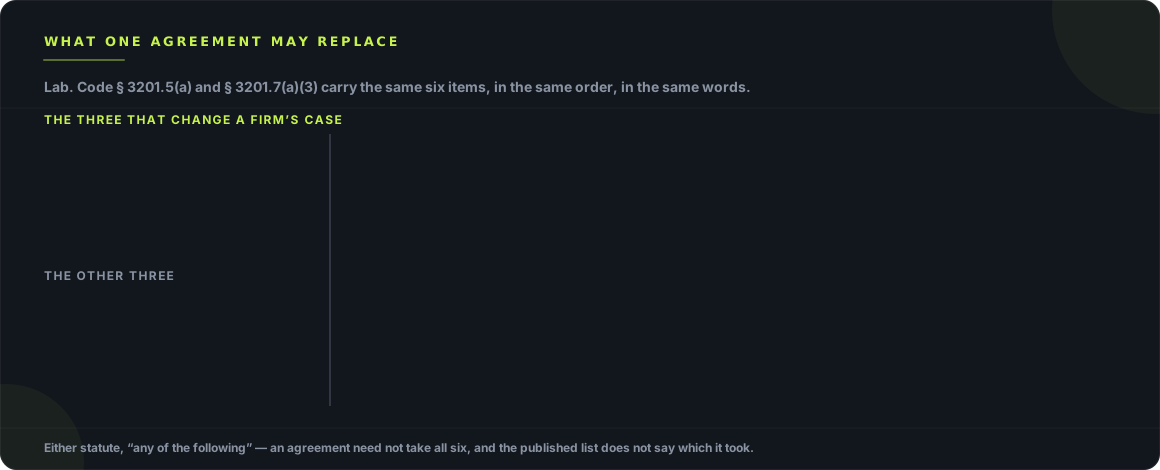
Both open the same way. The Department of Industrial Relations and the courts of this state “shall recognize as valid and binding” an agreement that establishes “any of the following,” and then the same six items appear in both sections in the same order. The first is the alternative dispute resolution system. The second is the agreed list of treatment providers. The third is the agreed limited list of qualified and agreed medical evaluators. The remaining three — joint safety committees, a light-duty or return-to-work programme, and a vocational rehabilitation panel — are real but are not the ones that change a case.
Two structural points are easy to miss and both matter to a firm reading the list.
The first is the phrase any of the following. A programme is not required to take all six items, and the published list does not record which it took. So the list tells you that an agreement exists; it does not tell you whether this particular employer’s workers are inside an exclusive provider list, or only inside a safety committee. The Division will send a copy of a programme’s ADR process on request — both pages carry an email address for it — and that request is the second step after reading the list.
The second is the eligibility floor, which tells you what kind of employer you are looking for before you look. Under § 3201.5 the employer must be developing, projecting or have recently paid a California workers’ compensation premium of “two hundred fifty thousand dollars ($250,000) or more,” or sit in a safety group at $2,000,000, or be self-insured on equivalent terms, or be covered by a single-site wrap-up policy at $2,000,000. Under § 3201.7 the floor drops hard: $50,000 of premium and at least 50 employees, or a safety group at $500,000, or self-insurance — expressly including cities and counties — or, in its own paragraph, “The State of California.”
That last clause is the tell. A fifty-thousand-dollar premium floor with a fifty-employee headcount is not a big-industry threshold; it is a threshold almost any mid-sized municipal department clears. The statute was drafted to let public employers in, and the published list shows that it worked.
| Lab. Code § 3201.5 | Lab. Code § 3201.7 | |
|---|---|---|
| Industries | Construction and listed adjacent trades | “An industry not covered by Section 3201.5” |
| Instrument | A provision in a collective bargaining agreement | A separate “labor-management agreement,” negotiated apart from the CBA |
| Premium floor | $250,000 (or $2,000,000 safety group / wrap-up) | $50,000 and 50+ employees (or $500,000 safety group) |
| Public employers | Not addressed | Self-insured cities and counties named; “The State of California” listed separately |
| Prior permission | Eligibility letter from the administrative director | Union petitions first; permission to negotiate runs one year, extendable once |
| Right to counsel | No such clause in the section | Express: no agreement may “deny to any employee the right to representation by counsel at all stages” |
| Published list | Monthly, under subdivision (i) | Monthly, under subdivision (h) |
The benefit floor is common to both and is worth stating plainly, because it is the thing a worker-facing critic reaches for first and it is not available: neither section allows an agreement that “diminishes the entitlement of an employee to compensation payments for total or partial disability, temporary disability, vocational rehabilitation, or medical treatment fully paid by the employer as otherwise provided in this division,” and the offending portion “shall be declared null and void.” A carve-out may change the route and the roster. It may not change the entitlement.
The list the state must publish every month
Both sections make the data confidential, then require the one derivative that a firm needs.
Subdivision (i) of § 3201.5 and subdivision (h) of § 3201.7 are drafted the same way. The data the administrative director collects “shall be confidential and not subject to public disclosure under any law of this state” — and then, in the next breath, the Division “shall create derivative works” that “shall not be confidential, but shall be public,” and: “On a monthly basis the administrative director shall make available an updated list of employers and unions entering into” these agreements.
That is an unusual piece of drafting to find in a comp act. The loss experience, the payroll, the claim counts: sealed. The identity of the participants: compelled, monthly. Whatever the Legislature’s reason, the practical effect for a marketer is that the hardest fact to get is the one that is given away.
The Division publishes it as two pages, one per section. Here is what was on them when we read them on 19 November 2026.
Take the counts with the caveat they deserve, because we are reading a web page rather than a register. Five of the 17 construction rows in the active table carry expiration dates that have already passed — two on 1 April 2026, two on 31 July 2026 and one on 6 May 2026 — and both pages are footed “June 2026” without saying what that date refers to. So 17 and 96 are the page’s numbers, not a verified count of agreements in force this morning. Treat the list as a lead, confirm with the Division, and do not put a number from it into a pitch deck.
With that said, the composition of the non-construction list is the finding, and it is robust to a few stale rows. By our reading of the employer column, 84 of the 96 active rows name a public employer: 29 cities from Los Angeles, Oakland and Fresno down to Farmersville, Kingsburg and Ripon; the counties of Orange, Riverside and Santa Barbara plus the City and County of San Francisco; the Los Angeles County Fire Department, the Orange County Fire Authority and the Chino Valley Independent Fire District; two transit districts and an airport authority. The remaining twelve rows are private, and they cluster tightly: building-services and janitorial contractors, two grocery operators, a staffing company, and one facilities contractor appearing three times for three separate corporate campuses.
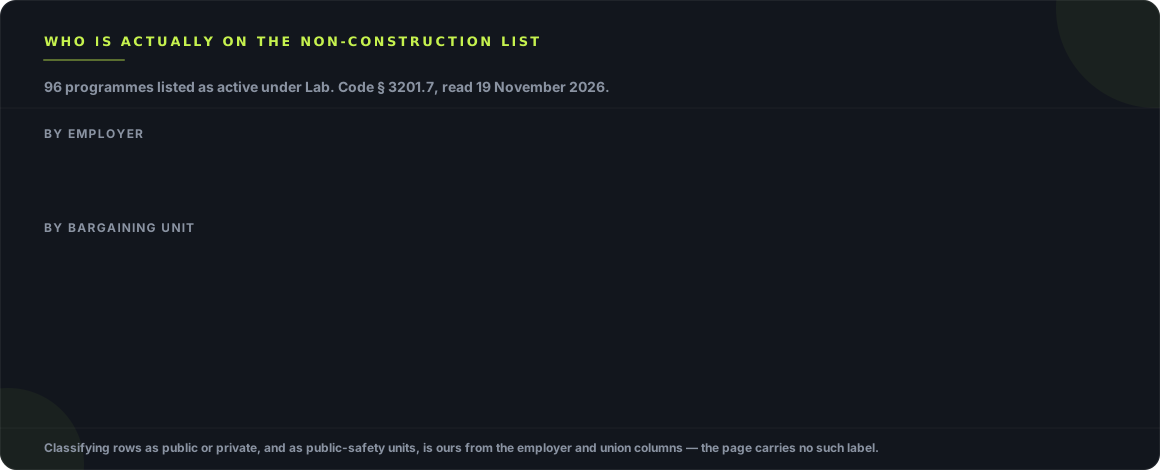
That overlap is the part worth stopping on. Statutory presumptions — the provisions that make a heart condition, a cancer or a back injury presumptively industrial for firefighters and police officers — are among the strongest marketing propositions in the category, because they are the only device in a comp act that makes a case stronger before anybody calls a lawyer. A firm that has built creative around them is addressing, in California, a workforce whose employers hold 53 of the 96 live non-construction carve-out agreements on the state’s own list. The proposition is not wrong. The forum it lands in may not be the one the firm priced.
Where the dispute goes, and where it comes back
The ADR system replaces the front of the process, not the review at the end of it.
The most common description of a carve-out in the wild is that it “takes the case out of the WCAB,” and that is half right in a way that matters. Read the clause: an alternative dispute resolution system “that supplements or replaces all or part of those dispute resolution processes contained in this division, including, but not limited to, mediation and arbitration.” Supplements or replaces. All or part. The statute is permissive about how much of the process goes, and the published list does not tell you how much went in any given programme.
Then comes the sentence that most summaries leave out. Any system of arbitration “shall provide that the decision of the arbiter or board of arbitration is subject to review by the appeals board in the same manner as provided for reconsideration of a final order, decision, or award made and filed by a workers’ compensation administrative law judge,” and by the court of appeal thereafter. And: “The findings of fact, award, order, or decision of the arbitrator shall have the same force and effect as an award, order, or decision of a workers’ compensation administrative law judge.”
So the path is a bypass, not an exit. It leaves the statutory route before the judge and rejoins it at reconsideration, with the arbitrator standing in the judge’s shoes for everything in between. Both sections also switch off a short list of the Labor Code’s own arbitration provisions — §§ 5270, 5270.5, 5271, 5272, 5273, 5275 and 5277 — for arbitration established this way, which is the statute saying that the parties’ process governs rather than the division’s.
For a firm, three practical consequences fall out of that single clause, and none of them is about jurisdiction.
The first is that the familiar calendar disappears. A firm’s months-to-fee assumption is an average over a docket — the float that every marketing budget is really borrowing against. An arbitration calendar set by a labour-management committee is a different distribution with a different mean, and no firm can know which way without asking.
The second is that the early procedural events a firm uses as intake qualifiers may not exist. There is no panel request to chase if the panel is an agreed list. There may be no delay letter in the form intake is trained to recognise.
The third is the only one that is unambiguously good news: because review runs to the appeals board in the ordinary way, the law a firm already knows still governs the back end. The carve-out changes the venue of the fight, not the standard it is fought to.
The word that matters is “exclusive”
Two of the six items reach past the dispute and into the medical file the case is built out of.
Items two and three on the list are the ones a comp firm should read twice, because they do not describe a process. They describe a roster.
Item two: “The use of an agreed list of providers of medical treatment that may be the exclusive source of all medical treatment provided under this division.” Item three: “The use of an agreed, limited list of qualified medical evaluators and agreed medical evaluators that may be the exclusive source of qualified medical evaluators and agreed medical evaluators under this division.” Identical wording in both sections.
Those two sentences do more work than the dispute clause. A comp case is, in the end, a stack of medical opinion, and two things decide what is in the stack: who treated the worker and who rated him. A firm’s whole referral roster is an answer to the first question, and the medical-legal examination machinery — the panel request, the specialty, the strike — is an answer to the second. In a programme that has taken items two and three, both answers may already be fixed by an agreement signed before the injury.
Note the hedge in the statute, and keep it: may be. The sections permit exclusivity; they do not impose it. A programme may have an agreed list that sits alongside the ordinary route rather than replacing it, and the published list does not say. This is exactly why the second step — asking the Division for the programme’s ADR process — is worth the four minutes. Without it, a firm is guessing at the two variables that decide the value of the case.
One statute writes in the lawyer. The other does not.
§ 3201.7(b)(1) contains an express right to counsel at all stages. § 3201.5(b)(1) does not contain it.
This is the asymmetry that surprised us, and we checked it in the official text rather than a summary because the temptation to write “the carve-out statutes preserve the right to counsel” is strong and it would be wrong.
Here is § 3201.7(b)(1) in full on the point. Nothing in the section allows an agreement that diminishes the statutory entitlements, “nor shall any agreement authorized by this section deny to any employee the right to representation by counsel at all stages during the alternative dispute resolution process. The portion of any agreement that violates this paragraph shall be declared null and void.”
And here is § 3201.5(b)(1), the construction equivalent, in full: “Nothing in this section shall allow a collective bargaining agreement that diminishes the entitlement of an employee to compensation payments for total or partial disability, temporary disability, vocational rehabilitation, or medical treatment fully paid by the employer as otherwise provided in this division. The portion of any agreement that violates this paragraph shall be declared null and void.” The benefit floor is there. The counsel clause is not.
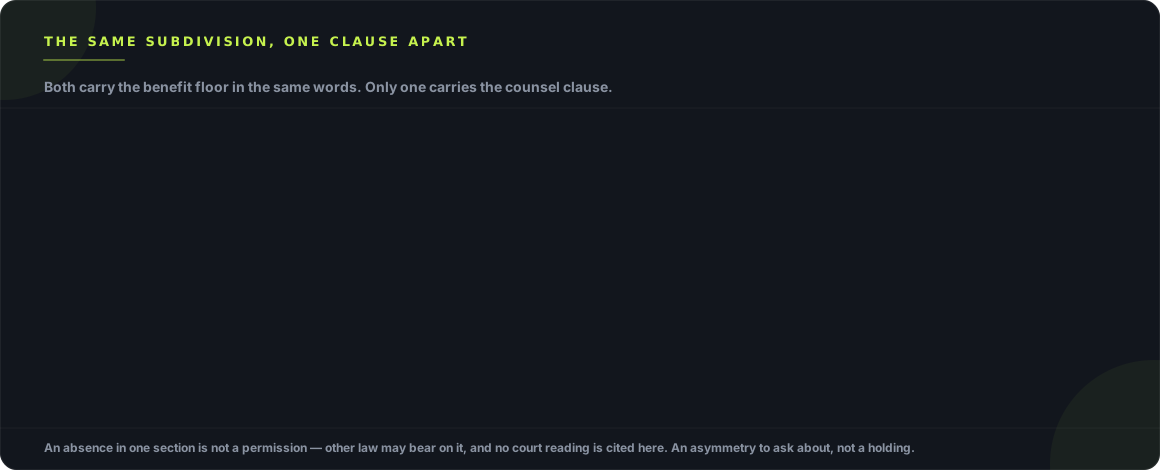
Why the two sections differ is not something we can tell you from the code. The sections were enacted a decade apart and were last amended together by the same 2012 bill, which is as much as the annotations say. The honest statement of the position is that the Legislature wrote an express protection into the newer, broader section and did not write it into the older, narrower one.
What a firm does with that is ask. If a construction programme in your market has taken the ADR item, the question for the Division — or for the union — is what the agreement itself says about representation, because the statute does not answer it for you. In practice, construction ADR programmes in California have operated with claimant representatives involved for thirty years; the point is that this is a fact about the programmes, not a right conferred by § 3201.5.
A firm that writes “the carve-out statutes preserve the right to counsel” has made the mistake the statutes invite. One of them does.
Nineteen out of three thousand one hundred
The state published outcome data on these programmes once. It is fourteen years old and it is remarkable.
Labor Code § 3201.9 requires a report on carve-out loss experience “on or before June 30, 2004, and biannually thereafter,” with an Insurance Commissioner’s review of rate adequacy and of “comparative results for these programs with other programs” folded into it. The only such report linked from the Division’s carve-out pages is titled Alternative Dispute Resolution/Carve-Out Program … Report on Activities for the Calendar Years 2004–2011 and is footed 30 June 2012.
The Division knows it stops there. Its carve-out index page carries a one-line pointer: “For additional information on carve-outs after 2011, please see the Carve-Out Section in the CHSWC Annual Reports.” So we went and looked. The 2024 and 2025 annual reports of the Commission on Health and Safety and Workers’ Compensation have no carve-out section in their tables of contents, and the only mention of the subject we found in either is a single bullet listing “carve outs” among the areas the Commission says it will continue to examine. We could not read the 2023 report at all — the server refused it — and we read roughly a third of each of the other two in full text rather than all of it, so this is a search that came up empty rather than a proof that nothing exists. State it as what it is: the public trail on these programmes, as far as two sessions of looking can follow it, ends in 2012 with data for 2011, and the pointer the agency gives for anything later did not lead anywhere we could find.
Everything below is therefore fourteen years old, and a reader should not treat any of it as current.
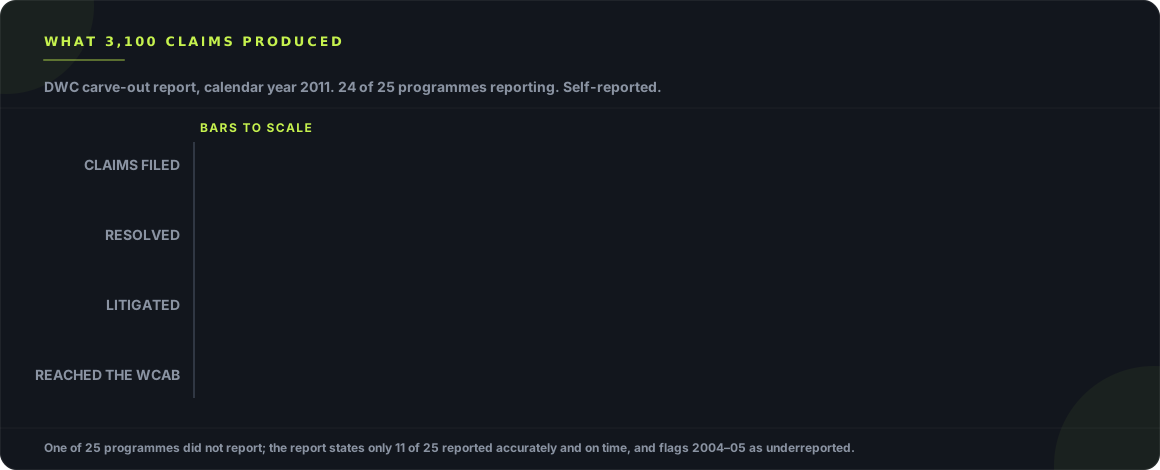
With that said. For 2011, 24 of the 25 programmes then operating reported: 20 construction, four non-construction, covering 1,586 employers, roughly $2.4 billion of payroll and 38,968 full-time-equivalent employees derived from 77,936,131 person-hours. Those employers filed 3,100 claims, split 1,600 medical-only and 1,500 indemnity, at $16.8 million paid and $20.8 million incurred.
And then the dispute figures, which are the reason this article exists. Of the 3,100 claims, 2,750 were resolved. The report’s own sentence: “In 2011, ADR programs resolved 2,745 claims prior to arbitration, which was 89 percent of all claims filed.” And: “In 2011, carve-out programs reported resolving 19 claims using litigation. Fourteen claims were resolved at mediation, one at arbitration, four at the WCAB, and none at the Court of Appeals.”
Hold two thoughts about that figure at once, because taking only one of them is how this gets misread.
The first is that it is a real and large effect. Nineteen litigated claims out of 3,100, on self-reported data the agency itself says only 11 of 25 programmes filed accurately and on time, in a system whose entire design is to resolve things before arbitration. Whatever the precision, the direction is not in doubt: these programmes produce very little litigated work.
The second is that “litigated” in that table is not the same thing as “represented.” The report contains no count of workers who had a lawyer, no attorney-fee figures and nothing at all about representation — we looked. A claim resolved at mediation with a claimant’s representative at the table is a resolved claim, not a litigated one. So the honest reading is that carve-outs compress the litigated tail hard, and that the state has published nothing about what they do to the demand for representation. Anyone who tells you these programmes eliminate the market for claimant work is going beyond the data, and so is anyone who tells you they do not touch it.
For a firm, that is enough to act on without resolving it. A market segment where the fight almost always ends before arbitration is a segment with a shorter cycle, a smaller contested middle and a different fee profile. At our own blended figures — roughly $75 a lead and about $775 of marketing cost behind each signed case, ours and aggregate rather than any benchmark — the question is not whether to advertise into these employers. It is whether the case you sign there is the case your model priced.
Monday
Four steps, none of which needs a lawyer or a budget.
One. Read both DWC carve-out pages against your service area. Cities, counties, fire districts, transit agencies first, because that is where the non-construction list lives; then your largest private targets. Write down the programme numbers.
Two. Email the Division and ask for a copy of the ADR process for each programme you hit. The email address is printed on both pages. You are asking which of the six items the agreement took — above all whether the treatment list and the evaluator list are exclusive.
Three. Put two questions in the intake script, after the employer name and before the denial question. Does your union handle comp disputes through its own process? Were you given a list of doctors you have to use? Tag the answers as a field, not a note, so that in ninety days you can run signed-case and fee outcomes for carve-out enquiries against everything else. Nobody has that number. Yours would be the first.
Four. If you market on statutory presumptions to police and fire, look at the list again with that in mind. Fifty-three of ninety-six live non-construction rows sit under a public-safety unit. That does not make the campaign wrong; it makes it a campaign whose cases may run in a forum you have never priced, and the fix is a line in a spreadsheet rather than a change of strategy.
Key takeaways
Two sections, one architecture. § 3201.5 lets construction employers and unions replace the comp dispute process; § 3201.7 does the same for every other industry.
The participants are published monthly, by statute. On 19 November 2026 the two DWC pages listed 17 construction and 96 non-construction programmes as active.
The non-construction list is municipal. 29 named cities, four counties, and 53 of the 96 rows sitting under a police, fire or sheriff’s union.
“Exclusive” is the operative word. The agreed treatment list and the agreed evaluator panel may be the exclusive source — which decides the medical file your case is built from.
Only one section writes in the lawyer. § 3201.7(b)(1) guarantees counsel at all stages. § 3201.5(b)(1) carries the same benefit floor and no counsel clause.
The litigated tail is tiny; representation is unmeasured. 2011: 19 litigated claims of 3,100 and four at the WCAB — self-reported, fourteen years old, and silent on who had a lawyer.
WorkersComp Marketing is a marketing agency, not a law firm. This article reads California Labor Code §§ 3201.5, 3201.7 and 3201.9 and two Division of Workers’ Compensation publications, and it reads them in order to explain what a published list of employers means for a firm’s media plan, its intake script and its case-value assumptions. Nothing here is legal advice, nothing here is an opinion on whether any particular carve-out agreement is valid or on what it permits, and nothing here tells an injured worker what to do. Two statements in this article are ours rather than any court’s or agency’s — that the absence of a counsel clause from § 3201.5(b)(1) is an asymmetry to ask about rather than a permission, and our own classification of listed employers as public or private — and both are flagged where they appear. The eligibility, validity and operation of any specific programme is a question for the Division and for your own counsel.
Frequently asked questions
Can a worker inside a carve-out programme still hire our firm?
Under § 3201.7 the answer is express: no agreement authorised by that section may “deny to any employee the right to representation by counsel at all stages during the alternative dispute resolution process,” and any portion of an agreement that does is null and void. Under § 3201.5, the construction section, there is no equivalent clause in the statute — which is not the same as a permission to exclude counsel, and we are not saying it is. What it means practically is that for a construction programme the answer comes from the agreement rather than from the code, so it is a question to put to the Division or the union rather than one to assume either way.
How do we find out whether an employer in our market has one?
Two web pages, both free. The Division of Workers’ Compensation publishes the § 3201.5 participants on its construction carve-out page and the § 3201.7 participants on its non-construction page, each as a table of programme number, union, employer, agreement type and dates. Both subdivisions require the administrative director to make an updated list available monthly. Search the employer column for the cities, counties, districts and large private employers inside your service radius. Then email the address printed on both pages for a copy of the programme’s ADR process, because the list does not say which of the six statutory items the agreement actually took.
Does a carve-out change what a case is worth?
It can change three of the inputs, which is not the same as changing the entitlement. Neither section permits an agreement that diminishes an employee’s entitlement to disability payments, temporary disability, vocational rehabilitation or employer-paid medical treatment; the offending portion is void. What an agreement may change is who treats the worker, who evaluates him, and how the dispute is resolved — and a case-value model built on WCAB experience is a reading of a system with different answers to all three. The honest position is that nobody has published carve-out case values, so this is a reason to measure your own rather than a figure we can give you.
Is the 17-and-96 count reliable?
It is the page’s count on the day we read it, 19 November 2026, and we counted the rows ourselves rather than taking a stated total, because neither page prints one. Treat it with care: five of the 17 rows in the construction active table carry expiration dates that have already passed, and both pages are footed “June 2026” without saying what that date describes. So the list is reliable as a list of employers to ask about and unreliable as a census of agreements in force this morning. Confirm anything you intend to act on with the Division.
Is there newer outcome data than 2011?
Not that we could find, and we followed the agency’s own pointer. The standalone report covers 2004–2011 and is dated 30 June 2012; the Division’s carve-out index page says that for information after 2011 you should see “the Carve-Out Section in the CHSWC Annual Reports.” The 2024 and 2025 CHSWC annual reports carry no carve-out section in their tables of contents, and we found only a passing bullet naming carve-outs as an area the Commission will continue to examine. We could not open the 2023 report, and we read about a third of each of the other two as full text rather than all of it, so treat this as an unsuccessful search rather than a finding that nothing exists. Every dispute figure in this article is fourteen years old, self-reported, and from a year in which the agency says only 11 of 25 programmes reported accurately and on time.
Does any of this apply outside California?
Not directly. §§ 3201.5, 3201.7 and 3201.9 are California statutes and the published lists are California lists. Several other states permit collective-bargaining alternatives in workers’ compensation in some form, and we did not read their statutes for this article and make no claim about what they allow or whether any of them requires a comparable public list. The transferable part is the method rather than the citation: find out whether your state lets an employer and a union replace the dispute process, and if it does, find out whether anyone has to publish who did it.
Sources
- 01Cal. Lab. Code § 3201.5
Construction. “Shall recognize as valid and binding” an agreement establishing “any of the following” six items; (a)(1) ADR that “supplements or replaces all or part” of the division’s processes, the arbitrator’s findings having “the same force and effect” as a judge’s and reviewable by the appeals board; (a)(2)–(3) lists that “may be the exclusive source”; (i) monthly list. Official text read 19 Nov 2026. (b)(1) contains no counsel clause — an absence we read as an asymmetry, not a permission.
- 02Cal. Lab. Code § 3201.7
Non-construction, for “an industry not covered by Section 3201.5.” Same six items. (b)(1): no agreement may “deny to any employee the right to representation by counsel at all stages.” (c)(1) $50,000 premium and 50+ employees; (c)(4) “The State of California”; (h) monthly list. Official text read 19 Nov 2026.
- 03Cal. Lab. Code § 3201.9
“On or before June 30, 2004, and biannually thereafter,” updated loss experience plus an Insurance Commissioner review of rate adequacy and “comparative results.” Still on the books; we located only the 2012 report and do not assert no later one exists. Its cross-references point to since-renumbered subdivisions, so we make no claim about which report satisfies it.
- 04DWC — Labor-Management (Carve-Out) Agreements / Construction
Active table: 17 programmes, 15 of them one union against multiple employers; 19 completed, ended or expired. Counts are ours, from the rows; the page prints no total. Five active rows carry expiration dates already past (1 Apr, 6 May, 31 Jul 2026), and the page is footed “June 2026” unexplained.
- 05DWC — Labor-Management (Carve-Out) Agreements / Non-Construction
Active table: 96 programmes across 51 employer entries, plus 11 with open permission to negotiate; 29 cities, four county-level, three fire agencies, two transit districts. Every count is ours, read 19 Nov 2026; the page prints no totals. Classifying 84 of 96 rows as public and 53 as public-safety units is our reading of the columns, which carry no such label. Same unexplained footer.
- 06DWC, ADR/Carve-Out Program Report on Activities for the Calendar Years 2004–2011 (30 June 2012)
2011: 24 of 25 programmes reporting, 1,586 employers, ~$2.4bn payroll, 38,968 FTE, 3,100 claims, 2,750 resolved, “2,745 claims prior to arbitration,” 19 litigated — 14 mediation, 1 arbitration, 4 WCAB, 0 Court of Appeal. Self-reported; one programme failed to report, only 11 of 25 reported accurately and on time, and 2004–05 is flagged as underreported. No data on attorney representation or fees. The 70-at-WCAB figure is our addition of its year columns, not a printed total.
- 07DWC — Labor-management (carve-out) agreements, index page
Programmes let employers and unions “create their own alternatives for workers’ compensation benefit delivery and dispute resolution”; eligibility “must be approved by the administrative director”; requirements in §§ 3201.5, 3201.7 and 8 CCR §§ 10200–10204. Pointer: after 2011, “see the Carve-Out Section in the CHSWC Annual Reports.” Footed June 2020. We did not read the title 8 regulations; that citation is the page’s.
- 08CHSWC Annual Reports, 2024 and 2025
Checked against the DWC pointer above. Neither table of contents carries a carve-out section; the only mention found is a bullet naming “carve outs” among areas the Commission will continue to examine. An unsuccessful search, not a proof of absence: about a third of each report was read as full text, the 2025 copy available to us is marked DRAFT and is hosted off the DIR domain, and the 2023 report could not be fetched at all.
- 09WorkersComp Marketing — our own figures
~$16.5M managed comp Meta spend, ~219,000 leads at ~$75 CPL, ~21,000 signed cases at ~$775 each. Ours, aggregate, across firms and years — not an industry benchmark, and from first-party advertising in the ordinary forum, not carve-out caseloads. The $775 is blended marketing cost per signed case, not a carve-out figure.
Spanning claims in this article were checked against each section separately: the six-item list, the “supplements or replaces” wording, the “may be the exclusive source” wording and the appeals-board review clause are identical in § 3201.5 and § 3201.7; the counsel clause is not, and that exception is named in the prose, the artwork and the takeaways. A marketing article about a published list, not legal advice.