
Somewhere in the first meeting, a workers’ compensation firm owner asks the agency whether it works with any of their competitors. The answer is almost always a version of the same sentence: we only take one firm per market. It is delivered the way a professional-conduct rule is delivered — as a matter of propriety, the thing a reputable shop does and a disreputable one does not.
That framing is a category error, and it is quietly expensive.
Exclusivity in paid media is not an ethics position. It is a pricing term. In a Google search auction, the amount you pay is not set by what you bid; it is set, in Google’s published words, by the advertiser standing immediately below you. Put a second firm into that stack and nobody has committed a discourtesy. What has happened is that an input to your cost per lead has changed — and if the same agency put it there, that input was selected by the party you are paying to bring it down.
So the claim of this article, stated plainly: whether your agency represents another firm in your market is not a question about its character, it is a line in your cost per lead, and it should be written into the contract as a defined, disclosable, checkable term rather than taken on trust — because on the channel where comp firms spend the most money, there is no report that will tell you afterwards.
One disclosure before we start, because it bears on how you should read everything below. One-firm-per-market exclusivity is how this agency works, so we have an obvious interest in your believing this matters. Our defence against that interest is to take the mechanic from the platforms’ own documentation rather than from our opinion, to say exactly where the evidence stops, and to give the last section of the article to the honest case against treating this as your main problem — which, for most firms, it is not.
Your bid is a ceiling. Somebody else sets the price
The number you enter in the bid field is the most you are willing to pay. What you actually pay is calculated from the advertiser ranked below you.
Most firm owners know their maximum cost-per-click bid and treat it as the thing they control. It is not what they are charged. Google’s help documentation on actual cost-per-click is unusually direct about this: you are “often charged less — sometimes much less — than your maximum cost-per-click (max. CPC) bid,” because with the Google Ads auction you “only pay what’s minimally required to clear the Ad Rank thresholds and beat the Ad Rank of the competitor immediately below you.”
Read that second clause slowly, because the whole argument is in it. The price is a function of somebody else’s Ad Rank. Not the market’s in the abstract, and not the highest bidder’s — the specific advertiser occupying the position directly beneath yours in that specific auction. Google says the same thing from the other direction on its Ad Rank page, where “the competitiveness of an auction” is one of the six factors it lists, and where a higher-ranking ad “will be more likely to win but also may pay a higher cost per click.”
An independent description of the same mechanic, from Search Engine Land’s PPC guide, puts it as: “The Ad Rank of the ad below is factored into the actual CPC that an advertiser will pay if someone clicks on their ad.” That guide is also worth citing for its caution, which we are going to honour: it notes that “it is often misstated that advertisers pay one cent more than the advertiser in the spot below them,” and that the next bidder’s rank is “really just one piece of the CPC calculation.”
That caution matters, so here is the careful version of the claim. We are not saying your CPC equals your stablemate’s bid plus a penny. We are saying something weaker and harder to argue with: the advertiser immediately below you is one of the inputs to what you pay, Google says so itself, and in an ordinary agency arrangement that advertiser is sometimes a firm your own agency recruited, onboarded and bid for.
Two ways a stablemate costs you
One of them shows up as a higher cost per lead. The other shows up as nothing at all, which is worse.
When two firms in one market are eligible for the same query, exactly one of them wins the better position, and the firm owner experiences the two outcomes very differently.
If the other firm ranks below you, you still win the click. You simply pay a clearing price that was measured against a bid somebody at your agency chose. Nothing looks wrong. Your impression share is healthy, your ads are serving, your campaigns are delivering — your cost per lead is just a little higher than it would otherwise have been, by an amount no report will itemise for you.
If the other firm ranks above you, the impression goes to them. You pay nothing for it, which is precisely the problem: a lost auction leaves no trace in your spend. It shows up, if at all, as impression share you never had, in a market you were told was yours.
The natural objection is that the platforms must surely handle this — that an agency’s accounts are treated as one advertiser, or that showing two ads for one query is prohibited. We looked, and we are going to be careful about what we found, because the honest answer is incomplete.
Which leaves the firm owner where firm owners usually are: unable to settle the question from first principles, and needing to look at their own data instead.
The one report that can show you
Auction insights is free, it is already in your account, and almost no firm owner has opened it.
Google publishes a competitive report most advertisers never look at. In Google’s description, “the auction insights report lets you compare your performance with other advertisers who are participating in the same auctions that you are.” It is not a market-share estimate from a third-party tool. It is Google telling you who else was in the room.
Four of its columns matter for this question, and Google defines them as follows.
| Column | Google’s definition | What it would tell you |
|---|---|---|
| Overlap rate | “How often another advertiser’s ad received an impression when your ad also received an impression.” | Whether a given firm is genuinely in your auctions or merely in your market. This is the one to read first. |
| Position above rate | “How often the other advertiser’s ad was shown in a higher position than yours was” when both were shown. Search campaigns only. | Which of the two outcomes in the previous section you are actually living with. |
| Outranking share | “How often your ad ranked higher in the auction than another advertiser’s ad” — or showed when theirs did not. | The net of it over time, which is the number to watch after a conversation with your agency. |
| Impression share | Impressions received divided by impressions you were eligible to receive; the report “also tells you the impression share of other advertisers.” | Roughly how much of your market a competing advertiser is contesting, rather than how often you meet. |
Run it at ad-group or keyword level rather than account level. An account-level view blends your brand terms — where your overlap with everyone is low and your outranking share is near total — into the handful of expensive non-brand terms where the contest actually happens, and the blend flatters everything.
One honest limitation on reading those rows. Google’s help page does not actually describe how the competing advertisers in the report are identified, and we are not going to assert something it does not say. The strongest hint on the page itself is its note that you may find “google.com” among your rows if a competitor’s landing page URL is a Google Site — which indicates the rows are keyed to the competitor’s domain. That is an inference from the structure of Google’s own example, not a documented statement, and you should treat it as such until you have opened the report and seen what your account shows.
Where the report cannot see — which is where your money is
The one channel with a competitive report is not the channel most comp firms spend on. The limits are published; the inversion is not.
Auction insights has three boundaries, all of them in Google’s own documentation, and all three work against exactly the case you would want to catch.
It is scoped: “the auction insights report is available for Search, Shopping, and Performance Max campaigns.” It is thresholded: data appears only for campaigns, ad groups and keywords “that meet a minimum threshold of activity,” and “the auction insights report doesn’t show insights when impression share is less than 10%.” Put those together and the blind spot has a shape: a newly onboarded firm, spending modestly, in its first months in your market, is the single case most likely to fall under the threshold and the single case you most wanted to see.
Then there is everything that is not Google Search. Local Services Ads, which comp firms use heavily and which we have written about at length, is an auction too — Google says ads there “are displayed and ranked based on an auction, where the highest ranked ads show first,” and that your bid “is the maximum amount you’re willing to pay for a lead, though you may end up paying less.” Same structure, same exposure. We read Google’s Local Services help pages on getting started and on ad rankings, and neither mentions auction insights, competitor reports or any competitive reporting at all. The only reporting they reference is reporting on your own ads.
And then there is Meta, where the bulk of the category’s injured-worker advertising money goes, including ours. Here we have to stop and declare a gap rather than fill it: Meta’s own help pages on its ad auction and on auction overlap refused automated access while this article was being written, so we did not read them. We are not going to characterise Meta’s auction internals from memory or from somebody’s blog. What we can say is that we are aware of no cross-advertiser competitive report on Meta equivalent to auction insights, and that Meta’s Ad Library — which we have leaned on before for competitive intelligence — tells you who is advertising, not who you met in an auction.
What it costs, in signed cases
Nobody can tell you the size of the effect. Everybody can work out what a given size would do.
We are not going to hand you a number for how much a stablemate raises your cost per lead, because we have not measured it and we would be suspicious of anyone who had. What is worth doing instead is running the sensitivity: pick an uplift, and see what it does to the only metric that pays for anything.
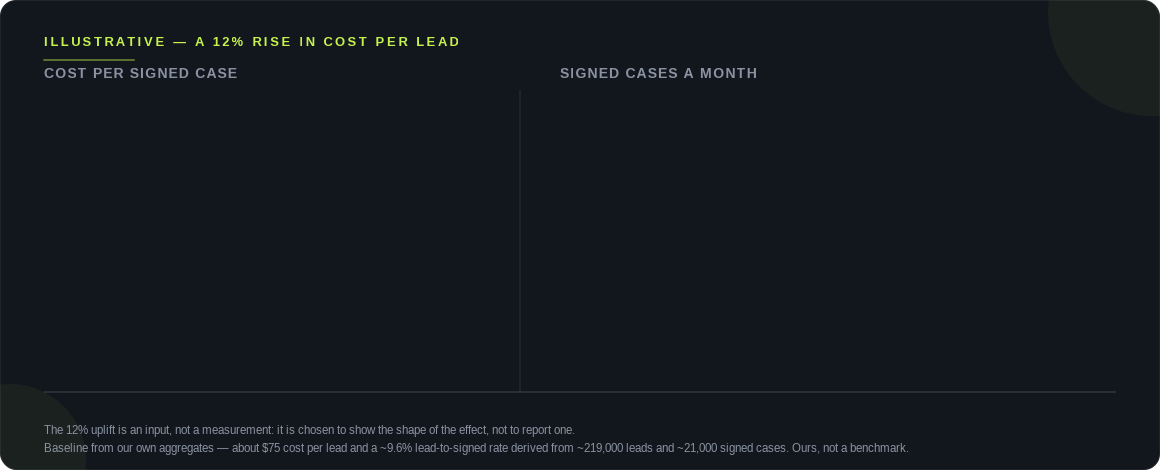
Start from our own aggregates. Across roughly $16.5M of managed workers’ compensation Meta spend we have bought about 219,000 injured-worker leads at an average $75 cost per lead and signed about 21,000 cases at roughly $775 each. Those two endpoints imply a lead-to-signed rate near 9.6% — which is a derivation from the aggregates, not a separately measured figure, and like the rest of them it is ours and not an industry benchmark. Work the chain forward at that rate and $75 a lead comes out at about $781 a signed case, within rounding of the $775 we publish.
| At a $20,000 monthly budget | Baseline | With a 12% CPL uplift | Difference |
|---|---|---|---|
| Cost per lead | $75 | $84 | +$9 |
| Leads a month | 267 | 238 | −29 |
| Signed cases a month (at ~9.6%) | 25.6 | 22.9 | −2.7 |
| Cost per signed case | ~$781 | ~$875 | +$94 |
| Signed cases a year | 307 | 274 | −33 |
Thirty-three signed cases a year is not a rounding error in a comp practice, and that is the point of running the arithmetic rather than arguing about the premise. But every number in the right-hand column rests on a 12% that we chose. It is an input, not a measurement: it is there to show the shape of the effect, and if the real figure in your market is 3% the conclusion is that this belongs well down your list.
Which is the honest way to use this: decide, before you ask your agency anything, what uplift would change your behaviour. If the answer is “anything over 5%,” this is worth a contract term. If the answer is “I would need to see 20%,” you have just established that this is not your problem and you should go and read the cost-per-signed-case model instead, where the leverage is larger.
On the organic side there is no price, only a position
Paid media has an auction you can overpay into. Search results have ten slots and no way to buy a second one.
Everything above is about auctions, and search engine optimisation is not an auction. That makes agency exclusivity a structurally different question on the organic side, and in one respect a starker one.
There is no clearing price in organic search, so there is no mechanism by which a stablemate quietly raises your costs. There is also no mechanism by which you can outspend them. Two firms in one city cannot both hold the first organic result for the query that matters most, and no amount of budget resolves that, because the thing being allocated is a position rather than a price. One client gets it. The agency decides which, through choices about which site gets the better content, the better internal linking and the better share of the link-building hours.
The second-order version is subtler and more common: the same keyword research, the same page architecture and the same editorial calendar get executed twice in one market, by one team, for two firms. Both sites end up chasing the same queries with near-identical structures, and the agency is then in the position of optimising two pages against each other. We have written about what winning those queries actually requires in the paid-search piece and across the Growth Library; none of it gets easier when the shop doing it is also doing it for the firm across town.
Write the term that is checkable
“We don’t work with your competitors” cannot be enforced, because not one word in it is defined.
If the verification route is weak — one report, on one channel, with a 10% floor — then the control has to move to the contract. And most exclusivity language in this industry is not a term at all. It is a sentiment that happens to appear in a document.
Four things turn it into something you could actually hold someone to.
| The sentiment | The term |
|---|---|
| “We only work with one firm per market.” | Name the market. A list of counties, or a named DMA, written into the agreement. “Market” is otherwise whatever the agency needs it to mean in the month it signs someone four miles away. |
| “We’d never take on a competitor.” | A disclosure duty with notice: the agency tells you before onboarding any firm whose service area intersects the defined market, and you have a defined window to object. |
| “Your campaigns are completely separate.” | A representation about overlap, not about accounts: no paid media for another firm on the same keywords and geographies — plus an undertaking to produce the auction insights overlap rate for your top ad groups on request. |
| “Obviously we’d make it right.” | A remedy that is not merely your right to leave. Termination is a remedy that costs the agency a client it has already decided to replace. |
And the part most agencies leave out, which we will say plainly because it is the other half of an honest conversation: exclusivity has a price. A shop that commits to one firm in a market is declining the rest of that market’s revenue, and it will recover that somewhere, usually in the fee. Our own engagements run roughly $8,000–$25,000 a month. If an agency offers you genuine, defined, contractual exclusivity at the bottom of the market rate, the question to ask is not whether they are generous. It is what they think the rest of your market is worth, and why so little.
The honest case for not making this your main worry
We sell exclusivity. Here is the argument against caring about it as much as we would like you to.
The strongest objection is one of magnitude. In any metropolitan market worth advertising in, a comp firm is bidding against many firms, lead vendors and national brands at once. Your agency’s other client is one participant among them. Removing it does not make your auctions cheap; it removes one bidder from a crowded room. The market sets most of your cost per click, and nothing in a contract changes that.
The second objection is that specialisation may be worth more than the penalty. A shop that has run injured-worker campaigns for years knows which creative angles get rejected, which audiences never convert and what intake does with the leads. A generalist learns all of that on your budget, and that learning is paid for in unsigned cases. If the choice is between a specialist with another client two counties away and a generalist with none, the specialist can easily be the better buy — and we would say so even though it argues against our own model.
Third, overlap is an empirical question and often the answer is reassuring. Two firms in a genuinely large market may target disjoint counties, different languages, or different case profiles, and never meet in an auction in any volume that matters. That is exactly what overlap rate is for. Measure before you escalate.
Fourth, and least comfortable for agencies: exclusivity is also a lock-in story. “We’re exclusive in your market” is a reason to pay more and a reason not to leave, and it is worth noticing when it is deployed at the moment a renewal is due.
So the claim this article makes is deliberately narrow, and we would rather state it narrowly than oversell it. Whether your agency represents another firm in your market is a real input to your cost per lead; it is knowable in one channel and unknowable in the others; and it is cheap to make contractual at the moment you sign. It is not the largest lever in your acquisition model. It is simply the one that most firms have agreed to on a handshake, having been told it was a question of manners.
Key takeaways
-
Exclusivity is a pricing term, not an ethics position. Google charges you only enough to beat the Ad Rank of the competitor immediately below you, so who stands there is an input to your cost per lead.
-
A stablemate costs you either way. Below you it raises your clearing price; above you it takes the impression and leaves no trace in your spend.
-
Auction insights is the only report we found that can expose it. Read overlap rate at ad-group level on your most expensive non-brand terms, not at account level, where brand traffic flatters everything.
-
Its blind spot is the case you want. Search, Shopping and Performance Max only, and nothing under 10% impression share — which is where a newly onboarded competitor sits.
-
Make it contractual, because you cannot audit it later. Name the counties, require notice before onboarding, bar overlapping keywords and geographies, and reserve a remedy beyond termination.
-
Keep it in proportion. The market sets most of your cost per click, and a specialist with another client can still beat a generalist with none. Intake leaks are worth more.
WorkersComp Marketing is a marketing agency, not a law firm. Nothing in this article is legal advice, and nothing in it is advice about your professional-conduct obligations. The contract language suggested above is an illustration of the kind of term that can be verified, not a draft for use — whether a particular exclusivity, disclosure or remedy provision is enforceable, and how it interacts with your jurisdiction’s rules on lawyer advertising and on arrangements with non-lawyer marketing providers, are questions for your own counsel on facts we do not have. We also make no claim in this article about what Google’s or Meta’s advertising policies permit as between separate businesses sharing an agency; the relevant policy pages were not available to us, and that gap is recorded rather than filled.
Frequently asked questions
Is it actually true that my agency’s other client raises my cost per click?
The mechanic is documented; the magnitude is not. Google states that you “only pay what’s minimally required to clear the Ad Rank thresholds and beat the Ad Rank of the competitor immediately below you,” so an additional eligible bidder can change what you pay when it lands beneath you. What nobody can tell you from published sources is how often that happens in your market or how much it adds, and anyone quoting you a single percentage for it is guessing. The honest position is that this is a real input of unknown size, which is a reason to make it contractual and to measure overlap rate rather than to panic.
Can I just look it up and find out whether my agency has another client here?
Partly, and only on Google Search, Shopping and Performance Max. Auction insights will show you other advertisers participating in the same auctions, and overlap rate will tell you how often you actually meet. What it will not do is tell you who manages those accounts — no advertising platform discloses that — and it shows nothing where impression share is under 10%, which is exactly where a recently onboarded competitor is likely to sit. So the report can confirm a suspicion and cannot clear one.
Doesn’t Google prohibit two ads from the same advertiser on one search?
We are not going to answer that, because we could not read the relevant policy page while writing this and we are not willing to characterise an advertising policy from memory. What we would say is that the question may be less useful than it looks: the prohibition people have in mind concerns one business running multiple accounts, and two independent law firms are two businesses regardless of who manages their media. If this matters to your decision, read the current policy yourself or ask the agency to point you to the provision it is relying on.
What about Meta, where most of our budget goes?
This is the weakest part of the evidence and we would rather flag it than paper over it. Meta’s own help pages on its ad auction and on auction overlap refused automated access while this article was researched, so we did not read them and we make no claim about how Meta’s auction treats accounts under one agency. What we can say is that we know of no Meta report equivalent to auction insights that compares you with other advertisers in the same auctions. The Ad Library shows you who is advertising; it does not show you who you competed against. That absence is the practical reason the control belongs in the contract.
Is exclusivity worth paying a premium for?
Work out the uplift that would change your mind before you negotiate. At a $20,000 monthly budget and our own aggregate figures, an illustrative 12% rise in cost per lead costs roughly 33 signed cases a year — but that 12% is a chosen input, not a measurement. Set your own threshold, decide what the term is worth at that threshold, and compare it with the fee difference. A firm that concludes the number is small has learned something useful and should spend the attention on intake instead.
Our agency says the accounts are kept completely separate. Is that the same thing?
No, and the distinction is the practical one in this whole article. Separate accounts, separate teams and internal walls are statements about how the agency is organised. The auction does not see any of that; it sees two eligible bidders. The representation worth having is not about account structure but about overlap — that no other firm’s paid media is being run on the same keywords in the same geographies — because that is the thing that determines whether you meet, and it is the thing overlap rate can be checked against.
Sources
-
01
How the price is set — Google’s own words
Google Ads Help, “Actual cost-per-click (CPC): Definition.” You “only pay what’s minimally required to clear the Ad Rank thresholds and beat the Ad Rank of the competitor immediately below you.” Primary — Google documenting its own auction — and changeable without notice.
-
02
Ad Rank, and competition as a factor in it
Google Ads Help, “About Ad Rank.” Ad Rank rests on six factors including “the competitiveness of an auction”; a higher-ranking ad “may pay a higher cost per click.” Same publisher as 01 — not an independent route.
-
03
The report, its columns and its limits
Google Ads Help, “Use auction insights to compare performance.” Overlap rate is “how often another advertiser’s ad received an impression when your ad also received an impression”; available “for Search, Shopping, and Performance Max campaigns” meeting “a minimum threshold of activity”; it “doesn’t show insights when impression share is less than 10%.” Does not state how competing advertisers are identified; the article’s domain inference is flagged in the text as an inference.
-
04
Local Services Ads is an auction too
Google Local Services Help, “About ad rankings” and “Getting started with Local Services Ads.” Ads “are displayed and ranked based on an auction”; your bid “is the maximum amount you’re willing to pay for a lead, though you may end up paying less.” Neither page mentions any competitive report: an absence in the pages read, not proof none exists.
-
05
Sourcing limitation — Meta, and Google’s double-serving policy
Meta’s Business Help pages on the ad auction and on auction overlap refused automated access during research, and Google’s double-serving / multiple-accounts policy page could not be retrieved. Neither was read. The article therefore makes no claim about Meta’s auction internals or about what either platform’s policy permits where separate businesses share an agency; figure 3’s Meta row records the limit of our verification, not a finding.
-
06
An independent description of the same mechanic
Search Engine Land, “How the PPC ad auction works”: “The Ad Rank of the ad below is factored into the actual CPC that an advertiser will pay if someone clicks on their ad.” It cautions that “it is often misstated that advertisers pay one cent more than the advertiser in the spot below them” — a caution this article adopts. Third-party, undated in the copy read, internally inconsistent on Quality Score; corroboration only.
-
07
The figures the arithmetic is built on
WorkersComp Marketing’s own managed campaigns: ~$16.5M of workers’ compensation Meta spend, ~219,000 injured-worker leads at ~$75 average CPL, ~21,000 signed cases at ~$775 each. The ~9.6% lead-to-signed rate is derived from those aggregates, not separately measured. Ours and aggregate — not an industry benchmark. The 12% CPL uplift is an illustrative input chosen to show sensitivity; we have not measured the effect of a shared agency on cost per lead.
Every quotation above was read from the linked page in the week of 24 November 2026. Platform documentation changes without notice; where a page could not be retrieved that is recorded in the entry rather than filled from memory.