Workers’ Comp Marketing in Alaska
Where Alaska’s injured workers are, the state’s workers’-comp rules and benefit numbers, the legal competition you’re up against, and how to build predictable signed-case flow — grounded in BLS data and the Alaska workers’-comp agency.
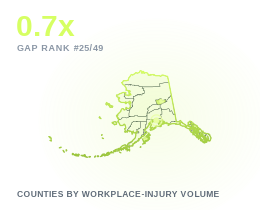
Alaska generates one of the largest volumes of workplace injuries in the country — about 748 estimated recordable injuries a year — in a market with deep legal competition (about 1,138 legal-services jobs). Here, marketing execution decides who signs the case, not scarcity.
Estimated recordable injuries a year against the local supply of legal help. The wider the gap, the more injured-worker demand each firm can reach.
The demand isn’t evenly spread — a handful of counties drive most of the volume. Target these first.
Source: U.S. BLS Quarterly Census of Employment and Wages, 2023 Q1. Injury figures are modeled from BLS injury rates applied to covered employment; counties BLS suppresses for disclosure are omitted. Legal-services employment is BLS NAICS 5411 (all legal services, not workers’-comp attorneys alone).
The core numbers that shape an injured worker’s claim — the things your intake and ads have to speak to. Every figure is sourced to the state agency below.
What an injured worker actually faces under Alaska law — the framework your marketing and intake have to fit.
One of the highest TTD rates in the nation (80% of spendable wage); PPD paid as a lump sum based on whole-person impairment.
Governing agency: Alaska Division of Workers' Compensation (Dept. of Labor and Workforce Development). Statutory details as of 2026 (source confidence: high). Benefit maximums, waiting periods and fee rules change — confirm current figures directly with the Alaska agency before relying on them. Statutory notice deadline is 30 days (AS 23.30.100). SOL trigger varies with controversion/last-payment date.
How far an Alaska claim actually goes — the ceilings on permanent disability, death benefits, and how long wage-loss checks last. These are the numbers injured workers ask about first.
Sourced from the Alaska workers’-comp agency and statute, as of 2026 (source confidence: medium). PPI statutory multiplier, funeral allowance, mileage rate, TTD cap, and annual claims not verified from official source Maximums are indexed to the state average wage and change each year — confirm the current figure with the board before relying on it. See the source.
Employment in the sectors that drive the most workers’-comp claims — the industries your injured-worker audience actually works in.
Source: U.S. BLS Quarterly Census of Employment and Wages (sector employment, not injury counts). Construction, manufacturing, transportation & warehousing and health care are consistently among the highest workers’-comp claim sources.
The people behind the claims — the demographic signals that shape how you reach, intake, and sign injured workers in Alaska.
Sources: U.S. Census Bureau American Community Survey (language spoken at home, median household income, median age) and U.S. BLS Quarterly Census of Employment and Wages (covered employment). Statewide figures.
We work exclusively with workers’-comp firms and run the whole acquisition system, so injured-worker demand in Alaska actually turns into signed cases.
Google Ads
Injured-worker intent captured the moment they search — high-intent claim and injury keywords across Alaska.
Meta Ads
Facebook & Instagram lead generation where Alaska workers spend their time — creative built for injured-worker response.
SEO & Content
Compounding organic visibility across Alaska injury, claim, and workers’-comp searches — the asset that keeps paying.
Intake & Speed-to-Lead
The system that turns a lead into a signed case — fast response, tight follow-up, nothing slipping through.
- Alaska has about 748 estimated recordable injuries a year — real, ongoing demand for representation.
- Competition is dense, so execution wins — speed-to-lead and injured-worker-specific campaigns beat raw ad spend.
- The demand is concentrated — a handful of counties above drive most of the volume, so targeting matters.
- We run the whole system — ads, SEO, and intake built specifically for injured-worker acquisition in Alaska.
See the national picture in our Workers’ Comp Coverage Gap study, compare every state on the by-state index, or drill into any county in the County Opportunity Explorer.
The Alaska tools injured workers are already finding
We publish and maintain these free calculators for Alaska. They are how injured workers in your market find us — and they are the same numbers your intake team is asked about every week. Free, no login.
Start with the Alaska workers’ compensation guide — deadlines, benefit rates and the state agency, in one place.
Build predictable case flow in Alaska
Book a call and we’ll map the Alaska opportunity for your firm — the channels, the numbers, and the plan.
Book a free callHow many cases is your website costing you?
You just read what good marketing looks like — now see where your own site stands. We grade it against 40+ factors, free, in about 30 seconds. Score on screen, full report in your inbox.
Run Website Intelligence on my site →