Workers’ Comp Marketing in Georgia
Where Georgia’s injured workers are, the state’s workers’-comp rules and benefit numbers, the legal competition you’re up against, and how to build predictable signed-case flow — grounded in BLS data and the Georgia workers’-comp agency.
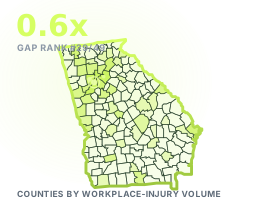
Georgia generates one of the largest volumes of workplace injuries in the country — about 22,351 estimated recordable injuries a year — in a market with deep legal competition (about 35,392 legal-services jobs). Here, marketing execution decides who signs the case, not scarcity.
Estimated recordable injuries a year against the local supply of legal help. The wider the gap, the more injured-worker demand each firm can reach.
The demand isn’t evenly spread — a handful of counties drive most of the volume. Target these first.
Source: U.S. BLS Quarterly Census of Employment and Wages, 2023 Q1. Injury figures are modeled from BLS injury rates applied to covered employment; counties BLS suppresses for disclosure are omitted. Legal-services employment is BLS NAICS 5411 (all legal services, not workers’-comp attorneys alone).
The core numbers that shape an injured worker’s claim — the things your intake and ads have to speak to. Every figure is sourced to the state agency below.
What an injured worker actually faces under Georgia law — the framework your marketing and intake have to fit.
Employer's posted panel of physicians controls the initial choice of doctor; non-catastrophic TTD is capped at 400 weeks.
Governing agency: Georgia State Board of Workers' Compensation. Statutory details as of 2026 (source confidence: high). Benefit maximums, waiting periods and fee rules change — confirm current figures directly with the Georgia agency before relying on them. Max weekly TTD ($800) applies to injuries on/after 7/1/2023; no increase was enacted for 2026.
How far a Georgia claim actually goes — the ceilings on permanent disability, death benefits, and how long wage-loss checks last. These are the numbers injured workers ask about first.
Sourced from the Georgia workers’-comp agency and statute, as of 2026 (source confidence: medium). GA max weekly ($800) is fixed by statute (HB 480, effective 7/1/2023) and does not auto-index; no increase was enacted for 2026. Mileage ($0.45) from a law-firm cheat sheet. Maximums are indexed to the state average wage and change each year — confirm the current figure with the board before relying on it. See the source.
Employment in the sectors that drive the most workers’-comp claims — the industries your injured-worker audience actually works in.
Source: U.S. BLS Quarterly Census of Employment and Wages (sector employment, not injury counts). Construction, manufacturing, transportation & warehousing and health care are consistently among the highest workers’-comp claim sources.
The people behind the claims — the demographic signals that shape how you reach, intake, and sign injured workers in Georgia.
Sources: U.S. Census Bureau American Community Survey (language spoken at home, median household income, median age) and U.S. BLS Quarterly Census of Employment and Wages (covered employment). Statewide figures.
We work exclusively with workers’-comp firms and run the whole acquisition system, so injured-worker demand in Georgia actually turns into signed cases.
Google Ads
Injured-worker intent captured the moment they search — high-intent claim and injury keywords across Georgia.
Meta Ads
Facebook & Instagram lead generation where Georgia workers spend their time — creative built for injured-worker response.
SEO & Content
Compounding organic visibility across Georgia injury, claim, and workers’-comp searches — the asset that keeps paying.
Intake & Speed-to-Lead
The system that turns a lead into a signed case — fast response, tight follow-up, nothing slipping through.
- Georgia has about 22,351 estimated recordable injuries a year — real, ongoing demand for representation.
- Competition is dense, so execution wins — speed-to-lead and injured-worker-specific campaigns beat raw ad spend.
- The demand is concentrated — a handful of counties above drive most of the volume, so targeting matters.
- We run the whole system — ads, SEO, and intake built specifically for injured-worker acquisition in Georgia.
See the national picture in our Workers’ Comp Coverage Gap study, compare every state on the by-state index, or drill into any county in the County Opportunity Explorer.
Explore the workers’-comp opportunity in other states.
The Georgia tools injured workers are already finding
We publish and maintain these free calculators for Georgia. They are how injured workers in your market find us — and they are the same numbers your intake team is asked about every week. Free, no login.
Start with the Georgia workers’ compensation guide — deadlines, benefit rates and the state agency, in one place.
Build predictable case flow in Georgia
Book a call and we’ll map the Georgia opportunity for your firm — the channels, the numbers, and the plan.
Book a free call