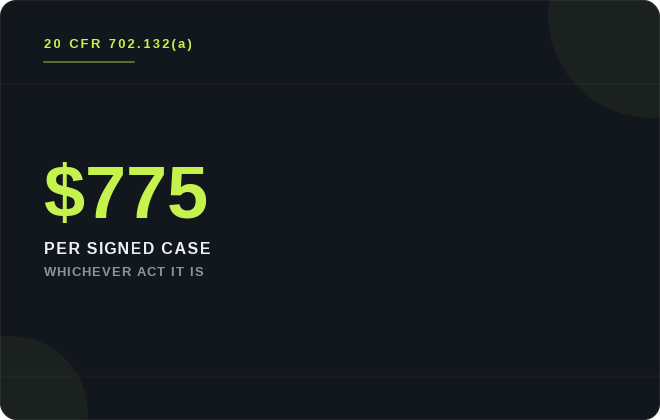
Our own numbers, across roughly $16.5M of managed workers’ compensation Meta spend, are about 219,000 injured-worker leads at an average $75 cost per lead and about 21,000 signed cases at roughly $775 each. We quote them constantly, including in the article that works the per-signed-case figure out from first principles. What we have never said out loud is what the word signed is carrying in that sentence.
It is carrying the whole model. A signed case is worth $775 of acquisition cost because signing is understood to create an enforceable interest in a percentage of a recovery that has not happened yet. Every downstream decision — which campaigns to scale, which counties to add, whether a $90 lead is still cheap — is a bet on that percentage. Take the percentage away and $775 is just a cost.
There is a class of injured worker, reachable by exactly the same advertising, in exactly the same counties, for whom the percentage does not exist. Not as a matter of negotiation or market practice: as a matter of the regulation that governs the fee. These are claims under the federal compensation acts, and the firms buying leads in port, shipyard and harbour markets are buying some number of them every month without a field in the CRM that says so.
So the claim of this article, stated plainly: a comp firm’s acquisition arithmetic is built on a contingency fee, and in the two federal compensation systems that overlap its market the contingency fee is either unrecognised or prohibited outright — which means the cases are not cheap or expensive, they are unpriceable by the instrument the firm uses, and the one that pays best pays on a mechanism the firm has no line item for.
What “signed” is doing in that number
Cost per signed case is a ratio of two things the firm controls. It is only a decision tool because of a third thing it does not.
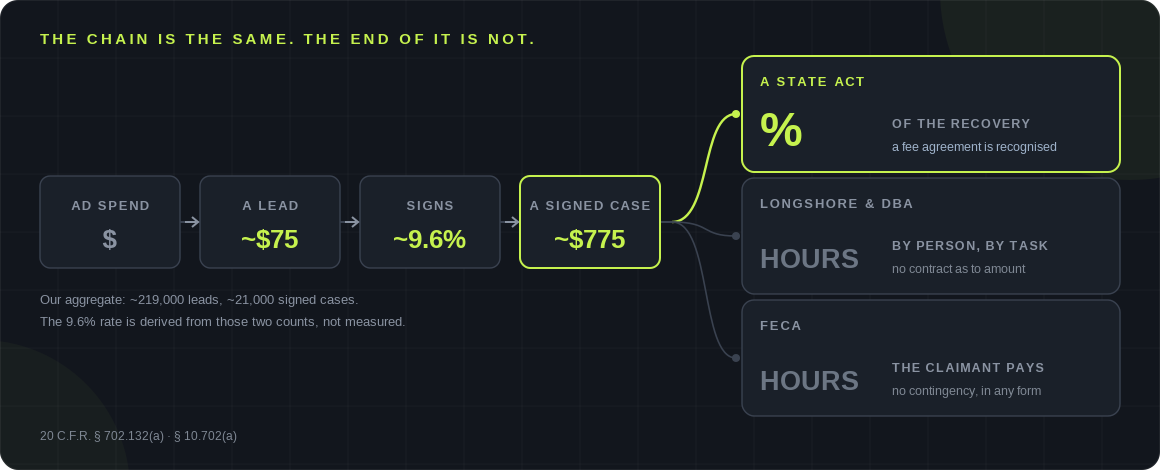
Work the chain forwards. Spend buys impressions; impressions buy an injured-worker lead at some cost per lead; some fraction of leads become signed cases. Divide spend by signed cases and you have $775. Nothing in that calculation requires a fee to exist. The ratio is arithmetically fine in a world where no lawyer is ever paid.
It becomes a decision the moment you compare $775 to an expected fee, and that comparison is where the contingency percentage enters. It never appears in the dashboard, because it does not have to: in a state compensation practice it is a constant. Whatever your state’s approved percentage practice is, it applies to every case in the pipeline, so it cancels out of every comparison between two campaigns and quietly becomes invisible.
A constant you have stopped seeing is a dangerous thing to have in a model, because you will not notice the cases where it is zero.
The useful way to hold this is that your acquisition model has four factors and you are only watching three. Spend, cost per lead and lead-to-signed rate are instrumented to two decimal places. The fourth factor — what a signature entitles the firm to — is assumed to be one number because, in a single-statute practice, it is. The moment the pipeline contains two statutes it stops being a constant and starts being a variable nobody is measuring.
One advertisement, three compensation acts
The injured worker who fills in your form has an employer, and the employer determines which compensation statute he is under. Nothing about the advertisement does.
There are three regimes a comp firm’s advertising can land in, and they are separated by facts about the employer and the place of injury rather than by anything the worker knows to tell you.
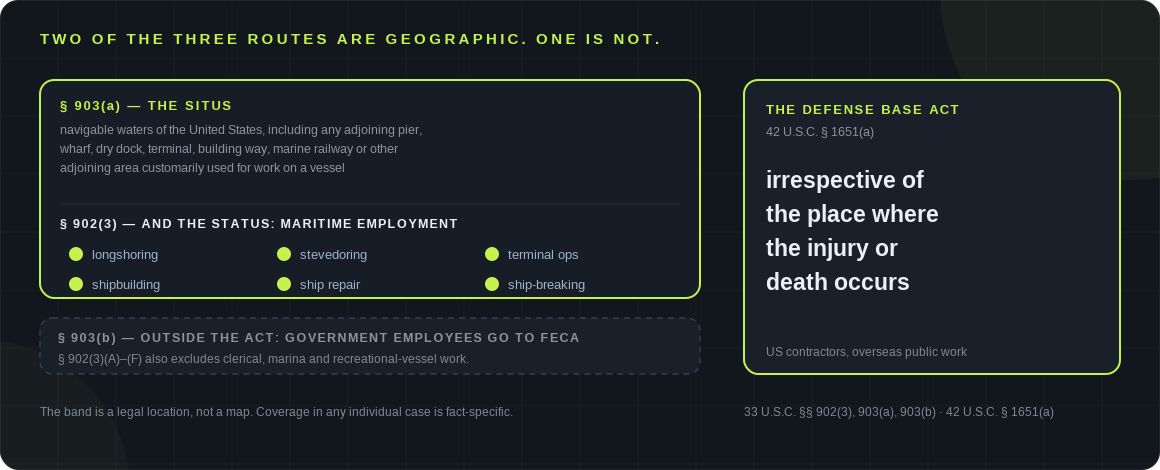
The state compensation act is the default and the whole of most firms’ practice. The Longshore and Harbor Workers’ Compensation Act covers, under 33 U.S.C. § 903(a), disability or death resulting from “an injury occurring upon the navigable waters of the United States (including any adjoining pier, wharf, dry dock, terminal, building way, marine railway, or other adjoining area customarily used by an employer in loading, unloading, repairing, dismantling, or building a vessel).” The Federal Employees’ Compensation Act covers federal civilian employees — and the Longshore Act expressly steps aside for them, because § 903(b) provides that “No compensation shall be payable in respect of the disability or death of an officer or employee of the United States, or any agency thereof, or of any State or foreign government.”
Then there is the extension that makes the Longshore Act bigger than its name. The Defense Base Act, at 42 U.S.C. § 1651(a), applies the Longshore Act’s provisions to employees of United States contractors performing public work outside the continental United States, and it does so “irrespective of the place where the injury or death occurs.” A Longshore Act claim, in other words, does not have to have anything to do with water, a harbour, or the United States.
| Regime | Who the worker is | Who can be made to pay the fee | What the fee is computed from | Is a fee agreement recognised? |
|---|---|---|---|---|
| State compensation act | Almost everyone else | Usually the worker’s recovery; some states shift it to the carrier in defined circumstances | Varies by state — a statutory percentage in Florida, time and expenses in Texas | Yes, subject to approval (see the state table below) |
| Longshore Act (33 U.S.C. ch. 18) | Maritime employment on or adjoining US navigable waters, per §§ 902(3) and 903(a) | The employer or carrier, where it declined within thirty days and lost (§ 928(a)) | Hours at billing rates, per person, by category of work (20 C.F.R. § 702.132(a)) | No — “No contract pertaining to the amount of a fee shall be recognized” |
| Defense Base Act (42 U.S.C. § 1651) | Employees of US contractors on public work outside the continental US | Same as Longshore — the Act applies “except as herein modified” | Same as Longshore | No — same regulation |
| FECA (5 U.S.C. ch. 81) | Federal civilian employees; excluded from Longshore by § 903(b) | Nobody but the claimant — OWCP is “in no way liable” | Approved services; the Secretary must approve any fee (5 U.S.C. § 8127(b)) | No contingency — “not allowed in any form” |
Read the right-hand column as a single fact rather than four rows. The instrument your acquisition model depends on exists in the first row and in none of the others.
The picture is worth pausing on, because the left-hand two-thirds of it is the only part most firms have ever drawn.
Where the exposure is, and what the data will not tell you
The volume is published every year. The part a marketer would actually need in order to target it is not published at all, and the Department of Labor says so.
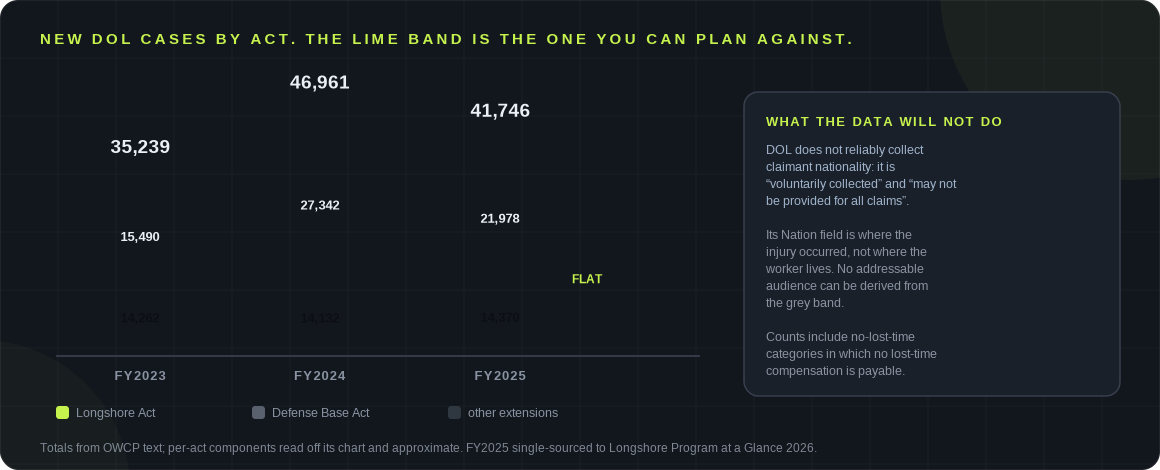
The Department of Labor’s Division of Longshore and Harbor Workers’ Compensation publishes new case creation by act. In FY2023 it created 35,239 cases across the Act and its extensions; in FY2024, 46,961; in FY2025, 41,746. Within those totals the Longshore Act proper accounts for about 14,262, 14,132 and 14,370 cases — effectively flat. Almost all the movement is the Defense Base Act: 15,490 in FY2023, 27,342 in FY2024, about 21,978 in FY2025.
So the first finding is a correction to the mental model. The Longshore Act’s largest case population is not longshoremen. In FY2024 and FY2025 the Defense Base Act created more new cases than the Act it is an extension of.
The second finding is the one that matters for a media plan, and it is a negative. You cannot tell from this data what share of those cases is reachable by a US advertisement, because the Department does not publish the claimants’ nationality. Its own methodology note is explicit that while nationality is tracked, “this information is not required to create a claim (voluntarily collected) and may not be provided for all claims,” and that the Nation field in the published reports “indicates the country where the injury or death occurred” — not where the worker lives or who he is.
What is knowable is the Longshore Act proper, and it is knowable because its coverage test is geographic by construction. Section 903(a) locates the claim on navigable waters or an adjoining pier, wharf, dry dock, terminal, building way, marine railway or customarily-used adjoining area. Section 902(3) then defines the employee as “any person engaged in maritime employment, including any longshoreman or other person engaged in longshoring operations, and any harbor-worker including a ship repairman, shipbuilder, and ship-breaker” — and excludes a list that includes clerical and security staff, marina employees who are not building or expanding the marina, aquaculture workers, recreational-vessel workers and a master or member of a crew, with most of those exclusions conditioned on the worker being covered by a state act instead.
That is roughly fourteen thousand new claims a year, concentrated wherever cargo is handled and vessels are built or repaired, in a population a firm in those counties is already advertising to. It is not a large number nationally. Divided across the handful of markets that contain nearly all of it, it is not a small one either — and the same geography logic we set out in the piece on industry mix applies, with the difference that this time the industry determines the statute and not just the injury rate.
The coverage test is worth drawing out, because two of the three federal routes are geographic and the third is explicitly not.
What the Longshore Act does with a denial
In a state comp practice a denial is the event that makes a case cost more. Section 928(a) makes it the event that moves the fee off the client.
This is the part that should change how a firm thinks about these cases, and it is the opposite of what the rest of this article might suggest.
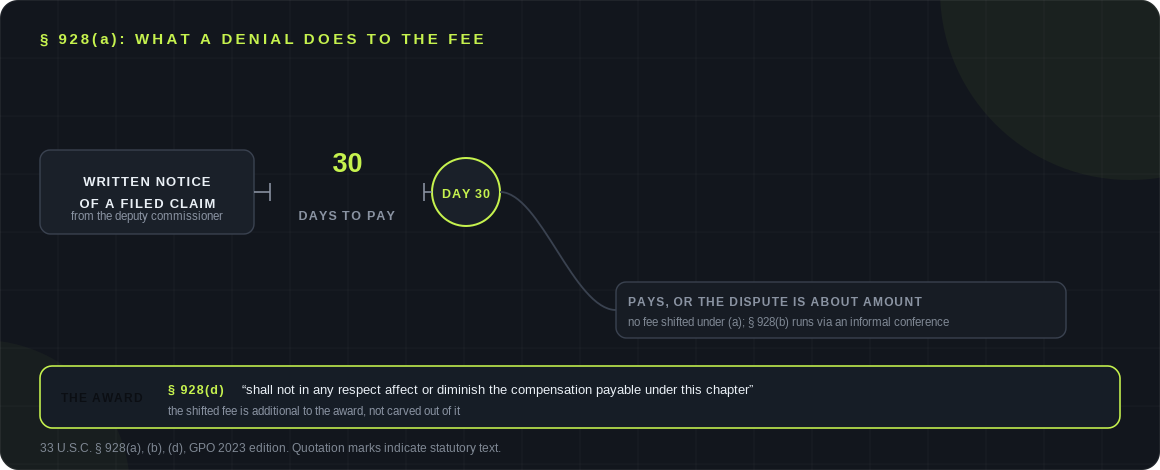
Section 928(a) provides that if the employer or carrier “declines to pay any compensation on or before the thirtieth day after receiving written notice of a claim for compensation having been filed from the deputy commissioner, on the ground that there is no liability for compensation,” and the claimant then uses an attorney “in the successful prosecution of his claim,” there shall be awarded “in addition to the award of compensation… a reasonable attorney’s fee against the employer or carrier,” paid “directly by the employer or carrier to the attorney for the claimant in a lump sum after the compensation order becomes final.”
Then § 928(d) closes it: amounts awarded against an employer or carrier as fees, costs and witness fees “shall not in any respect affect or diminish the compensation payable under this chapter.”
A denial is the most expensive event in a state comp case and, under § 928(a), the one event that takes the fee off the client entirely. Nothing in your intake script can tell the two apart.
There is a second route in § 928(b) for the commoner situation where the carrier is paying something and the dispute is about how much. It runs through an informal conference: the deputy commissioner or Board recommends a disposition in writing, the carrier has fourteen days to accept or to pay what it believes is owed, and if the claimant refuses that tender, instructs an attorney and is awarded more, a fee is added “based solely upon the difference between the amount awarded and the amount tendered or paid.” The subsection ends flatly: “In all other cases any claim for legal services shall not be assessed against the employer or carrier.”
The Department received 4,937 and 4,923 intervention requests in FY2023 and FY2024 and scheduled approximately 3,500 informal conferences each year, so this is a live mechanism and not a dead letter. But notice what it does to a forecast. Both fee-shifting routes are conditioned on events that happen after signing, that the firm does not control, and whose timing is set by a federal agency and then by whether a compensation order becomes final. Under § 928(b) the fee is sized by the gap between what was tendered and what was awarded, which means a generous carrier shrinks the fee by being generous.
The mechanism is short enough to draw in full, and the second half of it is the part that does not exist in state practice.
Nine words that remove the multiplier
Both federal systems pay the lawyer. Neither will enforce an agreement about how much, which is a different thing entirely.
Here is the regulation that does the damage to the model. 20 C.F.R. § 702.132(a) requires a fee application “supported by a complete statement of the extent and character of the necessary work done, described with particularity as to the professional status… of each person performing such work, the normal billing rate for each such person, and the hours devoted by each such person to each category of work.” An approved fee must be “reasonably commensurate with the necessary work done.” And then, as the subsection’s last sentence: “No contract pertaining to the amount of a fee shall be recognized.”
FECA reaches the same place by a different road. 20 C.F.R. § 10.702(a): “The claimant is solely responsible for paying the fee and other charges. The claimant will not be reimbursed by OWCP, nor is OWCP in any way liable for the amount of the fee. Contingency fees are not allowed in any form.” And 5 U.S.C. § 8127 makes representation itself broader than a law practice: subsection (a) lets a claimant “authorize an individual” to represent him, not an attorney, so the competitor for a FECA case may not be a law firm at all.
The two rules are not identical and the difference is worth stating precisely. Longshore declines to recognise any contract about the amount of a fee, percentage or otherwise. FECA permits a fee agreement but prohibits the contingency form of it and makes every fee valid only on the Secretary’s approval. What they share is the thing the model needs: in neither system can the firm hold, at the moment of signature, an enforceable entitlement to a share of an unknown future recovery.
It is worth being clear about what is not being claimed. These cases are not unprofitable, the fee is not small, and lawyers do this work for a living. The claim is narrower and harder to escape: the number your marketing is optimised against was derived from an instrument that two of the three regimes in your market do not contain.
The provision that names your acquisition channel
Section 928(e) is a criminal provision about unapproved fees. Its second clause is about how the case was obtained.
Read § 928(e) in full, because the second half is not what a comp marketer expects a compensation statute to contain. A person “who receives a fee, gratuity, or other consideration on account of services rendered as a representative of a claimant, unless the consideration is approved by the deputy commissioner, administrative law judge, Board, or court, or who makes it a business to solicit employment for a lawyer, or for himself, with respect to a claim or award for compensation under this chapter, shall, upon conviction thereof, for each offense be punished by a fine of not more than $1,000 or be imprisoned for not more than one year, or both.”
The first clause is a fee-approval rule. The second is about the business of generating claims, it is phrased as a per-offence misdemeanour, and it sits inside the statute that governs every Longshore and Defense Base Act claim. It has no counterpart in most state compensation acts, where the equivalent constraints live in professional-conduct rules rather than in a federal criminal provision.
We are not going to tell you what it covers, and anyone who tells you confidently should be treated with suspicion. We searched for decisions applying § 928(e) to a modern pay-per-lead or pay-per-case arrangement and did not find one; the Department’s own published reference works on Section 28 are almost entirely about fee quantum. What that means is that a firm in a port market running the acquisition machinery described in our piece on paying per case is operating, for some share of its claims, inside a statute whose solicitation clause nobody has mapped. That is a question for the firm’s own counsel before it is a marketing question.
What the state acts actually do — checked one at a time
The tempting version of this argument is that state acts are percentage systems and the federal acts are not. That version is false, and the true one is sharper.
It would be convenient to write that every state computes the fee as a share of the worker’s benefits and that the federal acts are the exception. We checked three states separately and that sentence does not survive.
Florida is the percentage case, strictly. Section 440.34(1) provides that an approved fee “must equal to 20 percent of the first $5,000 of the amount of the benefits secured, 15 percent of the next $5,000… 10 percent of the remaining amount… during the first 10 years after the date the claim is filed, and 5 percent of the benefits secured after 10 years,” and a retainer “may not be for compensation in excess of the amount allowed.” Florida also shifts the fee to the carrier on something close to the Longshore trigger: under § 440.34(3)(b), where “the employer or carrier files a response to petition denying benefits… and the injured person has employed an attorney in the successful prosecution of the petition.” But the shifted fee is still “an amount equal to the amount provided for in subsection (1)” — the payer changes, the percentage does not.
Texas breaks the generalisation outright. Labor Code § 408.221(b): “an attorney’s fee under this section is based on the attorney’s time and expenses according to written evidence presented to the division or court,” and “shall be paid from the claimant’s recovery” unless the carrier’s own judicial-review appeal triggers § 408.221(c). Texas is an hours state. Subsection (a) nonetheless contemplates “an attorney’s fee, including a contingency fee,” subject to approval.
California sits in between and is explicit that the agreement exists: Labor Code § 4906(a) makes a charge or agreement unenforceable only “in excess of a reasonable amount,” § 4906(b) bars demanding or accepting a fee until the appeals board has approved or set it, and § 4906(c) requires that “Any fee agreement shall be submitted to the appeals board for approval within 10 days after the agreement is made.” A statute that gives the agreement a filing deadline is a statute that recognises the agreement.
| Provision | Computed from | Who can be made to pay | Fee agreement recognised? |
|---|---|---|---|
| Fla. Stat. § 440.34(1), (3)(b) | Statutory percentage ladder, 20/15/10/5 | The worker, or the carrier on a denied-then-lost petition — at the same percentage | Yes — a retainer is contemplated and capped |
| Tex. Lab. Code § 408.221(a), (b) | Time and expenses, on written evidence | The claimant’s recovery; the carrier on its own judicial-review appeal | Yes — including a contingency fee, subject to approval |
| Cal. Lab. Code § 4906(a)–(c) | Reasonableness, on stated factors | The worker’s award, through the appeals board | Yes — and it must be filed within 10 days |
| 20 C.F.R. § 702.132(a) (Longshore, DBA) | Hours by person by category of work | The carrier on § 928(a)/(b); otherwise the claimant | No — no contract as to amount is recognized |
| 20 C.F.R. § 10.702(a) (FECA) | Approved services; Secretary must approve | The claimant alone; OWCP never liable | No contingency, in any form |
So the true common thread is not the percentage. It is the agreement. Across all three state acts we checked — whichever basis they use, whoever ends up paying — a fee agreement between the firm and the client is a recognised instrument that the tribunal approves, caps or files. In both federal systems it is not: Longshore will not recognise a contract as to amount at all, and FECA forbids the contingency form of one outright. Signing is the moment a state-act firm acquires something. In a federal-act matter, signing is the moment the firm acquires a client and nothing else.
Three questions, and what to do with the answers
This does not need a new system. It needs three fields and a rule about what happens when one of them is set.
The intake questions that would separate these claims are not the ones a comp firm asks, because the ones it asks are about the state system: have you filed a claim, who is your adjuster, what did the insurance company say. All three can be answered coherently by someone whose claim is not under the state act at all.
Three questions do the work, and all three are about the employer rather than the injury.
What to do when a field is set is a referral and conflict question, not a marketing one, and it is the firm’s to answer. What is a marketing question is the measurement. A pipeline that cannot distinguish a case with a percentage from a case without one is producing a cost per signed case that averages two incomparable things, and the fix is unglamorous: tag the statute at intake, report the two populations separately, and stop comparing campaigns on a blended number whose denominator contains both.
The second thing to do is to stop treating the rate as the whole story. We have argued before, in the piece on case float, that a comp firm’s real constraint is the gap between when money goes out and when a fee arrives. Federal-act matters are the extreme version of that argument: the fee is larger on a good day, arrives after a compensation order becomes final, and is sized by a document the firm has to construct from time records it may not be keeping.
And the third is the smallest and the most likely to matter. Go and read your lead-vendor agreement against § 928(e), with your own counsel, before you next renew it. Not because we know the answer — we have said plainly that we do not — but because it is a per-offence criminal provision sitting under some unknown share of the volume you are buying, and “nobody has litigated it” is a description of the present rather than a prediction.
Set the three years side by side and the shape of the population is immediately legible — as is the band you cannot plan against.
Key takeaways
-
Cost per signed case prices a signature, and the signature is the part that varies. Spend, cost per lead and close rate are instrumented; what a signature entitles the firm to is assumed constant.
-
Longshore regulations recognise no fee contract as to amount; FECA forbids contingency fees in any form. Both pay by approved hours instead, so neither case can be priced by the model.
-
A denial is the good outcome under § 928(a). A carrier that declines within thirty days and loses pays the fee itself, and § 928(d) bars it from reducing the worker’s compensation.
-
The Act’s largest population is not on a dock. The Defense Base Act created 27,342 of 46,961 new cases in FY2024; Longshore Act cases proper sat at 14,132 and have been flat for three years.
-
The published data cannot size a campaign. OWCP does not reliably collect claimant nationality, and its counts include no-lost-time categories where no compensation is payable.
-
§ 928(e) makes a business of soliciting this work a per-offence misdemeanour. We found no decision applying it to pay-per-lead buying, which is a reason to ask counsel rather than a reason to relax.
WorkersComp Marketing is a marketing agency, not a law firm. Nothing in this article is legal advice, and nothing in it is advice about your professional-conduct obligations. Whether a particular injured worker is covered by the Longshore and Harbor Workers’ Compensation Act, the Defense Base Act, the Federal Employees’ Compensation Act or a state compensation act is a question of fact and law that turns on matters we do not have; fee entitlement, fee approval and the scope of 33 U.S.C. § 928(e) are likewise questions for counsel admitted in the relevant forum. The statutes, regulations and state provisions quoted here are quoted to show what they say and that they differ — not to tell any firm which cases it may accept, what it may charge, or how it may acquire work. Read the current text and ask your own counsel before acting on any of it.
Frequently asked questions
Should a state-act comp firm take Longshore cases at all?
That is a practice-management and conflicts question rather than a marketing one, and it depends on things we cannot see — whether the firm has anyone who has run a claim through the Office of Administrative Law Judges, whether it can keep contemporaneous time records, and what its referral relationships look like. What this article argues is narrower and holds either way: whichever answer the firm gives, these cases are already arriving through its advertising, and a pipeline that cannot tell them apart from state-act files is producing a cost per signed case that averages two incomparable populations. Tag the statute at intake first. Decide what to do with the cases second.
Is the fee really better under the Longshore Act?
On a § 928(a) win it is structurally better, and we want to be careful about the word structurally. The fee is computed from hours actually worked rather than capped at a share of the award, it is paid directly by the carrier in a lump sum once the compensation order becomes final, and § 928(d) provides that it “shall not in any respect affect or diminish the compensation payable.” That is a better mechanism than a percentage of the client’s money. What we are not telling you is that it produces more revenue per case on average, because that depends on how many cases reach a § 928(a) or § 928(b) outcome rather than resolving some other way, and we have no data on that distribution. Section 928(b) also sizes the fee by the gap between what was tendered and what was awarded, so a carrier that tenders generously shrinks it.
How many of the cases in our market are actually federal?
Nobody can tell you from published data, and we think that is the most useful thing in this article to know. For the Longshore Act proper the population is geographically determined — roughly 14,000 new cases a year nationally, concentrated wherever cargo is handled and vessels are built or repaired — so a firm can reason about it from the employers in its service area. For the Defense Base Act band, which is the larger one, the Department of Labor states that claimant nationality is voluntarily collected and may not be provided for all claims, and that the country shown in its reports is where the injury occurred rather than where the worker lives. There is no public route from that data to an addressable audience. The answer has to come from your own intake, which is the argument for tagging it.
Does § 928(e) mean we cannot buy leads in a port market?
We do not know, we are not able to advise on it, and we would be suspicious of anyone who answered confidently in either direction. What we can tell you is what the provision says: it penalises a person who receives an unapproved fee as a claimant’s representative, or “who makes it a business to solicit employment for a lawyer, or for himself, with respect to a claim or award for compensation under this chapter,” by a fine of up to $1,000 or up to a year’s imprisonment, for each offence. We searched for decisions applying it to a modern pay-per-lead or pay-per-case arrangement and did not find one, and the Department’s own published reference material on Section 28 is overwhelmingly about how much a fee should be. The right next step is your own counsel reading your vendor agreement against the text, not a marketing decision.
Isn’t this just the same point as apportionment or third-party cases — a case type intake misses?
It is a different kind of miss, and the difference is the point. An apportionment issue or a third-party claim changes what a case is worth inside a system the firm already understands, with a fee mechanism that still works. A federal-act claim changes the mechanism itself: there is no instrument at signature that entitles the firm to a share of the outcome, so the error is not a mispriced case but an inapplicable price. The practical consequence is also different. Finding more third-party cases improves the same number. Finding federal-act cases tells you that number has been computed over a mixed population and needs splitting.
Our state shifts fees to the carrier too. Isn’t the Longshore Act just doing that?
Several state acts shift fees, and Florida’s trigger is close to the Longshore one — § 440.34(3)(b) applies where the carrier files a response denying benefits and the worker’s attorney successfully prosecutes the petition. We checked that provision before writing this, precisely because it would undercut a lazier version of the argument. The distinction that survives is not who pays. It is that Florida’s shifted fee is still “an amount equal to the amount provided for in subsection (1)” — the statutory 20/15/10/5 ladder — so the percentage is intact and the model still works. Under the Longshore Act the computation basis itself changes to hours, and no contract about the amount is recognised at all.
Sources
-
01
Longshore Act fees — the statute
33 U.S.C. § 928. Subsection (a): a carrier that “declines to pay any compensation on or before the thirtieth day” and loses pays “a reasonable attorney’s fee against the employer or carrier.” (d): such awards “shall not in any respect affect or diminish the compensation payable.” (e): the unapproved-fee and solicitation misdemeanour. Read on the official GPO 2023 edition and Cornell LII; they agree word for word.
-
02
Longshore coverage — situs and status
33 U.S.C. § 903(a) (navigable waters “including any adjoining pier, wharf, dry dock, terminal, building way, marine railway, or other adjoining area customarily used…”); § 903(b) (no compensation for an officer or employee of the United States or any State or foreign government); § 902(3) (“any person engaged in maritime employment”, plus eight exclusions mostly conditioned on state-act coverage). GPO text. Coverage is fact-specific: these provisions frame the question, not the answer.
-
03
Longshore fee regulation — the nine words
20 C.F.R. § 702.132(a): the application must state “the normal billing rate for each such person, and the hours devoted by each such person to each category of work,” and “No contract pertaining to the amount of a fee shall be recognized.” Double-sourced to the current eCFR and the official GPO 2024 CFR, which agree. It governs Defense Base Act claims too, through 42 U.S.C. § 1651(a).
-
04
FECA — representation and the contingency ban
5 U.S.C. § 8127: a claimant “may authorize an individual” to represent him, and a fee claim “is valid only if approved by the Secretary.” 20 C.F.R. § 10.702(a): “The claimant is solely responsible… nor is OWCP in any way liable… Contingency fees are not allowed in any form.” Statute from GPO; regulation double-sourced to the eCFR and GPO 2024 CFR. The asymmetry matters: FECA bars the contingency form, not every agreement.
-
05
Defense Base Act — the extension
42 U.S.C. § 1651(a): “Except as herein modified,” the Longshore Act applies to the listed overseas employments, including public work under a US contract, “irrespective of the place where the injury or death occurs.” Double-sourced to Cornell LII and the official GPO 2023 edition, which agree on the operative wording.
-
06
Case volumes, and the gap in them
OWCP’s Longshore Program at a Glance 2026 gives new cases by act for FY2023–25 (totals 35,239 / 46,961 / 41,746). The FY2023–24 Annual Report to Congress confirms those totals and the DBA figures at Longshore Table 1A, reading DBA FY2024 as 27,342 against the chart’s 27,341; we cite the report. Caveats, all load-bearing: FY2025 is single-sourced to the one-pager; the per-act bands are read off a chart rather than a table, so component figures are approximate; DOL states claimant nationality is “voluntarily collected” and “may not be provided for all claims” and its Nation field is where the injury occurred, so no addressable audience can be derived; and counts include no-lost-time and three-days-or-fewer categories where lost-time compensation is not payable, so these are report volumes, not representable claims.
-
07
The three state acts, checked separately
Fla. Stat. § 440.34(1) (the 20/15/10/5 ladder; a retainer may not exceed it) and (3)(b) (carrier pays at that same percentage on a denied-then-lost petition), Florida Senate 2024 statutes. Tex. Lab. Code § 408.221(a)–(c) (“based on the attorney’s time and expenses”; contingency fees contemplated and approvable), Texas Legislature. Cal. Lab. Code § 4906(a)–(c) (unenforceable only in excess of a reasonable amount; agreement filed within 10 days) — read on california.public.law, a third-party reproduction; the official leginfo text was not read. Three states is three states, not a fifty-state finding.
-
08
Our own figures
Approximately $16.5M of managed workers’ compensation Meta ad spend, about 219,000 injured-worker leads at roughly $75 average cost per lead, and about 21,000 signed cases at roughly $775 each. Our aggregate results across client firms — not an industry benchmark, not a promise of anyone else’s outcome. The 9.6% lead-to-signed rate is a derivation from those two counts, not a separately measured figure.
Every statutory and regulatory quotation above was read from the linked source during the week of 23 November 2026. We found no decision applying 33 U.S.C. § 928(e)’s solicitation clause to a lead-purchase arrangement; that absence is reported as an absence, not a conclusion. Coverage is fact-specific, and nothing here is legal advice or advice about professional-conduct obligations.