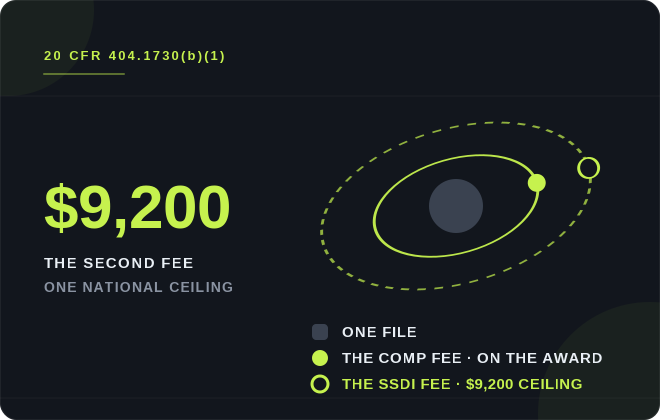
Every acquisition model in this category counts a file once. One lead, one cost per lead, one signature, one fee, one line in the report. It is a clean model and it is the reason cost per signed case works as a management number at all.
It is also, for a predictable share of the book, wrong by one whole revenue event.
The same workplace injury that produced the comp claim produces, in a minority of cases, a federal disability claim. That second claim has its own tribunal, its own calendar, its own payer, and — this is the part that does not appear in any comp firm’s reporting — its own fee, set by a single federal rule that is identical in Sacramento and in Scranton. Most comp firms hand it to somebody else, politely, for free. We have done it ourselves on this site: search our own library and the programme turns up a handful of times — as a case type to refer out graciously, as a Google Business Profile category a firm might claim, as a keyword somebody should probably exclude. Never once as revenue.
So the claim of this article, stated plainly: a comp firm’s signed-case book carries a second, federally priced fee on a measurable fraction of the files it has already paid to acquire — and the comp settlement the firm itself drafts is one of the inputs that decides how much of the client’s federal benefit survives. The line is currently priced at zero in almost every firm’s model, and zero is the one value we can be confident is wrong.
This is not an argument that every comp firm should open a Social Security practice; the last section is the honest case against it, and for many firms it wins. It is an argument that a number which is not zero should not be entered as zero.
The file you already own has a second claim on it
How often, and from which part of the book.
The only rigorous public estimate we could find of how often a comp claim becomes a federal disability claim comes from SSA’s own research office. In the Social Security Bulletin, Paul O’Leary, Leslie Boden, Seth Seabury, Al Ozonoff and Ethan Scherer matched New Mexico workers’ compensation records against SSA’s beneficiary files. The New Mexico Workers’ Compensation Administration gave them “data on all cases with injury dates from 1992 through 2001 for which workers’ compensation benefits were paid (N = 214,230)”; after exclusions the analytic sample was 98,148 cases, observed to the end of 2009.
Their finding, for injuries from 1994 to 2000: within five years of the injury, 5% of lost-time cases had become disability beneficiaries, against 2% of medical-only cases. Within ten years, 10% against 5%. In the authors’ words, “Both 5 years and 10 years after injury, the proportion of people with lost-time injuries who had become DI beneficiaries was about double that for medical-only cases.” The abstract states the mechanism plainly: “having a lost-time injury substantially increases the probability of DI receipt, and, for people who become DI beneficiaries, those with injuries receive DI benefits at younger ages.”
Four things about that number before anyone multiplies by it. It is one state. The cohort is now more than a quarter of a century old. It measures receipt — people who were awarded benefits and appear in SSA’s records — which means the number who applied is necessarily larger than the number counted. And the ten-year window is longer than most firms’ planning horizon, which is exactly why a line that accrues over a decade never makes it into a monthly report.
But note which row of that table describes a represented comp book. A firm’s signed cases are not a cross-section of workplace injuries; they are concentrated in the indemnity end, because a medical-only claim with no lost time rarely produces a client. The lost-time row is the relevant one, and it is the higher one. That is an inference from the composition of a comp docket rather than a measured figure for represented cases, and we have not found a study that measures it directly — so treat the direction as sound and the magnitude as unresolved.

What the second fee is, and why its ceiling does not move
One national rule, a nominal cap, and a payer that collects it for you.
Start with the part that makes this interesting as a business line rather than as a courtesy: SSA pays the fee itself, out of the client’s money, before the client sees it. The regulation is 20 CFR 404.1730. Where the claimant “was represented by an attorney or an eligible non-attorney,” SSA says it “will pay your representative out of the past-due benefits the lesser of” two amounts — “Twenty-five percent of the total of the past-due benefits” or “the amount of the fee that we set” — less an assessment. There is no collection step, no trust-account mechanics on the fee itself, and no client who has already spent it.
Past-due benefits are defined in 20 CFR 404.1703 as “the total amount of benefits under title II of the Act that has accumulated to all beneficiaries because of a favorable administrative or judicial determination or decision, up to but not including the month the determination or decision is made.” Two things are carved out: continued benefits under § 404.1597a and interim benefits under section 223(h). For fee purposes SSA computes the figure “before any applicable reduction under section 1127 of the Act,” which is the title XVI windfall offset.
The ceiling is the striking part. Under the fee agreement process, SSA states that “the current maximum fee amount allowed is $9,200 when a favorable decision is issued on or after November 30, 2024,” and that the fee “cannot exceed the lesser of 25 percent of the past-due benefits or the specified dollar amount.” That $9,200 arrived by Federal Register notice on 10 May 2024 (89 FR 40523). What happened next is the part worth knowing if you are modelling this line for the next five years.
The 2024 notice had promised that from January 2026 SSA would publish an annual notice addressing the maximum. On 6 May 2025, SSA rescinded that promise in part (90 FR 19241): it confirmed that “the $9,200 fee cap will remain in effect,” and said it “will not publish an FRN each year providing a rationale for either increasing or not increasing the fee cap, but will only publish a notice in the Federal Register when increasing the fee cap.” In plain terms: the ceiling on this fee is a nominal dollar figure with no escalator and no scheduled review. It moves when the agency decides to move it and is silent otherwise.
Against that, the assessment. SSA deducts a user fee for making the payment — “6.3 percent of the representative’s authorized fee or a dollar limit that is subject to the cost-of-living increase,” whichever is lower. SSA’s actuaries publish the limit: “The dollar limit effective for December 2026 is thus $128.00,” derived by increasing the December 2025 unrounded limit of $123.56 by 3.6% and rounding down. At the ceiling, then, the firm nets $9,072 of a $9,200 fee, and the regulation forbids recovering the difference from the client: a representative “may not, directly or indirectly, request or otherwise obtain reimbursement of the assessment from you.”
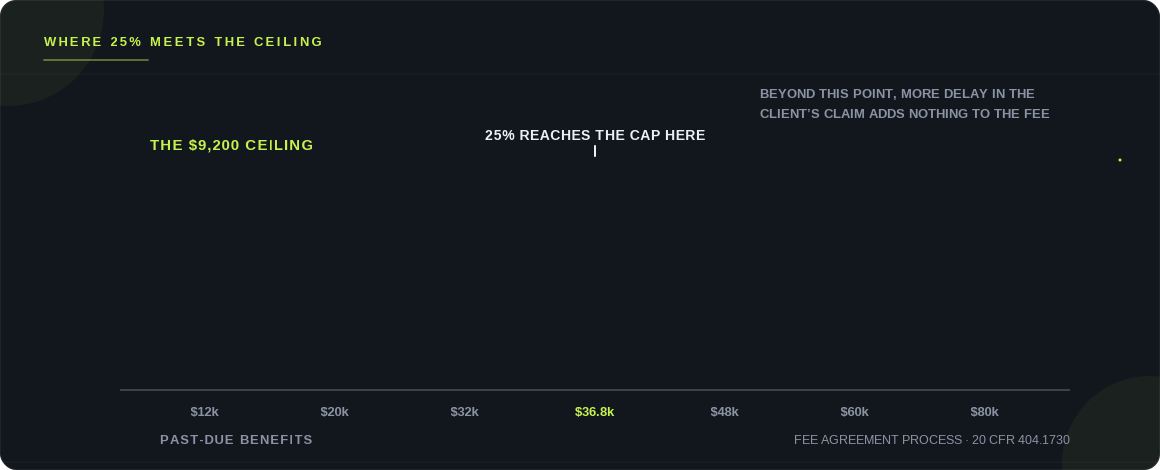
Now the arithmetic nobody publishes, which is simply the two limits meeting. Twenty-five per cent of past-due benefits equals $9,200 when past-due benefits reach $36,800. Below that, the fee is a percentage and scales with the size of the back award. Above it, the fee is flat, and every additional month of delay in the client’s case is worth nothing to the firm.
| Monthly benefit (illustrative) | Months of past-due benefits to reach $36,800 | What the 25% rule yields at that point |
|---|---|---|
| $1,200 | 31 months | $9,200 — the cap binds from here on |
| $1,600 | 23 months | $9,200 — the cap binds from here on |
| $2,000 | 19 months | $9,200 — the cap binds from here on |
| $2,400 | 16 months | $9,200 — the cap binds from here on |
The monthly amounts in that table are round illustrative inputs, not observed averages; the only thing being computed is $36,800 divided by each of them, and $36,800 is exact arithmetic on the two published limits. What the table is for is the shape: a fee that behaves like a percentage on short claims and like a fixed price on long ones.
The comp case prices the federal one
Why these are not two independent files in two independent practices.
If the two claims were parallel, running one or both would be a capacity question and nothing more. They are not. The federal benefit is reduced by reference to the comp benefit, so the settlement your firm negotiates is an input to a number your firm does not track.
The mechanism is section 224(a) of the Social Security Act, implemented at 20 CFR 404.408. SSA’s own procedure manual states the purpose: to “reduce DIB when the worker is also eligible for periodic or lump sum WC/PDB benefits” so that “the combined amount of the WC/PDB benefit and DIB do not exceed 80 percent of the worker’s average current earnings (ACE).” The test is applied against the higher of two figures — 80% of average current earnings, or total family benefits in the first possible month of offset — and the floor is absolute: the combined payment after reduction “can never be less than the amount of the total DIB payments before the reduction.”
The regulation itself is worth reading next to the manual, because it is a second, independent route to the same rule. 20 CFR 404.408(c)(1) reduces the benefit “monthly (but not below zero) by the amount by which the sum of the monthly disability insurance benefits” exceeds the higher of “eighty percent of his average current earnings” or the pre-reduction total of the worker’s own benefit and everything else payable on the same earnings record. The regulation and the manual agree, which is the point of checking.
Two details in that manual page matter more to a comp firm than they look. The first: “The DIB and WC/PDB do not have to be based on the same injury or illness for offset to apply.” A firm screening for whether the federal claim is “about the same injury” is screening on a question the rule does not ask. The second: offset applies only where the number holder — the worker — is the one receiving the comp payment, not where the only recipient is a dependent.
Your own fee is an excludable expense — and the rate you recite is not the last word
Two POMS sections that put a comp firm’s own paperwork inside the federal calculation.
A lump sum is not offset at its face value. SSA’s rule at POMS DI 52150.060 is that “a lump sum (LS) WC/PDB settlement is prorated and excludable expenses deducted before offset is applied,” and that “all three proration methods must always be considered when prorating a lump sum settlement award.” Both halves of that sentence are operationally live.
Take the proration first, because it is the half that is widely misunderstood. SSA does publish a priority order for the weekly rate, and at the top of it is “the rate specified in the LS award”; below that, in order, the latest periodic rate paid before the lump sum, an implied rate where the language implies one, and finally “the State’s WC maximum in effect on the date of the injury or illness.” So the rate recited in the award is first in line. It is not, however, the end of the matter. Where the settlement is written against life expectancy, SSA computes the rate itself: “the correct LE rate for proration purposes is determined by dividing the gross LS by the NH’s life expectancy,” and “the mention of a monthly LE rate in a LS award does not bind SSA to allocate expenses in a specific manner.” Retrofitting is worse still — on amended stipulations the manual says that “SSA is not bound by the terms of a subsequent or amended stipulation in determining whether and by what rate a disabled worker’s DIB should be offset on account of a WC lump sum.”
The latitude is not an administrative habit; it is written into the regulation. 20 CFR 404.408(g) treats a lump sum as “a commutation of or a substitute for periodic benefits” and directs that the reduction be made “at the time or times and in the amounts that the Administration determines will approximate as nearly as practicable the reduction required.” An approximation the agency determines is a different thing from a rate the parties agree.
Then the excludable expenses, which is where a comp firm’s own invoice becomes a federal document. POMS DI 52150.050 provides that where the worker “paid expenses, incurred expenses, or has pending incurred expenses in connection with the WC/PDB claim they are excludable from offset within the limits of the law,” and that “these expenses include documented medical, legal, or related expenses.” Legal expenses qualify when they are “legal expenses paid by worker” or “legal expenses incurred by the worker concerning the WC claim.” They do not qualify when they were paid by the employer, by the carrier, or “by someone other than the worker.” The “related” category reaches further than most people assume: taxes related to the claim, deposition expenses, expert witness costs, photocopying, telephone, transportation and recordation fees.
Read those two clauses together and the position is this. The fee a comp firm charges its client is, where the client bore it, an amount that comes out of the lump sum before SSA applies the reduction. The firm’s fee, properly evidenced, buys the client federal benefit back. But the evidencing is not automatic: “verify expense allegations. The burden of proof rests with the NH” — the worker — and among the acceptable secondary evidence the manual lists a “statement by an attorney of legal fees.”
Which produces the quiet absurdity at the centre of this article. The document that reduces the client’s federal offset is a statement of the comp firm’s own fee. The obligation to produce it sits with the client. And a firm that referred the federal claim to a different office has arranged for a third party to chase it for the client’s own paperwork about the first firm’s bill. Note also that deposition expenses, which we have written about as the one line of comp revenue that is not contingent, appear by name on SSA’s excludable list — the same cost item, doing a second job in a different programme.
Whether any of this runs is decided by the state of payment
A published list, and why reading it as a yes/no map is the mistake.
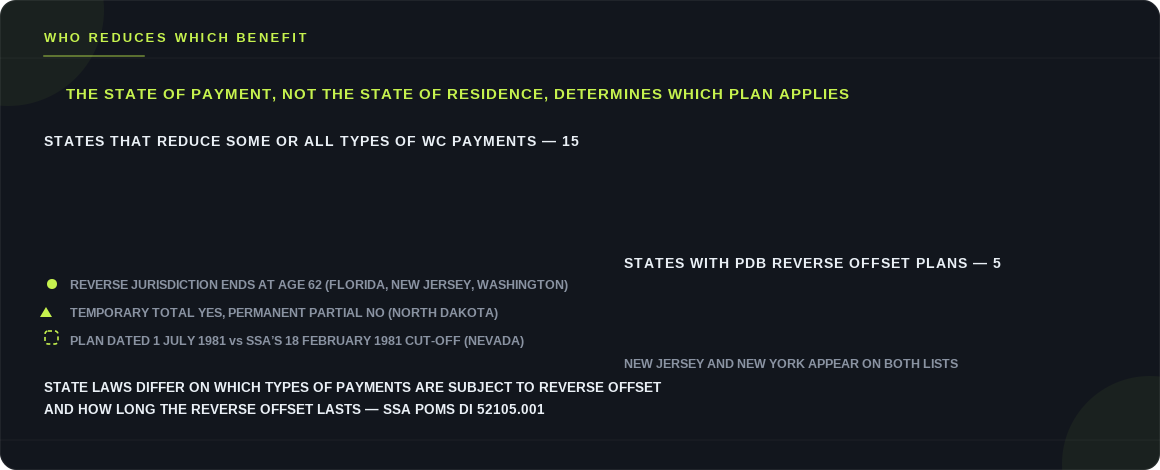
There is a second layer, and for a multi-market firm it is the one that decides what the line is worth where. Some states reduce the comp benefit instead of letting SSA reduce the federal one. SSA’s manual describes it in its own words: some states have plans that reduce workers’ compensation or public disability benefits “when the disabled worker is also receiving Social Security disability insurance benefits,” and “this is known as reverse offset or reverse jurisdiction.” Where SSA recognises such a plan, “the DIB benefits are not offset.”
Recognition is frozen in time. “Generally, SSA recognizes only reverse offset plans in effect on or before February 18, 1981,” and “new reverse offset plans or expansions of prior plans put into effect after February 18, 1981, are not recognized as reverse offset plans.” The authority the page names is the 1981 Social Security Amendments; it does not cite the United States Code, and we have not independently confirmed the subsection.
The lists themselves, as POMS DI 52105.001 sets them out. Under the heading “States that reduce some or all types of WC payments” there are fifteen entries: Alaska, California, Colorado, Florida, Louisiana, Minnesota, Montana, Nevada, New Jersey, New York, North Dakota, Ohio, Oregon, Washington and Wisconsin. Under “States with PDB reverse offset plans” there are five: Hawaii, Illinois, New Jersey, New York and Puerto Rico. New Jersey and New York appear on both. Separately, railroad sickness pensions paid under the Railroad Unemployment Insurance Act “are paid under a recognized plan.”
Now the part that makes a flat map wrong, and it is the page’s own caution: “state laws differ on which types of payments (i.e., permanent partial, temporary total, etc.) are subject to reverse offset and how long the reverse offset lasts.” Four specific limits sit on that same page:
- Age cuts it off in three of them. “In Florida, New Jersey, and Washington, reverse jurisdiction ends at age 62.” The same client, the same injury, a different birthday, a different answer — which is a point worth reading alongside what we have written about age as a case-value variable, because the age you buy in a targeting panel is now also an input here.
- Benefit type decides it in at least one. The manual’s own example is North Dakota, where temporary total is covered by the reverse offset and permanent partial is not.
- One entry contradicts the cutoff on its face. Nevada is in the fifteen, with a footnote that “Nevada’s reverse offset plan was effective 07/01/1981” — against the same page’s statement that “SSA does not recognize RJ plans after 02/18/1981.” We are not going to resolve that from the outside. We are flagging that a firm planning around Nevada should get it confirmed rather than read the list.
- Geography is the state of payment, not the client. “The State of payment, not the State of residence, determines which WC reverse offset plan applies,” and reverse offset “applies only to the WC/PDB paid under that State or entity’s plan or system.” For a firm with offices in three states and clients in five, the mapping unit is the jurisdiction the benefit is paid under.
On the Nevada puzzle there is one observation we can offer without resolving it, and it comes from the regulation rather than the manual. In the copy of 20 CFR 404.408 we were able to read, the 18 February 1981 condition — “and that law or plan so provided on February 18, 1981” — sits in the limb dealing with other public disability benefits, not in the limb dealing with workers’ compensation laws. The manual states the 1981 freeze as a general rule; the regulation appears to place it on one of the two limbs. We flag the discrepancy rather than resolve it, and we flag our own limitation with it: the official eCFR declined automated access to that section, so we read a third-party reproduction whose most recent listed amendment is from 2016, and we have not confirmed the current official text.
One loose end we could not tie off. SSA’s own 2005 Social Security Bulletin fact sheet on the offset says that “at the time of the 1981 legislation, 16 states and Puerto Rico had reverse offset statutes, which remain today.” That count does not match either POMS list as they now stand, and the two documents are twenty years apart. We are reporting both figures rather than picking the one that reads better, and we have not reconciled them.
What the line is worth, per hundred signed cases
The arithmetic, with every input labelled.
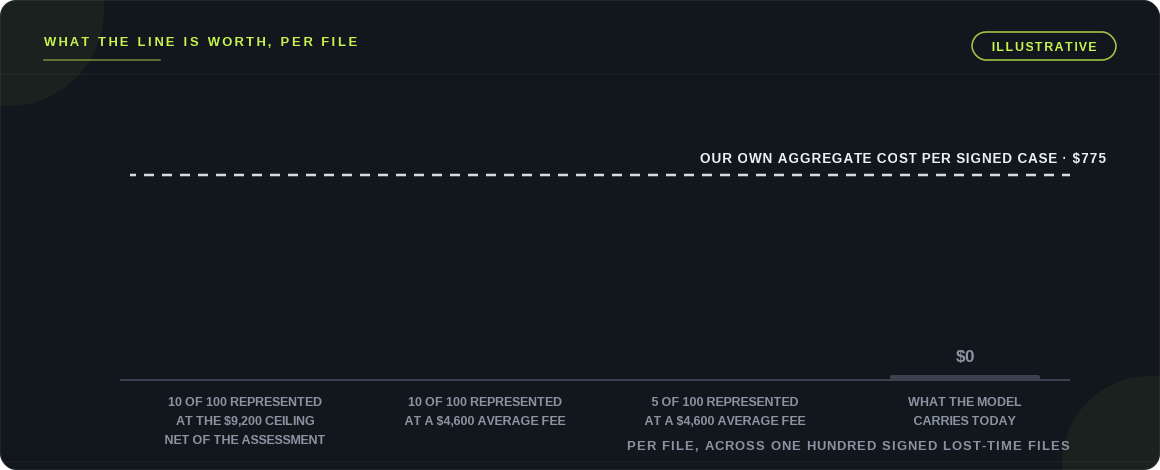
Take a hundred signed lost-time files. Apply the New Mexico cohort rate and ten of them become disability beneficiaries inside ten years. Assume the firm represents all ten. At the ceiling, that is ten fees of $9,200, or $92,000 gross, $90,720 after the assessment — $907 a file across the whole hundred.
Set that against the one figure here that is ours rather than borrowed: across the comp campaigns this agency has run, roughly $16.5M of Meta spend produced about 219,000 injured-worker leads at around $75 each and about 21,000 signed cases at roughly $775 per signed case. Those are our own aggregate numbers, not an industry benchmark. On that basis the second-fee line at its ceiling is worth more per file than the file cost to acquire.
Which is a striking sentence and needs immediate demolition work, because the ceiling is the maximum and not the expectation. Three things pull it down. Not every one of the ten will be represented by the firm. Not every represented claim reaches $36,800 of past-due benefits, which is where the cap starts to bind. And the money arrives on SSA’s calendar, years after the acquisition cost was paid — the same mismatch we sized in the case float, except longer — and the planning side of it sits in the Growth Library rather than in this article. Halve the participation and halve the fee and the line is $224 a file instead of $907. That is still not zero, and zero is what almost every model in this category currently carries.
What changes in intake, in the engagement letter, and in the referral
Five operational changes, none of which require opening a new practice area.
Four of the five changes below are about information rather than representation, so a firm can capture most of the value here without filing a single federal appeal.
| Change | Where it lives | What it rests on |
|---|---|---|
| Ask the question and store the answer as a field — is there a federal disability claim, has one been filed, was one denied, and on what date | Intake script and CRM, as a routing field rather than a qualification question | Offset applies whether or not the two claims concern the same injury, so “is it the same injury” is the wrong screen |
| Settle the scope before the case ends, not after | The engagement letter, at signature | The fee ceiling attaches to a favourable decision; the scope conversation after a comp settlement is a renegotiation |
| Put the fee statement in the client’s hands as a deliverable | Closing pack on every indemnity settlement | Legal expenses the worker paid or incurred are excludable, and the burden of proof is the worker’s; a “statement by an attorney of legal fees” is listed evidence |
| If you refer it, make the referral carry an obligation back | The referral agreement, in writing | Somebody has to produce the first firm’s paperwork for the second firm’s client; by default that is nobody |
| Map the footprint by state of payment | Wherever you plan markets, not where your offices are | “The State of payment, not the State of residence, determines which WC reverse offset plan applies” |
The reporting consequence is worth stating on its own, because it is the reason this belongs on a marketing site rather than in a practice-management newsletter. Cost per signed case is a ratio, and almost every firm computes it against an understated numerator of case revenue. If a tenth of the indemnity book carries a second fee and none of it is in the denominator of value, then every channel comparison, every budget decision and every “is this market worth entering” conversation has been run on a revenue figure that is too low by a knowable amount. The fix is not a new metric. It is one more field in the same cost per signed case model, and a decision about what goes in it.
The honest case against doing any of this
Read this before you act on the rest.
The strongest objection is that a federal disability practice is a different practice, not an extension of this one. Different forum, different medical evidence, different hearing culture, different pace. Direct payment of the fee is available where the representative is “an attorney or an eligible non-attorney”; a non-attorney who is not eligible is told flatly that SSA “will not deduct the fee from your past-due benefits.” Competence is not transferable just because the client is the same person.
The second objection is about size. At the ceiling this is $9,200, and a comp firm that routinely resolves cases worth multiples of that may rationally decide the attention is better spent elsewhere. We would agree in one specific case: if your intake is leaking, this is the wrong thing to fix first. We have sized that leak, and the capacity ceiling is a far bigger number than anything in this article. Fix the calls you are not answering, then come back.
The third objection is about the evidence, and it is ours to make rather than to wait for. The cohort rate at the centre of this article comes from one state, from injuries that happened between 1994 and 2000, observed to 2009, and measured as benefit receipt rather than as claims filed. A firm in Georgia in 2026 is not that cohort. We have not found a more recent or more general figure, and we would rather say so than dress up the one we have.
What survives all three objections is narrow and, we think, still worth the hour: a fee exists on a file you have already bought, it is priced by a published federal rule, its ceiling is a nominal figure that nobody is scheduled to revisit, the comp settlement you draft is an input to the client’s share of it, and whether any of it runs at all depends on a list of fifteen states you can read in ten minutes. None of that requires a decision today. All of it requires a number other than zero.
Key takeaways
-
A share of your signed book carries a second fee. In SSA’s New Mexico study, 10% of lost-time cases had become disability beneficiaries within ten years — about double the medical-only rate.
-
It is one national price, collected for you. The lesser of 25% of past-due benefits or $9,200, paid by SSA out of past-due benefits, less an assessment limited to $128.
-
The ceiling has no escalator. $9,200 since 30 November 2024, and in May 2025 SSA withdrew its promise to publish an annual notice about it.
-
Your settlement is an input to the federal cheque. The Act holds the combined total to 80% of average current earnings, and the lump sum is prorated before that reduction.
-
Your own fee buys benefit back. Legal expenses the worker paid or incurred are excludable before offset — on the worker’s burden of proof, evidenced by a statement of your fee.
-
Geography decides whether it runs. SSA lists fifteen states that reduce comp instead — with age-62 cut-offs in three of them — and the state of payment controls, not the client’s address.
WorkersComp Marketing is a marketing agency, not a law firm. Nothing here is legal advice, advice about your professional-conduct obligations, or guidance on how to draft a settlement, a fee agreement or a referral arrangement. The federal provisions summarised above — section 224 of the Social Security Act, 20 CFR parts 404.408, 404.1703 and 404.1730, and the POMS sections cited — are quoted as published because they bear on how a firm should price and report a case, and a procedure manual is guidance to SSA’s own staff rather than a statement of law. Whether your firm may take a federal disability claim, what scope and fee arrangements your jurisdiction permits, how a particular settlement should be worded, and what any of this means for a specific client are questions for counsel on facts we do not have. Where we could not verify something — the Nevada entry, the state count in SSA’s 2005 fact sheet, the later sections of the 2012 study — we have said so rather than filled the gap.
Frequently asked questions
How often does a comp case actually become a federal disability case?
The best public estimate we found is SSA’s own: matching New Mexico workers’ compensation records to SSA beneficiary files for injuries from 1994 to 2000, 5% of lost-time cases had become disability beneficiaries within five years and 10% within ten, roughly double the medical-only rate. Treat it as a direction rather than a forecast. It is one state, the cohort is a quarter of a century old, it counts awards rather than applications, and a represented comp book is weighted towards the lost-time end, which is the higher row. We have not found a figure measured specifically on represented cases.
Can we capture any of this without opening a Social Security practice?
Most of it, yes, and that is the practical answer for a lot of firms. Four of the five changes are informational: ask at intake whether there is a federal claim and store the answer as a field, settle the scope question in the engagement letter rather than after the comp case ends, put a statement of your own fee in the client’s closing pack because legal expenses the worker paid are excludable before SSA applies its reduction, and write an obligation into the referral so somebody is responsible for producing that paperwork. None of that requires filing anything federally.
Is the fee really $9,200, and does the firm keep all of it?
$9,200 is the ceiling under the fee agreement process for a favourable decision issued on or after 30 November 2024, and the fee is the lesser of that or 25% of past-due benefits — so the two limits cross at $36,800 of past-due benefits and the cap only binds on longer claims. SSA pays it out of past-due benefits directly to an attorney or eligible non-attorney, minus an assessment of 6.3% of the authorised fee capped at $128 for December 2026. At the ceiling that is $9,072 net, and the regulation bars recovering the assessment from the client.
Does our comp settlement really change the client’s federal benefit?
Yes, and that is the reason these are not two unrelated files. Section 224 of the Act reduces the disability benefit so that the combined amount does not exceed 80% of the worker’s average current earnings, and SSA prorates a lump sum and deducts excludable expenses before applying that reduction. The rate recited in the award is first in SSA’s own priority order for the weekly rate — but where the settlement is written against life expectancy SSA computes the rate itself by dividing the gross lump sum by life expectancy, and it states that it is not bound by a subsequent or amended stipulation.
We practise in a reverse-offset state. Does that mean none of this applies?
It means the offset half may not apply there, and it does not mean the fee half goes away. It also does not mean the answer is uniform inside the state. SSA’s manual lists fifteen states whose plans reduce some or all types of comp payments, and on the same page notes that reverse jurisdiction ends at age 62 in Florida, New Jersey and Washington, gives North Dakota as a case where temporary total is covered and permanent partial is not, and warns that state laws differ on which payment types are covered and for how long. The Nevada entry carries a footnote whose date appears to post-date SSA’s own recognition cutoff; confirm that one rather than relying on the list.
Is this worth the attention, honestly?
Not if your intake is leaking — fix the calls you are not answering first, because that number is larger. Not if you have no appetite for a different forum and no referral partner worth the name. The narrow claim that survives is that the line is currently entered as zero in almost every comp firm’s model, that zero is demonstrably the wrong number, and that four of the five changes cost one intake field and one document. Work out your own figure from your own indemnity volume before deciding; the arithmetic in the article is deliberately shown with its inputs exposed so you can change them.
Sources
-
01
How the fee is paid, and what past-due benefits are
20 CFR 404.1730 and 404.1703 (eCFR, title 20 current to 1 October 2026, which may carry amendments not yet in the printed CFR). SSA “will pay your representative out of the past-due benefits the lesser of” “twenty-five percent of the total of the past-due benefits” or the fee it sets, less an assessment the representative “may not” recover from the claimant.
-
02
The $9,200 ceiling
SSA, “Fee Agreements.” “The current maximum fee amount allowed is $9,200 when a favorable decision is issued on or after November 30, 2024”; the fee “cannot exceed the lesser of 25 percent of the past-due benefits or the specified dollar amount.” Carries a stale “($9,200 in 2025)” parenthetical and no last-updated date.
-
03
Why the ceiling has no scheduled review
90 FR 19241, applicable 6 May 2025, partially rescinding 89 FR 40523 of 10 May 2024. “The $9,200 fee cap will remain in effect”; SSA “will not publish an FRN each year … but will only publish a notice in the Federal Register when increasing the fee cap.” It rescinds the annual notice, not the cap.
-
04
The assessment SSA keeps
SSA Office of the Chief Actuary, “Appointed Representative Fee.” The user fee is the lower of “6.3 percent of the representative’s authorized fee” or a cost-of-living limit; “the dollar limit effective for December 2026 is thus $128.00.” The assessment limit, not the fee cap, and one worked derivation rather than a general indexing rule.
-
05
The 80% offset
POMS DI 52101.001. Reduce the benefit so “the combined amount of the WC/PDB benefit and DIB do not exceed 80 percent of the worker’s average current earnings (ACE)”; the two claims “do not have to be based on the same injury or illness.” Cites Act section 224(a) and 20 CFR 404.408, not the US Code; revised 14 December 2015; POMS is staff guidance, not law.
-
06
The offset in the regulation’s own words
20 CFR 404.408. Benefits are reduced “monthly (but not below zero)” by the amount the sum exceeds the higher of “eighty percent of his average current earnings” or the pre-reduction total; a lump sum counts as “a commutation of or a substitute for periodic benefits,” reduced “as nearly as practicable”; the condition “and that law or plan so provided on February 18, 1981” appears in the public-disability-benefit limb. Sourcing limitation: official eCFR declined automated access, so this is a third-party reproduction (Cornell LII) whose latest listed amendment is 2016; currency unconfirmed.
-
07
Proration, and the limits of settlement language
POMS DI 52150.060 and DI 52150.065. A lump sum “is prorated and excludable expenses deducted before offset is applied”; the weekly-rate priority begins with “the rate specified in the LS award.” But on life-expectancy awards SSA sets the rate by “dividing the gross LS by the NH’s life expectancy,” and “is not bound by the terms of a subsequent or amended stipulation.” Revised 1 August 2023.
-
08
Legal fees as an excludable expense
POMS DI 52150.050. Expenses the worker “paid” or “incurred” in connection with the claim “are excludable from offset within the limits of the law” and “include documented medical, legal, or related expenses”; fees paid by the employer or carrier are not. “The burden of proof rests with the NH,” with a “statement by an attorney of legal fees” listed as evidence. Revised 22 August 2016.
-
09
The reverse-offset lists and their limits
POMS DI 52105.001. Fifteen states “reduce some or all types of WC payments”; five jurisdictions have PDB plans; SSA “recognizes only reverse offset plans in effect on or before February 18, 1981”; “in Florida, New Jersey, and Washington, reverse jurisdiction ends at age 62”; “the State of payment, not the State of residence, determines which” plan applies. The Nevada footnote dates that plan 1 July 1981, apparently post-dating the same page’s cut-off — unresolved here. Revised 6 April 2017.
-
10
The cohort rate
O’Leary, Boden, Seabury, Ozonoff & Scherer, Social Security Bulletin 72(3), 2012. New Mexico cases, injuries 1994–2000, analytic sample 98,148, observed to 2009: 5% and 10% of lost-time cases were disability beneficiaries at five and ten years, “about double that for medical-only cases.” One state; benefit receipt, not applications. We read the opening sections verbatim only, so no figure from later sections is used.
-
11
The older state count, which we could not reconcile
Reno, Thompson Williams & Sengupta, Social Security Bulletin 65(4), released May 2005: “at the time of the 1981 legislation, 16 states and Puerto Rico had reverse offset statutes, which remain today.” Twenty-one years old, and the count matches neither current POMS list; both are reported above, unreconciled. Its separate 17% figure covers beneficiaries with “some connection” to comp — past receipt, lump sums, pending claims — so it is not an offset population and is not used here.
-
12
Our own figures
WorkersComp Marketing, aggregate across workers’ compensation campaigns: ~$16.5M managed Meta spend, ~219,000 injured-worker leads at ~$75 each, ~21,000 signed cases at ~$775 per signed case. Ours, aggregate, and not an industry benchmark; the per-file scenarios in this article are illustrative arithmetic on chosen inputs, not observed results.